
#On the Order That Teaches Shame to Walk
The Order of Saint Ephrath is the Bureau of Purity's theatrical fist: an inquisitorial brotherhood dedicated to the proposition that a heretic killed in private is a wasted curriculum. Ash makes examples of places. The Shroud makes examples vanish. Ephrath makes examples travel slowly through streets at a pace children can follow with their eyes.
They are called public humiliation fanatics by those who mistake precision for appetite. Appetite is vulgar. Ephrath possesses doctrine, staging, rope discipline, crowd geometry, tablet maintenance, glass optics, and a theology of shame so polished by repetition that it reflects the audience more cruelly than any mirror licensed by Heraldry. Their work is called spectacle by merchants, torture by cowards, and instruction by everyone who wishes to keep his tongue where Providence, in a moment of trust bordering on naivety, placed it.
Their seal is a tongue transfixed by a nail above an open book. Their field robes are grey-white rather than Purity's full bone-white, because pure white distracts under theatre lamps and because blood, if displayed badly, can make even holy violence look provincial. The Order's brothers train in chant, posture, grip, procession spacing, public address, controlled nonlethal injury, and that rarest of clerical arts: knowing when the crowd has learned enough.
#On Their Founding and Their Saint
Saint Ephrath (Unregistered)'s hagiography is, like all useful hagiography, a document wearing incense to hide its stitching. The approved Life says Ephrath was a deacon of Bohemia who, during the late Rationalist occupation of Prague, stood before a tribunal of philosophers and refused to answer their mockery except by reciting the Creed until his mouth filled with blood. The Rationalists nailed a pamphlet to his tongue. He kept reciting. The judges fled. The crowd converted. The pamphlet caught fire without consuming the paper, an elegant miracle which the Bureau of Doctrine ratified after removing five eyewitness contradictions, three impossible dates, and one unfortunate claim involving a talking mule.
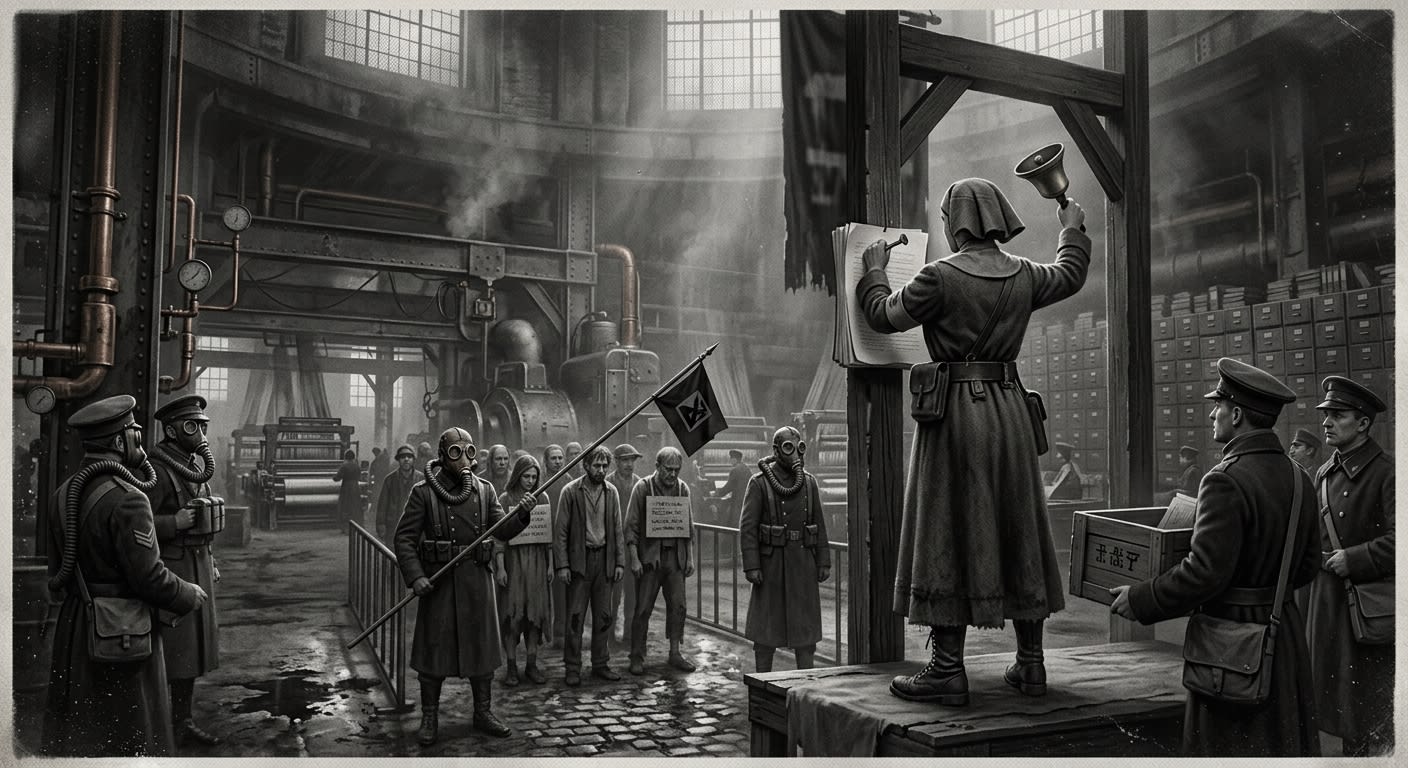
The Order itself was chartered after the Concordat, in the Purity consolidation years. Its Prague chapterhouse appears in the Ledger under A.S. 92 as “disciplinary theatre annex, Bohemian severity district.” By A.S. 94 the newly chartered brothers had petitioned for authority to conduct processiones poenitentiales linguae across the Charles Bridge. The petition ran forty-one pages and quoted Grand Inquisitor Severian with the zeal of pupils quoting a master whose handwriting still frightened them.
Provincial sermons claim Saint Ephrath founded the Order personally.
Corrected. Saint Ephrath was dead, dismembered, canonised, partially reassembled, and already arguing with three reliquary committees before the Order existed. The brothers founded themselves under his name, which is how institutions borrow sanctity without having to share control.
The Bureau of Purity approved their petition in a single afternoon. This astonishes only readers unfamiliar with Purity's erotic relation to procedure. The cover memorandum read: The tongue that served error shall carry doctrine. The mouth that raised itself against the Creed shall become a handle by which the Creed leads the body. A fine sentence. Brutal, tidy, portable. One can build an Order on less.
#On the Theology of Humiliation
Ephrath doctrine begins with an insult to secrecy. Hidden punishment, they teach, corrects only the punished. Public punishment corrects the punished, the witness, the absent citizen who later hears the account, and the clerk who copies it into a school primer with improving illustrations. Shame has radius. The Order measures that radius with the seriousness other men reserve for artillery.
The Ephrath brothers divide humiliation into three grades.
Exposure: the heretic is made visible in the condition produced by his error. A philosopher is marched with his citations pinned to his coat. A false preacher wears his sermon boards front and back until the wind reads them more fluently than he did. A municipal clerk who altered fasting exemptions stands in the ration court with a spoon tied to his forehead and a placard reading I fed myself first. Crude? Only to the unimaginative. The spoon became, in three parishes, a children's warning against theft from communal pots. No statute could have travelled faster.
Attachment: the condemned is bound physically to doctrine. Tablet, collar, glass, chain, bell-cord. The body carries what the mind rejected. Here lies the genius of the Procession of Tongues: the tongue remains present, active in pain, forced into relation with the oak face of the Creed. Severian supplied the theology; Ephrath supplied the choreography.
Reflection: the condemned is arranged so the witnesses recognise themselves. This is the principle behind the Pillars of Glass at Zaragoza, where translucent columns warp the upright entombed into figures too human to dismiss as monsters and too distorted to accept as neighbours. Ephrath calls this mercy. It permits the faithful to hate sin while rehearsing self-recognition, which is to say it makes civic dread pedagogically efficient.
#On the Procession of Tongues
Prague is Ephrath's cathedral, and the Procession of Tongues is its Mass.
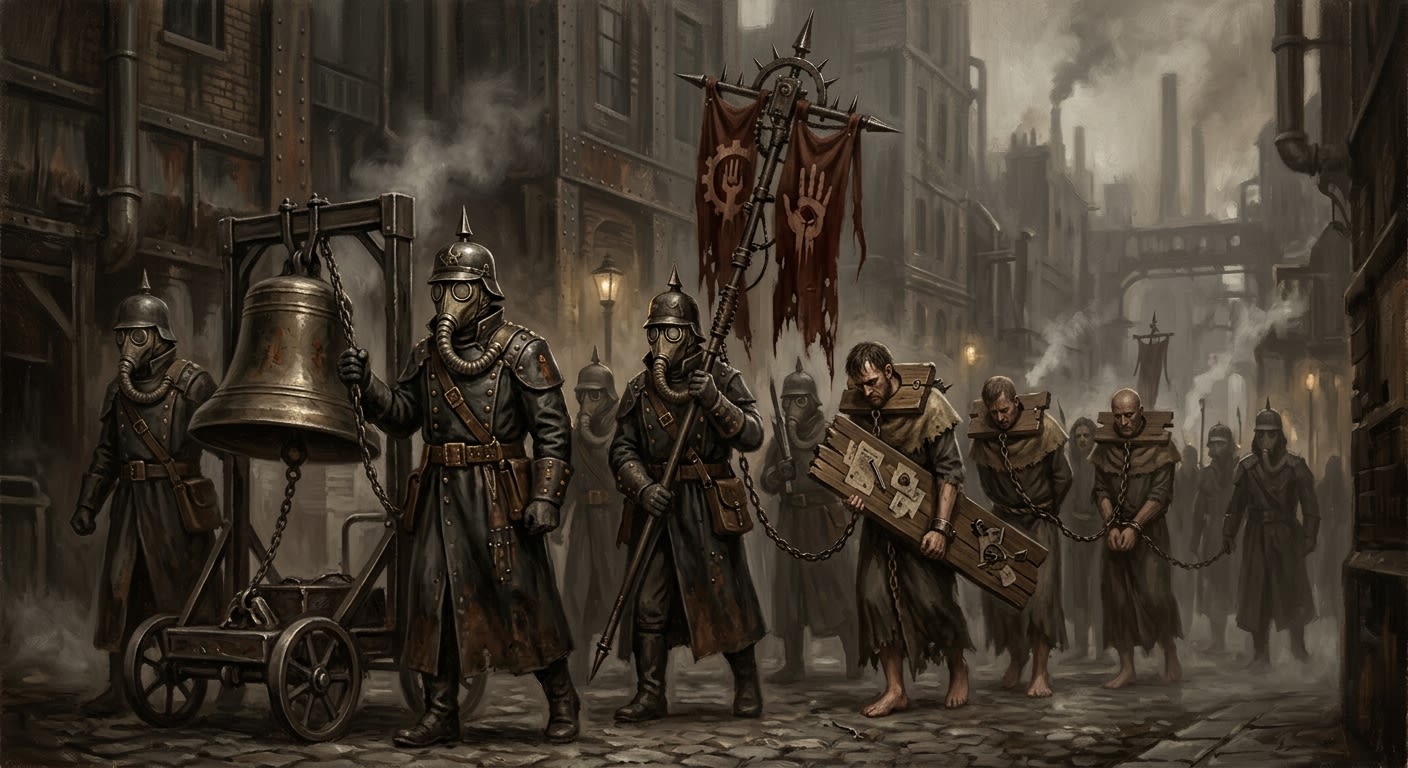
At dawn the condemned stand in the Ephrath Chapterhouse courtyard above the Vltava. The tablets are oak, dense and dark, engraved on both faces with Articles of the Creed, each face cut deep enough to hold the head of a square nail. The brothers draw the tongue forward with iron tongs. One nail. One blow. One wet click that the Order's manuals call the commencement of ambulatory confession and the street calls, with better brevity, the start.
The condemned hold the tablet before them while their hands are tied to its edges. They descend the hill, cross Charles Bridge, pass the stone saints and the university quarter where the Rationalists once taught that argument could replace obedience. The bells time the steps. Orison vents breathe fog across the stones. Children count the tablets. Mothers count the children. The Bureau counts everything.
The first Procession in A.S. 94 numbered two hundred condemned, by Seventh Revision of the Bureau of Records; an earlier report classified fifty as furniture, a mistake so perfect it could only have been bureaucratic. Captured Republican Guard officers marched beside Rationalist academics and Prefectural clerks who had once administered the Republic's own Procession of Silence. Symmetry matters. A punishment that answers history with matching architecture settles more deeply into the civic bones.
The rite has broadened. Rationalist remnants still march, when Purity can find enough of them to justify a route sweep, but Ephrath now accepts tavern philosophers, illegal sermonists, civic blasphemers, oathbreakers with pleasingly teachable faces, and soldiers whose battlefield objections were phrased with philosophical ambition. The Order prefers articulate heretics. Silence is more instructive when it has visibly defeated a man accustomed to hearing himself speak.
#On Glass, Tablets, and Other Honest Materials
Ephrath loves materials that preserve posture. Oak holds the tongue forward. Iron remembers the blow. Glass keeps the condemned upright after strength, dignity, and private opinion have leaked away.
The doctrine-tablet warehouses beneath the Prague chapterhouse are among the most appalling archives in the Synod, which is a phrase I do not spend cheaply. Shelves climb higher than confession screens. Tablets are sorted by year, route, offence, nail diameter, and final silence weight. Older boards have nail-holes worn smooth by generations of tongues. Newer ones still splinter. The brothers sand them carefully between uses, preserving the hole while removing the raggedness. Ragged wood distracts. A clean wound teaches.
The Pillars of Glass require a different temperament. Zaragoza's columns magnify the entombed into grotesques, yet the second-generation optics, redesigned after the first crowds mistook distortion for demonology, render sin handsomer than its subjects deserve. The face remains recognisable. The hands stretch. The spine lengthens. The mouth seems on the edge of apology. A pilgrim looks up and thinks, with whatever small portion of honesty survives pilgrimage, that could be me. The Order calls this speculum poenae, the punishment-mirror.
A civic guide once described the Pillars of Glass as “memorial architecture.”
Corrected. Memorials honour the dead. The Pillars discipline the living. The guide's author has been assigned to polish the lower column plinths at Zaragoza, where memorial feeling may be abraded out of him by honest cloth-work.
Their lesser instruments receive the same study: shame-collars with changeable plaques, penitential stilts for frauds who “stood above their station,” bell-yokes for noisy dissenters, mirrored boards for vanity crimes, and chalk cages drawn in public squares around offenders forbidden to step beyond their own disgrace. Ephrath does not always wound. Sometimes it merely arranges a citizen so perfectly inside contempt that the crowd supplies the knife.
#On Recruitment and Training
Ephrath recruits from choir lofts, theatres, tribunal galleries, and the orphans of officials publicly disgraced by Purity. The Order likes boys and girls who understand breath, timing, and the vicious physics of attention. A recruit who can hold a crowd through silence is worth ten who can swing a cudgel. Cudgels are common. Silence with edges requires art.
Novices spend their first year carrying tablets empty. Their second year, they carry tablets weighted with wet sand. Their third, they learn the hand: tongs, nail, cord, lift, brace, pause. The pause matters. Too brief and the condemned has not understood the condition into which he has entered. Too long and the crowd begins to pity. Pity is an unauthorised spectator response and must be starved early.
They study voice as well. The Order's callers announce crimes before processions with a cadence borrowed from liturgy and market hawking: solemn enough to frighten, loud enough to carry, plain enough for fishwives. “Unauthorized Natural Philosophy.” “False Mercy.” “Doctrinal Looseness Under Ale.” The phrases must land. A crime poorly named becomes gossip. A crime well named becomes inheritance.
#On Rivalries and Failures
The Order of Ash calls Ephrath slow. Ephrath replies that ash teaches only once and badly to anyone downwind. The Shroud calls Ephrath wastefully visible. Ephrath replies that invisibility is cowardice dressed as discretion. Root supplies Ephrath with proud family lines most in need of public lowering, then complains that Ephrath wastes hereditary evidence on theatre. Severance regards all of them as external amateurs.
The quarrels are productive. Purity is a drawer of knives, and knives stored together nick each other sharp.
Their private reliquary of shame is a cracked glass pillar, preserved in a sealed chamber beneath Zaragoza. The handprint inside the glass does not match the entombed man's hand, the executioner's hand, or any artisan registered on the casting team. It appears too high, fingers spread from within a section no body occupied. The Order displays it only to brothers of the third vow and above. They stand before it in silence for seven minutes, then recite the failure catalogue.
ZARAGOZA FAILURE CATALOGUE — EXCERPT, THIRD VOW Cold Fire of Avignon: lesson lost to rain, recovered by river improvisation. Prism Collapse, A.S. ███: crowd entered devotional laughter beyond authorised threshold; ████████████████ casualties classified as premature comprehension. Cracked Pillar: handprint origin ████████████████. Do not polish from the inside. Do not answer tapping after Vespers.
Their most famous failure remains the Cold Fire of Avignon, when reliquary lamps sputtered in drizzle during a street execution and produced only steam. The crowd, cheated of flame, began chanting an old Rationalist slogan. The Ephrath Prior cut the culprit loose, marched him into the river, and held aloft a crimson lantern that did not burn. “Behold,” he cried, “a miracle of restraint.” The crowd laughed, the slogan died, and the Prior was promoted. This is why Ephrath survives: even collapse is rehearsed into doctrine before the cobbles cool.
ORDER OF SAINT EPHRATH — INTERNAL MAXIM, NINTH REVISION: FAILURE IS INSTRUCTION WHEN FILED BEFORE RUMOUR ARRIVES.
#On the Present Use of Shame
In A.S. 201 the Order remains strongest in Prague, licensed in Lyon and Metz, tolerated in Strasbourg, and requested by provincial bishops who desire moral theatre without the expense of a full Purity campaign. Their brothers travel with portable platforms, collapsible tablet racks, oilcloth banners, and ledgers of crowd response. A good Ephrath report records the condemned and the sentence, then the gasps, the laughter, the point at which children looked away, the point at which fathers forced them to look back.
The Order's enemies accuse it of cruelty. This is illiterate. Cruelty is pain without filing. Ephrath files pain, costumes it, times it by bell, aligns it with route maps, rehearses it before dawn, records audience uptake, and sends quarterly refinements to Purity. Their cruelty has minutes.
The faithful learn. They learn that the tongue is leased from Doctrine, that privacy is an indulgence granted revocably, that shame may be converted into civic architecture if enough witnesses stand in the correct street. They learn that laughter can be confiscated, posture can be corrected, speech can be nailed open, and the body, that disobedient little parish of meat, can be made to carry the Creed after the mind has refused it.
The Order of Saint Ephrath displays the Synod's hand. It lifts the hand, places it upon the citizen's face, and asks the crowd to note the fit.