
#On the Ceremony's Origin
"The tongue that lies is still a tongue. Remove it, and the lie remains, voiceless, breeding in the dark. Better to nail it open, so the world may hear what heresy sounds like when it can no longer hide." — Grand Inquisitor Severian, Commentaries on Faithful Severity, Second Appendix
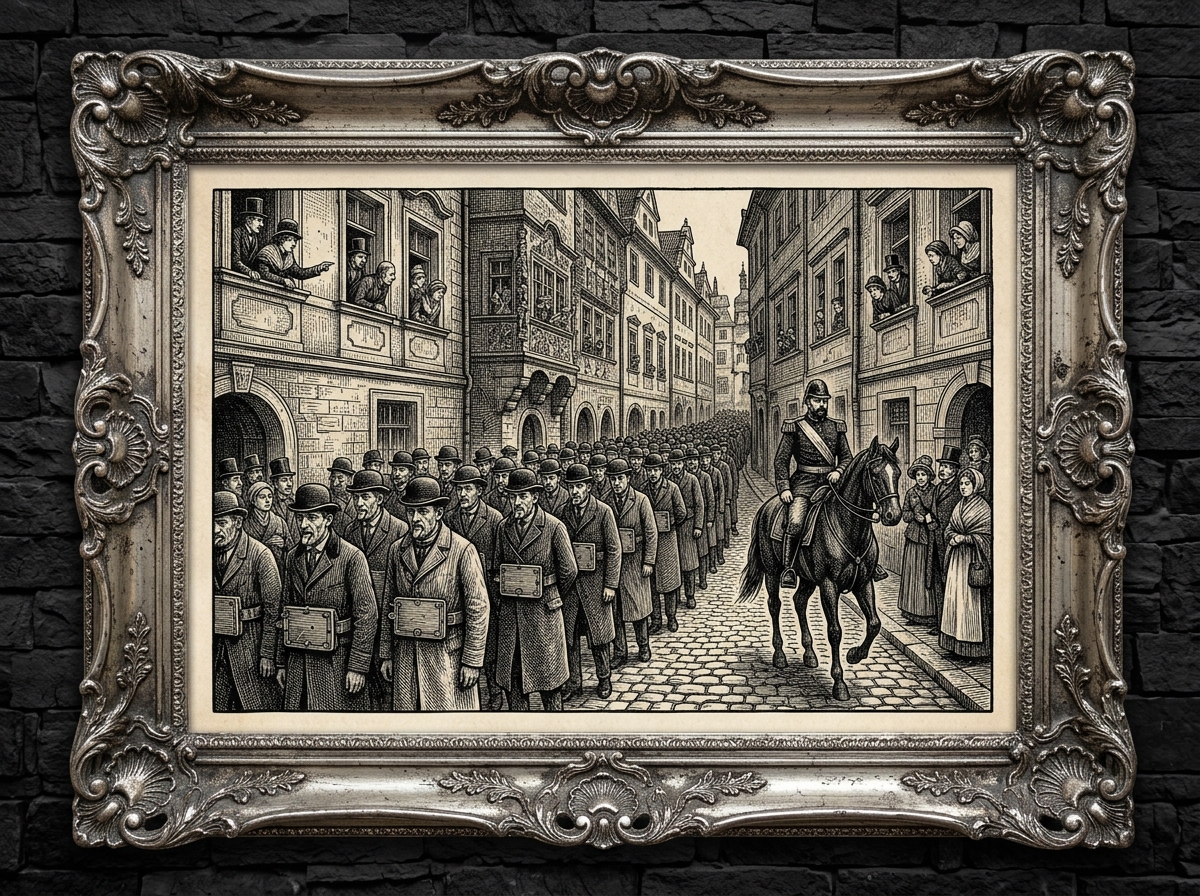
The Bureau of Purity did not invent the Procession of Tongues. The Rationalists did — or rather, they invented the impulse that the Procession corrects. In A.S. 3, when the Republic's Procession of Silence herded pilgrims through the squares of occupied cities with slit tongues and sealed mouths, the message was clear enough even for a Rationalist: superstition could be rendered mute. Faith could be cut from the body at the root. The pilgrims stumbled through market squares trailing blood from their chins, and the Republic's engravers distributed prints to every prefectural office captioned with that immortal banality: Silence is progress.
It took the Synod the better part of a century to steal the idea back. The Bureau of Purity's formal adoption of the Procession occurred in A.S. 94, two years after the Bureaus were constituted, when the newly chartered Order of Saint Ephrath petitioned the Bureau for authority to conduct processiones poenitentiales linguae in the cities of Bohemia. The petition ran to forty-one pages. The Bureau approved it in a single afternoon. The cover memorandum, signed by the first Archon of Purity, read: The Rationalists proved that the tongue is the organ of heresy. We shall prove that it is also the organ of confession. The difference is documentation.
And documentation, as I have remarked in better company, makes all the difference.
#On the Mechanics of the March
"Nailed and walking — that is the Creed's grammar for those who refused to learn it seated." — Order of Saint Ephrath, Training Manual, 14th Revision
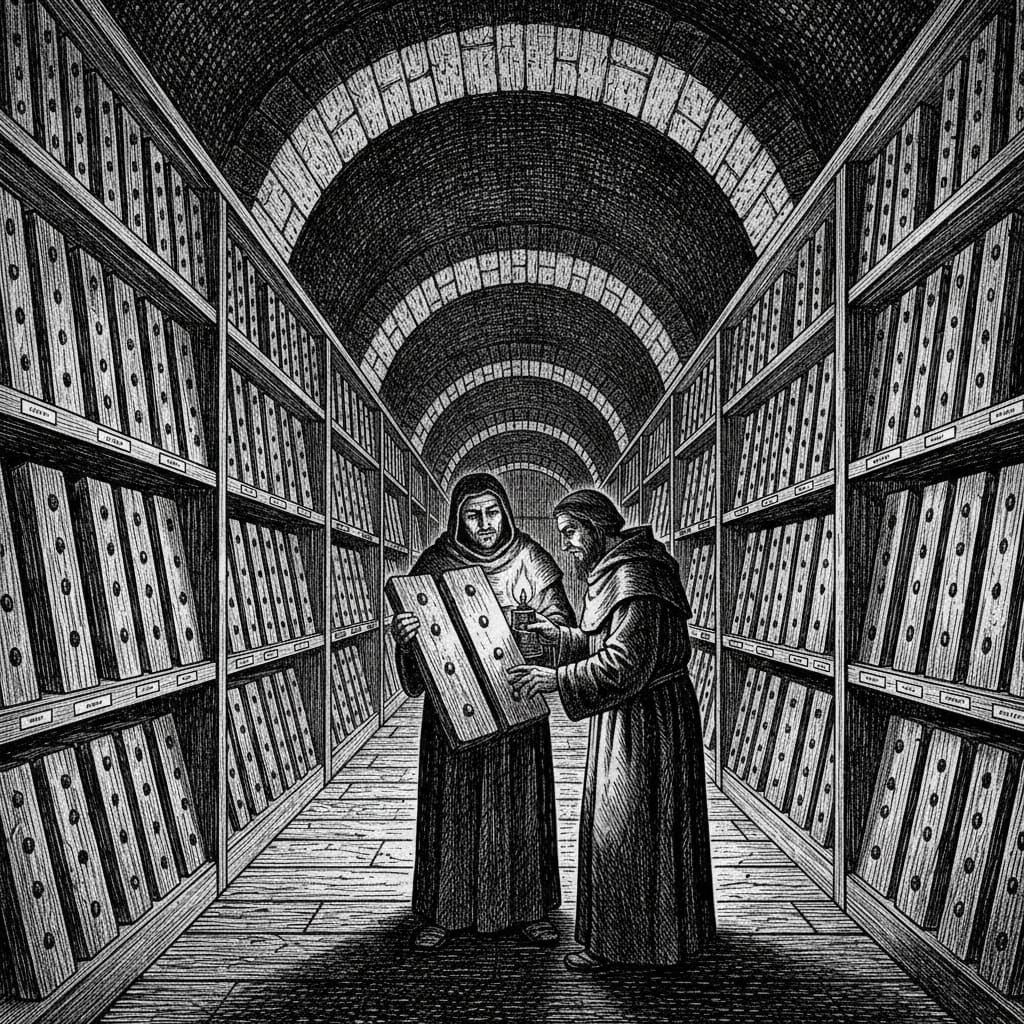
The Procession is held in Prague, and Prague alone holds the authority to conduct the full rite — though the Bureau has licensed derivative ceremonies in Lyon, Metz, and, on three occasions, Strasbourg itself. The Prague rite is the original. Every other is a diminished copy, and the Ephrath Priors will tell you so with the serenity of men who keep warehouses of nail-punctured doctrine tablets sanded smooth and ready to wound again.
The condemned are assembled at dawn in the courtyard of the Ephrath Chapterhouse on the hill above the Vltava (Unregistered). Their crimes have been read the previous evening; their sentences, ratified by a quorum of Purity officers and counter-sealed by the Bureau of Oaths, are inscribed on tablets of dense oak — each tablet engraved on both faces with Articles of the Creed in lettering cut deep enough to hold a nail-head. The tablets are heavy. A man holds one in both hands with effort. Each tablet is matched to a specific convict, and the convict's name is branded into the wood's lower edge in characters too small to read from the crowd, because the crowd is not the audience. The Ledger is.
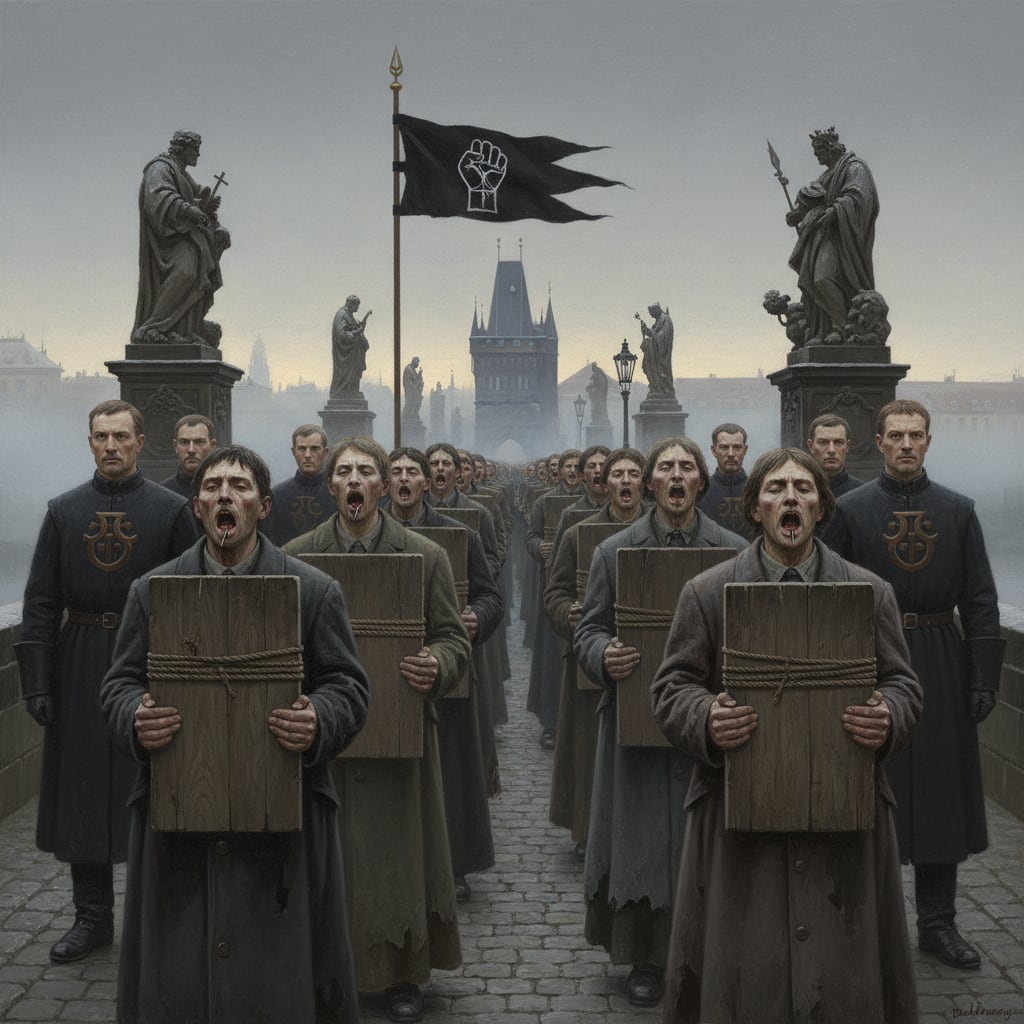
The nailing is conducted by ordained Ephrath brothers in the Chapterhouse courtyard, out of public view. I record this because certain Rationalist sympathisers — whose pamphlets circulate in Dutch harbours with the persistence of contraband mildew — claim the nailing is performed on the march, for the crowd's enjoyment. It is performed in private, for the convict's instruction. The tongue is drawn forward with iron tongs. A single square nail, blessed by the Chapterhouse Confessor and heated to dull red, is driven through the centre of the tongue into the oak face of the doctrine tablet. The convict holds the tablet before him. His hands are bound to the tablet's edges with tarred cord so he cannot drop it, because a man whose tongue is nailed to a plank of the Creed and who drops the Creed has committed a second heresy, and the Bureau prefers to prosecute one crime at a time.
The march begins at the second bell after dawn. The condemned proceed single-file down the Chapterhouse hill, across the Charles Bridge — where the stone saints look down with expressions I have always found insufficiently sympathetic — and through the university quarter, past the faculties of Law, Rhetoric, and Natural Philosophy where the Rationalists once lectured. The route is fixed by charter and has not deviated since A.S. 96. The Bureau of Bells coordinates the peals so precisely that the footfalls of the condemned align with the toll: each step a beat, each beat a syllable of the Gloria Patri, each syllable driven home by bronze. I attended with a delegation from the Bureau of Orison and Song; by the third street the hymnals we carried seemed ashamed to be paper and not iron.
The Orison vents — brass grates set into the street at intervals prescribed by the Bureau of Bells — exhale the curfew fog in thin sheets as the Procession passes, lending the entire thoroughfare the aspect of a low cloud walking. Children perched on windowsills hold their breath when a marcher falters. Mothers grip beads. Even the Wardens stand straighter, and Wardens, I assure you, are not a population given to posture.
The march lasts between three and seven hours, depending on the number of condemned and the rate at which silence claims them. When a convict can no longer walk — when the blood loss, the swelling, the sheer weight of oak and iron and doctrine drags him to his knees — he is permitted to kneel. He is not permitted to stop. Ephrath brothers lift him by the elbows and carry him forward, his feet dragging furrows in the cobblestones, the tablet swinging from his ruined mouth like a censer. This is not cruelty. The Bureau classifies it as ambulatory confession — a confession that proceeds at the body's own pace, regardless of the body's wishes.
#On the Condemned
The Procession was conceived for Rationalist prisoners, and for the first decades of its operation the condemned were exclusively apostates, seditionists, and practitioners of what the Bureau terms "philosophical heresy" — that is, heresy conducted with citations. The two hundred marched in the inaugural Procession of A.S. 94 were captured Republican Guard officers, Rationalist academics, and three Prefectural clerks who had administered the Republic's own Procession of Silence in Bohemia decades earlier. The symmetry was deliberate. The Bureau of Purity, alone among the Bureaus, possesses a sense of poetry, though it would flog you for calling it that.
Previous editions stated the inaugural Procession numbered "approximately one hundred and fifty." Bureau of Records, Seventh Revision, corrects this to two hundred, based on recovered Order of Saint Ephrath intake ledgers from the Chapterhouse archive. The discrepancy of fifty is attributed to a filing error in the Bureau of Purity's A.S. 95 annual report, wherein fifty convicts were accidentally classified as "furniture."
The demographic has broadened. By A.S. 130, the supply of living Rationalists had dwindled — the Republic being, at that point, some eighty-five years defunct and its surviving adherents largely deceased, imprisoned, or converted with varying degrees of sincerity. The Bureau adapted. The Procession now accommodates any heresy the Bureau deems sufficiently public to warrant public correction: Ledgerists, Bell Monists, Merciful Pragmatists, unlicensed sermon-speakers, tavern philosophers whose arguments exceeded the three-drink doctrinal exemption, soldiers who questioned orders in language classifiable as "theological dissent," and — on one occasion in A.S. 178 — a baker in the Lesser Quarter who had inscribed the word Ratio on a loaf as a joke. The baker marched. The joke did not survive the second street.
Women march. Children above the age of twelve march, though the Bureau of Mercy has twice petitioned for the age to be raised to fourteen, and has been twice denied. The elderly march, and when they fall, they are carried, and when they die, they are carried still, because the sentence specifies the route, and a corpse that has not completed the route is a sentence unfulfilled, and an unfulfilled sentence is an administrative irregularity, and the Bureau of Purity does not tolerate administrative irregularities.
#On the Festival Variant
The Prague Procession is the original — the Inquisitorial terror, the signature cruelty, the iron text written in sinew and cobblestone. But the Bureau of Festivals has adapted the form, as the Bureau of Festivals adapts everything, scrubbing the blood from the spectacle and replacing it with enthusiasm.
In Lyon, the Procession of Tongues is held annually on the Feast of Saint Sabina. Citizens — not convicts, citizens — are assembled by parish and made to recite the Creed aloud, in unison, for the duration of a four-hour processional route through the city's river wards. There are no nails. There are no tablets. The instrument is repetition itself. The Creed is chanted until voices crack, until throats bleed, until the words lose their meaning and become pure sound — syllables hammered into the air with the persistence of a bell that cannot stop ringing because no one has told it to. Those who falter are silenced by gagging: a linen strip soaked in blessed oil, tied across the mouth by a Festivals clerk, who marks the gagging in a ledger with the notation vox defecit — "the voice failed." The gagged walk the remainder of the route in silence, their covered mouths a visible rebuke to the hoarse columns still chanting around them.
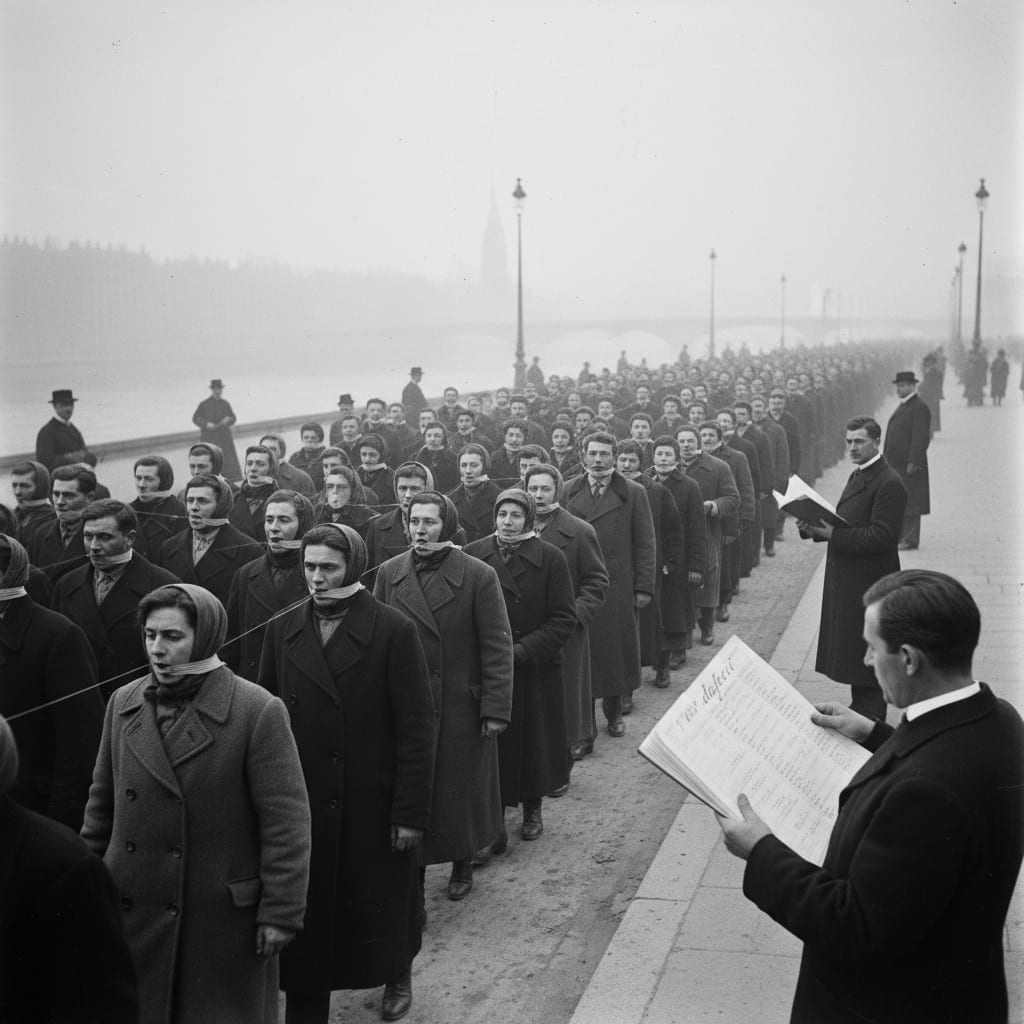
The Bureau of Purity views the Lyon variant with the contempt of a master craftsman watching an apprentice sand a table. The Ephrath Priors in Prague consider it a dilution — a carnival wearing a procession's clothes. I find both positions defensible, which is to say I find both positions useful, depending on who is asking and what they hope I will condemn.
The distinction the Bureau draws is theological: the Prague Procession punishes the heretical tongue; the Lyon Procession disciplines the faithful one. Prague extracts confession through silence — the march continues until the condemned can no longer speak, and in that silence the Bureau reads absolution, or at least the absence of further dissent, which amounts to the same thing in the Bureau's arithmetic. Lyon extracts obedience through volume — the march continues until the voice itself is worn to meat, and in that rawness the Bureau reads submission, the body's testimony that it has spoken every word it was told to speak and has nothing left to offer but loyalty.
#On the Present Condition
The Procession of Tongues has been conducted in Prague without interruption since A.S. 94 — one hundred and seven consecutive years. The Order of Saint Ephrath maintains its Chapterhouse on the hill with the meticulous devotion of men who believe that sanded oak is a sacrament. Their warehouses hold doctrine tablets from every decade, filed by year and sorted by the weight of the convict's silence — a cataloguing system I find both appalling and admirable. The nail-holes in the older tablets have been worn smooth by generations of tongues. The newer tablets still show splinters.
In A.S. 199, the Procession was notable for two developments. The first: the Bureau of Bells dispatched a delegation to record the precise acoustic profile of the march — the footfalls, the peals, the wet sounds, the silences — for incorporation into a standing reference for "doctrinal acoustics," a field the Bureau of Bells insists is a legitimate discipline and which the Bureau of Doctrine has not yet found the energy to deny. The second: a Judge was sighted at the foot of the Charles Bridge during the march. The Ephrath Prior in charge of the Procession noted the sighting in his daily report with the single word vidit — "he saw." The Bureau of Purity's response, appended in the margin of the Prior's report, read: What did he see? The Prior did not reply. The Bureau did not press the question. I find the silence instructive.
The Rationalists slit tongues to prove faith mute. The Bureau nails tongues open to prove heresy audible. The distinction is procedural, theological, and — the Bureau insists — absolute. I have examined the distinction from every angle available to a man of my station and my access. The Rationalists lacked documentation. The Bureau has documentation in abundance. And documentation, as I have said, as the Bureau has said, as the Ledger itself proclaims in every stamped and counter-sealed folio from Strasbourg to the Line — documentation makes all the difference.