
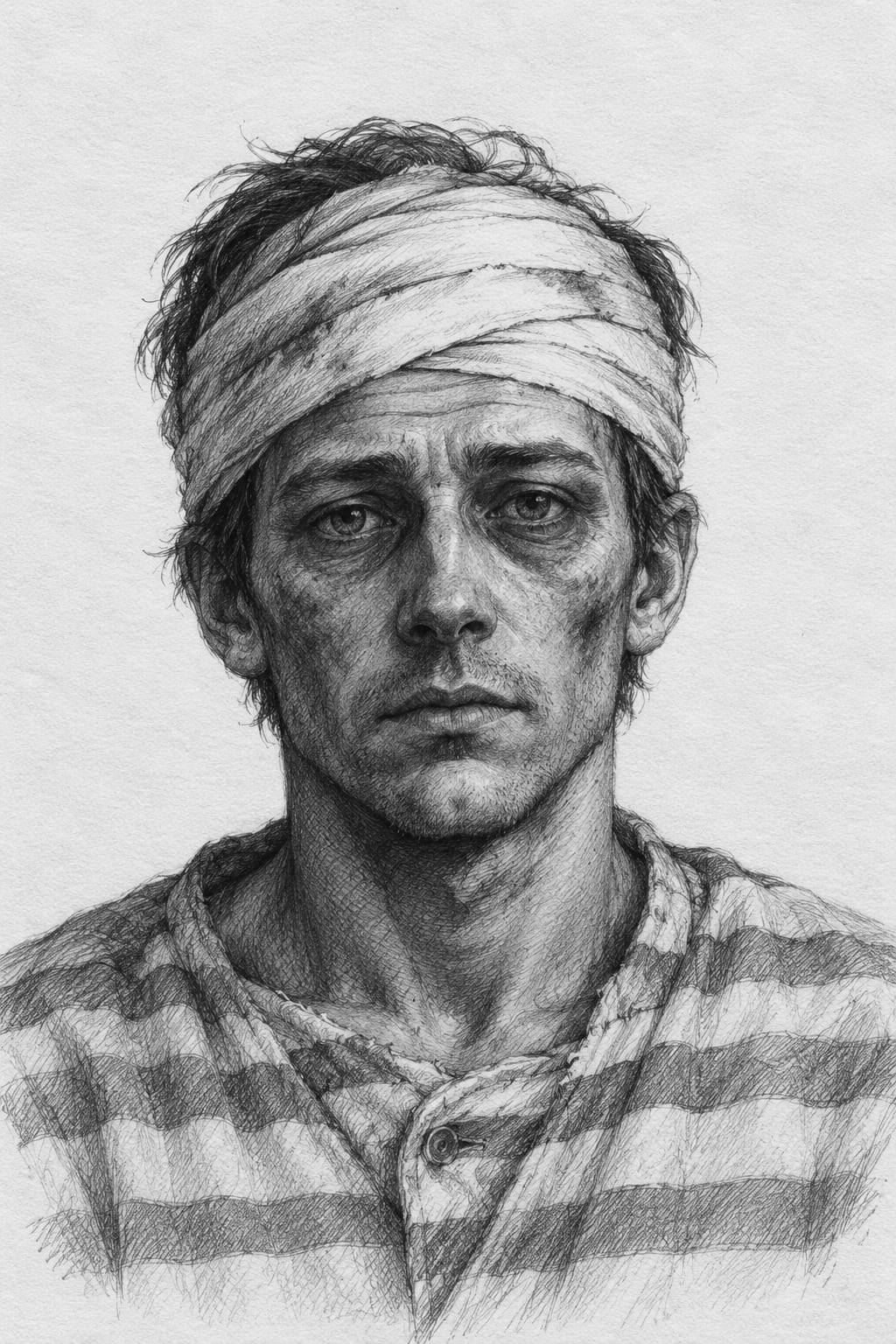
#On the Station of Private Voss
Private █████ Voss holds a place in the Church's archive that most generals would envy and no sane soldier would accept. It consists of one passage in a suppressed addendum, attached to the Flesh-Mud file in A.S. 197, and of nothing else. No service sheet accompanies it. No deposition, letter or chaplain's note on the state of the soul has been bound in behind it. The rank survives, and so does the surname. The name that once stood before the surname was inked over by an office that did not sign its work. I reproduce the bars as I found them, because a Warden of the Sacred Ledger who restores a redaction for the reader's comfort deserves to be redacted himself.
This dossier is thin, and I will not fatten it. Building a biography out of a rank and a surname is a job for hagiographers and the provincial press. The Ledger requires only what it was given: a private, a bed, a jar, and a leg in storage that nobody has yet formally assigned to anyone.
#On the Sector and the Ward
The addendum turns on the phrase amputees from the same sector, and that phrase cannot be read without the mud. Flesh-Mud is the mire of No Man's Land, the contested strip east of the Sagittal Line. It is battlefield slurry seeded with bone-reefs, a ground that seizes the ankle with ligaments belonging to nobody present. The Bureaus file it as Category Two Hostile Terrain, Variable Sentience. Survey rods lowered by Engineering come back wrapped in fibrous tissue that no catalogue will own. It has swallowed marching formations without the enemy troubling to fire a shot. By the arithmetic of the Line, a soldier who leaves it with one leg fewer has done well.
Such soldiers go to the wards. The Bureau of Mercy keeps its hospitals the way it keeps everything else, by count. Intake is tagged treat, hold, isolate, transfer, release or ossuary. Bowls are matched to bodies, drops to signatures, deaths to transfer tags. At the close of every shift a Mercy ward expects the number of patients in the register to agree with the number of patients in the beds. Whatever the saw has taken from a patient stays on the books until it is burned, buried or surrendered to the reliquaries. Mercy calls this stewardship. Its patients call it being counted, which in a Synodal hospital is the nearest thing to being loved.
None of this ordinary procedure is attested for Voss in particular. The addendum names no surgeon, no ward-sister, no wound, no day of admission and no bastion. Of the sector it says only that it was the one the samples came from. I decline to guess Brest or Przemyśl merely because the mud is notorious near both. Proximity is not posting.
#On the Addendum of A.S. 197
Here is the whole of it, in the order the clerk set it down.
Suppressed addendum, A.S. 197: Active Flesh-Mud samples placed in sealed reliquary jars moved overnight toward the ward containing amputees from the same sector. One jar arrived at the bedside of Private █████ Voss. The jar was intact. The bed was empty. The amputated leg in storage had gained a foot.
Five sentences. I have read longer inscriptions on pew-rent receipts.
Mark the order, because order is all the clerk allows us. First come the samples: active, jarred, sealed. Then comes movement, overnight, toward the ward. The clerk records no watcher, no distance and no manner of travel. The jars were in one place at dusk and in another by morning, and the second place was nearer the amputees. Then comes the singular, one jar at one bedside. Last come three observations with a sentence each, the way a confessor gives each sin its own line so that none can hide behind another. The jar intact. The bed empty. The leg in storage, the amputated leg in some unnamed store, now bearing a foot it had not possessed before.
The clerk did not write that Voss was taken. The clerk did not write that the jar was opened, or that a second hand examined it, or that a priest tested the seal. Intact is a clerk's word for a jar that is not in pieces. Nor did the clerk write whose leg it was. That sentence sits beside Voss's bed in the paragraph, and readers have been marrying the two ever since without reading the banns. The Ledger does not officiate at such weddings.
A lazier clerk would have written incident and gone to supper. A braver one would have written a second page. We have neither.
#On What the Report Will Not Bear
An empty bed is a fact about furniture. It establishes that at the hour someone looked, Private Voss was not in it. It does not establish death, since there is no body. It does not establish desertion, since there is no charge. Rapture, consumption, cure, escape and discharge are equally unproven. Whoever files the case under any of them has filed a private wish under a public seal.
An intact jar is a fact about glassware. It invites the reader to imagine passage through glass, and that is exactly why imagination is rationed at the Front.
A leg that has gained a foot is the fact nobody wants. By Mercy's own procedure, the stored limb was the one object in the hospital already written off. It had been counted out of a body and into a store, and then it grew. The report does not say that the private grew anything, regained anything or walked anywhere. It says the leg in storage had gained a foot, and then it stops, the way a sensible man stops at the edge of a mire.
The Bureaus have their explanations of Flesh-Mud. None has been entered for this ward. The Bureau of War speaks of anaerobic slurry with ligamentous response. Engineering speaks of battlefield sediment under pressure. The Bureau of Doctrine speaks of hostile matter animated by the Lie of the Great Deceiver. Each describes mud in a trench. None describes mud in a jar travelling toward a ward in the night, and I will not insult the Bureaus by finishing their sentences for them.
In A.S. 114, after patrols vanished east of Przemyśl, Chaplain-Major Iven Tars proposed that the mud feeds by recognition: grief makes the hook and memory supplies the barb. It is a fine sermon, and it is a hypothesis about patrols. Nothing in the addendum says Voss grieved, or remembered any particular dead man, or called to the samples. Nothing says the samples answered anyone at all. Applying Tars here would mean convicting a missing private of mourning on no evidence but absence. The Creator may know what drew the jar to that bedside. The Ledger has not been told.
The institution was once confident about recovery, and Mercy put that confidence in print.
Mercy pamphlet A.S. 151 instructed stretcher teams that "no faithful soldier is beyond retrieval."
Clarified after the Third Knife-Mile Recovery. Some faithful soldiers are beyond retrieval. Others are retrievable only in pieces that argue with the stretcher team. The clarification was written for the mire. It did not foresee a soldier beyond retrieval from a hospital bed, under a roof, inside the count, and no further clarification has reached the Ledger.
#On the Recorded Disposition
The last report on Private █████ Voss is the one already quoted. Four years have passed. It is A.S. 201, and Flesh-Mud persists across Zone Five, held still by salt bombardment for its few minutes at a time and never cured. Of Voss there is no subsequent line. The Ledger holds no body, no return and no death certificate, and no search order bearing the name has crossed my desk. The Bureau of Mercy does not leave a cot empty while the Line keeps supplying amputees. The register for the beds has moved on, as registers must.
What remains is a rank, a surname, a bar of ink where a given name was, and five sentences filed under the mud rather than under the soldier. The Church knows where to put a terrain. It has never been issued a drawer for a private who left an empty bed and an intact jar behind.