
#On the Quake-Year
Bastion-Irongate remembers the Quake-Year of A.S. 160, which the civil reckoning calls 1870, by what it broke. The particulars were never filed in any order a clerk could love. No surviving account gives the day the shaking began, the month, the season, or the hour it ended. The name says a year. Salvagers gave it that name, and Salvagers bill by the incident and remember by the scar.
What the record does hold is concrete enough. In the Iron Gates gorge, where the Danube narrows at Orșova and the batteries sit on both cliffs like two creditors facing each other across a table, the cliff galleries shifted. Lung chambers cracked. Old reliquary cupboards, sealed into the cliff chapels by hands no one now living can name, split along their seams and breathed into the corridors. Out came gold dust, bell mould, the close sweet saint-smell that stays in wool for a week, and a small dry clicking. Veterans of the southern works have since learned to leave a room at that sound without asking anyone's permission.
By then the Synod had stood seventy years on its Strasbourg settlement. It had Bureaus, seals, registers, and a Sagittal Line (Unregistered) running from the Baltic to the Bosphorus. It had no means of keeping stone still. No one ever recorded the quake's cause, its centre, how far it reached along the Line, its dead, or the cost of repairs, and I decline to supply them. A Ledger that invents a casualty figure to look complete is a forger's Ledger with better binding.
#On the Opened Chapels
A cracked fortress wall is a problem for the engineers. A cracked wall with consecrated matter inside it belongs to the Bureau of Relics. When the plaster starts falling, the Bureau of Relics sends for Reliquary Salvagers: miners, vault-rats, debtors, and now and then a defrocked notary who learned the trade sooner than he wished.
The reasoning is old and sound. A reliquary opened by accident has lost its custody but kept its contents. Left where it lies, the unsung thing goes on working, quietly, in the walls of a garrison that has to sleep beside it. If masons in a hurry pour lime over it, it wakes wrong. If the first crew to bribe the patrol loots it, it turns into counterfeits and shrine-wars within the season. So the Bureau, which distrusts Salvagers in every clause of its regulations, keeps their names on a list for exactly these occasions.
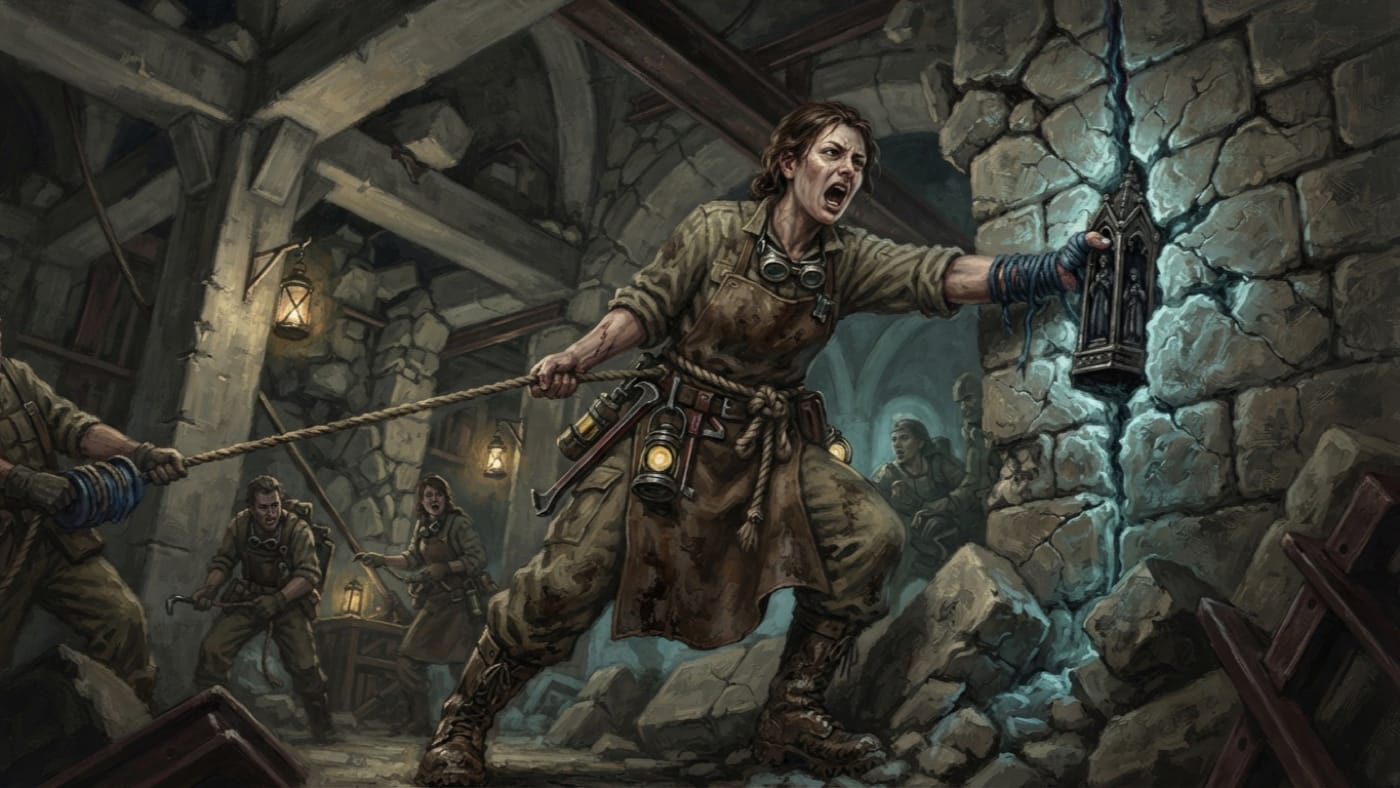
One of those names in A.S. 160 was Vera Malrec, a working Salvager licensed for some contracts and deniable for others. Her crew was sent to a cracked service chapel below the southern cliff batteries. The map showed solid stone behind its east wall. A resonance fork struck against that blank stone gave back three tones.
Two teams had been in before her. The first tagged the site singing. The second tagged it unclean. These are the trade's own tags. The first means it is alive. The second means it is alive and we dislike it. Malrec listened to the wall for a while, spat dust, and tagged it payable.
For any such seam, the Salvage Protocol of the day required withdrawal, notification, quieting, and three signatures before a hand went near it. I respect the Protocol, as my office requires. I also note that a wall which is opening and closing does not wait for the third signature.
#On the Extraction
The masonry pulsed. That is the crew's plain word, and I keep it plain. Under the plaster the stones moved against one another. The mortar joints opened and closed in a slow, regular rhythm. Men who had worked the lung chambers knew that rhythm from the gaskets and did not like seeing it in a chapel. Each time the joint widened, the lantern showed what lay behind the seam: a saint-housing, whole, with its reliquary shell, inner cradle, seal-band and inscription plate. The wall had taken it at some point no record gives. It had not broken it.
I cannot tell you what moved the wall, and neither Engineering nor Relics has told me. The description is all the Bureau owns.
Malrec tied a rope around her waist and had it run back to the winch. She wrapped her right hand in two layers of blue wax cord. That cord is the licensed Salvager's mark. In a collapse it serves as grip, as insulation, and as a small public notice of whom to blame. Then she went in.
FIELD ACCOUNT — IRONGATE, SOUTHERN CLIFF, A.S. 160 Operative placed her hand into the seam to the wrist. The wall closed. Operative instructed crew to pull only when she cursed. Duration: eleven minutes. Sound: low bell; wet stone; operative's voice, saying ███████ ██ ████████. The curse is withheld from devotional editions.
Eleven minutes. Let the reader sit in a chapel with one hand inside a wall for eleven minutes, and then lecture me about the Protocol.
When she cursed, they pulled. The rope burned through one crewman's palms. A second crewman's thumb was driven against the winch housing and broke there. The crew later called that solidarity, and the medical clerk called it avoidable. Malrec's left shoulder dislocated and two of her teeth broke. When the saint-housing cleared the seam, the wall closed on the last thing still inside it, which was her right thumb, and crushed it.
The housing came out intact. Its inscription plate has not been read into any copy I have been shown, and I will not furnish a reading.
The object rang once.
After the ring, the shaking stopped in that corridor. Three sources say so: the crew's testimony, Engineering's account, and the part of the Relics account that survived later revision. None of them speaks for the rest of the cliff, the rest of Irongate, or the rest of the year. Why the corridor went still is another matter. The housing may have been released, the wall satisfied, or the thumb accepted as a seal. The Bureau has no finding on it, and I have no licence to make one up.
Children's chapbooks report that Malrec "smiled serenely" as the wall took her thumb.
Corrected from the crew testimony: she screamed, threatened to kill the winchman, vomited, asked whether the housing was intact, and fainted. The serene version is withdrawn. She was in too much pain to arrange her face.
#On the Iron Taken Afterwards
The thumb was gone. An Irongate armourer, unnamed in every account, made her a new one from blackened hinge-iron taken off the outer clamps of the housing she had pulled. Whether he asked the Bureau first is a question no one answered in writing. The metal was sacred property and he was a workman with a forge. You may do the arithmetic yourself.
It was a tool before anyone called it a relic. With it Malrec could grip rope again. She could press wax for a seal, hook a reliquary lip, and pry at a joint where flesh would hesitate. Foremen say she could rap it on a table hard enough to end a contract dispute. I count that its most useful property.
The Salvagers did what working people do with any wound that pays: they made a word of it. Within five years "iron-thumb" was the trade's term for a Salvager willing to hold the object while everyone else debated whether to touch it. The word entered the trade the way soot enters a lung, gradually, without anyone deciding on it. By about A.S. 165, crews were using it of one another, admiringly at the vault mouth and with contempt at the inquest.
Her later work took her along the quake-lines, among other places to Przemyśl after the aftershocks of A.S. 162. The Przemyśl shaking tells us where she went. It tells us nothing about the nature or reach of what happened at Irongate, and I will not let it be used as evidence for either.
#On What the Ledger Retains
Nothing that survives names the housing's saint. Its contents, its size, and its path through custody after it left the chapel are not recorded either. A Saint-Bone Melter never had any business with it, and that alone marks the recovery as exceptional. Most of what comes out of an Irongate wall comes out in shards, and shards end up in mortar.
The iron thumb outlasted its bearer. It is now held at Bastion-Sibiu, far from the chapel, in a small reliquary of black iron and pale glass. Devotion to Malrec is tolerated pending review, and no full cult decree has been issued. Salvagers chalk the thumb-mark over lintels before a descent. The Bureau has not yet found it cheaper to stop them than to let them.
From A.S. 160 the trade kept a sequence it can teach. First the fork's three tones, then the rope and the wax cord and the eleven minutes in the wall, then the pull and the ring, and last the iron made afterwards. What the trade added, meaning the stopped quake, the bargained thumb and the freed saint, remains the trade's own property, unsealed.