
#On the Saint-Bone Melter, or: The Doctrine of Structural Holiness
"Holiness must bear weight." — Purity Kiln Decree, Third Revision, A.S. 142
The question is whether the bones of the saints should be ground to powder and rendered into lime. The question was settled in A.S. 96, when the Bureau of Tithes published the first Saint-Bone Melting Acts, and the Synod — with a pragmatism that would have made the Rationalists weep with envy — declared that sanctity, like capital, must be deployed. A femur in a reliquary inspires. A femur in a wall holds.
The Saint-Bone Melter is the artisan who performs this transubstantiation of purpose — who takes the chipped, the cracked, the surplus, the "unassignable" fragments of holy dead and feeds them to the kiln, and who receives in return a paste of caustic lime that smells of lye and faith and the particular grief of a shrine-keeper watching her chapel's prize possession become mortar. It is a profession that exists because the Synod built two thousand miles of fortification and discovered, in the building, that brick alone cracks under demonic pressure, that common lime fails where the Enemy concentrates, and that the only sealant the Sagittal Line has ever fully trusted is the calcined remains of those the Church calls blessed.
The profession carries several titles, arranged by the usual Synod gradient from the grand to the unprintable. Formally: Reliquary Reduction Artisan, Sanctified Lime Operator, Ossuary Mortar Catechist. On the kiln floor: Bone-Boiler, Holy Kilnman, Lime-Saint. In the mouths of shrine-keepers who have watched their collections diminished: Relic Butcher, Saint-Eater, Wall-Liar. The Melters accept all names with the flat calm of people who have breathed enough caustic dust to have lost interest in arguments about dignity.
#The Founding Doctrine
The official account — and the Bureau of Doctrine has been generous enough to provide one — holds that the practice descends from Saint Aurel of the White Wall, who, during the desperate first decades after the Sundering, offered his own bones to the masons of a besieged tower. "Make me wall," he is reported to have said, which is a magnificent line and almost without question fabricated, because no one who has handled fresh bone has ever spoken with that economy.
The true origin is blunter. After the Sundering, and throughout the long decades of the Great Retreat, the Synod accumulated relics at a rate that outpaced every vault, every ossuary, every reliquary shelf on the continent. Battlefield harvests. Mass ossuary events. The bones of the faithful dead, collected with a fervour that exceeded the available storage by orders of magnitude. Fragments multiplied. Authentication collapsed under volume — the Relic Authenticators of the early Line era processed claims in assembly-line fashion, and a disconcerting number of saints appear to have possessed between seven and eleven femurs each. Something had to give, and what gave was reverence.
The Cracked Ring Sieges at Bastion-Constantinople — those grinding months when the outer ossuary rings buckled under Maldrake's bombardment — demonstrated the principle that would become policy. Walls sealed with bone-lime held. Walls sealed with common mortar cracked, and through the cracks came things that the operational reports describe with a brevity I find admirable. The correlation was noted. The correlation was tested. The correlation was exploited, and the exploitation was given a hymn-book, a licensing charter, and a patron saint of uncertain provenance, and thus was born the trade.
#The Kiln Yard
The workplace of the Saint-Bone Melter is an ossuary annex rebuilt as an industrial furnace, or a kiln yard thrown up behind bastion walls with the architectural finesse of a field latrine, or — at the trenchline quick-kilns of the forward positions — a hole in the ground with a fire in it and a prayer that the wind blows west.
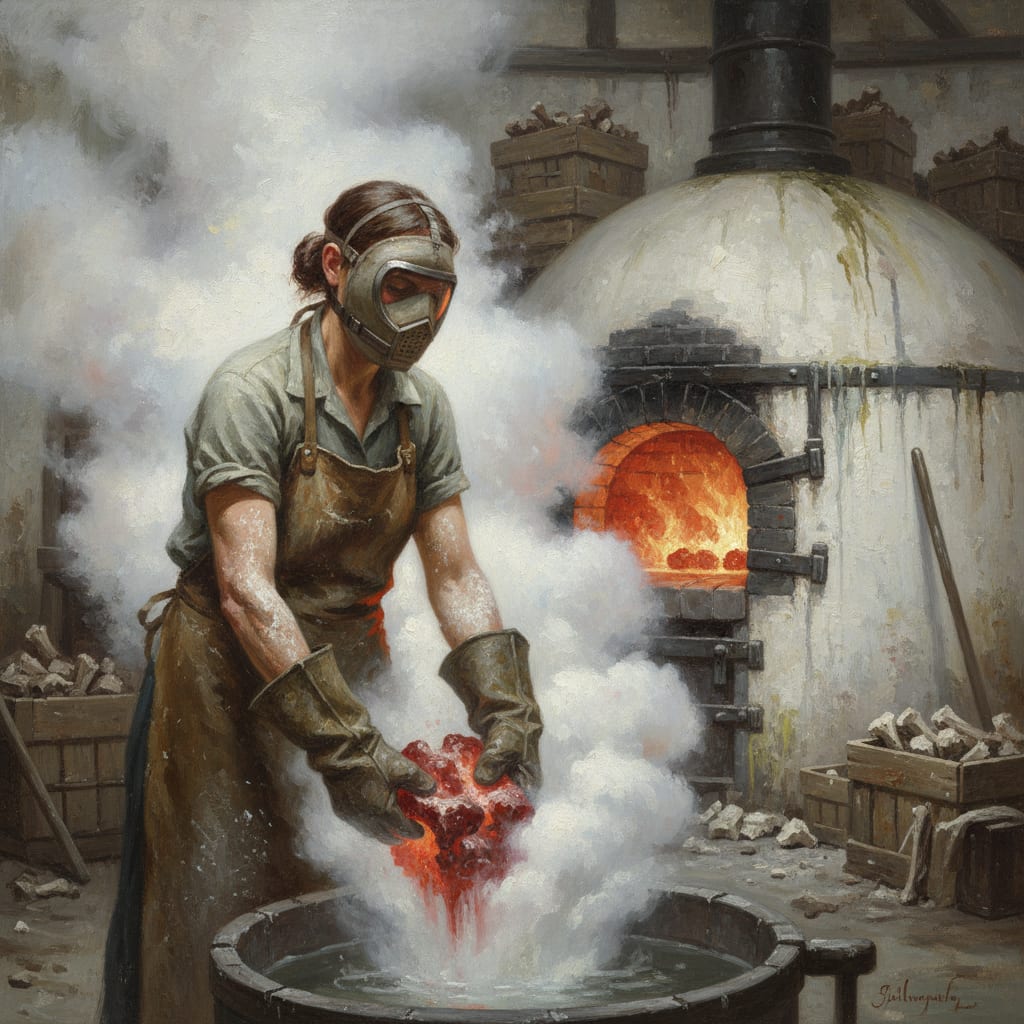
The physical environment is heat. Caustic dust that bites exposed skin and turns sweat to acid. The sour-lime stink that veteran Melters no longer notice and everyone else never forgets. Bone smoke, which smells exactly as one would expect and which the Bureau of Rites has declared "sanctified vapour" in a classificatory triumph that ranks among the Synod's more creative acts of re-description. The light is harsh — kiln glow and lime-white glare, so that the workers move through a world bleached of shadow, squinting and burned and chalked from crown to boot-sole.
The tools are simple and brutal. Kiln tongs. Crucible rakes. Lime slakers — broad iron paddles for managing the violent reaction when calcined bone meets water. Stamped batch rings for sealing completed barrels. Respirator masks issued by the Bureau of Engineering, which are inadequate in the way that all Bureau-issued safety equipment is inadequate: they meet a specification written by someone who has never stood downwind of a bone kiln. The Melters supplement with contraband — better filters purchased from black-market suppliers, illicit relic-hardener additives that improve mortar strength at the cost of doctrinal purity, and occasionally a shard of demon-glass wedged into the kiln wall as a "heat listener," which is heretical and effective and therefore tolerated by everyone except the Bureau of Purity, who tolerate nothing.
Every Melter carries a chant wheel — a rotating ring of litanies matched to the stages of the burn. First Feed, Rising Heat, White Glow, Full Calcination, Cooling, Slake Preparation, Final Set. Each stage has its hymn. The hymns are mandatory. The Purity Kiln Decrees of A.S. 142 standardized the cycle after several incidents involving "unclean burn" — mortar that set improperly, or set properly but produced sounds during curing that the masons described as "singing," which is the word the Synod uses when it means "we don't know what this is and we don't want to."
#The Process
The work proceeds in seven steps, each logged, each witnessed where inspectors are present and approximated where they are not.
Intake and classification. Fragment crates arrive from ossuary processors, Relic Authenticators, dead-goods tariffers, and Wound-Site Prospectors. Each crate carries a provenance tag — or should. The Melter sorts: renderable (surplus, damaged, disputed, unassignable) versus protected (named, venerated, politically owned). The distinction is the profession's knife-edge. Render a protected fragment and the Bureau of Purity will make an example of you that will be discussed in kiln yards for a generation. Fail to render enough surplus and the wall cracks, and the wall cracks are discussed by no one, because the people who would have discussed them are dead.
Fragment cleansing. Salt wash, smoke pass, and the "quiet hour" — a period of bell-hush during which the fragments rest under a linen cloth in a sealed room, attended by no one, observed by no one, and explained by the Bureau of Rites as "allowing the sanctity to consolidate for transition." What happens during the quiet hour is unknown. The fragments emerge unchanged. The Melters perform the ritual because the Melters have always performed the ritual, and because the one Melter who skipped it in A.S. 161, at a quick-kiln outside Bastion-Irongate, produced a batch of mortar that set perfectly and then wept a clear fluid for three days. The Bureau of Rites attributed this to "condensation." The Melter retired.
Calcination. The kiln burn. Bone to calcium oxide, the mineral stripped of everything that made it a person and reduced to a powder the colour of dead light. The temperature must be precise — underburned lime produces weak mortar that crumbles under siege pressure; overburned lime produces brittle mortar that shatters on impact. The chant wheel turns. The hymn rises. The bone becomes powder, and the powder becomes the raw material of walls that must hold against things that should not exist.
Slaking. Water meets calcined bone. The reaction is violent — steam, heat, expansion, a hissing roar that veteran Melters time by counting heartbeats and apprentices time by screaming. The chant pacing is designed to regulate the water addition. Too fast and the slake explodes. Too slow and the paste sets unevenly. The slaking pit is the most dangerous station in the kiln yard, and the most feared assignment, and the one that apprentices must master before they are permitted to touch a batch seal.
Mixing. Aggregate — sand, crushed gravel, brick dust — combined with the slaked lime in ratios that the Melters guard as professional secrets, despite the fact that the Bureau of Engineering published the official ratios in A.S. 147 and the Melters ignored them on the grounds that the Bureau of Engineering has never sealed a wall during a demon assault and therefore its opinion on ratios is decorative.
Stamping. Each completed barrel receives a batch seal — wax-pressed, cord-tied, marked with the kiln number, the date, the Melter's personal stamp, and a ward-line compatibility code that tells the receiving mason where in the fortification this particular mortar may be applied. Seal forgery is possible. Seal forgery is also the fastest route to the designation "wall-heretic," which is the Bureau of Purity's term for someone whose professional future has been cancelled with prejudice.
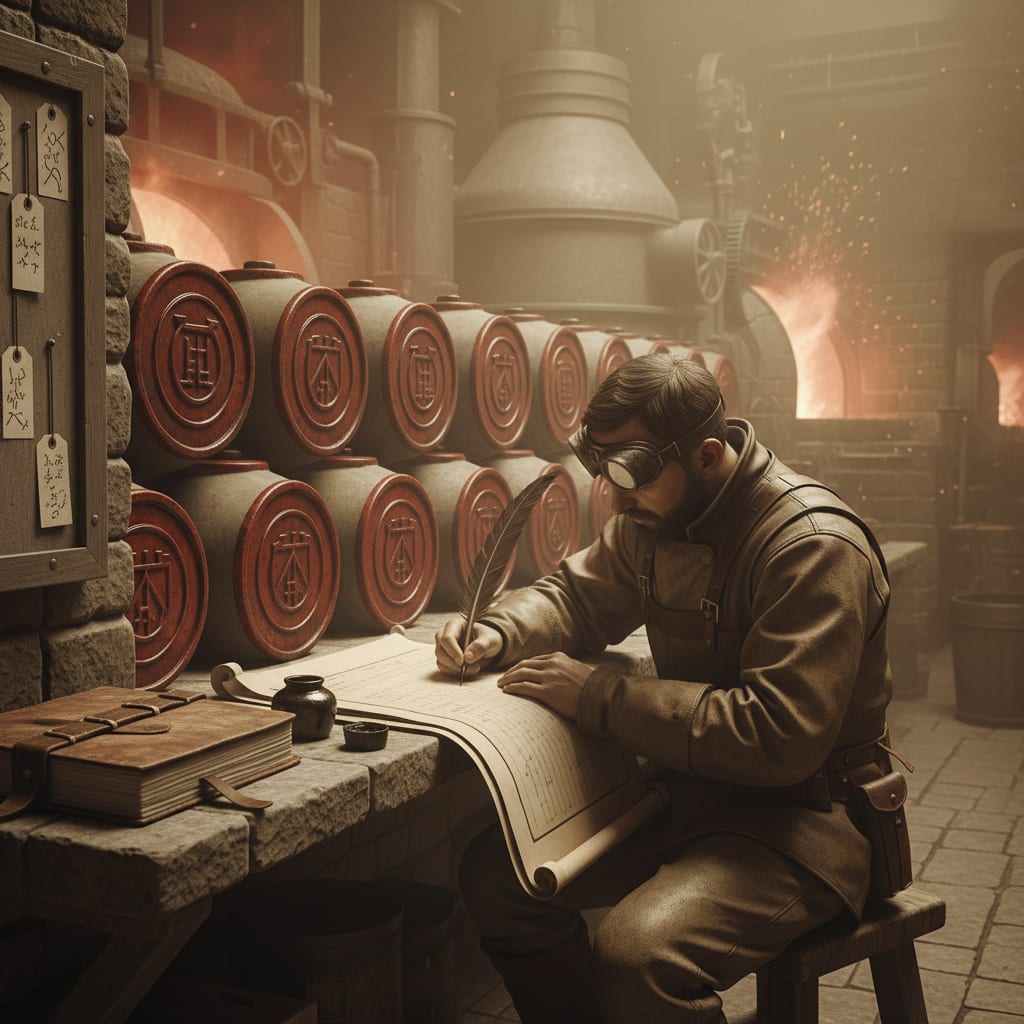
Delivery. Mortar barrels travel by convoy to masons, wardwrights, bell-tower crews, and trenchline sappers. The mortar must be applied within a specified window — sanctified lime loses efficacy with exposure, or so the Bureau of Rites claims, and whether this is theology or chemistry the Melters have learned not to ask, because the answer to that question satisfies no one.
#The Internal World
The profession divides along a fault line as old as the kilns themselves. The Purity Melters — strict in render rules, obsessive about hymn perfection, meticulous in their provenance audits — hold that sanctity is a measurable property and that the mortar's strength flows from doctrinal compliance. The Siege Melters — pragmatists who have worked the quick-kilns at forward positions, who have sealed cracks during demon assaults with whatever fragments were at hand — hold that the wall either holds or it does not, and that the dead do not care what hymn accompanied their rendering.
Between these camps, additional fractures proliferate. Ossuary Loyalists versus Shrine Sympathizers. White-Lime Traditionalists versus Additive Heretics — the latter being Melters who employ illicit binding agents to improve mortar strength and who are technically in violation of three separate Purity Decrees and practically responsible for the continued structural integrity of several bastion sectors the Bureau of Engineering prefers not to discuss.
The hierarchy is steep. Ash-Hands and Slake Runners at the bottom — the ones who breathe the worst of the dust and bear the worst of the burns. Kiln Tenders and Batch Scribes in the middle. Master Melters and Purity Foremen at the top, their authority stamped in the bone-rings they wear — iron bands etched with the batch numbers of every kiln cycle they have supervised. At the apex, the Ward-Mortar Calibrators and Black-Lime Containment Leads, specialists whose expertise the Bureau values and whose existence the Bureau would prefer to deny, because the existence of a "Black-Lime Containment Lead" implies the existence of black lime, and the existence of black lime implies questions that the Bureau of Rites has classified as "theologically inadvisable."
An earlier edition of this entry attributed the Purity Kiln Decrees to the Bureau of Purity.
The Decrees were jointly issued by the Bureau of Rites and the Bureau of Engineering. The Bureau of Purity's contribution was limited to the enforcement provisions, which it authored with its customary enthusiasm and which constitute, by volume, approximately eighty per cent of the final document.
#On Black Lime
It must be addressed, because the Melters will not stop talking about it even when instructed to stop, and because the Bureau of Rites has issued four separate memoranda declaring that it does not exist, which is three more memoranda than one would expect for a substance that does not exist.
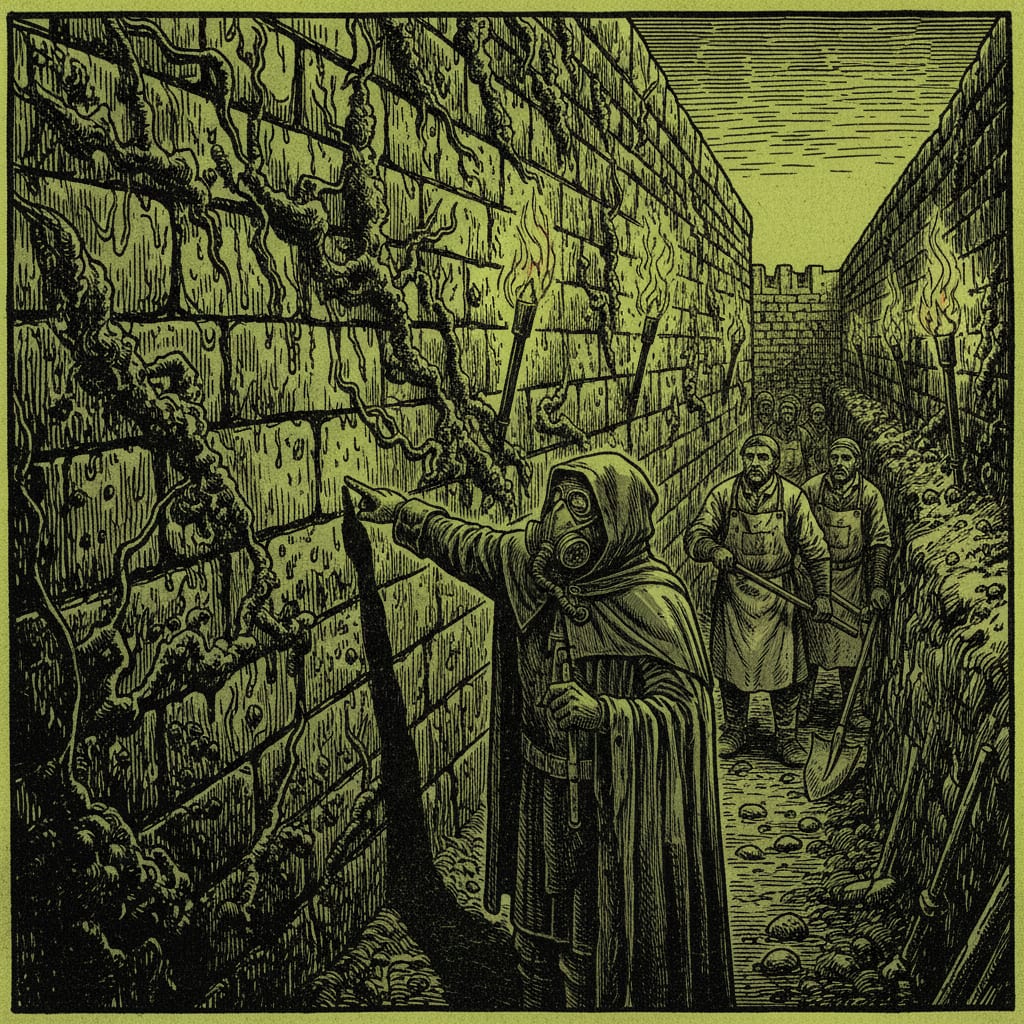
Black-lime bloom is the term for mortar that emerges from a kiln cycle visually correct — white, smooth, properly calcined — but which, when applied to a wall and permitted to set, darkens over a period of hours to a grey-black colour and exhibits properties that the operational vocabulary describes with admirable restraint. The mortar "sweats." The mortar "ticks." The mortar, in certain atmospheric conditions and at certain hours, "sings" — a faint, high tone that masons have reported and that the Bureau of Rites has attributed, variously, to wind resonance, thermal expansion, and "the natural harmonic properties of well-mixed aggregate," which is a phrase that no mason has ever repeated without swearing.
████████████████████████████████████████████████████████████████████████████████████████████████████
The causes are disputed. Contaminated water. Wrong hymn sequence. Kiln temperature fluctuations during the chant cycle. Provenance failure — fragments that were not, in fact, holy, or fragments that were holy in a direction the Bureau would prefer not to contemplate. The Melters have their own theory, which they share only with each other and only after dark: that black lime occurs when the fragment remembers what it was, and objects.
The containment protocol is blunt. Quarantine the batch. Seal the pit. Report to the nearest Purity Fume-Inspector. Wait. The Fume-Inspector will arrive, inspect, file a report that no one outside the Bureau of Purity will be permitted to read, and declare the batch either "cleared for disposal" or "reserved for further study," and in either case the batch will vanish from the kiln yard and from the operational records with a completeness that the Bureau of Records would find impressive if the Bureau of Records were informed, which it is not.
#The Cost
A previous version of this entry listed the average service life of a Saint-Bone Melter as "twelve to fifteen years."
The Bureau of Mercy's actuarial tables, updated A.S. 199, give the figure as nine years for kiln-yard Melters and four years for trenchline quick-kiln operators. The previous figure reflected a calculation error that the Bureau of Mercy attributes to "optimistic rounding" and that the Melters attribute to the Bureau of Mercy never having visited a kiln yard.
The physical toll is specific and cumulative. Lime burns on the forearms — the white scars that mark every Melter past their second year. Caustic blindness, partial or complete, from slaking accidents and chronic dust exposure. Lung scarring — the "bone cough" that begins as a rasp and ends as a rattle and for which the Bureau of Mercy prescribes rest, clean air, and a transfer to duties that do not involve breathing calcium oxide, which is to say duties that do not exist within the profession. The chalky eyelashes. The tremor from heat fatigue. The knuckles cracked white from years of alkaline exposure.
The moral toll is quieter and worse. A Melter begins each day by receiving crates of fragments — chipped bone, cracked teeth, dust from ossuaries — and converting them to construction material. Each fragment, before it was chipped or cracked or ground to dust, was prayed to. Each was carried in procession, displayed in reliquaries, kissed by pilgrims, wept over by the devout. The shrine-keepers who deliver them weep. The Melter receives the crates, logs the contents, feeds the kiln, and writes a destruction certificate: Rendered for fortification use. Four words that erase a history of veneration and replace it with a batch number.
The Melters tell themselves a story. "I'm not destroying saints. I'm multiplying them." A femur in a reliquary protects one chapel. A femur rendered to lime protects a thousand feet of wall. The arithmetic is correct. The arithmetic has always been correct. The arithmetic is the reason the profession exists, and the reason the profession drinks, and the reason the Melters wash their hands in vinegar three times a day — once before the shift, once after, and once at midnight, when the hands feel dirty for reasons that vinegar cannot address.
The trade endures because the walls endure, and the walls endure because the Melters feed them. When siege cracks spread and demon pressure rises through the bastion foundations, the Synod's first request is not for sermons, nor for troops, nor for the intercession of the Bureau of Rites. The first request is for bone-lime — fresh barrels, hot from the kiln, delivered by convoy before nightfall. And the Melters deliver, because the Melters have always delivered, and because the wall is the only sermon that the Enemy has ever been forced to hear.