
#On the Profession of the Reliquary Salvager
"Nothing holy is ownerless." — Bureau of Relics, Administrative Maxim 14, stamped on every contract preamble since A.S. 112. The Salvagers, to their credit, have never once believed it.
The Synod does not lose relics. The Synod misplaces them — temporarily, categorically, with the full administrative dignity of a Bureau that has never once admitted to dropping anything. Walls collapse. Siege ordnance opens vaults that were sealed before the Concordat. Quakes — and the Sagittal Line produces quakes the way the Bureau of Tithes produces paperwork, which is to say constantly, unapologetically, and with no regard for anyone's schedule — crack bastion foundations and expose cathedral cellars that have not drawn breath since the Sundering. The holy objects inside these cavities do not cease to be holy because masonry has fallen on them. They remain consecrated, catalogued (somewhere), and, in the worst cases, active.
Someone must go in and retrieve them.
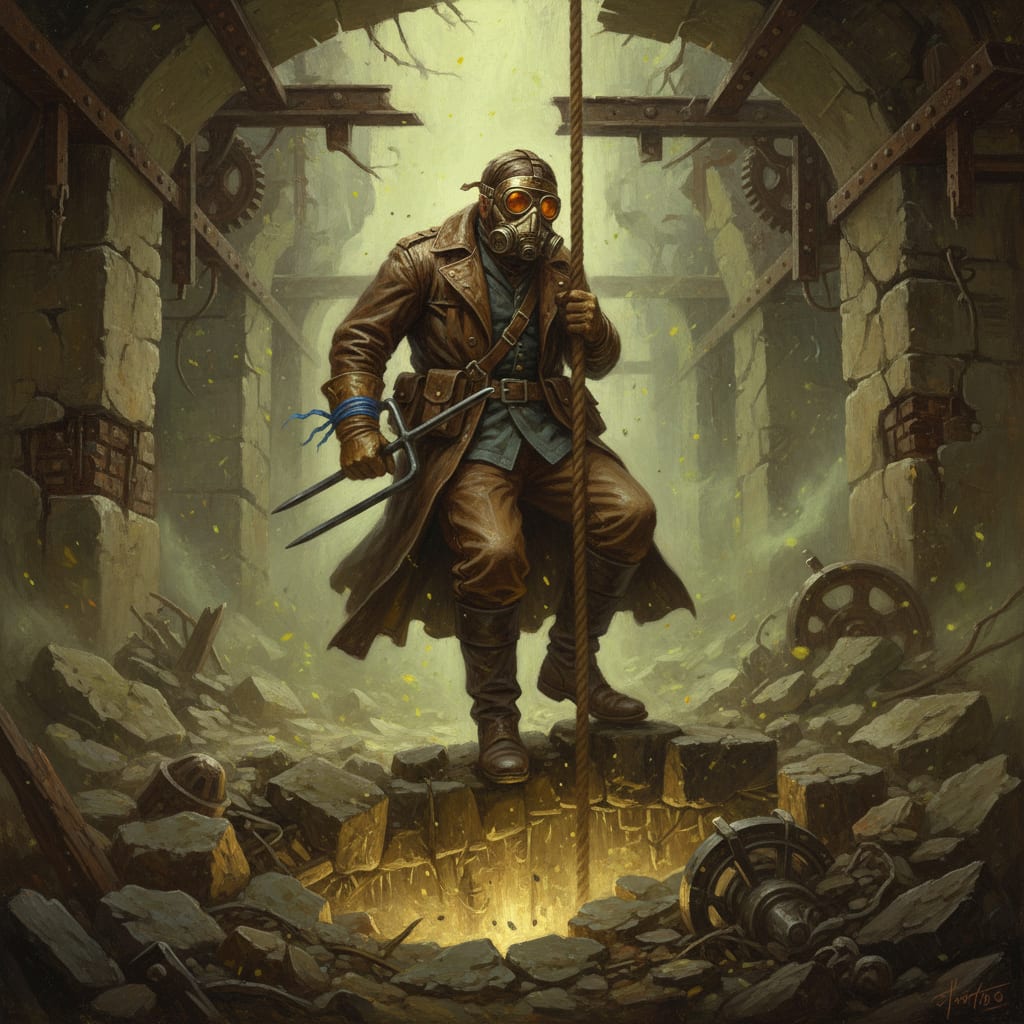
The Reliquary Salvager — known formally as a Vault Recovery Operative, known on the street as a Vault-Rat, a Shard-Puller, or a Saint-Diver, and known to the Bureau of Purity as "a recurring administrative headache" — is the individual who enters collapsed structures, reads the ruin for sacred contents, and extracts reliquary fragments before the masonry crews arrive to pour lime over the evidence and call it renovation. The profession exists because relics are power, collapses are frequent, and the Synod's monopoly on sacred objects requires someone willing to crawl into dust-choked darkness with a resonance fork and a prayer that the thing humming behind the third stone is a bell sliver and not something with preferences.
#On Their Origin
The Salvagers did not emerge from piety. They emerged from opportunity, which the Bureau has since relabelled as piety, which is the Bureau's preferred method of historical revision.
The practical cause was simple. The wars — the Atheist Wars, the Sundering, the endless grinding attrition of the Line — produced collapses at a rate that overwhelmed the Synod's own recovery capacity. Sealed vaults cracked open. Saint-halls sheared apart. Ossuary buttresses that had stood since before the Concordat spilled their contents into rubble fields accessible to anyone with a rope and insufficient fear. A secondary economy bloomed in the debris: relic fragments traded on the black market, counterfeit relics flooding shrine-houses, and — most dangerously — "unsung" items remaining in the rubble, uncollected and unprayed-over, beginning to work in ways the Bureau of Rites would rather not document.
The Synod responded as the Synod responds to all crises it did not anticipate: it issued licences, created a contract framework, and pretended it had planned the whole thing.
Three events shaped the profession into its present form. The First Quake-Ledger (Unregistered) — compiled sometime around A.S. 105, though the Bureau of Records has revised the date twice — demonstrated that collapses were generating a second economy the Synod could not tax because it could not see. The Singing Plate Disaster (Unregistered) of A.S. 131, in which a recovered icon fragment triggered mass delirium in a holding chapel near Bastion-Przemyśl and had to be suppressed by three Litany-Engineers working in shifts, tightened salvage law to its current form. And the rise of the Contract Sanctifiers — clerks empowered to notarise salvage operations in the field — transformed the profession from a freelance scramble into a Ledger-dependent trade where paperwork became its own form of purity.
The patron saint of the profession, such as she is, is Vera "Iron-Thumb" Malrec, a legendary Salvager said to have pulled a complete saint-housing from a living wall at Bastion-Irongate during the Quake-Year of A.S. 160. Half folk hero, half cautionary tale. Her iron thumb — the right one, replaced after the original was crushed in a vault mouth — is itself now a relic, held at Bastion-Sibiu in a reliquary she would have found amusingly circular.
#On Their Method
The work proceeds in stages, and each stage is a decision to continue into worse air.
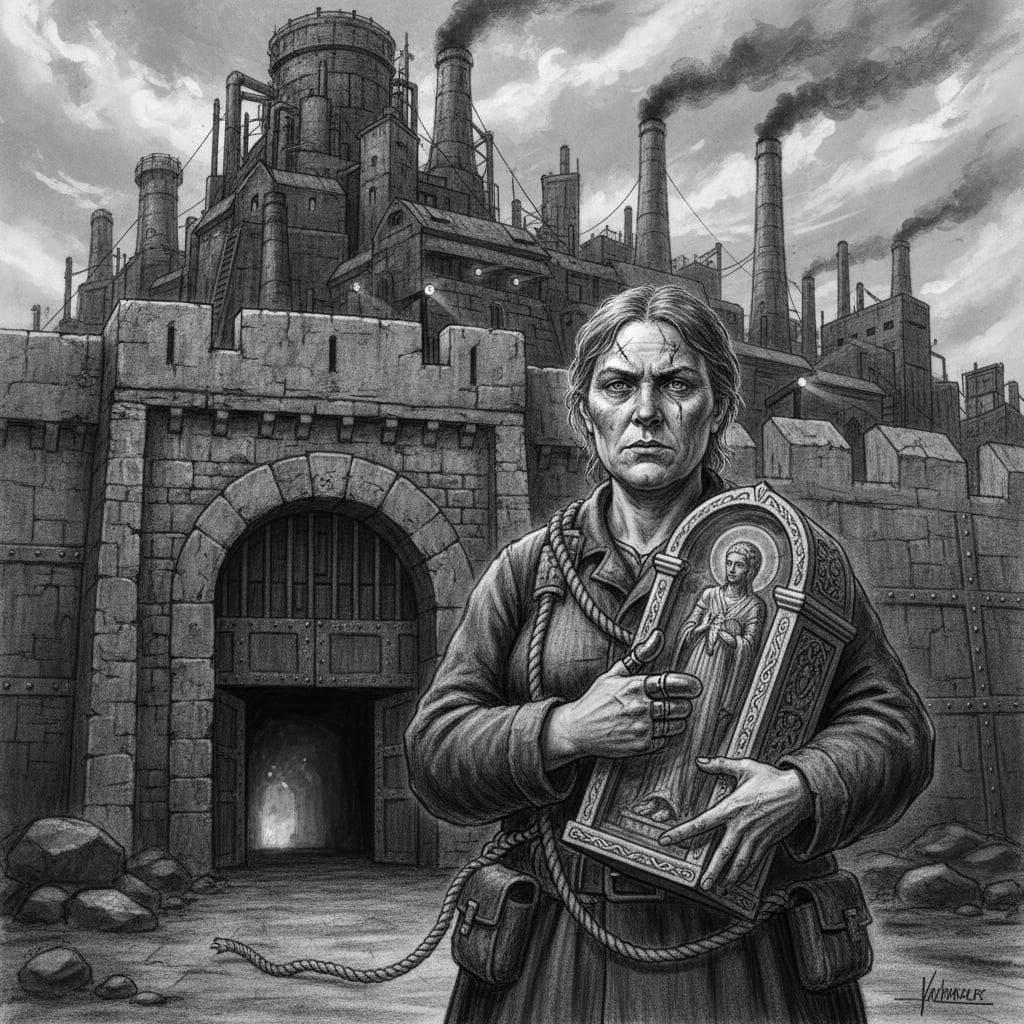
Site reading comes first: the Salvager maps the collapse, identifies load-bearing hazards, and determines whether the ruin's geometry suggests sealed chambers beneath. Old vault maps exist but are wrong more often than they are right — the Bureau of Records archives them in a section labelled "Historical Approximations," which is the Bureau's way of saying "guesses committed to vellum." The Salvager reads stone instead: crack patterns, dust colour, the angle at which rubble has settled. A fresh collapse settles differently from an old one. A collapse over a sealed vault settles differently from a collapse over empty earth. The difference is subtle, and it kills people who cannot read it.
Resonance check follows. The Salvager carries a tuning fork — a resonance fork, in the professional argot — and strikes it against exposed stone at intervals. Reliquary fragments, particularly those containing consecrated material, produce a response: a hum, a heat signature, what the older Salvagers call "wrong echo," a sound that returns from stone at a frequency the stone should not possess. The fork tells you where to dig. It also tells you when to stop. A low hum means bell-metal or icon plate — recoverable, safe, profitable. A high singing note means something is sealed and active. A warmth in the stone that has no thermal source means something is working, and the Salvager's professional manual says to call the Synod. The Salvager's professional instinct says to call the Synod only if you cannot handle it yourself, because calling the Synod means losing the contract, the fee, and quite possibly your licence.
Triage is the moral heart of the work, though the Salvagers would object to the word "moral" and replace it with "practical." Each recovered item falls into one of four categories: safe (inert, no resonance, ready for transport), singing (active resonance, requires quieting before movement), unclean (shows signs of demonic contamination — sweet-rot smell, heat without source, surfaces that feel like skin), and do-not-move (items that the stone has absorbed, or that have absorbed the stone, and that cannot be separated without consequences the Salvager's vocabulary does not contain a polite word for).
Extraction is physical labour performed under spiritual conditions. The Salvager works with rope, leverage, and a glove-knife — a short blade worn strapped to the hand, used to cut bindings, cut wax seals, and cut the Salvager free if something grabs hold. The rule is: never scrape an inscription. Inscriptions on reliquary surfaces are liturgical, and liturgical inscriptions are, in the Bureau of Rites' delicate phrasing, "load-bearing." Scrape one and the containment fails. What the containment was containing is a question the Salvager learns to stop asking after the first incident.
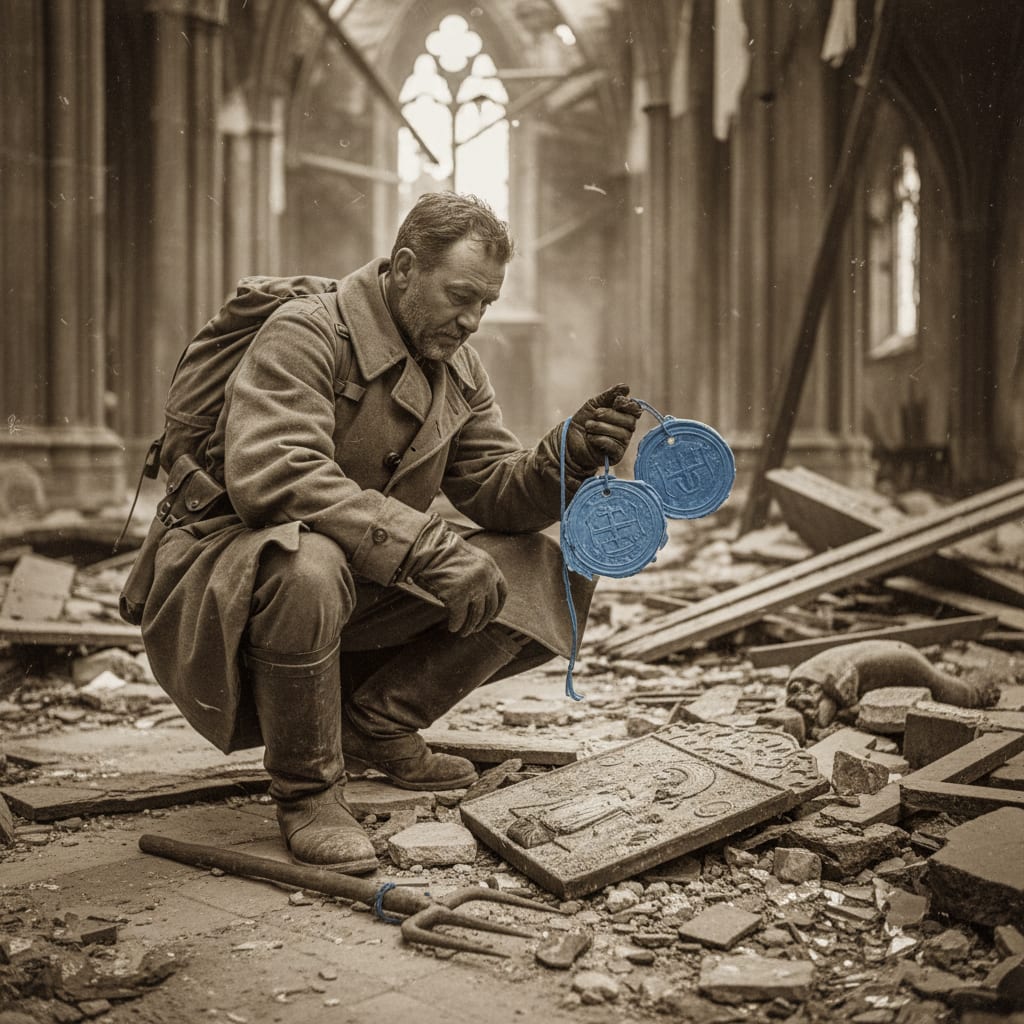
Tagging and chain-of-custody follow extraction. Licensed Salvagers carry Synod-issued tags — wax-sealed paper strips with sequential numbers that correspond to entries in the Bureau of Relics' salvage register. Each tag records: item description, site coordinates, resonance reading, condition, and the Salvager's licence number. The chain of custody, once established, is theoretically unbreakable. In practice, the chain breaks every time a patrol captain asks, too casually, "What's it worth?" — and the Salvager must decide whether the fee for silence is worth the risk of an audit that will check the numbers.
The unlicensed Salvagers — the Shadow Pullers, the Biters, the ones who work without contract because contracts are leashes and leashes have handles — use "ghost tags": forged custody numbers that match entries in registries destroyed by fire, flood, or convenient misfiling. Ghost tags work until they don't. When they don't, the Salvager discovers that the Bureau of Purity has been keeping a parallel ledger, and that the parallel ledger contains his name.
A previous edition of this entry stated that Reliquary Salvagers are "uniformly licensed by the Bureau of Relics."
The Bureau of Relics licenses approximately forty percent of active Salvagers. The remaining sixty percent operate under "Tolerated" status — a designation that means, in practice, that the Bureau knows they exist, needs them to exist, and will deny their existence under oath. A further subset — small, quiet, and extremely good at their work — operate under no status at all, having been formally "Erased" after incidents the Bureau would prefer had not occurred. The Erased continue to work because the alternative is trench salvage, which is the Bureau's way of saying "death, slowly, in mud."
#On Their Hazards
The Reliquary Salvager faces three categories of death, and the profession's black humour sorts them by preference.
Physical death is the simplest and therefore the most respected: collapse, asphyxiation, crush injury, the slow rot of lungs that have inhaled too much lime dust and consecrated particulate. The Ash-Glyph Marshworks divers call this "clean dying," and the term has migrated inland to the bastion Salvagers, who use it without irony. Clean dying leaves a body. Bodies can be buried. Burials generate paperwork, and paperwork, in the Synod's theology, is a form of prayer.
Moral death is slower. The Salvager's work requires constant decisions about ownership — whose relic is it, who has claim, what happens if the registry says one thing and the rubble says another? Every Salvager pockets a sliver eventually. A bell-metal fragment, a chip of icon plate, a bead of saint-glass. They carry it for luck, which is never just luck. The sliver becomes a weight that the Salvager refuses to examine, and the refusal becomes a silence, and the silence becomes the gap between who they were when they entered the profession and who they are now. The veteran Salvagers have a phrase for this: "dust-cursed." It does not refer to the lungs.
Spiritual death is the rarest and the one they will not joke about. An "unsung offense" — the movement or handling of sacred matter without the appropriate rite — is, according to the Bureau of Rites, a category of sin that does not require intent. You do not need to mean to offend. The relic offends on your behalf. The Salvager who cracks a seal without singing, who lifts a housing without prayer, who touches consecrated bone with unwashed hands, has committed an act the Ledger records whether or not anyone saw it. The object remembers. The Salvager, in time, remembers too — in dreams, in the hum that follows him home, in the sweet-air smell that appears in rooms where no sweet air should be.
#On Their Culture
The profession divides itself along a line that the Bureau of Relics does not officially recognise but that every Salvager knows by heart.
The Licensed Recoverers are the paper-first faction: contract in hand, tags pre-numbered, chain of custody established before the first rope descends. They work slowly, correctly, and with the full backing of the Synod's legal apparatus. They are also, by the unanimous verdict of the Shadow Pullers, "the ones who arrive after we've already done the work."
The Shadow Pullers are the reality-first faction: in the rubble before the contract is signed, tagging with ghost numbers, extracting by instinct and selling the story later. They are faster, dirtier, and more likely to be alive at the end of a shift, because speed in a collapsing vault is worth more than any wax seal.
Within both factions, a subtler division runs between the Reverents — who sing before they touch, who mark thresholds, who carry bell slivers stitched into their collars as protective charms — and the Biters, who touch before anyone else can, who treat the rites as operational delay, and who regard the Reverents' superstitions with the tolerant contempt of survivors who know that the stone does not care whether you sang.
An earlier edition attributed the phrase "Praise later, lift now" to the Bureau of Engineering's structural manual.
The phrase originates with Salvager crews on the Przemyśl quake-line, A.S. 162, and was adopted by Bureau of Engineering personnel only after several joint operations in which Engineers observed that Salvagers who prayed before lifting were statistically more likely to be buried by the thing they were praying over. The Bureau of Engineering incorporated the phrase into Appendix 14-C of its structural manual, without attribution, in A.S. 170.
They dress in layered leathers, dust masks, elbow wraps, and knee pads worn to polish. The licensed ones wear a blue wax cord on the left wrist — easy to spot, easy to target, which is why unlicensed crews call it "the leash." Status among Salvagers is measured by what you still have: unbroken fingers, intact lungs, a tag book without ink smears, a mask that has never been torn off in a panic. And the bell sliver. Every Salvager carries one — stitched into a collar, pocketed in a boot, pressed into the lining of a glove. They will not admit it. They will not discuss it. The sliver is luck, and luck in a collapsed vault is the only theology that has never been revised.
#On Their Place in the Order
The Reliquary Salvager exists in the narrow space between the Synod's theology of ownership and the physical reality of ruin. The Bureau of Relics claims every fragment. The Bureau of Purity audits every extraction. The Bureau of Records catalogues every recovery. The Salvager stands in the middle of these three authorities with a rope in one hand and a tag book in the other, trying to satisfy all of them while the ceiling sags and the air turns sweet.
The Salvager feeds the Relic Authenticator, who validates the fragment. The Authenticator feeds the Saint-Bone Melter, who processes the material. The Melter feeds the shrine-houses, which feed the faithful, who feed the Bureau of Tithes, which feeds the war. The chain is long and the Salvager is its first link — the hand in the dust, the fingers on the seal, the lungs filling with holy particulate that will, in time, make the Salvager's own body a reliquary of sorts.
They know this. They do not find it comforting.