

#On Their Place in the Long Queue
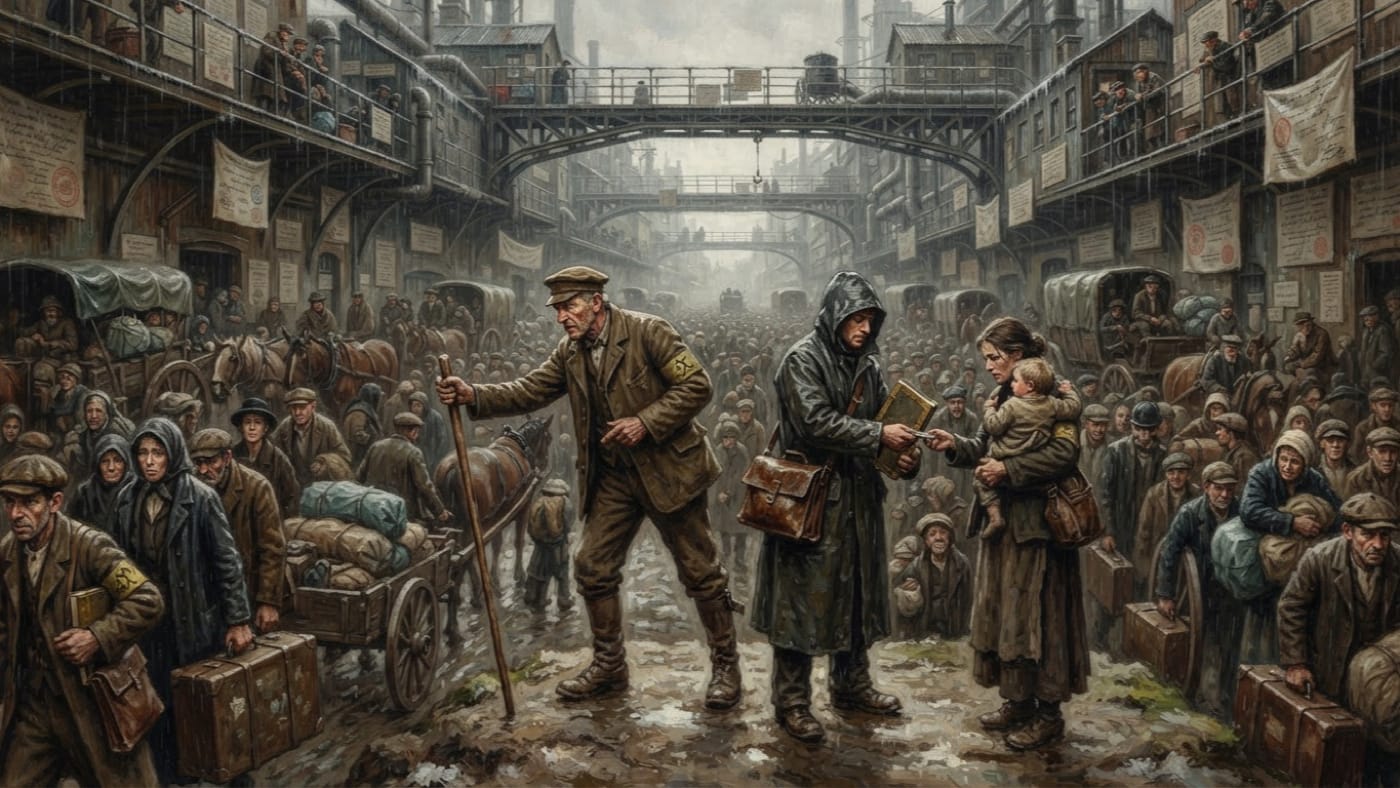
Three miles of wagons stand in the mud beneath Latchford's catwalks, and between the wagons stand the people who came with them: carters, pilgrims, conscripts, families carrying their papers in oilcloth against the rain. The Long Queue smells of wet wool, horses and sour bread. It does not move of its own accord. Somebody must tell several thousand frightened people where they are standing, and in the Latchford Permit-Yards that somebody is a Queue Shepherd.
The yard sorts its population into four layers, and the Shepherds occupy the second. They rank as Licensed Labor, beneath the clerks and officers whom Latchford calls the Stamped and Sated, above the Unwindowed who hold no valid time slot, and comfortably above the Erased-but-Used who work the culverts after dark. The licence lets its holder work the line. It carries no seal and no window, and it gives no authority over a single page in the Hall of Seals. What it provides is proximity. In a queue, proximity is a form of government.
A Shepherd's real equipment is knowledge. Shepherds know which wagon has waited longest and which family has eaten least. They know whose child coughs through the night, whose grandmother will faint by midday, which carter swings a fist when the line shifts and which one only weeps. The yard survey states the matter without decoration: a Shepherd knows every family's breaking point. The Bureau of Records keeps the ledger of names. The Shepherds keep the ledger of what those names can bear.
#On the Reshuffle and Its Price
At dawn the bell windows are posted and the queue is reshuffled. Families whose windows have opened must be brought forward to the doors. Families whose windows have lapsed must drop back without tearing the line apart. Wagons that War has prioritised must pass through civilians who have stood in the same rut for a week. Done badly, the reshuffle is a crush. Done well, it looks like nothing at all, and the Shepherds take the credit for that nothing.
The work protects people. A Shepherd keeps bodies off the catwalk ladders, which Latchford custom forbids anyone to block, and keeps the crowd loose enough to breathe. Shepherds stand where a surge would start and put themselves in the way of it. They keep the line countable, and the yard's officers value a countable line more than a fed one. A queue that its keepers understand panics less often than one they do not.
The same work extorts them. Shepherds who decide the order of a reshuffle also decide what a better position costs. The Hall of Seals entry records that they deliver the crowd to the doors and collect their tolls along the way. Latchford pays in what it has: ration chits, wax, warm food, a ring, a promise, the name of a clerk who might be bribed later. No published rate exists. The price is whatever a family can be made to feel it owes.
Rumour serves the same purpose. A word passed down the line that a window will close early sends one section pressing forward and leaves the next section's place unguarded. A word that a convoy release is coming clears a lane before any red sash appears. When a Shepherd says "the clerk at bay nine is in a mood today," it may be the truth, or it may be a means of moving forty people a yard to the left. The crowd cannot tell the difference, and the Shepherd profits either way.
Then there is shade. Latchford's rain comes down in sheets at shift-change, and the only dry ground in the Long Queue lies under the catwalks, among the posts holding up the offices that will decide your fate. Shepherds rent it out. A family that has stood three nights in the wet will pay for one night beneath the boards, and the Shepherd who sells that night already knows, to the crust, what the family has left.
#On the Compact and the Yard Command
The Shepherds are organised as the Queue Shepherds' Compact, which is a union or guild according to the mood of whoever is describing it. Its territory is the Long Queue. Its stated purpose is crowd safety. Its actual interests, as the yard survey sets them out, are control of the reshuffles and collection of the bribe tolls. It works through intimidation and rumour control, and the spark of a stamp riot brings it into the open.
The Queue Shepherds' Compact exists to secure the safety of persons waiting in the Long Queue.
Corrected. The Compact secures the safety of persons waiting in the Long Queue to the extent that their safety protects the reshuffle and the tolls. Where the two diverge, the toll is collected first and the safety is reported afterward.
The Compact's reach stops where paper begins. Formal authority over the yard belongs to the Joint Yard Command of Records and the Bureau of War. Prefect Mavren Tull controls the blank permit stock. Quarter-Commander Hesta Brune controls convoy priority. The Yard Tribunal judges, and the Wardens arrest. A Shepherd can bring a family to the counter with a minute to spare, or let them arrive a minute too late, but cannot issue the window, countersign the permit or open the ford. The Compact governs bodies. The Command governs paper. At Latchford the paper always has the final word.
The Compact should also not be confused with the Checkpoint Queue-Marshals. The Marshals are commissioned servants of the Synod's lane system, with their own record and their own grievances. The Shepherds are licensed workers of one yard. They manage the same crowds without the commission.
Only one Shepherd officer is named in the survey: Queue-Captain Dorryn Pike, who keeps the peace by choosing who bleeds first. I do not know how Pike obtained the captaincy or what place it holds in the Compact. The record gives one sentence, and it is enough. When a riot is coming, someone has to decide which part of the crowd absorbs it. Pike decides.
#On Their Dealings Beneath the Boards
The Minute Market lies under the same catwalks where the Shepherds rent their shade, and the two trades share a ceiling, a customer base and, at times, personnel.
My dossier on Old Sable lists Queue Shepherds among his runners, alongside culvert children with clean nails and women who smell of paper ash. They are Shepherds who can turn a crowd with one cough. The use to a broker is plain enough. A runner who can make a section of the Long Queue look left can carry a slip to a wagon on the right. A runner who knows every family's breaking point knows when a buyer is ready. The record establishes that some Shepherds run for Sable. It does not say how many, on what terms, or whether the Compact approves, profits, or simply looks away. I will not invent a chain of command for a broker nobody has seen in daylight.
The Compact's public stance is condemnation. In my earlier phrasing, it denounces Sable by noon and buys from him by Sext. I meant that as a description of character, and nobody should treat it as a timetable. The Market entry makes the same point more plainly: Shepherds denounce the Market in daylight and buy lane rumours after curfew. A guild that lives by rumour control must buy its rumours somewhere.
The goods should be kept apart. Sable sells forged minute-slips, stolen windows and route intelligence. The Shepherds sell position and shelter. A family may buy a dry night from one and a false minute from the other, and the two purchases may be carried by the same hands. They are still separate goods, and a careful clerk should file them separately.
A Shepherd was among those who quoted to me the street saying that Sable sells kindness as a premium extra. I note that the quotation came from a trade that rents out shade.
The blank master-permits that vanished from the Hall of Seals in late A.S. 199 have made the Market's merchandise more dangerous, and every route a slip travels has become more valuable with it. No record connects the Shepherds to that disappearance. Shepherds have every reason to know where the new slips are going, and that is all I am prepared to enter.
#On the Peace They Keep
The Long Queue in A.S. 201 is a place where windows expire while people wait for them, where rations thin to leather, and where papers are collected at curfew and the missing are discovered. The Master Gate Clock decides who moves. The Shepherds decide how the people who do not move are arranged around those who do.
That arrangement keeps people alive. A family steered away from the crush survives the morning. An old woman brought under the boards before the rain survives the night. The yard depends on this, and the Command knows it. A Latchford without Shepherds would hold three miles of hunger and no one who knew where it would break.
The arrangement also has a price. The family that was steered paid for it, and the woman under the boards paid rent. When a stamp riot sparks, the Compact arrives with the same knowledge it charges for in quieter hours and uses it to choose, as Pike chooses, which corner of the crowd will be hurt so that the rest stays countable. Families in the Long Queue know this. They go on paying, because the person who knows their breaking point is also the only person who stands between them and it.