

#On the Compact's Station
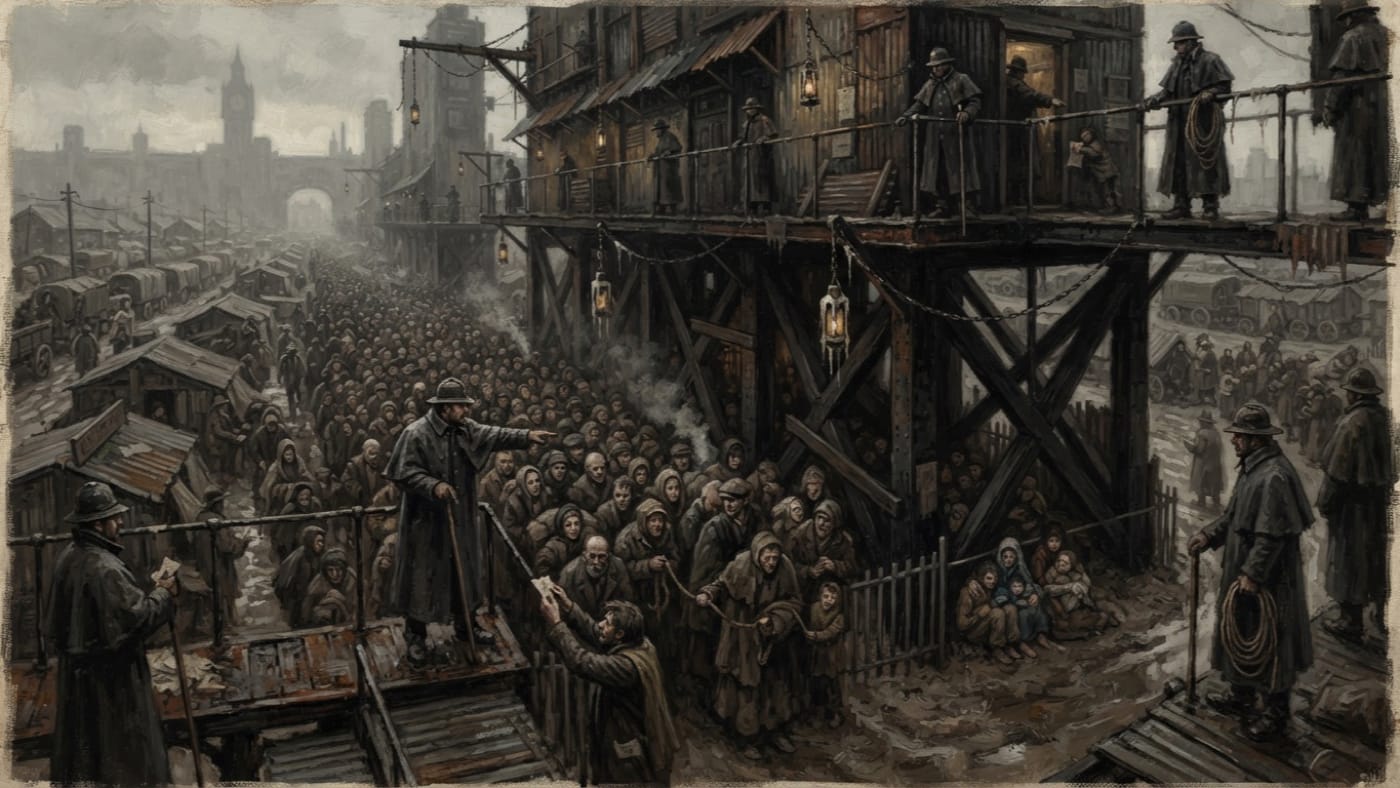
Three miles of wagons wait in the mud beside the ford at Latchford, and the people who came with the wagons wait between them. The Long Queue smells of wet wool, horses and sour bread. Above it the catwalk offices of the Latchford Permit-Yards hang in tiers on rusted scaffolds, strung with lantern chains, dripping tallow onto whoever stands below. A crowd that size will not hold its shape out of piety. It needs handlers, and the yard draws them from its second class.
Queue Shepherds rank as Licensed Labor. Above them stand the Stamped and Sated, the clerks and officers who live by the seal. Below them are the Unwindowed, who hold no valid time slot, and the Erased-but-Used, who clean the culverts after curfew and go uncounted while they do it. A Shepherd carries no seal and issues no window. A Shepherd holds a patch of ground and the standing to tell other people where theirs is.
Everything that follows depends on that distinction. A place in the Long Queue and permission to cross the ford are separate possessions. Permission is paper, and it comes down from the catwalks through the Hall of Seals. A place is mud, and the mud belongs to whoever can keep several thousand frightened people standing on it in order.
The Shepherds who hold the mud are organised as the Queue Shepherds' Compact, a union or a guild depending on the mood of the clerk who files it. Its public declaration is crowd safety. It keeps the crowd safe.
It keeps the crowd safe.
Corrected. The yard survey enters crowd safety as the Compact's public face, and control of the reshuffles and the bribe tolls as its true interest. The crowd is safe on days when safety and the tolls agree. The survey records nothing about the other days. The Long Queue keeps that record itself, and it does not keep it on paper.
#On the Reshuffle and Its Price
At Latchford the dawn belongs to the Master Gate Clock. The bell windows are posted and the queue is reshuffled to match them. Families whose windows have opened must come forward. Families whose windows have lapsed must drop back without tearing the line. Wagons with War priority must get through civilians who have stood in the same rut for a week. A bad reshuffle is a crush. A good one looks like nothing at all, and the Compact charges for the nothing.
The charging is the trade. Whoever arranges the reshuffle decides who is near the doors when a bay opens, and who stands forty wagons back where windows expire while their holders are still walking. The survey calls the proceeds bribe tolls. It gives no rate, no schedule and no receipt, and I will invent none. Latchford pays in what it has: ration chits, wax, warm food, bone tokens, a minute-slip, a name. A toll with no published rate is set by the fear of whoever pays it.
Rumour does the rest and costs nothing in materials. Rumour control is the Compact's other recorded method, and a queue three miles long runs on rumour as surely as the Hall runs on wax. Say that bay nine closes early and one section surges forward, leaving its old ground unguarded. Say that a convoy is coming and a lane clears before the first red sash appears. The crowd cannot check either report. It can only follow the voice that gave it.
The Queue Litany belongs to the yard as a whole, and I credit nobody in particular with writing it. I have heard Shepherds lead it all the same. Are you counted? — We are counted. A crowd that answers in unison has been counted, and it has also been taught where to look.
Then there is shade. The survey sketches the working Shepherd in two clauses: one who knows every family's breaking point, and who rents shade under the catwalk. Both clauses describe the same business. Latchford's rain comes down in sheets at shift-change, and the only dry ground in the Long Queue lies under the boards, among the posts that hold up the offices deciding your future. A family three nights in the wet will pay for one night underneath. The Shepherd who sells that night has learned what the family has left by the same patient watching that keeps the crush away.
That knowledge is the Compact's capital. Picture any section of the line. Its Shepherd knows which grandmother will faint by midday, which carter swings a fist when the line shifts and which one only weeps, whose child coughs all night. Knowing these things keeps a crowd alive. It also tells the knower what each family will pay before it breaks. Every family that buys the first service hands over the second piece of knowledge free.
#On the Yard's Authorities
The Compact governs bodies and has no authority over paper. Formal rule at Latchford belongs to the Joint Yard Command of the Bureau of Records and the Bureau of War. Prefect Mavren Tull holds the blank permit stock. Quarter-Commander Hesta Brune holds convoy priority. Wardens arrest, and the local Yard Tribunal judges. Nothing in the record lets a Shepherd issue a window, countersign a permit, command a Warden or overturn a convoy order. A Shepherd can bring a family to the counter with a minute to spare, or let them arrive a minute late. Either way the stamp comes down from above.
Nor are the Shepherds the Checkpoint Queue-Marshals of the Sagittal Line, who have their own commission, their own equipment and their own grievances. The Shepherds work one yard and carry its licence.
The survey names a single Shepherd officer, Queue-Captain Dorryn Pike, in a single line: Pike keeps the peace by choosing who bleeds first. I do not know how Pike came to the captaincy, whether other captains serve alongside, or who in the Compact ranks higher. One line is enough. The survey names the spark of a stamp riot as the event that brings the Compact into the open. Once that spark catches, someone has to decide which part of the crowd takes the force so the rest stays countable. The survey does not say whether the Compact puts riots down, steers them or profits from them. Pike's line describes a procedure that can manage all three before the next bell.
Latchford remembers what a riot costs. The First Stamp Riot trampled hundreds when windows were cut without notice, and no year for it survives in the record I hold. A Command that remembers that figure has good reason to value whoever stands between the crowd and the doors, and to leave that person's prices unaudited.
#On Its Dealings with Old Sable
My dossier on Old Sable records that the Compact denounces him by noon and buys from him by Sext. I stand by the sentence. It describes character, and it should not be filed as a timetable.
The entry on the Minute Market has Shepherds denouncing the Market in daylight and buying lane rumours after curfew. That is the likeliest reading of what the Compact buys. A guild whose recorded method is rumour control has to restock somewhere, and the only well-supplied shop sits under the same boards where the Shepherds rent their shade.
The dossier also counts Queue Shepherds among Sable's runners: Shepherds who can turn a crowd with one cough. A broker has obvious use for them. A runner who can make one stretch of the Long Queue look left can carry a slip to a wagon on the right. The record shows that some Shepherds run for Sable. It does not say how many, on what terms, or whether the Compact's officers direct them, tax them or look away. Nobody has ever seen that broker in daylight, and I will not draw a chain of command beneath him.
The goods need to be kept apart. Sable sells forged minute-slips, stolen windows and route intelligence. The Compact sells position and shelter. A family might buy a dry night from one and a false minute from the other, and the same hands might carry both. The first purchase is a toll. The second is an offence against the Clock. The Tribunal can tell them apart. The family usually cannot.
The Waxwrights, who keep their monopoly on wax and moulds by choking the supply, are a pressure on the Compact. They are not its partner. The Night Sweepers are another. Shepherds repeat in the queue that the Sweepers take only criminals, and a crowd that believes it stays in line after dark. I record that the rumour is useful and decline to record anything more.
In late A.S. 199 a batch of blank master-permits vanished from the Hall of Seals. Street arithmetic blames Sable, and responsibility remains unproved. Nothing on file connects the Compact to the loss. Shepherds have every reason to know where the newer slips travel, since they stand along every route those slips take, and that is all I will enter. Shadows has shown its usual patience toward the whole underside of the yard. It has sent me no remarks on the Shepherds, and I take that silence as neither praise nor permission.
#On the Peace Preserved
This assessment is compiled from records already on file and describes the present state of A.S. 201. In the Long Queue, windows expire while people wait for them, rations thin to leather, papers are collected at curfew and the missing are found to be missing. The Clock decides who moves. The Compact decides how everyone who cannot move is arranged around those who can.
That arrangement keeps people alive. A family steered clear of the crush lives through the morning. An old woman brought under the boards before the rain lives through the night. The yard depends on this. Without the Shepherds, Latchford would be three miles of hunger with nobody who knew where it would break.
The family that was steered paid for it. The woman under the boards paid rent. When a riot sparks, the Compact arrives with the same knowledge it charges for on quiet days, and spends it as Pike spends it, choosing a corner. The families go on paying, because the person who knows their breaking point is also the only person standing between them and it.