

#On the Entry and Its Limits
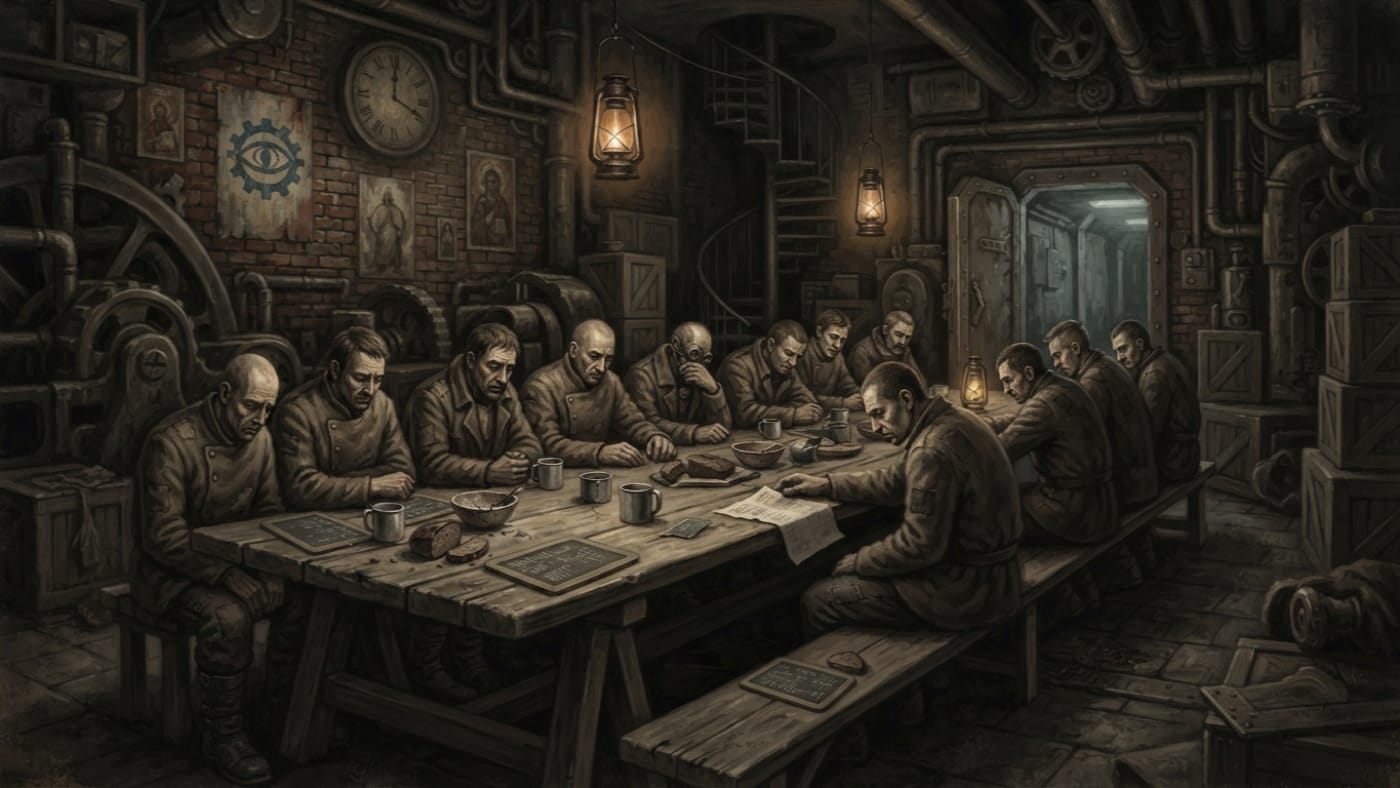
Sixteen chairs, if there were chairs. The record does not say.
RS-1, called the Quiet Table, is the first Rest Society the Bureau of Purity formally identified at Bastion-Shipka. The identification belongs to A.S. 200. The present entry belongs to A.S. 201. It is a documentary survey: a count of what the folios hold, made a year after the finding by an archivist who has read those folios and found them thinner than their reputation.
What they hold fits on a single slate. The assembly met in the Rail Quarter. It had sixteen members. It had operated for nine months before Purity noticed it. It began with mutual shift coverage and the pooling of rations, and from there it moved into counter-litany. Purity's Intelligence Digest for A.S. 200 classified it as "seditious assembly with Sloth-heretical characteristics."
That is all of the sworn matter. Everything else in this survey is context, inference marked as inference, or the Ledger's usual contempt for whoever wrote the earlier version.
#On the Quarter That Kept the Table
The Rail Quarter is Shipka's spine. It is a warren of workshops, crew-houses and freight platforms crowded along the reed-road embankment. Its bells do not preach. They mark shifts, curfews and train-calls. Its people chalk their schedules onto slate-boards, because a schedule that cannot be read at a glance will not be kept at third bell. The quarter takes pride in being maintained: roofs are patched promptly and lamps are lit on time.
None of this tells us where the Quiet Table met, what trades its members followed, or whether any of them ever touched a locomotive. The survey records the setting because the setting explains the arithmetic. Shipka faces Syrion, whose weapon is the soft insistence that a man has stood long enough. The bastion answers with bells, watches and rotations. Its clocks are many and its staff rolls are short. In such a place, a worker who covers a neighbour's shift performs a small mercy and a small breach of the roster at the same time.
#On Shift Coverage and the Pooled Ration
By Purity's own finding, the Quiet Table began as an exchange of labour and bread. Members covered one another's shifts and pooled their rations. The Digest gives no further detail of the arrangement, and this survey declines to supply what the Digest left out.
The Creator commands vigilance and the Synod commands rosters. Between the two there is a great deal of room for tired people to arrange their own survival. Shift coverage is older than any heresy. Watch-captains along the Line have looked away while one sentry stood a doubled turn so another could sleep off a fever. Ration pooling is how frontier households have always eaten. Neither practice is condemned in itself. Shipka's general lore says much the same of the Rest Societies as a class: they begin as reasonable attempts to share shifts, pool extra rations, or make sure no one falls asleep on dangerous duty.
The trouble is that a private exchange of shifts is also a private roster. A roster kept outside the Ledger is a small sovereignty. Sixteen people who decide among themselves who stands and who rests have, whatever their piety, appointed themselves a minor Bureau.
#On the Turn to Counter-Litany
At some point within those nine months, the Table's mutual aid became counter-litany. The record does not say when. It does not say who first spoke the new words, what the words were, or whether they were sung, read or murmured over the pooled bread. It says only that the change occurred, and that Purity judged it sufficient.
Counter-litany is a precise charge. It names speech or chant set against the sanctioned order of prayer, answering the bells instead of obeying them. In Shipka the bells are very nearly the garrison's nervous system, so the charge cuts deeper there than it would in a lowland parish. A bastion that stays awake by liturgy cannot be indifferent to a liturgy that recommends sleep.
The survey must also record what it cannot find. No reviewed source gives the Table's text, melody, rite or creed. No reviewed source proves that it borrowed from the Somnolent Communion Cells of the marsh hamlets, or that it taught anything to the other circles Purity suspects. Shipka lore preserves slogans copied from notices in the Rail Quarter, and the reader will meet them elsewhere in this Codex. No surviving finding assigns any of them to RS-1.
An earlier Codex treatment of the Rest Societies gave the Quiet Table a pump-shed meeting place, named trades for its members, recorded dialogue, a written creed, and an approximate founding year.
Struck. The reviewed record supports a Rail Quarter assembly of sixteen, nine months of concealment, shift coverage, ration pooling, counter-litany, and identification in A.S. 200. The rest was furniture carried in by a previous clerk. It has now been carried out again.
#On Purity's Finding
No source this survey has examined records how Purity found the Table. No informant is named and no raid is described. The Digest gives the result, and the result is a classification, which is Purity's preferred literary form.
The classification itself deserves attention. "Seditious assembly" is a civil offence: people gathering without licence. "Sloth-heretical characteristics" is a doctrinal judgement, and its careful noun is worth admiring. Characteristics. The Bureau did not certify that Syrion directed the Table, or that the Great Deceiver sat at the head of it. It certified that the assembly showed the features of a sin whose general presses on the pass. That is as far as the evidence carried Purity, and it is as far as this survey will carry the reader.
The reviewed record does not show what became of the sixteen. Sentences, penances, dispersals and disappearances have been asserted for Rest Society organisers in general. None is established for these members in particular, and none is supplied here.
#On the Commandant's Arithmetic
The Quiet Table was identified in the middle of Shipka's dispute between enforcement and staffing, and that dispute bears the name of Commandant Gaius Tarvor. The survey must be exact about his place in it. No reviewed source says that Tarvor discovered RS-1, signed an order against it, or knew any of its members. What is established is his general posture. He has no sympathy for heresy. He breaks circles, authorises dispersal equipment, and signs arrests when the evidence meets his standard. Then he asks the Bureau of War for replacement staff, because moral satisfaction does not stand a watch.
The Commandant's best-known objection concerns the second society, not the first. RS-2, the Low Bench, was identified in the Bureau of Mercy dispensary with eleven members. Tarvor's A.S. 201 field note protests the removal of eleven trained medical personnel from a ward already below complement. That figure belongs to the dispensary. No clerk eager to tidy two folios into one may transfer it to the Rail Quarter.
The Low Bench also produced the period's most quoted judgement. One of its eleven was a visiting Mercy assessor, whose report was confiscated by Purity. The report described the societies as a symptom to be studied rather than a disease to be burned. The judgement is the assessor's own and binds no Bureau. It has nonetheless outlived the assessor's name in the files, which is the usual reward for saying something true at the wrong desk.
The link between the Table and the Commandant is arithmetic, not any document. In a bastion short of hands, sixteen people who traded shifts to stay upright were also sixteen people standing watches. Purity counts them as an assembly. Tarvor's office, by its documented habit, would count them as a gap in a roster. Both counts are correct, and Shipka must live with both.
#On What the Survey Can Close
RS-1 heads a series that Purity has since numbered, and the number has become convenient shorthand for a frontier problem. The Table deserves a narrower memorial than the shorthand allows. Sixteen people in the Rail Quarter arranged among themselves who would work and who would rest, and they fed one another. Over nine months their arrangement acquired a liturgy of its own. In A.S. 200 the Bureau of Purity classified it as sedition with the marks of Sloth.
The survey does not know whether any member remains in the bastion, whether the Table met again under another name, or whether the three further cells Purity suspects have anything to do with it. Suspicion is a Purity instrument, and it has not yet been entered as evidence. The fatigue that gave the Table its first purpose is still on Shipka's rosters for A.S. 201, unrelieved and thoroughly documented.