

#On the Union's Office
"The beads do not lie. The reconciler declines to show his working." — saying of the northern arcade, of no recorded author
The Reconciliers' Union keeps the counts honest. That is its public office. It is true in the sense that every count the Union files becomes, upon filing, the honest one.
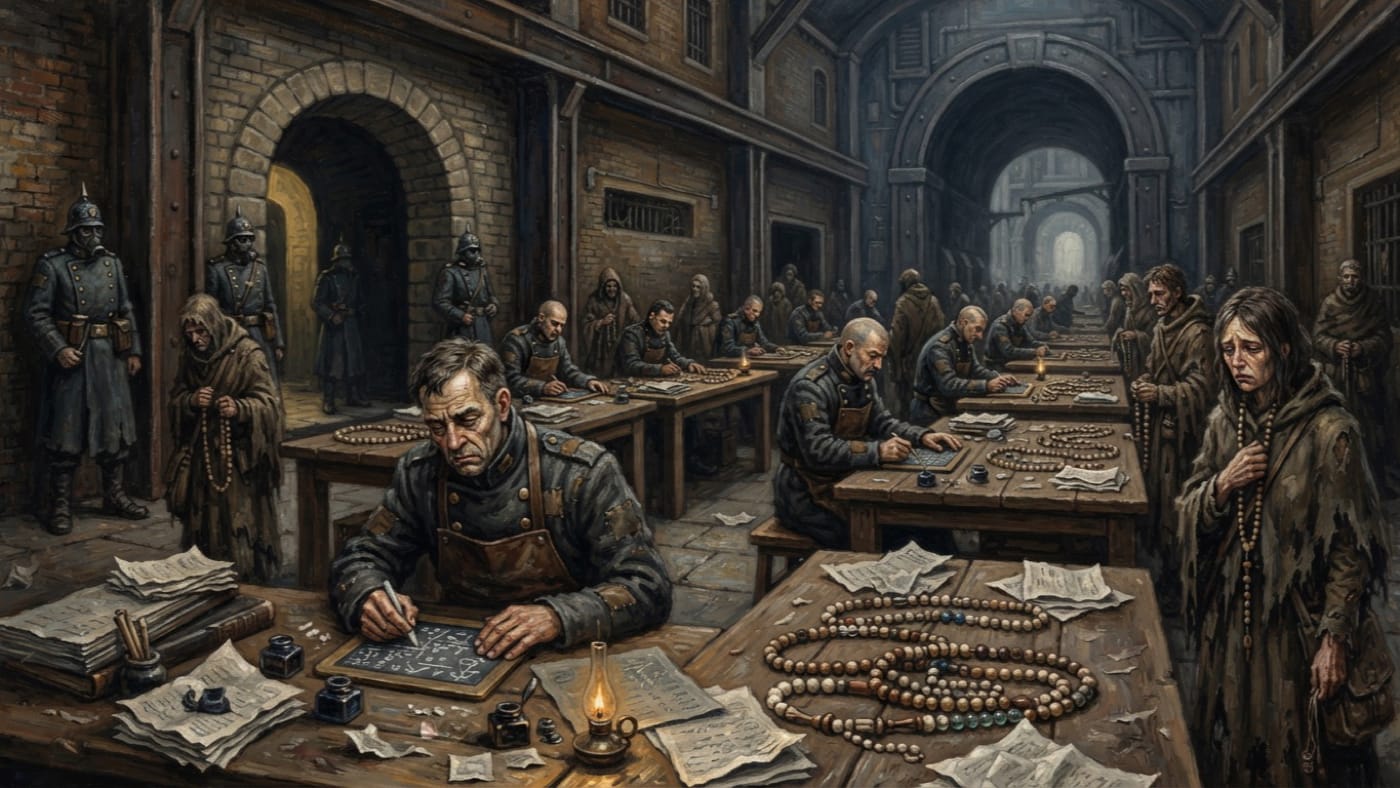
The Union is the ledger faction of the Bead Courts, which occupy the northern arcade of Peregrine Row. There are twelve reconciliation tables, a smell of chalk dust and onion stew, and a queue of pilgrims holding their sins on string. The pilgrims call the tables the Bead Courts, and the clerks seated at them answer to the Union. This distinction matters to no one standing in the queue and to everyone sitting down.
I record the number twelve because readers of a certain temperament will want to make a council of it: twelve seats, twelve stewards and a chair at the head. The tables are furniture. The archive does not say how many clerks sit at them, how they came to sit there, or who could order them to stand. I do not make a habit of supplying the archive with what it has declined to hold.
What the Union holds is narrower than a council and worse. It decides who counts, how the counting is done, and what the count means. A pilgrim arrives at the table as a traveller with papers. The pilgrim leaves either reconciled, and free to continue along the Pilgrim Roads, or unreconciled, which makes them a different kind of person in law, in debt, and in the eyes of the Wardens waiting at the head of the Vowel-Stair. The gate belongs to the proctors, the escort to the brokers, the keys to the Wardens. The Union supplies the word on which all three act.
#On the String and the Slate
Every pilgrim carries a string. Bone marks the minor sins, wood the moderate and glass the grievous, so that a soul's condition can be judged at arm's length by weight, and by the noise the string makes when it is set down. A string heavy with glass rings on the table like a dropped chalice. A string of bone merely clicks.
The string is the pilgrim's claim, and the clerk sets the evidence beside it. That evidence is the confession receipts, the passage stamps, and whatever tithe credits the Bureau of Records has seen fit to assign. Reconciliation consists in making these documents agree: the sins confessed, the sins carried, and the sins charged against passage credit. The tables know what a glass bead costs in passage. I have never seen the figure written down, and the Row's published account of the courts records no tariff. The clerks keep it in their heads, which is the most secure archive the Church has yet devised. It cannot be stolen, subpoenaed or read.
The calculation is worked in chalk on slate, and the slate is wiped when the session ends. Only one word is filed, reconciled or unreconciled, and the word survives where the arithmetic does not. A pilgrim may dispute the result. What they would dispute it against is a matter the slate has already settled with a damp cloth.
The Row's account gives a single example of the scale, and I reproduce it with the limits it carries. On a string of sixty, one bead astray is a miscount. Two is suspicion. Three is heresy. This is how Peregrine Row describes its own tables. It is no statute for every road or for every length of string. The tables decide what counts as error on a string of forty, or of two hundred, at the time of counting, and that time is wiped along with the slate.
#On Errors and Delay
The Row's own records list the Union's methods in three words: arithmetic, "errors," delay. They read like a hymn-board, and they deserve more attention than a hymn-board gets.
Anyone taught long division by a priest needs no explanation of arithmetic as punishment. A count can be done strictly or generously. In poor light a bead can be read as wood. A receipt can be found to cover the sin but not the processing of the sin. Each step is correct, and the total is ruinous.
The "errors" have earned their quotation marks. The Row's records note that the tables' errors are used to detain rivals. The Union's mistakes, in other words, have a gift for falling on the right people. The record does not say whose rivals. Anyone may have rivals. The clerks have chalk.
Delay is the purest of the three because it requires nothing at all. Peregrine Row runs to a schedule: escort contracts with their safe-windows, water rations, and the wax stamp on the left forearm, which must reach the eastern gate unsmudged or the pilgrim starts again at their own expense. A pilgrim kept at the tables for an afternoon may miss the window the broker sold them. A pilgrim kept for two days may find the escort gone, the contract lapsed and the wax beginning to blur. A lapsed contract is itself a cause for detention. The clerk has done nothing, and at Peregrine Row nothing is very expensive.
The Echo Creed supplies the tables with disputed paper. The gate proctors hear each recitation twice, once from the pilgrim and once, a vowel off, from the canyon. Contracts left overnight in the Hall have been found with their letters changed. The proctors judge the syllables. The Union receives what the gate has already written down, and it neither claims to know whether a fault came from the tongue, the stone or the ink, nor needs to. A receipt arrives at the table already doubtful, and a doubtful receipt has never reconciled faster than a sound one.
#On Unreconciled Persons
An unreconciled pilgrim is remanded to the Quiet Pens. The Union does not take them there. The Quiet Pen Wardens hold the detainees, act under the Road Chapter's authority, and are paid from the Broker Compact's budget. The Union's part in the matter ends at the word, and the word is enough.
There are two ways out: payment, or a supplementary confession. A supplementary confession produces a supplementary receipt. That receipt must be reconciled at the tables, and reconciliation carries a processing charge. If the original discrepancy was graded as heresy, the heresy carries its own processing fee. The fee produces a new bead, the bead goes on the string, and the string goes back on the table. Elsewhere I have called this a prayer wheel that grinds grain instead of sin. The tables call it the queue.
A pilgrim who cannot pay has a service assignment instead. The Row turns unpaid liabilities into labour for the Bead Courts, the Escort Yards or, after long detention, distant bastions that are less particular about whether the labour is voluntary. Some of the hands that sweep chalk dust in the northern arcade belong to pilgrims whose count was taken at the same tables. The record leaves the arranging of assignments with the Road Chapter and the Wardens. The Union classifies the debtor at one end of the arcade and receives the debtor's labour at the other. I see no conflict in this. I was not asked to look for one.
Above it all sit the quarterly targets. The Road Chapter sets a number of detentions, a volume of labour and a sum of fees, and Cantor-Auditor Selm Peregrin's office answers for creed legitimacy and quotas. The proctors can tighten their vowels and the tables can tighten their sums. Both reach the same Pens.
This compulsion has a pedigree. In A.S. 101 a convoy of six hundred pilgrims was ambushed in the eastern canyon. Two hundred and fourteen died, and the survivors were fined for doctrinal negligence. The Road Chapter answered with controls on every side. Reconciliation was made compulsory by A.S. 104, and by A.S. 110 it ran as a formal daily audit. Neither date marks the founding of the Union. The founding is not recorded.
Previous editions of the entry on the Choir-Broker Hall of Peregrine Row stated that bead-count reconciliation was "voluntary."
CORRECTED by order of the Cantor-Auditor's office, Peregrine Row, A.S. 200: reconciliation has been mandatory since A.S. 104, and voluntary participation was never offered, discussed, or theologically plausible. Reproduced here because the tables are where the correction is enforced. Filed.
#On the Present Application
Peregrine Row has stood at Amber since A.S. 199. That year a leaked ledger alleged that the Row's brokers had contracted and paid for "demonstration ambushes" in the eastern canyons. The Road Chapter's own investigation found "no evidence of systematic coordination," and the clerk who leaked the ledger was fined and remanded. The leak does not name the Union, and neither does the denial. I name it in neither. In A.S. 201 the Row remains under review and the tables keep counting, as tables under review do.
The Union's pressure points are listed in the Row's own records, and I enter them as listed: missing ledgers and impossible totals. A total is impossible when the string, the receipts and the stamps cannot be made to agree by any arithmetic, generous or punitive. The table files unreconciled. That settles the pilgrim and leaves the impossibility where it was. Which ledgers are missing, and since when, is exactly what a missing ledger would have told us.
There is a rumour on the Row of pilgrims counted at the tables who never came through the western gate. I record it as a rumour. The slate, when consulted, is clean.