
#On the Count
"Count slow. The slate is patient. The Pens are not." — saying of the northern arcade, attributed to no clerk willing to be named
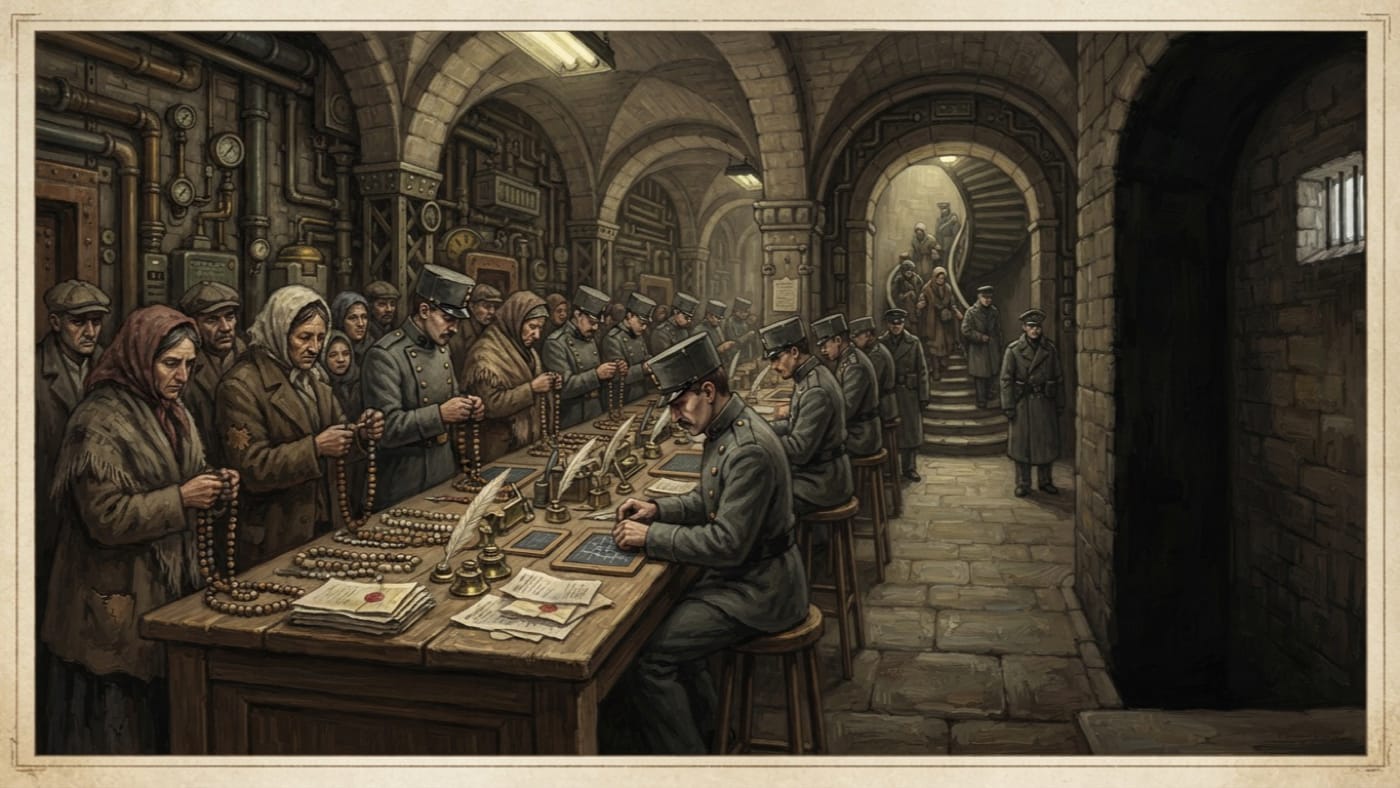
North of the Choir-Broker Hall, under an arcade of dusty limestone that smells of chalk and onion stew, twelve reconciliation tables stand in a row. At each of them a clerk of the Reconciliers' Union waits for a pilgrim to lay down a string of beads. These are the Bead Courts of Peregrine Row. The Echo Creed file names them and the Hall file places them. They are one establishment, and it has never needed a second.
The ordinary transaction runs as follows, and it is repeated many times on any fair morning in season. A pilgrim arrives from the Gate of Clean Tongues with the wax stamp still soft on the left forearm, carrying a confession receipt, a passage stamp and a string. The clerk counts the string and reads the papers, then works a sum in chalk. When the sum is done, the pilgrim is either permitted to continue east along the Pilgrim Roads or directed toward the Vowel-Stair.
That is the whole of the doctrine. Everything else is procedure, and procedure is where the Church keeps its teeth.
#On Compulsory Reconciliation
The Courts descend from the Concordat of Strasbourg of A.S. 90 only in the sense that every lawful table in the Synod does. Their direct parent is the Road Chapter of Peregrine, chartered in A.S. 94 over "transit, devotion, and syllabic compliance." The phrase is wide enough to take a pilgrim's purse, soul and tongue in a single stroke of the pen.
The charter did not build the arcade. I have found no founding date for the Courts, no builder's ledger and no consecrating hand, and I decline to supply any. A table that has always been there is harder to overturn.
The ambush of A.S. 101 fixed their character. Six hundred pilgrims entered the eastern canyon and two hundred and fourteen of them died there. The survivors were fined for doctrinal negligence. The Road Chapter's reasoning was elegant: impure recitation had weakened the road's protective virtue, so the road required an audit of impurity, and an audit is worthless unless everyone submits to it. By the Chapter's own account, reconciliation became mandatory in A.S. 104. By A.S. 110 it had hardened into a daily audit, with one sitting for every day the gates are open. In Peregrine Row the gates are open every day.
Earlier filings from this office on the Choir-Broker Hall described bead-count reconciliation as "voluntary."
CORRECTED on the Road Chapter's clarification, entered by the Cantor-Auditor's office in A.S. 200. Reconciliation has been mandatory since A.S. 104, and voluntary participation was never offered. The word was a clerical kindness and has been withdrawn.
#On the Slate and the String
The string is sorted by denomination. Bone stands for minor sins, wood for moderate ones and glass for grievous ones. The pilgrim threads the beads at confession, or pays to have them threaded, and carries the result the way a mule carries salt. The clerk sets three kinds of paper against the string: the confession receipts, the passage stamps collected on the road, and whatever tithe credits the Bureau of Records has seen fit to assign. The sins are tallied and priced, and the price is deducted from passage credit. Whatever credit remains is either enough or it is not.
Pilgrims speak of reconciling "to zero," as though arithmetic could empty the soul of its debts. The Courts make no such promise. Their zero is a balance between string and paper. The sins remain the Creator's business, and the balance remains the Chapter's.
The calculation is worked in chalk on slate, and when the session closes the slate is wiped. No record of the working outlasts the sponge. Only the result is filed, reconciled or unreconciled, and that file is kept with a care the calculation never receives. The receipts stay in their bundles, the stamps on their papers and the credits in the Bureau's ledgers. Every input to the judgment is preserved. The one sheet that would show how those inputs became a verdict is erased before the pilgrim reaches the door.
It is the finest doctrinal instrument on the road. A verdict with its working attached invites appeal. A verdict alone invites obedience.
The documented example sets out the tolerance. An error of one bead in a string of sixty is a miscount. Two is suspicious. Three is heresy, and heresy carries a processing fee. The fee is entered as a debt on the pilgrim's account and the debt is entered as a bead. That bead must be reconciled at the next sitting by a clerk who now knows the pilgrim's name and the pilgrim's file.
Nobody has satisfactorily explained to me how a string carrying a heresy fee ever returns to an even count. The clerks say it happens. The clerks also keep the slates.
The Reconciliers' Union holds the tables. Its public purpose is honest counting. In practice it decides who becomes unsound, and it uses the methods open to any body that controls arithmetic: an error found, an error withheld, or a sitting delayed until a stamp expires or a wax impression cracks. The Union answers to the Road Chapter, takes its business from the Broker Compact's contracts, and needs no charter of its own. Whoever holds the chalk holds the Court.
#On the Vowel Entered as Debt
The Echo Creed reaches the tables through paperwork. At the Gate of Clean Tongues a pilgrim recites the Seventh Catechism. After a short delay the limestone returns the recitation with one vowel altered, and the gate proctor decides whose vowel it was. If the proctor rules against the pilgrim, the line is entered as a mispronunciation. A mispronounced penitential line raises the pilgrim's assessed sin weight, and the heavier weight changes the bead total the paperwork demands. The string, threaded honestly at confession, no longer matches. The clerk finds the discrepancy, and the pilgrim is unreconciled.
The Bureau of Doctrine holds that the echo has no doctrinal authority. The Road Chapter grants it procedural authority whenever it helps a detention or a surcharge. The Courts take no side between these positions. They receive the gate receipt and count.
The canyon was altering recitations before the Year of Ash Rain. The Bureau of Alchemical Standards classified the disturbance only in A.S. 143, after the ash, when it grew worse. Its cause is still unestablished. The tables have never needed one.
The Road Chapter's quarterly targets for detentions and revenue reach the gate before they reach the tables. Cantor-Auditor Selm Peregrin hears profit in mispronunciation and signs passage to match, and detention revenue has tripled under his hand. The clerks of the northern arcade have been spared the work of inventing discrepancies. The gate delivers them already assessed.
#On Unreconciled Persons
An unreconciled pilgrim is sent down the Vowel-Stair to the Quiet Pens beneath the Tinmarket Arcade, into stone rooms that smell of lye. The Wardens there act under Road Chapter authority on the Broker Compact's budget. They wear saffron armbands to signify mercy, and they charge a processing fee at entry.
There are two ways back up the stair. The first is to pay the discrepancy and every fee added since. The second is a supplementary confession. That confession produces a supplementary receipt, the receipt must be reconciled at the tables, and the reconciliation carries a processing fee of its own. Charges keep accumulating for as long as the detention lasts.
A pilgrim who can manage neither is offered a service assignment. The labour goes where labour is wanted. Some goes to the Escort Yards south of the Hall. Some goes to the distant bastions and supply depots of the Sagittal Line, whose quartermasters have never asked whether a work gang came willingly. Some goes to the Bead Courts themselves, where the unreconciled haul slate, grind chalk, sweep the arcade and carry bundles of receipts for pilgrims who have not yet been counted.
From the Road Chapter's contract accounts, previously disclosed in this office's filing on the Echo Creed: each labour contract sold to a Line depot returns a portion to the Chapter outside the published tithe schedules. The portion is ███████. The accounts in which it is booked are ██████████. Quarterly targets are set with the portion in view.
The Bureau of Pilgrimage records such persons as having left the road "in service." The phrase is accurate.
#On the Present Application
As of A.S. 201, Peregrine Row remains under Amber status. The status was revised in A.S. 199, after a leaked Broker Compact ledger described "demonstration ambushes" paid for by the brokers themselves. The Road Chapter found no systematic coordination and sent the clerk who leaked the ledger to the Pens. Broker-Matron Lysa Vane still keeps the Compact's register of casualties and grief clauses, and every contract written at the Hall reaches the tables as paper to be reconciled. Captain Odrik Ridge-Hook still opens and closes the safe-windows on the eastern road. Any pilgrim held too long at the tables misses one window and pays for the next.
The twelve tables sit daily and the slates are wiped at every close. The fees attach and the beads multiply on paper, and the Vowel-Stair is worn smooth down its middle.
Review continues. Nothing in the review has required the Courts to stop counting, and I know of no article of doctrine that would.