

#On the Charter
"The road was here first. The Chapter came second, and has billed for it ever since." — gate-scribe's proverb, unlicensed
The Road Chapter of Peregrine is the Synodal chapter that governs the designated pilgrim corridor through Peregrine Row, a Zone 1/2 waystation on the Pilgrim Roads. Its charter covers three things: transit, devotion and syllabic compliance. The first is a road, the second is a soul and the third is a vowel. The Chapter administers all three from the same table, and the vowel makes the most money.
The Row is older than the Chapter. A shrine stood above a spring-fed cistern, and three families, Peregrin, Voss and Haelke, charged for water and passage before any Synod existed to call the charge a tithe. No record gives a date for that first settlement. It is filed as old, which is as much as the Bureau will ever say about an arrangement it inherited instead of inventing.
The Concordat of Strasbourg established the formal Synod in A.S. 90 / 1800 CE. Four years later, in A.S. 94 / 1804 CE, the Road Chapter was chartered over the corridor, and a Cantor-Auditor was sent from Strasbourg to hold it. His name survives in no file I have been permitted to read. The charter did not dispossess the families. It licensed them. Their tolls became administration and their cistern became a chapel account. Their grip on the canyon throat acquired a seal. A family that once charged for water now charged for it under canon law, which raised the price and lowered the risk of being stabbed over it.
#On the Chapter's Authority
The Chapter works from two places, the gates and the dais of the Choir-Broker Hall. Its public mandate is to keep pilgrims safe and doctrinally pure. Its working mandate is quarterly, and it is written in columns.
The officer now responsible for Creed legitimacy and syllabic compliance is Cantor-Auditor Selm Peregrin. He is of the Peregrin line that once sold the cistern's water by the cup. The Chapter's record credits him with eleven years in office up to A.S. 201. His instrument of appointment is not in the archive, and I will not supply one. He is soft-spoken; witnesses agree on this the way they agree on the temperature of a cellar. He holds the detention figures, and a man who holds the detention figures has no need to raise his voice.
Under him, the gate proctors wear the throat cords of their office. They conduct the examinations and issue or refuse the permits without which no pilgrim goes east. The Chapter grants transit, licenses escorts and sets detention targets. Those powers are its own.
Everything else it borrows. The Broker Compact Council has seven seats: three hereditary to Peregrin, Voss and Haelke, and four that rotate among licensed brokers. The Council prices protection, bonds the escort companies and pays the Quiet Pen Wardens. The Reconciliers' Union does the bead calculations and finds each account reconciled or unreconciled. The Gate Provosts patrol and enforce. The Chapter commands the detention, the Compact pays the jailers and the Union does the sums. Each body can say, accurately, that it did not do the whole thing.
The record does not say whether Selm holds the Peregrin seat on the Council. Broker-Matron Lysa Vane controls contracts and pricing. Captain Odrik "Ridge-Hook" commands the largest escort company and has influence over the ridge signals. Both share the Chapter's appetites. A shared appetite does not make a chain of command, and no document I hold places either of them under him.
#On Examination and Assignment
The procedure is orderly. That is where the cruelty lies.
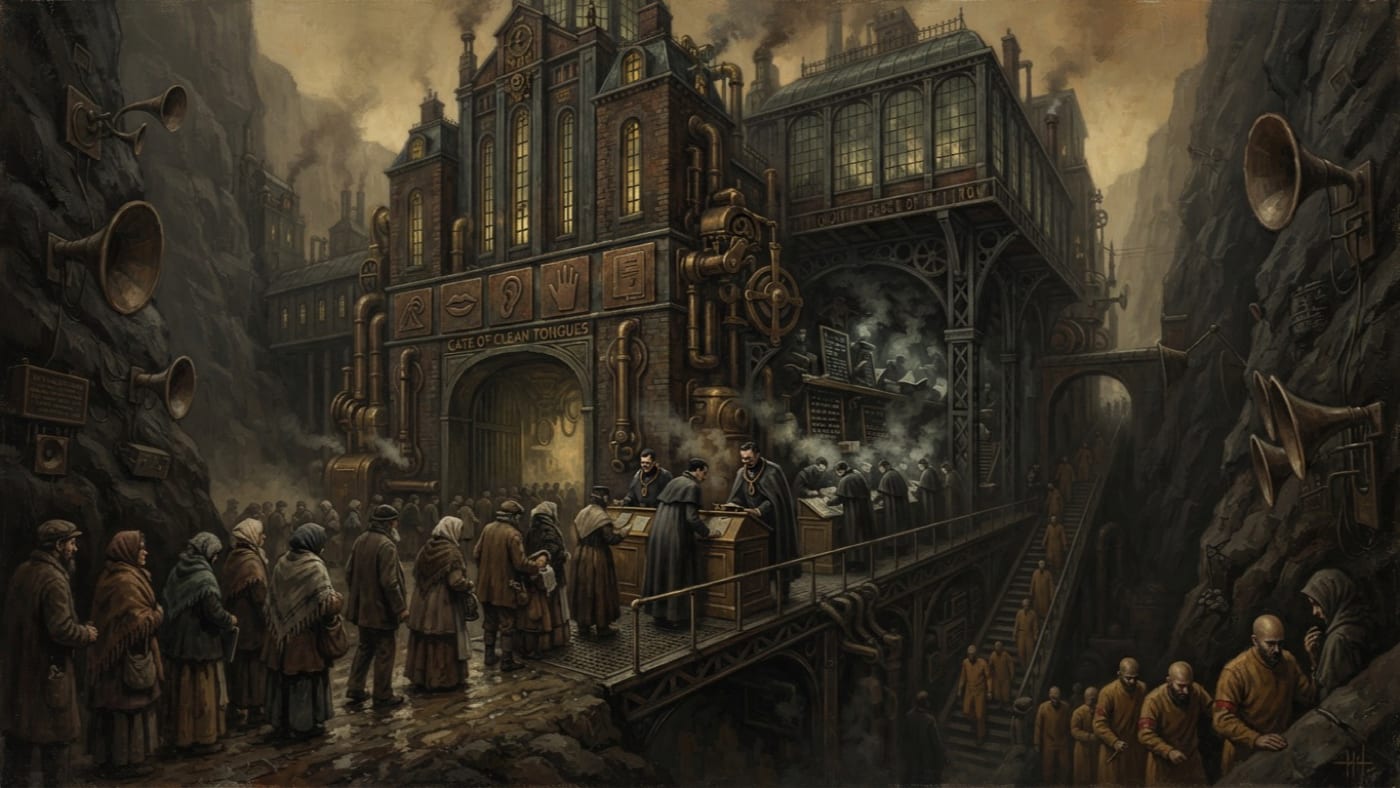
A pilgrim arrives at the western Gate of Clean Tongues and recites the Seventh Catechism before a proctor. The proctor listens, and so does the canyon. Preliminary bead verification follows at the gate. Then a wax identity impression is pressed onto the left forearm, warm enough to sting. From that moment the pilgrim is a document with legs.
Full reconciliation takes place in the Bead Courts of the northern arcade. Bone, wood and glass beads each stand for a different denomination of sin. Clerks lay the string beside the pilgrim's confession receipts, passage stamps and tithe credits, and work out the balance in chalk on slate. The working is wiped and the verdict is kept. An auditor who wants to check the arithmetic will find a clean slate and a filed conclusion, which is how arithmetic achieves infallibility.
Quota pressure enters at the throat. The Chapter keeps quarterly targets for detentions, extracted labour and fees collected, and a proctor who has fallen behind on the column has one instrument that can be adjusted: the vowel. Tighten the standard for an acceptable second vowel and failures rise to meet the schedule. An adverse speech finding changes the assessed bead total. A changed total produces an unreconciled account. An unreconciled account goes down the Vowel-Stair to the Quiet Pens beneath the Tinmarket Arcade. There the wardens in saffron receive it, under Chapter authority and on the Compact's budget.
Detention accrues processing charges. To be released, a prisoner must settle everything accrued or accept a service assignment. The devout try supplementary confession. It produces a new receipt, which must climb back to the northern tables for reconciliation and may come back down the stair carrying a fresh fee. The soul is eased; the ledger is not.
Assigned labour goes where it is wanted. Some stays at home in the Courts and the Escort Yards. The rest goes to distant bastions and supply depots along the Line. The contracts are sold, and part of the proceeds returns to the Chapter as a tithe that appears in no public schedule.
Proportion of labour-contract proceeds returned to the Road Chapter: ████████. Purchasers: ████████. Ledger of receipt: ████████.
I have blacked out those lines because nobody has given me anything to put in them. The tithe's existence is established. Its figure, its buyers and its full accounting have never been supplied to this office, and I decline to invent them.
The Echo Creed serves the machinery as a witness nobody can bribe. The canyon returns a prayer with one vowel altered. Doctrine denies the return any doctrinal authority, while Chapter practice accepts a useful echo as procedural evidence. Nobody has established when the disturbance began, or who or what moves it. The Chapter profits from it, but profit is a long way from proof that the Chapter made it. Protection is sold in tiers. Waxed ear-cords go to whoever can buy them. Silent hand-signs go to whoever holds a licence for them. Bead-buffer chants go to those who have been taught which ones the Chapter tolerates. The poor recite plainly, and the canyon corrects them.
Bead reconciliation at Peregrine Row is a voluntary devotional observance offered to pilgrims for the comfort of their souls.
CORRECTED, A.S. 200. Reconciliation has been compulsory since A.S. 104 and audited daily since A.S. 110. The earlier wording is withdrawn. Pilgrims detained in the belief that they had volunteered are advised that their charges stand.
#On the Investigation
The Chapter's present form was cut from a massacre. In A.S. 101 / 1811 CE, six hundred pilgrims were ambushed on the eastern approach and two hundred and fourteen died. The official finding blamed impure recitation. The survivors were fined, and the attackers were never identified. Creed examinations and compulsory escort contracts followed. A road made dangerous by bad pronunciation could now be made safe only by purchase.
In A.S. 199 / 1909 CE, a ledger leaked from the Compact's internal audit. It described "demonstration ambushes" in the eastern canyons, contracted and paid for. The papers in this matter stand on different footing, and I keep them apart.
No office has authenticated the ledger. Its signatories are not established.
The Road Chapter's investigation found "no evidence of systematic coordination between licensed brokers and unlicensed hostile elements." That finding is sealed.
The clerk who leaked the ledger was fined for administrative indiscretion and remanded to the Quiet Pens. His status is filed as "processing." No document that has surfaced records who ordered the remand.
The Row's status was revised to Amber.
Nothing under seal links the ledger to the attackers of A.S. 101. Nothing links those attackers to the Canyon Saints, or any ambush to an order in the Cantor-Auditor's hand. What I can set down is what was filed. The Chapter investigated an accusation against its principal financier, found no system, and detained the accuser. Each act stands on its own paper.
#On the Present Application
In A.S. 201 / 1911 CE, the Road Chapter of Peregrine operates under Amber. Through the corridor's listing it answers to the Bureau of Pilgrimage, which oversees the roads today but did not issue the charter of A.S. 94. The gates examine, the Courts reconcile and the Pens hold.
Three demands press on the Chapter at once. The Compact wants higher premiums. The Chapter wants more detentions. The escorts threaten to strike unless they are exempted from Creed trials. None of these demands has been granted, and no strike has been called. Expanding the gates, testing more often and purifying the canyon mouths all remain plans on paper.
The difficulty is supply. Every quota is filled from the queue, and the queue is made of pilgrims who can take a longer road if they have the money. Those with money are taking it. The Chapter's survey records this as seasonal variation. The proctors still have to fill their columns from whoever is left, and they have been instructed to listen more closely.