
#On the Rooms Below
"Say it clean. Walk it safe." — Inscription above the Gate of Clean Tongues, a short walk and one staircase from the rooms that enforce it
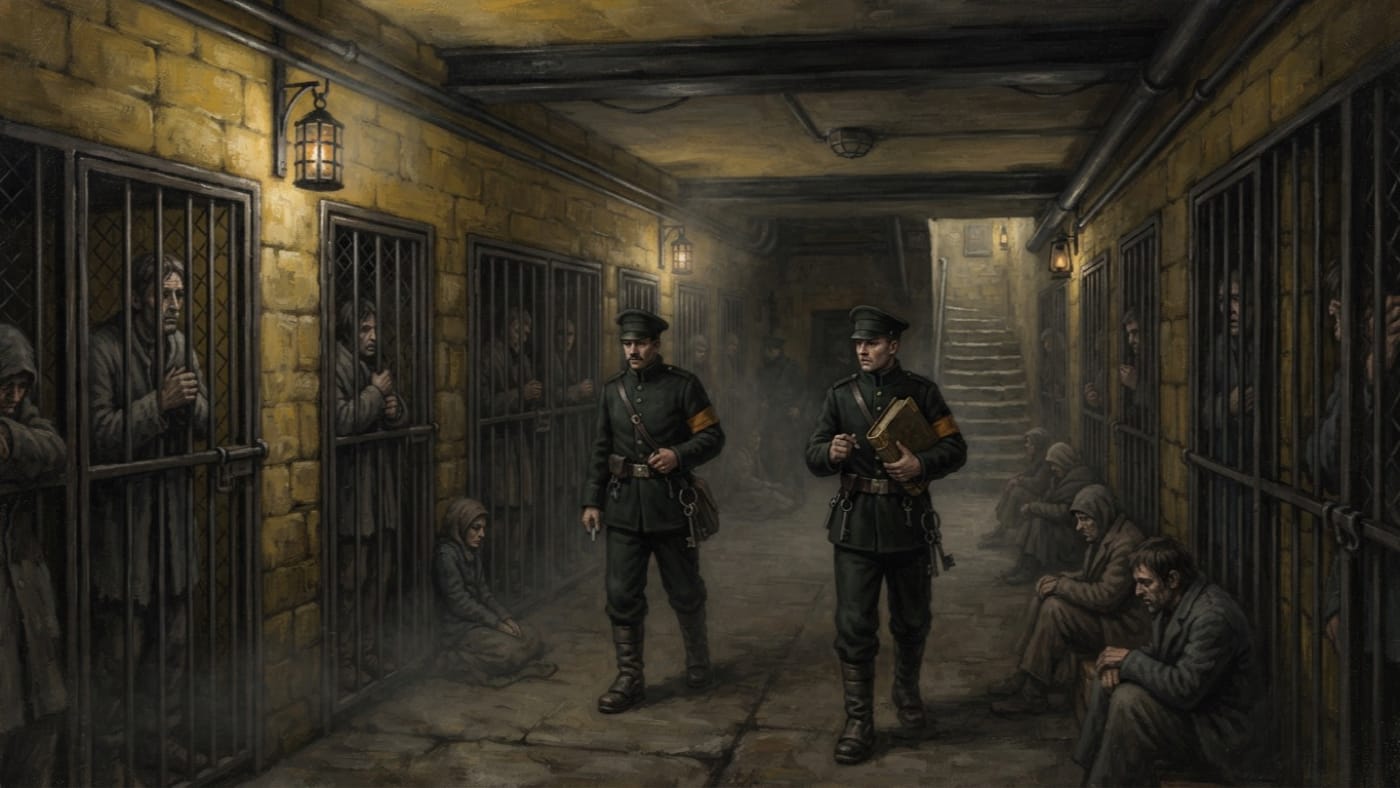
A staircase runs down into the canyon floor beneath the Tinmarket Arcade of Peregrine Row, where the stallholders sell hot tin, rotting spice and bead-string by the yard. The locals call it the Vowel-Stair. At its foot lie the Quiet Pens. They are stone rooms, and I decline to give them a grander noun.
The masonry is close-set limestone. The rooms smell of lye and of bodies held nearer to one another than the Creator made them to be held, and over both hangs a fear that never rises to a scream and never subsides. The walls are painted saffron. The keepers' armbands are the same colour, and on the armband saffron signifies mercy. On the walls it signifies only that someone was paid to paint them.
The Row's published account puts between forty and three hundred souls in the Pens at any given time. That is an observed range. No one has certified a maximum, entered a count of rooms in any record, or added up a year's arrivals, and no office of the Synod has thought the omission worth a letter.
The name needs a correction before the reader decorates it. I have found no ordinance that compels silence below the arcade, and no mason's account of deadened walls. The Pens are quiet the way a sealed ledger is quiet: whatever is said inside does not change the totals.
The Row's layout explains the rest. The Bead Courts stand to the north, the Escort Yards to the south and the Choir-Broker Hall between them. The Pens sit under all three like an alms-box beneath a nave, collecting what falls through the floor of commerce. Their keepers are the Quiet Pen Wardens, a local clique that holds its authority from the Road Chapter of Peregrine and draws its budget from the Broker Compact. They should not be confused with the Peregrine Wardens of the Bureau of Pilgrimage, who patrol the Pilgrim Roads. These Wardens patrol a cellar.
#On Admission
Four roads lead to the Vowel-Stair, and each is paved with a document. At the Gate of Clean Tongues, a proctor may judge a creed recitation deficient, and a scribe writes the deficiency on a carbon-backed receipt. At the twelve tables of the Bead Courts, a pilgrim's string may fail to reconcile. On the eastern road, an escort contract may lapse partway through a passage, leaving its holder uninsured and therefore suspect. And on certain mornings a proctor simply takes against a face. The Road Chapter has never troubled to separate this fourth road from the other three.
Whichever road applies, the finding comes down the stair with the body it describes. The Wardens judge nothing. They accept the verdict as filed and open an account.
The arrangement has an ancestry, though not one I can trace back to a foundation stone. The Road Chapter of Peregrine received its charter in A.S. 94, four years after the Concordat of Strasbourg turned a council of offices into a formal Synod. The charter dates the Chapter. It dates no masonry, and I have found no record of when the first door below the arcade was first barred.
The catastrophe came in A.S. 101. Six hundred pilgrims entered the eastern canyon, and two hundred and fourteen of them died in an ambush from the ridge caves. The survivors were fined for doctrinal negligence. The Chapter's answer was creed-testing at the western gate, compulsory escort and an audit of beads. Detention, until then a holding room for the actively heretical, widened to take in the merely unreconciled. Reconciliation became compulsory in A.S. 104. By A.S. 110 the audits were daily, and traffic on the stair grew accordingly.
Bead-count reconciliation at Peregrine Row is undertaken voluntarily by pilgrims wishing to set their accounts in order before the Creator.
CORRECTED by order of the Cantor-Auditor's office, Peregrine Row, A.S. 200. Reconciliation has been mandatory since A.S. 104. Voluntary participation was never offered, discussed or theologically plausible. Every admission described above stands on that footing.
#On the Account
Each arrival is charged a processing fee on entry. The Wardens assess it against three particulars: the detainee's sin-count, passage status and ability to pay. The third does most of the work.
The sin-count arrives on a string. Bone beads mark minor sins, wood moderate ones and glass the grievous. The Synod has thereby made it possible to weigh a soul on a jeweller's scale and charge for the glass. At the northern tables the string is set against the pilgrim's confession receipts, passage stamps and tithe credits. The clerks work the arithmetic in chalk on slate. When the session ends, they wipe the slate. Only one word goes into the file: reconciled or unreconciled.
So a detainee who wants to dispute the finding has to show where the sum went wrong, and the sum is gone. No appeal procedure appears in any file this office has seen. If one existed, it would have nothing to examine.
The devout prisoner reaches for the obvious remedy, a supplementary confession, and the system expects it. The confession may well cure the discrepancy that sent its maker down the stair. It also produces a supplementary receipt. That receipt must go up to the tables to be reconciled, the reconciliation carries its own processing charge, and the charge comes back down to join the account. Confession cleans the soul before the Creator. The Compact does not extend the Creator credit.
Paper owed outside the Pens follows its debtor in. Escort contracts become liens, and unpaid premiums become a claim on the body that failed to pay them. I can find no published schedule by which the account grows, and none is needed. Every procedure adds an entry, and the Pens are made of procedures.
#On Service
There are two conditions for release: full payment of everything accrued, or a service assignment. In the Road Chapter's public language the second is called service, and on occasion correction, and either word does the job of a third that the Chapter never uses.
The work goes where it is wanted. Some detainees go back up the stair to forced labour in the Bead Courts. There they serve the same tables that declared them unsound, and nobody records whether they recognise the slates. Others go south to the Escort Yards. Their service there is entered in the books as voluntary, with the volunteer's debts entered beside it. Those held longest go farthest, to distant bastions and to the supply depots of the Sagittal Line, where quartermasters have never asked how a contracted hand came to be under contract.
The Row's own lore records the concealed half of the trade, and I set it down as plainly as it is recorded. The Road Chapter's detention quotas are funded by a hidden tithe. Each wrong syllable generates a labour contract, the contract is sold to a distant bastion, and the Chapter takes its return out of sight. Who buys, what the tithe comes to, how long a contract binds and by which road the bought go east: no ledger I have been permitted to open says. Publicly, the pilgrim is corrected. On paper, the pilgrim has been sold.
#On Standards
Each quarter the Road Chapter sets three targets: a number of detentions to process, a volume of labour to extract and a sum of fees to collect. The quotas are achievable because the gate can be calibrated to meet them. A proctor short of his number need not find more sinners. He only has to listen more strictly to the ones he has, and a tighter vowel standard costs the Chapter nothing.
The canyon supplies the rest. The Echo Creed returns every recitation from the limestone a moment late, with one vowel changed. The proctor hears the pilgrim and then the stone, and he must decide which of the two voices was at fault. Training is supposed to settle the question. In practice the quota settles it, along with the proctor's relations with the pilgrim's broker. The Category Two classification belongs to the disturbance. The Pens have no classification at all, because they need none: they are the room where the disturbance's findings are kept.
The Bureau of Alchemical Standards classified the disturbance in A.S. 143, the Year of Ash Rain, and recorded that it grew worse from that year. When the canyon first began to misquote the faithful is not settled, and the Bureaus have filed enough rival accounts to keep it unsettled indefinitely. Doctrine does not need the cause in order to use the result. Neither do the Pens.
The Bureau of Doctrine has been informed of the arrangement. Its reply, Internal Memorandum 7R-201, reads in full: "Standards are standards."
#On the Present Condition
In A.S. 199 a ledger from the Broker Compact's internal audit reached hands it was not meant for. It recorded "demonstration ambushes" in the eastern canyons, contracted and paid for by the brokers who sold protection against them. The Road Chapter revised the Row to Amber status, investigated and found "no evidence of systematic coordination between licensed brokers and unlicensed hostile elements." The clerk who leaked the ledger was fined for administrative indiscretion and remanded to the Quiet Pens.
The clerk's file reads processing. The word does not say whether the clerk is alive or dead, at the foot of the stair or on a contract east. It records only that the account is still open. The Compact's brokers fund the Wardens' wages. The clerk who exposed those brokers now owes the Wardens fees. I mention this for the symmetry, which any auditor would admire.
In A.S. 200 the Cantor-Auditor's office filed its correction confirming that reconciliation had never been voluntary. By the present-condition account of A.S. 201, under the presidency of Cantor-Auditor Selm Peregrin, the Row is still under Amber review and the Pens are in operation. The slates are still wiped at the close of every session. The proctors are still listening to the canyon. The stair still carries pilgrims down as debtors and back up as labour.