
#On Their Charge
"Protection is obedience." — Public motto of Peregrine Row, painted on the arcade lintels and, by the evidence of their receipts, read closely by the Wardens.
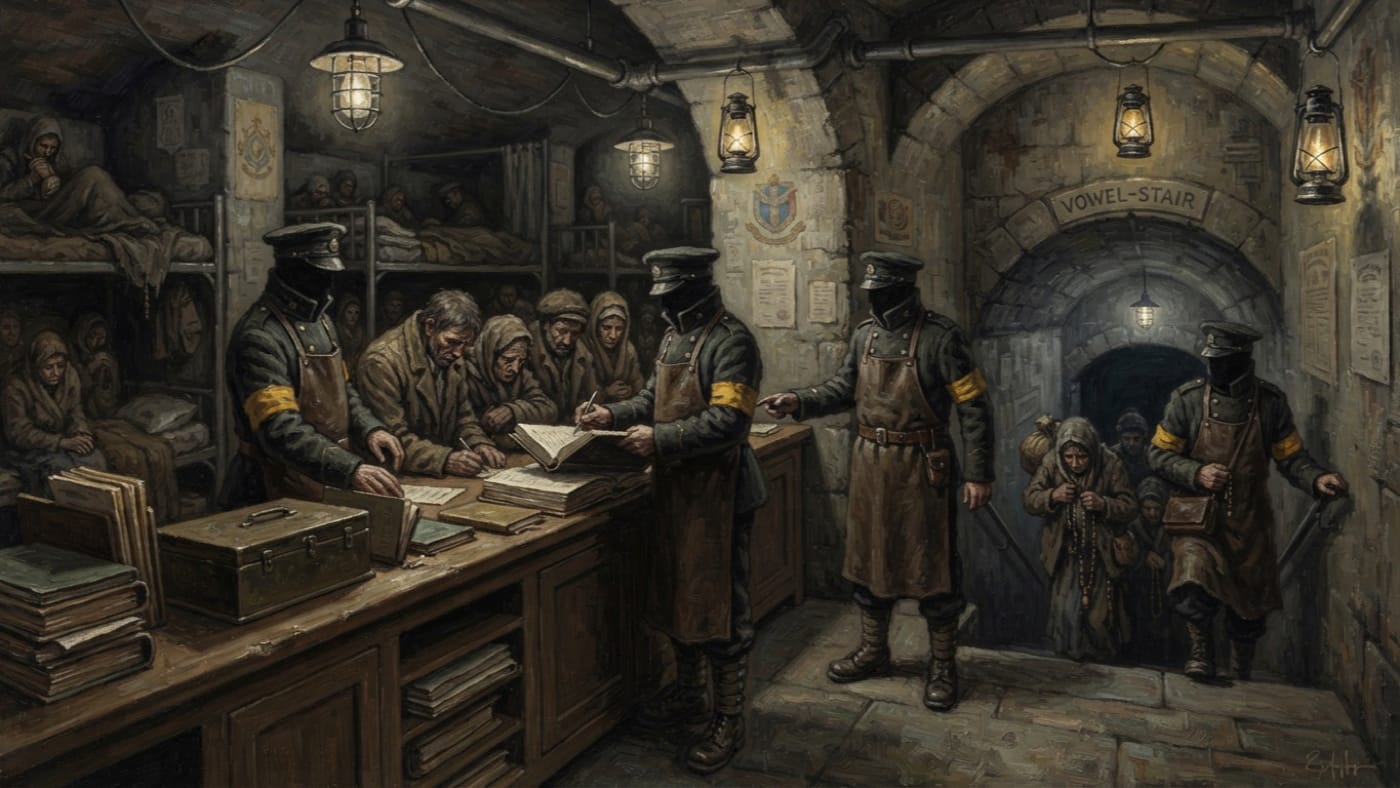
The Quiet Pen Wardens keep the stone rooms beneath the Tinmarket Arcade of Peregrine Row, and they keep them occupied. They are an enforcement clique of the Row itself, local in remit and local in appetite. They must on no account be confused with the Peregrine Wardens of the Bureau of Pilgrimage, who patrol the roads. The Quiet Pen Wardens patrol a staircase.
Their constitution is a small masterpiece of shared deniability. The Road Chapter of Peregrine furnishes their authority. The Broker Compact furnishes their budget. One party signs the warrant and the other signs the wage-sheet, so each may assure a visiting auditor, with perfect sincerity, that the Wardens are properly the other's concern.
Publicly, they maintain order. In practice, as anyone who has handled their paperwork can see, they harvest fees and labour by means of detention, processing, and the patient application of threat. Their badge is a saffron armband, and the saffron signifies mercy. When the clique first formed, how many it musters, by what rite or bribe a man acquires the armband, and who commands at the foot of the stair: on all four points the records of the Row are silent. The Bureau of Records has not asked. The Wardens have not volunteered.
#On Admission
No Warden judges a pilgrim. The office is purer than that. Judgment is made upstairs by better-spoken hands, and it comes down the Vowel-Stair as a finding, and the Wardens receive the finding together with the body it describes.
There are several roads to that staircase. The gate proctor at the Gate of Clean Tongues may judge a recitation deficient. An escort contract may lapse partway through a passage. A proctor may take against a face on a bad morning and record the fact in terms the Pens will accept. Most traffic, though, comes from the north, from the twelve tables of the Bead Courts, where the Reconciliers' Union weighs each pilgrim's string of bone, wood, and glass against confession receipts, passage stamps, and tithe credits. The Union alone declares a soul unsound. The Wardens only house the declaration.
The reconciliation is done in chalk on slate. When the session ends the slate is wiped. Only the verdict, reconciled or unreconciled, goes into the file.
Consider the result. A Warden taking custody at the bottom of the stair has a single word to go on and the person standing in front of him. The arithmetic that produced the word has been erased, so he cannot review it, and nobody has ever paid him to try. In all my years among the Synod's instruments I have met no tidier device for keeping error from being corrected: the evidence is destroyed before the accused reaches the room where it might be challenged.
The system has a lineage. After the eastern-canyon ambush of A.S. 101, in which two hundred and fourteen of six hundred pilgrims died, the Road Chapter brought in creed-testing and mandatory escort. By A.S. 110 the daily audit was established. Detention began as a holding room for the actively heretical. It grew to take in the merely unreconciled, and the stair grew busier to match.
#On Processing
The stair goes down into limestone. The rooms at the bottom smell of lye, of bodies kept close for longer than bodies should be, and of a fear that never peaks and never fades. On an ordinary day they hold somewhere between forty and three hundred souls. I give the range the parent survey gives. Nobody has certified a maximum, and I doubt anyone has tried to find one.
A processing fee is charged on entry. The Wardens assess it against three particulars: the detainee's sin-count, the detainee's passage status, and the detainee's ability to pay. The third particular rules the other two. The Wardens examine a purse as closely as a sacristan examines the collection plate, and with less embarrassment.
The charges then accumulate. Custody costs money every day it lasts, and the account below is kept as carefully as the account above. Outside, the passage arrangement keeps aging, and the escort window the pilgrim paid for closes without them.
The devout prisoner has one obvious remedy, supplementary confession, and the system has anticipated it. A supplementary confession produces a supplementary receipt. That receipt has to go back up to the northern tables to be reconciled. Reconciling it generates a fresh processing charge, and the charge comes back down the stair to join the rest. Confession may well ease the soul before the Creator. It is the account it fails to ease, and the account is what the Wardens hold.
There are two ways out: full payment of everything accrued, or a service assignment. No third door has been sanctioned.
#On Service
A service assignment is often called release, and the people who say so mostly have not had one. It transfers the detainee from a debt they cannot pay into work they cannot refuse. The person comes off the custody book and goes onto a labour contract. As the Row's bookkeeping sees it, the pilgrim has been converted.
The labour goes where it is wanted. Some goes back up the stair to the Bead Courts, whose tables want carrying, sweeping, and tending. Some goes to the Escort Yards, where the companies take on debtors alongside their paid men. The long-detained go farthest, to the supply works of distant bastions on the Line, whose quartermasters have never been particular about how a contracted hand came to be contracted.
The Row's own lore records the concealed side of the trade, and I will put it on the page exactly as plainly as it is recorded. A hidden tithe sits under the detention quotas. Every wrong syllable produces a labour contract, the contract is sold to a distant bastion, and the Road Chapter collects its return out of view. What the tithe amounts to, which purchasers pay it, and whether any of it stays in a saffron-banded hand are things no ledger I have been allowed to open discloses. Until such a ledger is produced, I will not speculate.
Reconciliation at the northern tables is undertaken voluntarily, at the pilgrim's own pious request.
WITHDRAWN. Earlier Codex wording described reconciliation as voluntary. By the Road Chapter's correction filed at Peregrine Row in A.S. 200, reconciliation has been compulsory since A.S. 104, and voluntary participation was never offered. Every admission to the Quiet Pens described above should be read accordingly.
#On Standards
Every quarter the Road Chapter sets its targets: so many detentions processed, so much labour extracted, so much revenue collected. I do not have the figures, and I will not make them up for the reader's convenience. Their existence is documented. That is enough to account for what the gate does.
A target can be met in two ways. More pilgrims can fail, or the same pilgrims can fail more easily. The second costs nothing. A gate proctor who is short of his number can tighten the vowel standard, and the canyon will supply the evidence for him.
That evidence is the Echo Creed. A pilgrim recites, and the stone gives the prayer back with one vowel changed. The proctor hears both voices and has to decide which belongs to the pilgrim. Since the ash year of A.S. 143, when the disturbance was classified and grew worse, the Bureaus have filed many accounts of what the echo is and why it does what it does. Not one of them settles the question. Doctrine does not need it settled to put the echo to use, and the Pens do not need it settled to collect the people it marks. The Wardens did not make the canyon. They have only given it a cellar.
The Bureau of Doctrine has been told about the arrangement. It replied by Internal Memorandum 7R-201, whose complete text is: "Standards are standards." The memorandum has never been revised, and I can find no record that anyone was ever asked to revise it.
#On the Present Application
The Row has been under Amber status since A.S. 199, when a ledger from the Broker Compact's internal audit got out. It recorded certain "demonstration ambushes" in the eastern canyons that the brokers had contracted and paid for themselves. The ledger's authenticity is a matter for the reviewers. The Road Chapter's verdict on it is a matter of record: having investigated, the Chapter found "no evidence of systematic coordination between licensed brokers and unlicensed hostile elements."
The clerk who leaked the ledger was fined for administrative indiscretion and remanded to the Quiet Pens. The Wardens received this clerk as they receive everyone else, on a finding from upstairs, and they charged the processing fee. I have not been able to learn the clerk's name or what has happened since. The file says processing. The Wardens have no reason to change it, and nobody above them has told them to.
At the survey of A.S. 201 / 1911 CE, under the presidency of Cantor-Auditor Selm Peregrin, the Pens are in operation. The chalk is still wiped at the northern tables at the end of every session. The armbands are still saffron. The proctors still listen to the canyon. The stair still takes pilgrims of the Pilgrim Roads down to the stone rooms, and it brings them back up as labour, sometimes after they have paid in full and more often after they have not.