

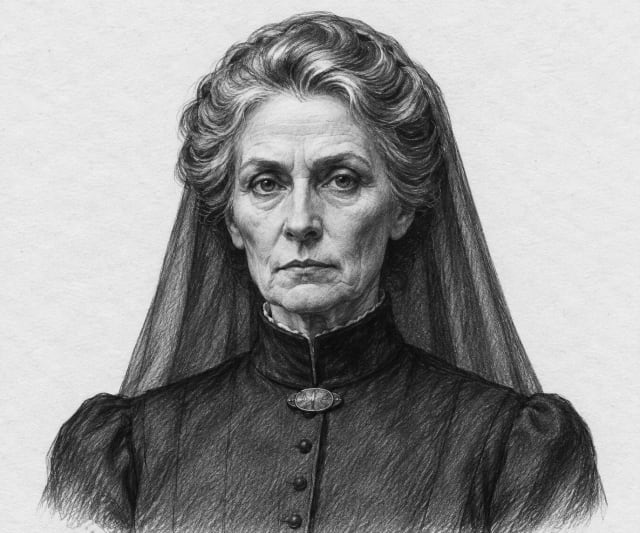
#On Her Station
Archivist-Widow Sareh Comnena holds the archive's chair at the Triune Table of the Widow's Syndicate. She is one of three women who between them know more about the households of Bastion-Constantinople than the households themselves do. She sits with Mother Ledgermistress Anka Vey and Cup-Matron Ilyena Sorn. Each House elects one matron, and the electors vote with the household mark: the thumbprint, the stitched initial or the drawn anchor that a woman puts on a pension slip when the Bureaus have left her nothing else to sign with. Coin buys no vote at that Table, rank carries none, and no cleric is asked to bless the count. The Church has never formally objected, because the Church has never formally noticed.
No charter in my possession names her keeper of the House of Grey Veils. Her title names her. The Table has three chairs, and the archive House sits in the one marked Archivist. A clerk would call that inference. A clerk who has spent any time in Constantinople would call it the seating plan.
The Codex holds no birth year for her. It also holds no husband's name, no date of election and no predecessor. Widow appears in her title, but the register does not say whose widow she is, and I decline to supply a corpse to make the dossier tidy. This dossier records her office, and the office is enough to alarm a careful Bureau.
The matron holds no seal of any Bureau. She signs nothing the Bureau of Records must obey, and she cannot order a single ration restored. Her authority is the authority of a folder that turns out to be right, and in a city where the official folder is so often wrong, that authority has teeth.
#On the Household Index
The Bureaus file a soldier the way an army prefers to remember him: by regiment, rank and service number, standing in formation long after the formation has been reduced to a mass grave and a requisition for lime. The Grey Veils file him by the house that waited for him.
The archive under Sareh's chair keeps death notices, hospital transfers, missing-person slips, erased-name appeals, pension denials and the irregular battlefield testimony that Records will not file and families will not burn. It also holds lists of children evacuated from the outer rings, tags from the Ossuary infirmaries, pay-books pulled out of the mud, and letters that the Bureau of Silence censored so thoroughly that only the dent of the pen survives. Some notices are written on ration paper because the proper forms ran out during the Ninth Bell Famine. Those are the ones I trust most, since nobody forges on ration paper.
Read the keys in order and the method explains itself. The house comes first and the missing man second. The manner of his going comes third: killed, transferred, erased, detained, returned wrong. Only then does the archive ask which office had its hand on the matter.
Consider what a household file does in practice. A widow holds a notice giving her husband's death as spring. The Bureau of War holds one giving autumn, and Records holds a third that has him alive and drawing pay through the winter. Until the dates agree she has no pension, no burial allowance and no standing to inherit the lease on her own kitchen. The Grey Veils file may hold the hospital transfer, the last place he was counted and the slip pinned to the body that came back. It cannot reconcile the dates by decree. It can put the documents in front of the magistrate in the right order, so that the wrong date has to explain itself.
I insist on that distinction, because I am a servant of the Ledger and the Ledger certifies. Sareh Comnena's archive does not restore an erased name, does not pronounce identity and does not pay a pension. It only preserves the evidence. The Bureaus still do the certifying, and on a good day they now do it correctly.
Household filing also shows what regimental filing hides. A single service number tells you nothing. Forty households filed under the same corridor, the same ship or the same countersigning officer make a pattern, and patterns are what a Bureau most dislikes finding in someone else's cabinet.
#On the Copies Records Accepted
In A.S. 156 (1866 CE) the Mold Ledger Rot took three months of southern casualty reconciliations from the Bureau of Records. Three months is how much of the record was lost. Nobody has measured how long the loss lasted or how long the repair took. When Records went looking for what it had lost, the House of Grey Veils produced copies.
No source I accept names Sareh Comnena in that matter. Nothing shows that she carried the copies, ordered them or signed for them, and I will not put her name into a file it has never occupied. What her chair inherits is the precedent: forty-five years ago the archive she now governs was asked to stand in for the Bureau's memory, and it did.
Records accepted the pages, and then it denied having needed them.
The Bureau of Records has never relied upon Syndicate archives for official corrections.
Withdrawn. The denial is preserved in Records File 156-M, attached to forty-seven pages in Grey Veils ink, on Grey Veils stock, under Grey Veils pagination. In that attachment, the denial is the only sheet the Grey Veils did not supply.
Records maintains that the pages became official the moment Records received them. I admire the doctrine, though as a theory of property I would not teach it to children. It means the Bureau needs an archive it calls duplicative, and needs it badly enough to absorb the archive's paper while disowning its source. Every Bureau has a relative like this. It borrows the good spoons and then explains at dinner that it has always owned them.
#On Her Place at the Table
The three Houses descend from the same rope-market relief table below the Byzantine seawall, and they work the way a sound household works: one keeps the purse, one keeps the papers and one keeps the guests in their chairs.
Black Pennies lends, and it lends against pensions, ration arrears and burial reimbursements. A loan against a pension is only as sound as the pension, and a pension is only as sound as the recorded death behind it. Where that record is in dispute, the household file is what makes a widow's expectation look like collateral and not like a prayer. I do not say that the Archivist approves Black Pennies' loans, or that every Black Pennies account sits in a Grey Veils box. The two Houses hold different instruments. They simply happen to be reading the same families.
White Cups works through hospitality, documents and obligations remembered over a second cup. An officer who denied a burial escort finds his own requisition delayed by a clerk whose aunt was recently served tea. A correction arrives on a desk, and the person receiving it is wise enough not to ask where it came from. Paper is what lets such a correction stand up to inspection, and the archive is where the paper lives.
What binds the three matrons is the electorate. Households elect them, and households can stop electing them. A Bureau official answers upward to an office. Sareh Comnena answers outward, to women who know exactly which folder holds their husband and will notice if it ever goes missing. I have served under bishops who would collapse under that kind of accountability.
#On the Present File
The Bureau of Records suspects the Grey Veils of building a parallel census of Constantinople that is more accurate than the official one. That is the Bureau's suspicion. I have seen no completed census, no secret programme and no conspiracy of folders. I have seen an index that begins with the household. Carried on long enough across the city, such an index would become a census whether anyone intended one or not.
My own reading, which I offer as a Hieromnemon and not as a finding, is that the Syndicate is preparing for the day Constantinople's official systems fail. Military ledgers burn, and the household mark tends to survive its regiment. An archive that already knows who lived in which room would be the first thing a ruined Bureau sent for. On that reading, the Archivist's chair is a reserve of memory kept against the end of the Bureaus, which I can describe without lamenting.
Beneath the Harbor of Chains lies the Syndicate's licensed vault, approved in A.S. 142 for pension collateral, relief reserves, pledged valuables and duplicate household registers. That last category puts the archive's copies in the harbor. It does not put the Archivist there. The A.S. 198 survey confirmed the chamber's filed dimensions. The A.S. 200 survey found the eastern wall eleven metres farther east. No one has explained this. Nothing on record makes Sareh Comnena the builder of that wall, its custodian or its investigator, and I will not make her any of them to give the paragraph an ending.
As of A.S. 201 no formal charge lies against the Widow's Syndicate. That says nothing about the Archivist personally, in either direction. The Codex holds no charge against her, no acquittal and no doctrinal classification, and inquirers who want one may apply to the Bureau of Records. Records will open its file on Sareh Comnena and find it shorter than hers.