
#On the Founding of a Useful Grief
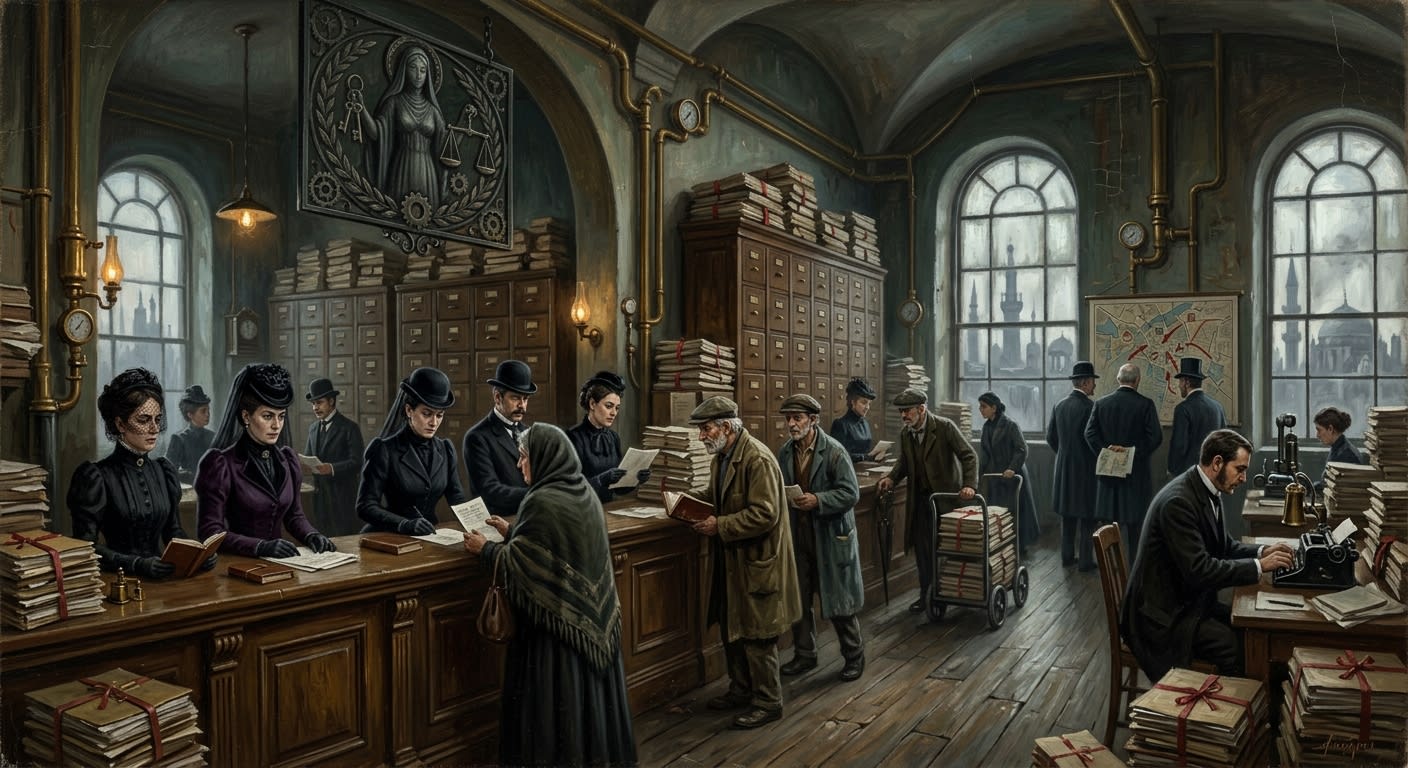
The Widow's Syndicate of Constantinople began, as all powerful institutions prefer to claim they began, with charity. A.S. 65 gave the southern Line its first mathematics of bereavement: millions in retreat, thousands in the trenches, hundreds entering the city each week with a husband's name, a folded discharge notice, a ration chit, and the particular expression worn by those who have discovered that the State can count the dead faster than it can feed the living. The Synod calls this administrative lag. The hungry call it dinner postponed until theology improves.
The first widows met in the old rope-market below the Byzantine seawall, where sail hemp was sold, bodies were identified, and clerks from the provisional garrison attempted to decide which signatures qualified as proof of death when the dead man had been eaten, burned, drowned, unmade, reassigned, or promoted posthumously by an officer who had also died before countersigning the order. The women brought witnesses. The clerks demanded forms. The women brought more widows. The clerks discovered, with the belated intelligence characteristic of armed bureaucracy, that a crowd of mourning women is not a crowd. It is a tribunal with shawls.
The rope-market office became a relief table. The relief table became a lending chest. The lending chest became the House of Black Pennies, the first of the Syndicate's three chartered houses. By A.S. 82, the widows were lending small sums to soldiers' families against future pensions. By A.S. 91, after the Concordat of Strasbourg made the Synod honest in the technical sense and stronger in every unpleasant one, the House had branches in the Blue Zone (Unregistered), the Ossuary Ring approaches, and the harbor terraces. By A.S. 120, no soldier's widow in Constantinople received a pension without someone from the Syndicate knowing the sum before the widow did.
This knowledge was lawful. Illegal knowledge is knowledge held by amateurs. The Syndicate requested licenses, paid fees, produced seals, submitted to inspection, and learned the Bureau's favorite sacrament: if a thing is stamped in triplicate, it may continue breathing.
The Bureau of Tithes tried to absorb the House in A.S. 103. Its Assessors found every account balanced, every loan witnessed, every widow's mark re-copied in clean ink beside the original, every fee lower than the Bureau's own widow levy of A.S. 65, which the Bureau had abolished while preserving the appetite that produced it. The Assessors left with receipts. Several later borrowed money.
Earlier port circulars described the Widow's Syndicate as "an informal charitable association of limited administrative relevance."
The phrase is withdrawn. The association is formal, charitable when profitable, and relevant in the way a locked gate is relevant to a procession that has forgotten its key.
#On the Three Houses
The Syndicate is no sisterhood, although outsiders insist on saying so because outsiders enjoy making women sound harmless when they have not been paying attention. It is a consortium of three houses, each descended from a table in the rope-market and each holding a different kind of grief as capital.
The House of Black Pennies remains the oldest and most public. It operates the lending-houses, pension counters, pawn altars, and widow-relief offices from the Blue Zone up through the Ochre terraces. Its ledgers are immaculate. That word should frighten you. Immaculate accounts in Constantinople do not mean innocence; they mean the account knows who will read it. Black Pennies lends against pensions, dock wages, ration arrears, burial reimbursements, and those apology stipends the Bureau of War issues when a shell lands on the wrong chapel and everyone agrees, after a brief doctrinal pause, that the chapel had been tactically ambiguous.
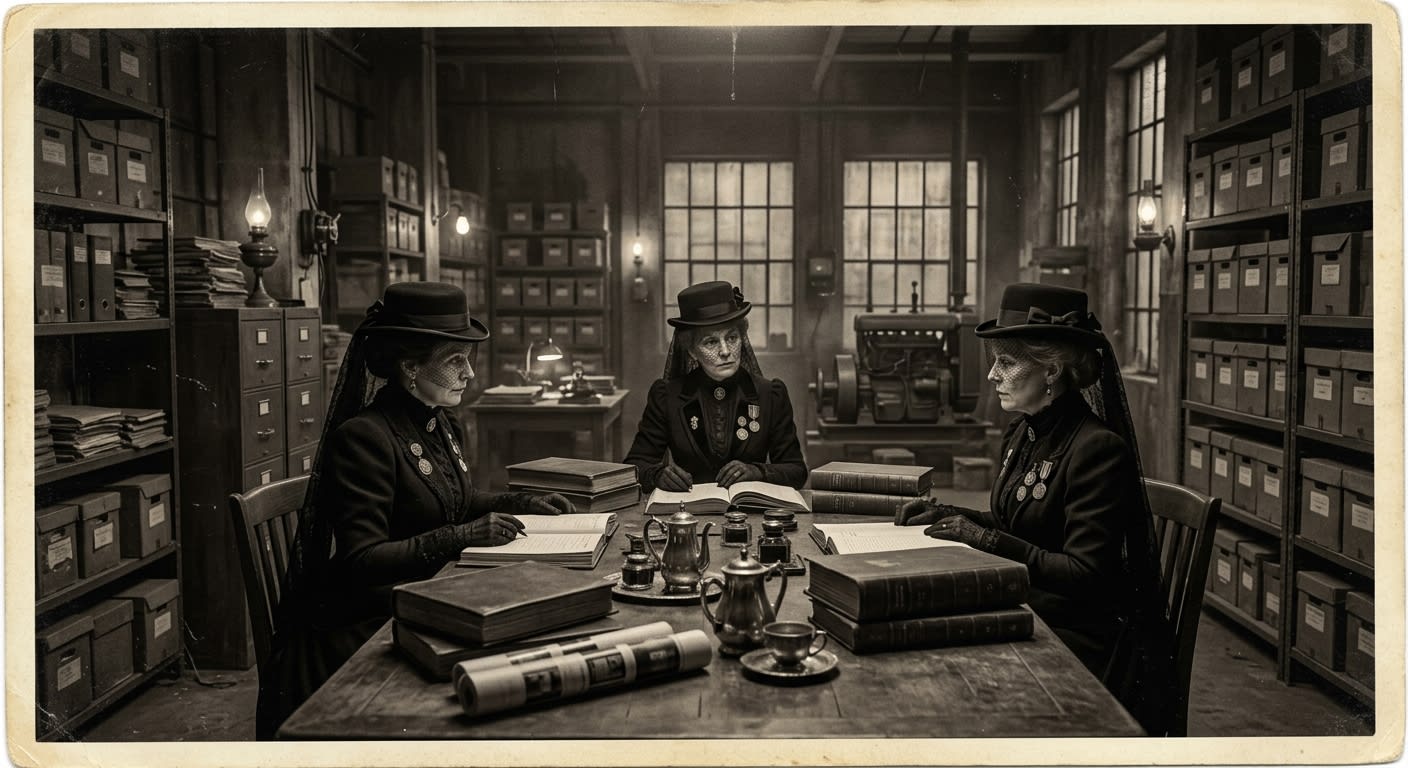
The House of Grey Veils maintains the unofficial record-archives. It keeps copies of death notices, hospital transfers, missing-person slips, erased-name appeals, pension denials, and the little scraps of battlefield testimony that the Bureau of Records considers too irregular to file and families consider too sacred to lose. Grey Veils can tell a mother where her son was last counted, a wife whether the man returned in her husband's coat was legally her husband, and a magistrate which three official dates of death have been assigned to the same body.
The House of White Cups is the smallest, richest, and most dangerous. It operates relief offices in which no transaction appears to occur. Women enter. Tea is served. Papers are folded. Men who have delayed payments discover a correction waiting on their desk. Officers who denied burial escort permits find their own supply requisitions delayed by a clerk whose aunt was served tea the week prior. Inquisitors who ask direct questions are answered with warmth, documentation, and a second cup. White Cups keeps no visible archive. That is how one knows it has the best one.
Leadership rests with the Triune Table: three matrons, one from each House, elected by household mark rather than by coin, rank, or clerical ratification. The current Table consists of Mother Ledgermistress Anka Vey, Archivist-Widow Sareh Comnena (Unregistered), and Cup-Matron Ilyena Sorn. Their names appear separately under licensed charitable administration. The Bureau is fond of separate listings. It allows the elephant to enter the cathedral disguised as processional furniture.
#On Lending, Relief, and the Interest of the Dead
The Syndicate's lending is gentle by Constantinople standards, which is to say it takes less blood than the alternatives and returns the cup. Interest is assessed according to the Widow Scale (Unregistered): combat widow, famine widow, plague widow, administrative widow, uncertain widow, and living widow. The last category has caused repeated correspondence with the Bureau of Records, which insists a woman with a living husband cannot be widowed. The Syndicate replies that a husband missing in a Bureau corridor for six months is alive only as a theory, and theories do not mend roofs.
Combat widows receive the best terms. Famine widows receive grain-credit. Administrative widows receive legal assistance, because erasure produces no corpse, no pension, no funeral, and no one to blame except the Great Ledger, which does not attend hearings. Uncertain widows are those whose husbands have returned altered, duplicated, misnamed, or carrying a death certificate signed in their own hand. Living widows are women whose husbands have become so entirely absorbed into a Bureau, regiment, cult, prison, ship, or silence that household survival requires proceeding as though the marriage were a memorial practice.
Repayment is secured through pension drafts, ration allotments, dowry remnants, labor pledges, and occasionally secrets. The Syndicate denies accepting secrets as collateral. The denial is phrased with exquisite care: No secret is held as monetary security in a registered loan instrument. I admire the sentence. It has trapdoors. It has curtains. It has a little balcony from which an advocate can wave while the truth escapes down an alley.
The lending-houses are clean, narrow, and quiet: a black counter, three chairs, indexed boxes, and a kettle kept just below boil. Each office displays the Empty Hook, a brass hook from which the dead husband's cloak would once have hung. The Synod says the husband died for Order. The Hook says he is not here.
#On the Unofficial Archives
The Grey Veils archive everything that official grief discards. There are death notices written on ration paper because the forms ran out during the Ninth Bell Famine. There are lists of children evacuated from the outer rings and never reconciled against arrival registers. There are hospital tags from the Ossuary infirmaries, prayer slips pinned to unknown bodies, pay-books retrieved from mud, wedding crowns pawned and redeemed and pawned again, private letters censored so aggressively by the Bureau of Silence that only the pressure of the beloved hand remains in the paper.
This archive has saved the Bureau more often than the Bureau admits. When Records lost three months of southern casualty reconciliations during the Mold Ledger Rot of A.S. 156, Grey Veils produced copies. When War misdirected pension arrears to a dead regiment for eleven years, Black Pennies supplied the household trail. When Purity needed a Crimson Concord courier identified, White Cups provided the route, the name, the false tear pattern, and a biscuit.
The Bureau of Records denies ever relying upon Syndicate archives for official corrections.
The denial is preserved in Records File 156-M, where it is attached to forty-seven pages copied in Grey Veils ink, on Grey Veils stock, bearing Grey Veils pagination. The Bureau's position remains that the pages became official at the moment Records accepted them, which is a charming doctrine and should be taught to thieves.
The archive is arranged by household rather than by soldier. The Bureau files a man under regiment, rank, and service number. The Syndicate files him under who waited for him, who fed him, who borrowed against him, who buried him, who argued that the returned thing wearing his boots was not entitled to his spoon. Household filing reveals what military ledgers miss: officers with too many administrative widows, ships with altered signatures, alleys where grief arrives before the casualty lists.
Records has attempted to copy the method. It failed because household filing requires knowing households, and Records prefers citizens as entries, not as persons. Entries do not shout. Persons do. Widows shout beautifully.
#On the Vault Beneath the Harbor
The permitted Syndicate vault lies beneath the Harbor of Chains, at harbor level, between the second winch foundation and a blocked Byzantine cistern whose blockage predates every institution currently lying about it. It was licensed in A.S. 142 for the storage of pension collateral, duplicate household registers, pledged valuables, and relief reserves during bombardment. The filed plan shows a rectangular chamber, twenty-one meters by nine, with three alcoves, two barred doors, and one kettle-room. Of course there is a kettle-room. Civilisation is not dead while hot water remains weaponised.
The A.S. 198 survey confirmed the filed dimensions. The A.S. 200 survey found the eastern wall eleven meters farther east.
No excavation permit exists. No rubble was removed. No laborers were logged. The adjacent winch foundation did not shift. The blocked cistern remains blocked from the harbor side, although a Harbor Patrol apprentice reports hearing teaspoons behind it. The Syndicate produced documentation showing that the wall had always occupied its current position. The ink tested as fresh. The paper tested as eighty years old. The signatures tested as genuine, including one from a surveyor who died in A.S. 131.
Engineering requested invasive inspection. The request entered Syndicate review, acquired six attached pension disputes involving Engineering personnel, and returned with a tea invitation. Two surveyors emerged forty minutes later carrying three tins of excellent tea, one corrected pension schedule, and no abacus. Their report stated that the vault was structurally sound.
Purity requested a sweep. White Cups asked whether Purity preferred the records of eleven administrative widows produced by Purity's own corrective actions in A.S. 183 to be reconciled before or after the sweep. Purity deferred. Procedure remains clarifying itself.
What is stored in the added eleven meters? The Syndicate says registered collateral. The Harbor says it has no jurisdiction. Mother-Cryptor Sabine, whose own deep records lie below, smiled once when asked. I do not trust smiles in Constantinople. They are shutters with teeth.
Inventory fragment recovered from a waste-basket outside White Cups, A.S. ███: — one wedding ring, fused shut from inside — forty-seven pension drafts, unsigned by dead men — chain-link rubbing, dimensions matching no registered link of Saint Anakletos — ledger page headed "HUSBANDS BELOW" — █████████████████████████ The fragment was returned to the Syndicate by order of ███████████. A receipt was issued. The receipt smelled of salt.
#On Resistance to Inquiry
The Widow's Syndicate does not defy the Synod. Defiance is for amateurs, martyrs, and men with insufficient filing cabinets. The Syndicate complies until compliance becomes a maze and the pursuer, having followed every posted sign, discovers himself back at the same tea table holding a corrected copy of his grandmother's pension appeal.
Its first defence is documentation. Every question receives a paper. Every paper bears a seal. Every seal belongs to someone authorised to have issued it, even when that person died before the matter occurred, or was not yet born, or occupied a post that did not exist until after the form was revised. The Syndicate has mastered the Bureau's own metaphysics: paper does not record reality; paper instructs reality how it has always behaved.
Its second defence is social debt. Half the harbor has borrowed from Black Pennies. A third of the Blue Zone has a file in Grey Veils. White Cups has served tea to officers, priests, smugglers, magistrates, confessors, grieving mothers, and three men I have seen deny ever entering the building while stirring their tea the way White Cups teaches.
Its third defence is gender, and I write this with the caution of a man who has survived committees: the Synod consistently underestimates women whose power is domestic, fiscal, and archival. It imagines armies where it should see kitchens. It imagines charity where it should see credit. It imagines mourning where it should see governance conducted in black sleeves. Chivalry deserves no blame here. Stupidity does, wearing a clean collar.
The Syndicate's tea is not drugged. This has been tested. The tea is excellent because excellence itself is a tactic. Hospitality creates sequence: sit, sip, listen, sign. By the time the inspector remembers he came to inspect, he has accepted three premises, two courtesies, and one debt.
The Bureau of Shadows respects the Syndicate. That should alarm everyone. Shadows despises competition, unless the competition is useful, old, and holding copies of documents Shadows would rather not admit it misplaced. The relationship between Mother-Cryptor Sabine and the Triune Table is officially nonexistent. It is warm enough to affect the walls.
#On the Present Suspicion
No formal charge lies against the Widow's Syndicate as of A.S. 201. Absence of indictment should not be mistaken for innocence. It should be counted as aim.
The expanded vault, the harbor proximity, the collateral involving chain-link rubbings, the movement of unofficial household records through Blue Zone routes, the Syndicate's access to pension rolls, casualty delays, maritime disappearances, and administrative widows attached to sealed Harbor work — these facts sit together on the desk like knives laid out for inventory. The question is whether they belong to a kitchen, an armoury, or a murder.
There are theories. Tithes believes the Syndicate is running an untaxed relief bank whose reserves exceed declared holdings by a factor of four. Records believes Grey Veils is constructing a parallel census of Constantinople more accurate than the official one, which Records regards as an insult bordering on sorcery. Purity suspects contact with the Velvet Choir, because Purity suspects contact with the Velvet Choir whenever two women speak without a man present to misunderstand them. War believes the Syndicate is hoarding emergency credit against a breach. Shadows says nothing, which is the loudest theory in the room.
My own suspicion is simpler and less flattering to every Bureau involved: the Syndicate is preparing for the day Constantinople's official systems fail. It keeps household truth because the military ledger will burn. It keeps collateral because coin will sour. It keeps widow routes because roads will close. It keeps tea because even apocalypse can be made to sit down for a moment if addressed by an old woman with steady hands.
If this preparation is treason, the Synod may indict half its surviving virtues. If it is loyalty, the Syndicate may be the most loyal institution in the southern anchor, which explains why the Bureaus hate it so sincerely.
I left White Cups with two documents I had not requested: a corrected transcript of my interview, and a pension appeal for the widow of a Doctrine clerk whose name I had forgotten signing away in A.S. 194. The tea was excellent.