
#The Harbor of Chains
"A mile of quay, a hundred fathoms of iron, and one man with a ledger who has outlasted every storm, siege, and administrative reorganization the Synod has thrown at this water." — Drax, margin note on the Harbor Patrol's annual requisition, A.S. 200
The Bosphorus is not a river. Rivers obey gravity; the Bosphorus obeys nothing, least of all the Bureau of Engineering's hydrological models, which have been revised fourteen times since A.S. 90 and which still predict a current that flows north-to-south at three knots when every sailor on the water knows the current flows whichever direction will be most inconvenient for the convoy schedule. The Bureau has classified the discrepancy as "tidal variance." The sailors have classified it as the strait being alive, which is heresy, but heresy that runs on time, and running on time is the only virtue the Harbor of Chains recognizes.
The Harbor fronts the Bosphorus along one mile of fortified quay — granite-faced, iron-capped, bolted to the ancient Byzantine substrate with pins the Bureau of Engineering drove in A.S. 68 and has not inspected since, because inspecting them would require admitting that the original pins might fail, and the original pins were consecrated by three Procurators, and consecrated pins do not fail. This is doctrine. The quay sags fourteen inches at the midpoint. Doctrine and the quay maintain their positions with equal conviction.
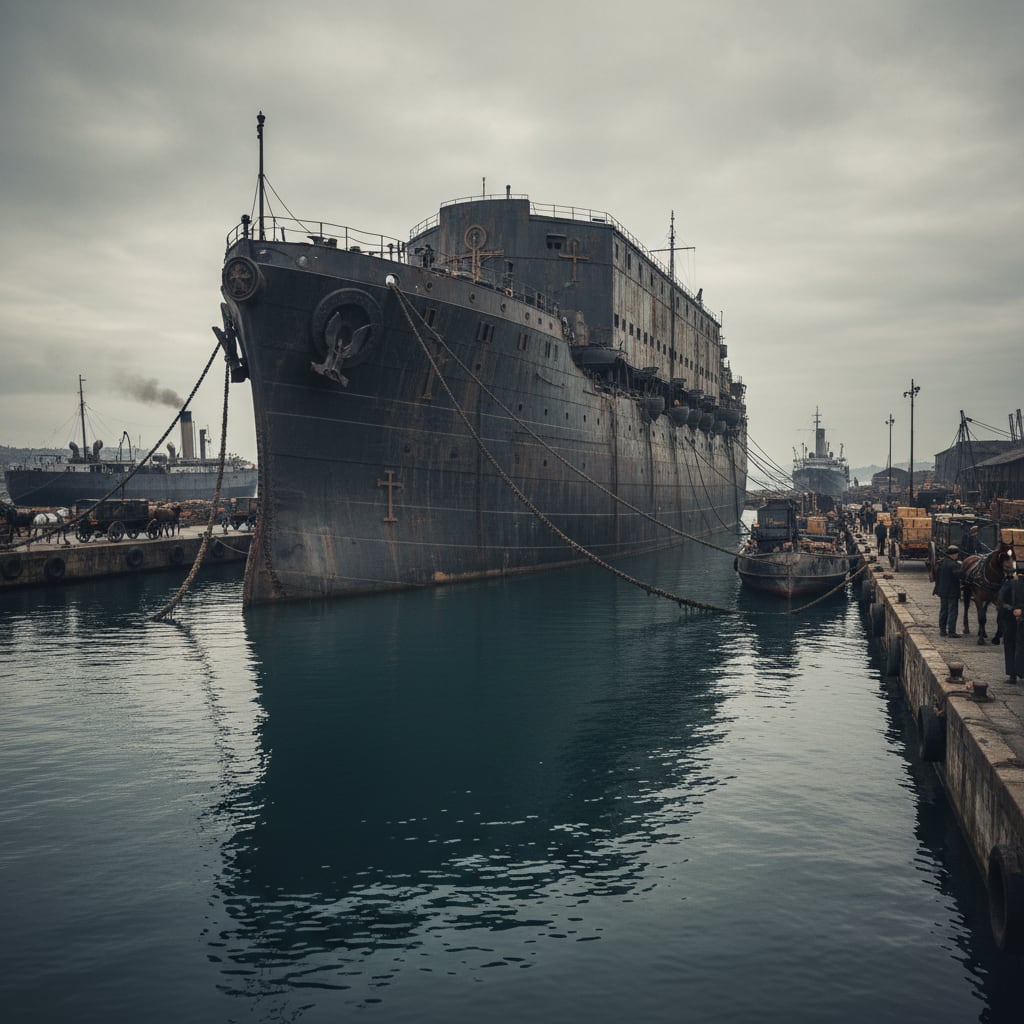
Eleven piers extend from the quay into the strait, each numbered, each assigned a specific function by writ of the Bureau of War and re-assigned, in practice, by whoever arrives first with a cargo manifest that cannot wait. Piers One through Four handle military supply — munitions, rations, replacement levies, and the sealed crates the Bureau of Shadows sends without manifests and collects without signatures. Piers Five and Six are pilgrim wharves, where the faithful disembark from Marseille and Genoa clutching their stamped permits and their devotional pamphlets, blinking at the fortress walls, and discovering that Bastion-Constantinople smells considerably worse than the Bureau of Pilgrimage's recruitment literature suggested. Piers Eight through Eleven handle commercial traffic — grain from the Anatolian coast, coal from the Hintermark foundry-towns, salt from the southern routes, and whatever the Reliquary Flotilla sends in its sealed barrels that the customs clerks are instructed to weigh, stamp, and never open.
Pier Seven is occupied by the Catacomb-Carrier Threnody, and has been for eleven years. The Threnody does not move. The Threnody's crew is listed, in the Bureau of Records' harbor registry, as "intact — see supplemental." The supplemental has not been filed. The pier's mooring fees are paid quarterly by a Bureau of War account that predates the current accounting system by two administrative generations, and the clerks who process the payments do so with the particular blank efficiency of people who have learned that certain questions generate paperwork that generates more questions that generates more paperwork, and that the resulting stack will outlive them.
#The Chain of Saint Anakletos
The chain is the harbor's reason for existing, and the harbor is the chain's reason for not falling into the sea.
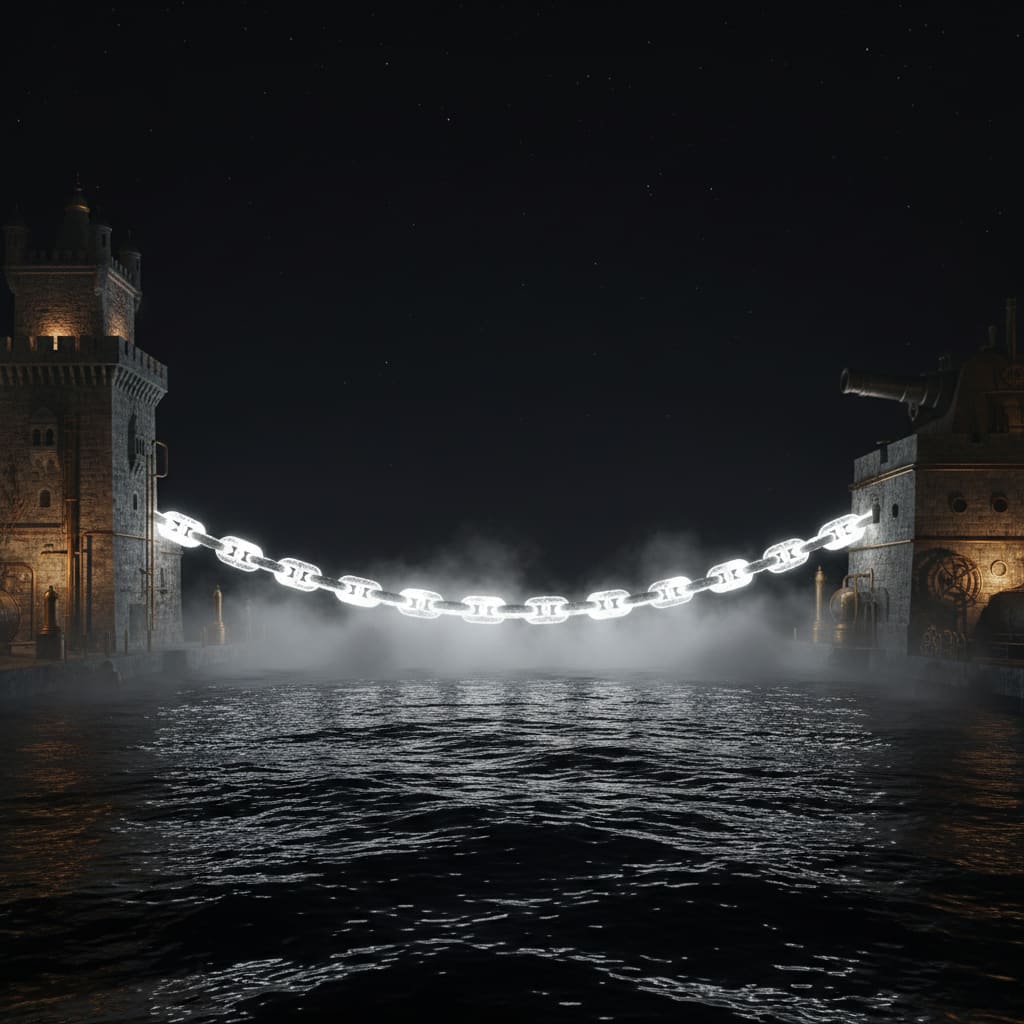
The Chain of Saint Anakletos stretches across the Bosphorus from the Harbor's southern tower to the Anatolian gun emplacement opposite — a distance of approximately twelve hundred yards of open water, closed at night by three hundred and forty-seven links of consecrated iron, each link the height of a man and the weight of a draft horse, each set with a reliquary capsule containing crushed bone and blessed oil drawn from the stores of the Bureau of Relics.
The chain is raised at dusk and lowered at dawn by a winch-house crew of fourteen men who work in shifts of seven and who have, over the course of a century and a half, developed a dialect of technical commands so compressed and idiosyncratic that the Bureau of Bells' linguistic auditors, sent to standardize harbor communication in A.S. 189, spent three weeks observing the crew and concluded that the dialect was "operationally adequate and doctrinally impenetrable, which may be the same thing."
The chain was first strung in A.S. 68, the year of the Bastion's founding. It was the work of the first Bureau of Engineering detachment — men who had retreated from the Danube with nothing but iron stock, a portable forge, and the conviction that if the strait could be closed, the war could be held. They were correct. The strait was closed. The war was held. The chain has been repaired, replaced link by link, re-consecrated eleven times, and re-forged twice in its entirety, and the Bureau of Doctrine maintains that it is the same chain, in the way that a man who has replaced every plank of his ship maintains it is the same ship. The Bureau of Doctrine is correct. Identity is a matter of continuity, and continuity is a matter of paperwork, and the paperwork is impeccable.
An earlier edition of this Codex described the Chain as "three hundred and forty links."
The present count is three hundred and forty-seven. The additional seven links appeared between the A.S. 199 survey and the A.S. 200 survey. No requisition for new links was filed. No forge in the Foundry Quarter produced them. The Bureau of Engineering measured them: the metal is identical in composition to the original A.S. 68 stock, which is impossible, because the A.S. 68 stock was smelted from Anatolian ore that has not been mined since A.S. 112. The Bureau of Records has classified the discrepancy as "surveyor's variance." Seven links is a great deal of variance.
#The Night the Chains Burned
Every chain has its hour. The Chain of Saint Anakletos had its hour on the night of the Black Sea Armada, A.S. 162, and the hour lasted seven.
Forty-seven demon-crewed warships entered the Bosphorus approach in late autumn, timing the assault to coincide with the grain convoy season when the strait was crowded with supply vessels and the gun emplacements were oriented toward the coastal approaches rather than the channel mouth. The fleet was Kargath's work — crewed by things the Bureau of Records logged as "hostile maritime entities, classification pending" and armed with siege-rams that the Bureau of Engineering later determined were made of fused human bone.
The chain held. The chain did more than hold — it burned. White-hot, humming with what the Hieromnemons on the southern tower described as "divine resonance" and what the engineers on the winch-house floor described as "a sound like a bell that has forgotten how to stop ringing." The glow was visible from the Ash Gardens, three miles inland. Ships that struck the chain did not bounce or break. They melted. Iron prows ran like wax against the links and the water beneath turned to steam and the steam smelled, according to seven independent testimonies filed under seal, of incense.
Forty-three ships sank. Three retreated into the Black Sea. One was never accounted for — a matter addressed in the parent entry's Unconfirmed Intelligence supplement, and a matter I do not intend to address here, because addressing it would require me to discuss what the fishermen of Phaleron Bay see on the sea floor, and I have discussed the fishermen of Phaleron Bay enough for one career.
The wrecked ships were melted for scrap at the Foundry Quarter. Some of the metal screams when reheated. The artificers have learned to work through it. The screaming stops after the third tempering. The Bureau of Rites has declared this "consistent with the purgation of residual spiritual contamination." The artificers have a shorter name for it. The Bureau does not record the shorter name.
#The Dormancy
The chain has not glowed since.
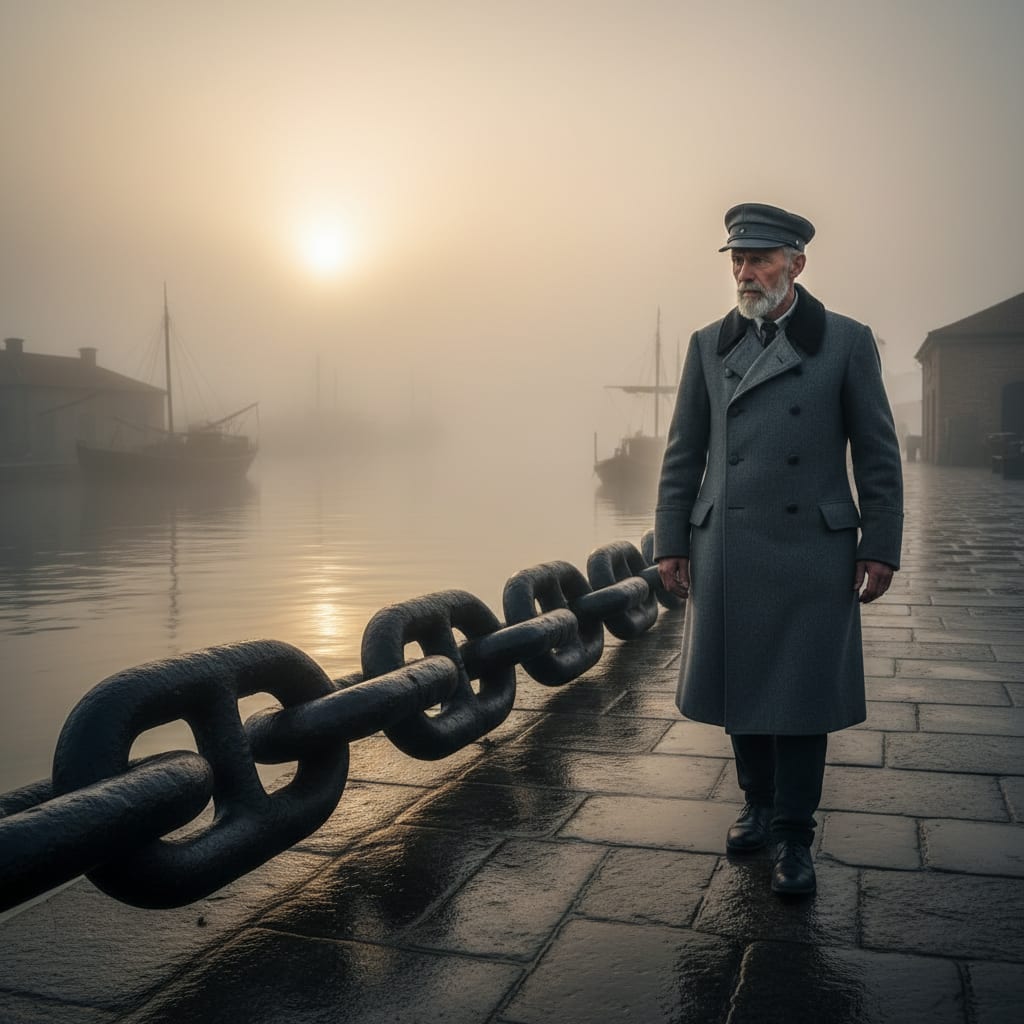
This is the fact that Harbormaster Joram Clee records in his daily inspection log, and has recorded every day for thirty-nine years, and will presumably continue to record until the Bureau of Records runs out of ink or Clee runs out of years, whichever comes first. The entry is the same each morning: the chain's condition (satisfactory), the chain's temperature (ambient), the chain's luminosity (nil). Three lines. Thirty-nine years. Fourteen thousand two hundred and thirty-five entries, each identical, each filed in triplicate, each countersigned by the harbor watch.
Clee is seventy-one years old. He assumed the post at thirty-two, replacing a Harbormaster who died at his desk — ink still wet, pen still in hand, cause of death listed as "administrative exhaustion, consistent with chronic overwork." Clee has not taken leave. Clee has not been ill. Clee has not, in the memory of any living person on the harbor staff, raised his voice, lost his composure, or expressed an opinion about anything that was not directly related to the operational status of a pier, a chain, or a mooring bollard. The Bureau of Purity has investigated him twice. He passed both times. The investigators noted, in their classified summaries, that Clee demonstrated "an absence of detectable motivation beyond duty, which is either exemplary devotion or something the Bureau does not have a diagnostic category for."
He knows the chain is dormant. He does not appear to regard this as a problem. He does not appear to regard it as anything. He records. He files. He walks the quay at dawn and dusk, counting links with his eyes, and when he reaches the far tower and turns back, his expression is the expression of a man who has confirmed that the world is as he left it, and who finds this neither comforting nor distressing, merely noted.
Earlier editions listed Harbormaster Clee's tenure as "thirty-seven years."
The Bureau of Records has corrected the figure to thirty-nine. Clee himself, when informed of the discrepancy, produced his own log — a personal journal, maintained in addition to the official record — which confirms thirty-nine years to the day. The two missing years had been omitted from the Bureau's tally by a filing clerk who transposed the dates on Clee's appointment writ. The filing clerk has been reprimanded. Clee's expression upon learning of the reprimand was, the reporting officer noted, "consistent with his expression at all other times."
#What Lies Beneath the Quay
The Harbor of Chains is a surface installation. Beneath it, things are less orderly.
The sub-vaults extend three levels below the quay, carved into the same Byzantine bedrock that supports the Ossuary Rings half a mile inland. The first level is storage — Bureau of War munitions, ration reserves, the materiel that cannot be left above ground where a well-aimed shell from the Thracian approaches might find it. The second level is the Harbor Patrol's operational headquarters, where the chain-winch mechanisms root into the bedrock and where the patrol boats are maintained in covered slips accessible through water-gates that open directly into the strait.
The third level belongs to Mother-Cryptor Sabine.
It is here that the Bureau of Shadows files its sealed records — the deep archives, the things recovered from corrupted Macedon caravans, the material too sensitive for the Ossuary Rings' general vaults. The Bureau of Purity's quarterly sweeps do not extend to the third level. The Bureau of Purity has been informed that the third level contains "records of historical interest, Classification: Maximum." The Bureau of Purity has accepted this. The Bureau of Purity has not, to my knowledge, asked what "historical interest" means in a vault whose temperature drops four degrees between the second stair and the third, and whose walls carry the faint residue of salt that has no marine origin.
#The Eleven Dark Nights
In the eighteen months preceding this writing, the Chain of Saint Anakletos has gone dark on eleven separate occasions. The harbor patrol logs for those nights attribute the loss of luminosity to "atmospheric interference." The Bureau of Rites produced a written theological explanation running to forty-seven pages, asserting that light, when it retreats from holy iron, is itself performing a kind of prayer.
I will say what the Bureau will not: the chain is dormant and has been dormant since A.S. 162, and dormancy is the natural condition of iron, and iron does not pray. What concerns me is that dormancy and darkness are different states. Dormant iron does not glow. Dark iron does not glow and should. The chain glowed for ninety-four years. It stopped. This is either the end of something or the beginning of something, and neither option comforts me.
On the fourth dark night — the Bureau of Records logged it as the 14th of Corvus, A.S. 200 — a single vessel moved through the strait. The harbor patrol's log does not record it. The chain, when it resumed its usual dormancy at dawn, bore three new links that no forge had produced and no hand had installed.
#On Service at the Harbor
To serve at the Harbor of Chains is to serve at the threshold of Constantinople — the place where the sea meets the war and the war meets the ledger and the ledger meets the water-stained desk of a clerk who has been filing manifests since before you were born and will be filing them after you are dead, and who does not look up when you enter because looking up is not in his operational brief.
The harbor employs, at present census, eleven hundred souls — chain crews, pier wardens, customs clerks, patrol sailors, munitions handlers, the winch-house engineers, the Bureau of Bells' harbor carillonist (who rings the arrival and departure peals from a small tower at the quay's midpoint and who sleeps, by regulation, in the tower itself, because the bells must be rung and the ringer must be present and the Bureau does not trust the concept of "running to work"), and Clee. Always Clee.
The harbor does not sleep. The strait does not sleep. The chain, dormant or dark or whatever it is becoming, hangs across the water each night like a sentence the Bureau has written and cannot quite bring itself to finish.
On the morning of the 7th of Argent, A.S. 199 — four days after the Vigil Ark's broadcast — Harbormaster Clee made a single deviation from his standard log entry. In the luminosity field, where thirty-nine years of records read "nil," he wrote: ████████████████. The entry was sealed by order of the Bureau of Doctrine within the hour. Clee resumed standard entries the following day. He has not been asked to explain. He has not offered to explain. The sealed page remains in the harbor archive, between entries 14,227 and 14,229. Entry 14,228 does not exist in the Bureau's index. It exists in the archive. The distinction between index and archive is, the Bureau assures me, procedural.