

#On the House as Registered
A widow in Constantinople who needs money goes to the Black Pennies. A widow who needs proof goes to the Grey Veils. A widow who needs a clerk to remember that she exists goes to the House of White Cups. More and more often, so does the clerk.
The Blue Zone civil registry of Bastion-Constantinople, at the Bosphorus end of the southern Line, lists three licensed Houses under charitable administration and lists them separately. It finds no corporate body called the Widow's Syndicate. The finding is accurate as far as it goes. The registry looked for a charter, a seal and a treasurer, and it found three of each in three different buildings, held by three women who sit at one table. The Houses are real, licensed and distinct offices. The registry declines to add them together, and the Bureaus have adopted its arithmetic because the alternative would oblige someone to write a memorandum.
White Cups is the smallest of the three. I have called it the richest and the most dangerous, and I repeat that assessment here under my own seal, since no other office has offered to share it. The Syndicate's account traces each House to the relief tables of the old rope-market below the seawall, where widows of the southern defence once brought witnesses to clerks who wanted forms. The Black Pennies can show descent from a lending chest. White Cups shows nothing. No charter year for the House appears in any register I have been permitted to read, and I will not borrow the rope-market's date to give it a birthday.
#On Hospitality and Corrections
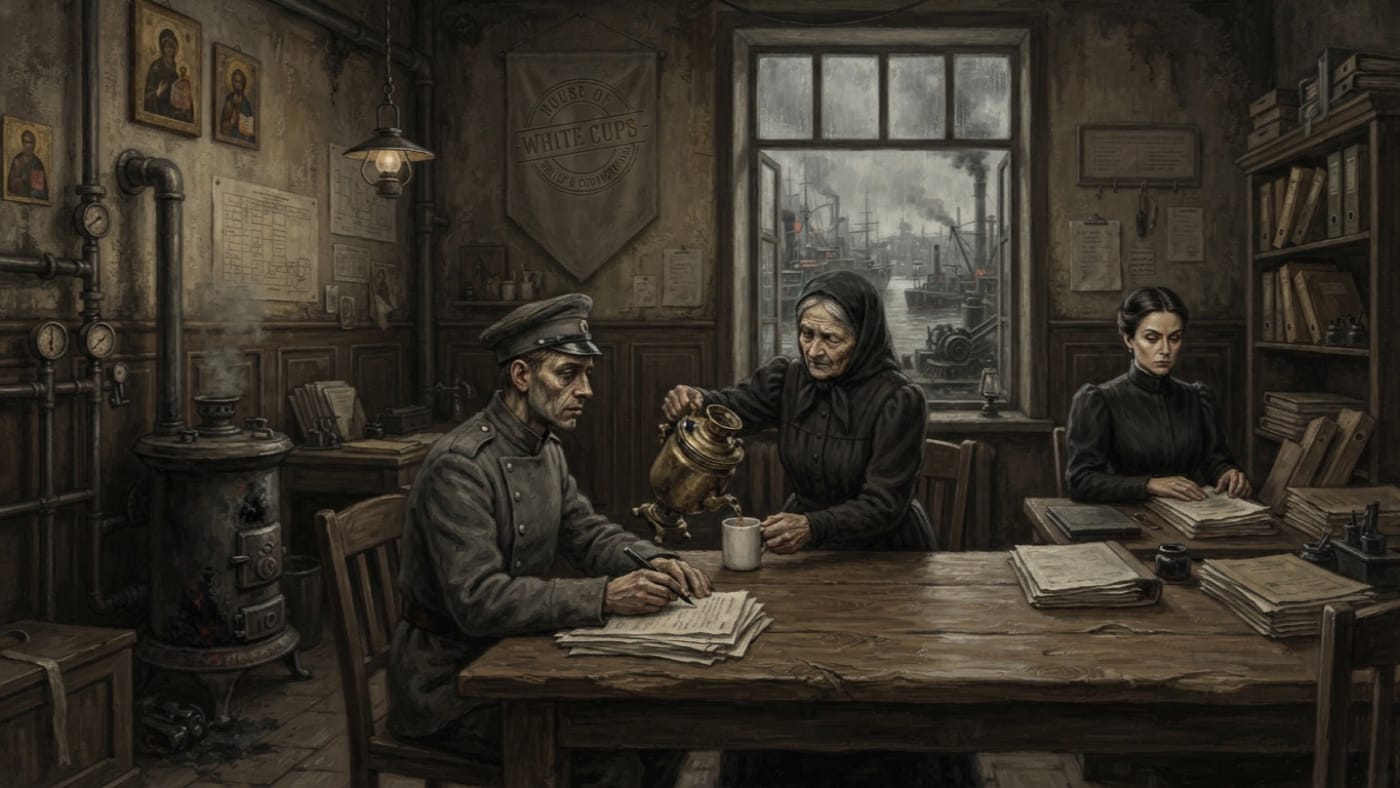
A White Cups relief office holds a table, chairs, a kettle and papers. Visitors come in. Tea is served. Papers are folded and handed across. That is everything an observer can swear to, and I have sworn to it, having sat there.
What follows a visit is recorded elsewhere, in other people's files. A man who has delayed a payment due to a widow finds a correction waiting on his desk, with the sum, the date it fell due and the clause he overlooked. An officer who refused a burial escort finds his own supply requisitions slowing. They are held up by a clerk whose aunt took tea at White Cups the week before. Nobody instructs the clerk, and nobody needs to. Constantinople is a city of households, and every household has an aunt. Every aunt has, at some hour of grief, been given a chair and a cup and had her paperwork put in order.
Inquisitors receive the same treatment. Those who arrive with direct questions get direct documents, complete and accurate, and then a second cup. The completeness is the House's quiet insult. An interrogator expects evasion and has brought tools for it. He has brought nothing for a folder that answers every question he wrote down and two he did not.
The tea has been tested, and it contains no drug. Its power lies in sequence: sit, drink, listen, sign. I keep a careful line between what the House does and what I infer from it. The House keeps no visible archive. From that absence I infer that it holds the best archive in the city, carried in the memory of every household it has served, where nobody can seize it, burn it or misfile it. That is my inference. It proves no secret repository, and I attach no sorcery to it. Old women remember things. The Synod's error has been to arrange its whole administration on the assumption that they forget.
The House has also been useful. When the Bureau of Purity needed a Crimson Concord courier identified, White Cups supplied the route, the name, the false tear pattern and a biscuit. That help shows the House's reach. It does not make the House a confederate of the Concord, and Purity, which took the name, has never suggested that it does.
#On the Cup-Matron and the Table
The Triune Table seats three matrons, one for each House, elected by household mark. The registry recognises that franchise in no other context. Mother Ledgermistress Anka Vey answers for the Black Pennies and their lending. Archivist-Widow Sareh Comnena answers for the Grey Veils and their household evidence. Cup-Matron Ilyena Sorn answers for White Cups.
Outsiders blur this division at their cost. Black Pennies holds the money and Grey Veils holds the paper. White Cups holds the room where money and paper are introduced to the official who must act on them. A correction that lands on a desk after tea may have been costed at Vey's counters and checked against Comnena's files, but the House that poured took custody of neither. Its trade is the meeting itself, and the obligation the meeting leaves behind.
On the Cup-Matron herself the file holds the office and little more. Her election year, her term and her predecessor are missing from every register open to me. I once called her subtle, meaning it as flattery. She told me I was simply slow. I have disliked her with admiration ever since, and nothing in the record has encouraged me to revise either half of that.
The House depends on households the way a parish depends on its baptismal roll. Each chair at the table stands for a household that came once in mourning and will remember the cup. Take the households away and White Cups is a kettle in a rented room. The Bureaus have noticed this and concluded that the House is weak, which is the wrong conclusion.
Port circulars of the Constantinople administration described the Widow's Syndicate as "an informal charitable association of limited administrative relevance."
The characterisation is withdrawn as it applies to the House of White Cups. A House that can stall a War requisition through a clerk's aunt, and defer a Purity sweep by offering tidier files, has the administrative relevance of a countersignature. Nobody sees it until it is missing.
#On Accounts Without Names
The House came to the Codex's notice this season because of a denial. Matej Sorn is a cooper's assistant of the Blue Zone, filed as Subject Argent-1. He received the Screaming Coin in A.S. 197 and has not slept since. The Bureau of Medicine's final review, dated A.S. 201, observes no sleep, no fatigue and no proven contamination, and it recommends keeping him away from coinage. The rest of his history belongs to his own file, and I will not drag it in here.
He lives in a room above a cooper's yard. The rent comes from an anonymous relief account, and White Cups denies administering it.
I have read the denial. It is short and properly signed, and it says what it says. Nothing in the record shows it to be false. The account pays on time, which in Constantinople is a distinguishing mark in itself, and whoever controls it has kept their name off every paper I have been shown.
Two inferences offer themselves, and I refuse both. The first says that a quiet, prompt relief payment in the Blue Zone must be White Cups' work, because quiet promptness is the House's style. Style is not authorship. Half the district has learned the House's manners at its table, and any household could imitate them. The second says that the Cup-Matron and the tenant share a surname and must therefore be kin. No register I have seen records any relation between them. Until a baptismal roll says otherwise, a shared surname is a coincidence in ink.
So the account stays nameless and the denial stands undisturbed. Sorn stays in a room whose rent is the one part of his life that behaves.
#On Inquiry and Present Standing
The clearest example of the House's method under scrutiny concerns the Syndicate vault beneath the Harbor of Chains. The vault belongs to the Syndicate's wider file, and its irregularities are no part of this entry. Purity requested a sweep. White Cups asked whether Purity would prefer the records of eleven administrative widows, made widows by Purity's own corrective actions of A.S. 183, to be reconciled before the sweep or after it. Purity deferred.
The question carried an offer of service and a list of names, and it refused nothing. Purity could have answered "after" and carried on. On reflection it found that it did not want eleven widows reconciled in the same week it searched the houses that relieve them. The sweep remains postponed. I call that a well-timed courtesy. Purity calls it procedure. Both words describe the same chair.
The Harbor Patrol, whose apprentices work nearest the vault, connects White Cups with harbor-side hospitality and can prove little beyond that. One apprentice reports hearing teaspoons behind a blocked cistern. I record the teaspoons and draw nothing from them.
The other Bureaus have theories. The Bureau of Tithes estimates Syndicate reserves at four times the declared figure. Purity suspects the Velvet Choir, as it does of any room containing women and no minute-taker. War imagines credit hoarded against a breach. Each of these is a position. None is a finding. No formal charge lies against the Syndicate as of A.S. 201. That acquits no individual officer of anything. It means only that nobody has yet written the charge and got through the tea.
My own position is compromised, and I record that before someone else does. In A.S. 194 I signed away a Doctrine clerk's pension and then forgot his name. The appeal came back to me across a White Cups table, corrected, costed at Black Pennies' counters and folded by a hand I did not see. I have paid the arrears. Nobody has asked me for anything more. I await the invoice.