
#On the Name
“At the ninth bell, the doors open and the bread comes. Except when it does not. The bell tolls regardless.” — Synodal Ration Catechism (Unregistered), revised edition, A.S. 144
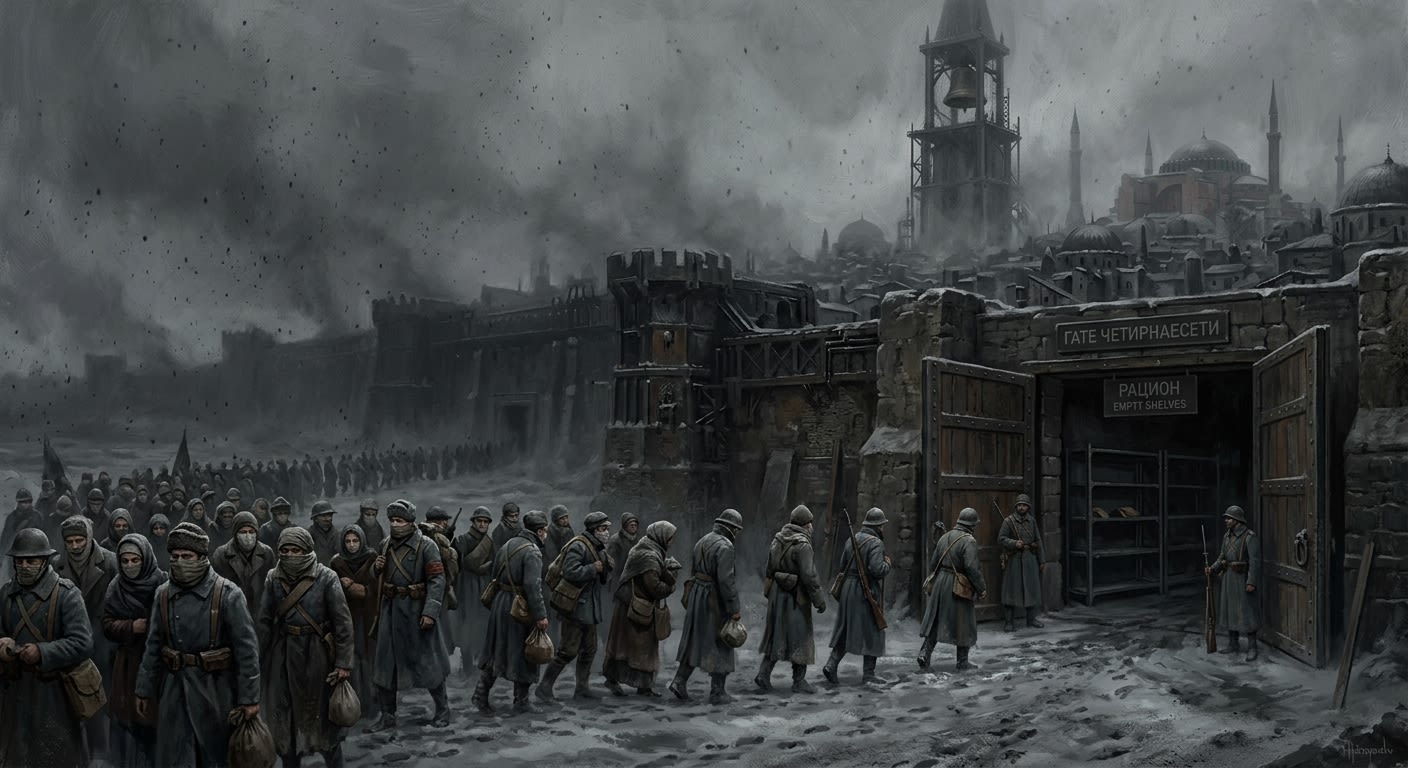
Every settlement within three hundred miles of the Sagittal Line distributes its bread at the ninth bell. The system is old, invariant, and holy — sanctified by the Bureau of Doctrine under the Ration Catechism of A.S. 92, which declares that bread given at the ordained hour is sacrament, and bread given at any other hour is mere sustenance, and the distinction matters, and the faithful will understand why the distinction matters when they are hungry enough. The ninth bell tolls. The doors open. The clerks stamp. The queue moves. Thirty minutes. Then the doors close, whether or not the queue has been served, because the bell schedule does not accommodate the appetites of the living.
In the year A.S. 143, the ninth bell tolled across the eastern prefectures and the doors opened and there was nothing behind them.
The Ninth Bell Famine is the name the Bureau assigned. Soldiers called it the Ash Hunger. Chaplains called it the Grey Season. The dead, who were sixty-eight thousand in number by the time the Bureau stopped counting, called it nothing, because the dead do not name things, and because the Bureau had not yet invented a form for posthumous complaint.
#On the Cause
“A fire is a fire. The theological significance of fire is determined after the fire, by the Bureau, in consultation with whoever survived.” — Bureau of Doctrine internal memorandum, A.S. 143
Maldrake burned the Thracian forests.
This requires elaboration, though Maldrake would not have thought so. The Thracian Plain north of Bastion-Constantinople was, in the spring of A.S. 143, still partially forested — vast tracts of old growth that the Bureau of Engineering had classified as “strategic timber reserve” and the Bureau of War had classified as “flammable, regrettably.” Both classifications proved correct. The timber was strategic. The timber was flammable. Maldrake resolved the competing assessments by igniting the entire forest in a single night.
The forests burned for three weeks. The ash rose. The ash did not come down for nine months.
Let me be precise, because imprecision in matters of atmospheric theology is how careers end: the ash from the Thracian fires entered the upper atmosphere in sufficient quantity to darken the sky over Constantinople and six neighbouring prefectures from mid-Lenten to the Feast of Doctrinal Submission the following year. The Bureau of Engineering dispatched surveyors who measured ash-fall density at seventeen monitoring stations across the eastern theatre. Average deposit: two inches per week. Peak deposit, at Station Twelve (the Foundry Quarter roof, south of the Sixth Ravelin): nine inches in a single night. The surveyors reported that standing in the open for ten minutes coated a man in grey from crown to boot, and that breathing without a rag pressed to the mouth was inadvisable, and that the ash tasted — this was noted with some professional distaste — of charcoal, sulphur, and something the senior surveyor described as “cooked stone.”
The crops failed.
This is the sentence the Bureau of Records wished to avoid, and it is the sentence I am required to write. The crops failed across the eastern prefectures. The grain stores at Constantinople, which had been calculated to last through a standard siege season of six months, were consumed in four. The supplementary stores at the Foundry Quarter — requisitioned from the civilian granaries by the Bureau of War under Emergency Provision 17-C — lasted another two weeks. The reserve stores beneath the Ossuary Rings, which were not supposed to exist and which the Bureau of Tithes had been quietly filling since A.S. 130, lasted one week beyond that. After which there was nothing.
#On the Ash
The ash was the enemy's weapon, and it was a better weapon than his artillery.
Maldrake's shells, which had been falling on Constantinople at irregular intervals since the Line solidified in A.S. 65, killed soldiers. The ash killed everyone. Soldiers, civilians, clerks, children, pilgrims trapped in the eastern approach corridors, mules in the supply trains, horses in the cavalry stables, rats in the granary walls — the ash was democratic in a manner that the Synod's own governance has never achieved. It fell on the just and the unjust, on the faithful and the questionable, on the Bureau of Doctrine's roof and the tavern keeper's cellar with identical thoroughness.
The ash clogged the water cisterns. The Bureau of Engineering dispatched teams to clear the intake filters every six hours; by the fourth month, the teams were clearing every two hours; by the seventh, they had installed permanent ash-traps at every cistern mouth in the city, and the ash-traps themselves required cleaning, and the men who cleaned the ash-traps developed a cough the Bureau of Medicine classified as “ash-lung, occupational, Category Two” and treated with a tincture of chrismole oil and prayer in proportions the Bureau declined to specify.
The ash coated the ravelins. Gun embrasures filled overnight. Sentries on the Ravelin of Vigilance reported that the ash settled on their rifle barrels and fused with the metal in patterns the Bureau of Rites described as “coincidental.” The Bureau of Engineering described the same patterns as “corrosive.” The Bureau of War described them as “operationally irrelevant provided the guns still fire,” and the guns still fired, though their accuracy declined by an estimated fourteen percent over the nine-month period — a figure the Bureau of War logged as “within acceptable deviation” and which the sixty-eight thousand dead might have described otherwise.
Prior Bureau of Records inventory logs (A.S. 140–142) describe the Thracian forests as “an inexhaustible timber asset.” The characterisation has been revised. The forests were exhaustible. Maldrake exhausted them. This erratum replaces Standing Assessment 140-T/TIMBER with revised assessment 144-T/ASH.
The ash fell on the Host.
I record this because a chaplain named Father Aldric of the Seventh Ravelin recorded it, in a field dispatch dated fourteenth of the sixth month, A.S. 143, addressed to the Bureau of Doctrine, in which he stated — and I quote because I retrieved his dispatch from the sealed correspondence archive myself — that “the faithful cannot distinguish the Consecrated Host from the soot upon their tongues, and I fear that neither can I, and I wonder whether this distinction was ever as clear as the Catechism claims.” Father Aldric was reassigned to the Bureau of Bells, Northern Division, within the week. His dispatch was classified as “theologically imprecise.” His observation, however, was empirically accurate: the ash tasted of nothing, and the Host tasted of nothing, and the faithful ate both and were nourished by neither.
#On the Famine Itself
The granaries emptied by the fourth month. The ration system, designed for siege conditions and tested against Maldrake's conventional assaults, had never been calculated for a nine-month atmospheric siege in which no shell fell and no wall was breached and the enemy's only weapon was the sky itself. The Bureau of War requisitioned civilian food stocks under Emergency Provision 17-C on the first day of the second month. The civilian population, which had been allocated four hundred grams of bread per person per day under the Standard Ration, was reduced to two hundred grams. Then one hundred. Then fifty, which is bread only by clerical courtesy and a theological gesture in substance — a reminder that bread exists, that the Synod controls its distribution, and that gratitude is appropriate even when the stomach disputes the premise.
The ninth bell tolled. The doors opened. The queues formed in the ash and the grey light, shuffling forward in that patient resignation which the Bureau of Doctrine calls faith and the Bureau of Medicine calls caloric deficit. At the head of the queue, the ration clerks sat behind their stamps and ledgers with nothing to stamp and nothing to distribute, and they stamped the ledgers anyway, because the paperwork must be completed regardless of whether the transaction it records has occurred. A ration clerk at Gate Fourteen of the Third Prefecture stamped 1,240 empty distributions in a single day — each entry bearing the name, parish registration number, and allocated portion of a citizen who received nothing. The Bureau of Records filed these as “completed transactions.” The citizens filed them as reasons to die.
The black markets appeared within the first month. Bread at forty times the regulated price. Mule meat — the cavalry's dead draught animals, slaughtered by quartermaster's order when the forage ran out — at twenty. Rat, which Constantinople had always had in surplus, at prices that fluctuated with supply and demand in a manner the Bureau of Tithes found academically interesting and morally unacceptable, though the Bureau of Tithes' objection was to the unregulated commerce rather than to the consumption of vermin. The Bureau of Purity executed nine black-market profiteers in the first three months. The executions did not reduce the black market. The executions reduced the number of profiteers by nine, and the remaining profiteers raised their prices to compensate.
The soup kitchens opened. The Bureau of Mercy, which in normal times handles deafness, combat injury, and “devotional incapacities” with the serene detachment of an institution that believes suffering is sanctifying, found itself operating forty-three emergency feeding stations across Constantinople's seven administrative zones. The soup was thin. The Bureau of Mercy's official recipe — water, bone-meal, salt, and a blessing — sustained life in the medical sense and mocked it in every other. Chaplains blessed each cauldron. Whether the blessing improved the nutritional content is debated by departments that have better things to argue about and choose this argument instead.
#On the Dead
Sixty-eight thousand.
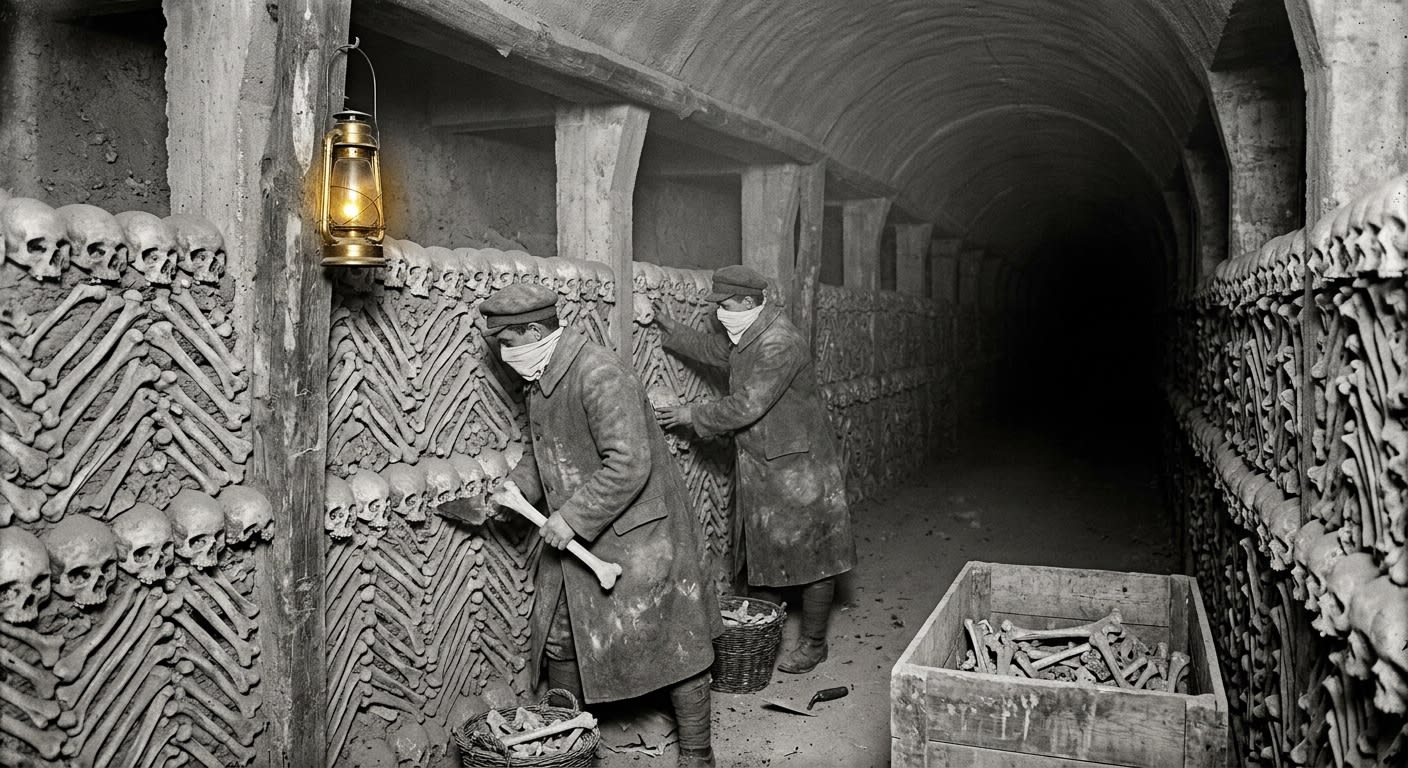
The Bureau of Records logged them over the course of seven months, in a process that was itself a form of administration that bordered on art. Each death required a name, a parish registration number, a cause (listed uniformly as “caloric insufficiency secondary to atmospheric contamination”), a burial assignment, and a stamp. The stamps had to be replaced twice during the famine — the first batch exhausted by sheer volume, the second batch corroded by the ash that infiltrated the Bureau of Records annex at the Seventh Prefecture and turned the ink to paste. The third batch of stamps was manufactured from bone, because bone was the one resource Constantinople did not lack.
The Ossuary Rings expanded by a quarter-mile.
I write this as a geographic fact. The six concentric rings of catacomb-fortification that surround Constantinople's inner defences — the oldest sealed since A.S. 47, the newest under continuous expansion — grew by a quarter-mile of new tunnelling between the fourth month and the ninth. The Bureau of Engineering supervised the excavation. The dead were the material. The tunnels were lined with the bones of the sixty-eight thousand in the pattern specified by the Bureau of Rites — skulls facing outward, long bones set in chevron courses, vertebrae packed as mortar fill — because the Synod wastes nothing, and the dead are structural, and the Ossuary Rings serve as both cemetery and fortification, and the distinction between the two is, in Constantinople, largely administrative.
The children died first. Then the elderly. Then the ill, the infirm, the unregistered, the pilgrims trapped in the approach corridors, the denizens of the Warrens whose ration cards had been revoked for administrative infractions, the orphans whose caretakers had themselves died and whose ration claims required a living guardian to process. The Bureau of Records maintained the queue. The Bureau of Records maintained the queue with absolute precision throughout the famine. Every name was logged. Every death was stamped. The Ledger did not miss a single soul. The Ledger, in this as in all things, was perfect. The people whose names it contained were the ones who failed.
#On the Chain
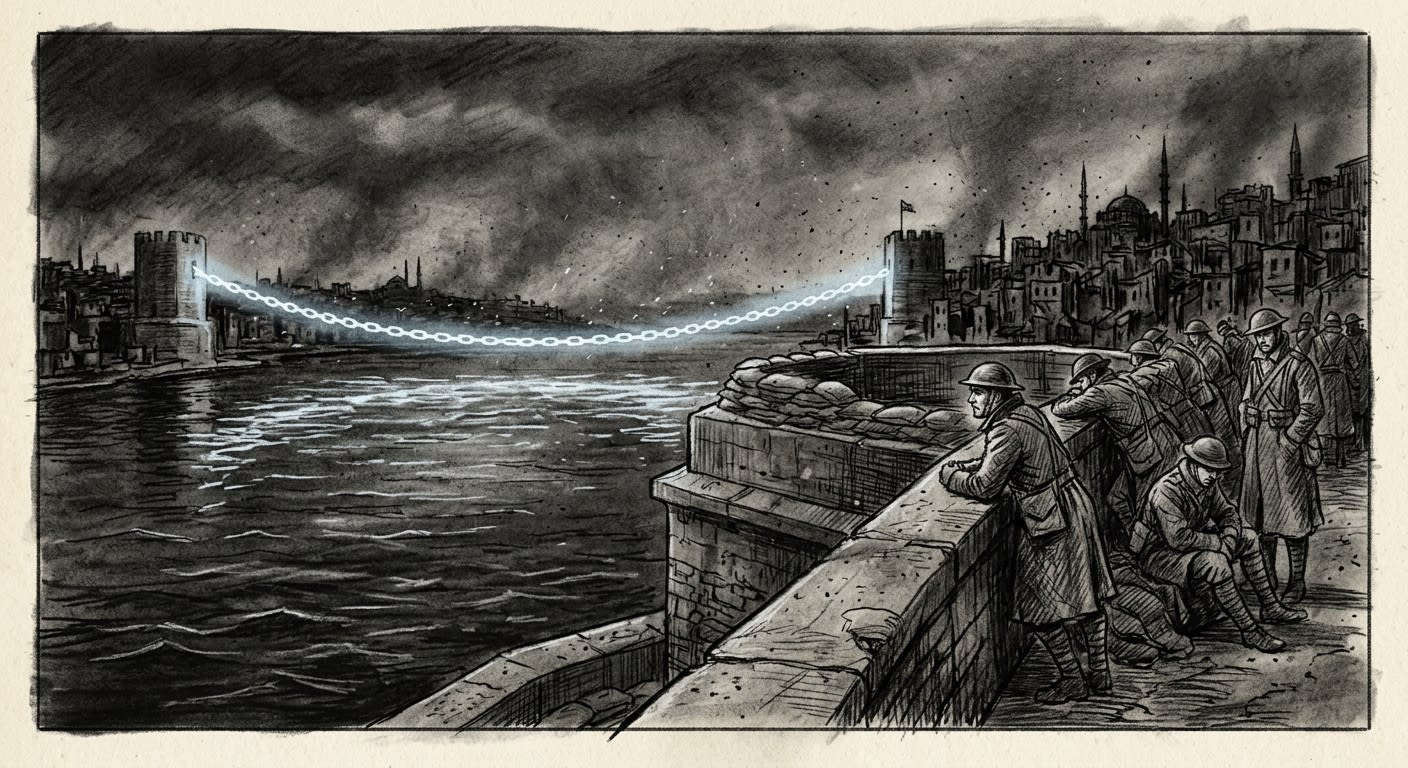
The chain booms across the Bosphorus glowed.
This had never happened before. The Chain of Saint Anakletos, the reliquary chain boom strung across the strait to prevent demon-fleet incursion, had been cold iron and consecrated links since its installation in A.S. 68. It had held against storms, sabotage, corrosion, and a direct assault by Kargath's barge-swarm in A.S. 112. It had not glowed. It had done its duty as metal does duty — passively, structurally, without commentary.
In the seventh month of the famine, the chain began to emit light. Not heat — the Bureau of Engineering was very specific on this point, submitting a fourteen-page metallurgical assessment that distinguished between “luminous expression” and “thermal emission” in language that I suspect was designed to prevent anyone from understanding the distinction. The chain glowed white. The glow was visible from the Ravelin of Vigilance at night. The glow persisted through dawn and into the following night, fading only when the ash-fall thinned briefly during the seasonal wind shift.
The faithful took it as a sign. The Bureau of Doctrine, which had been struggling to frame the famine as anything other than a catastrophe, seized on the chain's luminance with the enthusiasm of a clerk discovering a misplaced receipt. The glow was proof, the Bureau declared, that the Creator had not abandoned Constantinople — that divine power resided in the holy instruments even as the human instruments faltered — that the famine was a test, and the chain was the answer, and the answer was: endure.
The dead endured nothing. The living endured everything. The chain glowed between the two positions and resolved neither.
#On the Aftermath
The ash stopped falling on the Feast of Doctrinal Submission, A.S. 144. The Bureau of Rites declared this timing “providential.” The Bureau of Engineering declared the atmospheric conditions “consistent with prevailing wind pattern analysis.” Both Bureaus published their conclusions on the same day, in documents of equal length, filed in adjacent drawers of the same cabinet, and neither acknowledged the other's existence.
The crop cycle required two full growing seasons to recover. Emergency grain convoys from Strasbourg — diverted from the northern supply corridors at the cost of three months' reduced rations at Bastion-Brest and Bastion-Przemyśl — arrived in Constantinople by late A.S. 144. The convoys were insufficient. They were always going to be insufficient. The Bureau of War had calculated the convoy capacity against Constantinople's peacetime population; the famine-era population, swollen by refugees from the eastern prefectures who had fled the ash-fall and arrived at the gates with nothing, exceeded the calculation by thirty percent.
The Bureau of Records conducted a full census in A.S. 145. The population of Constantinople and its dependent prefectures had declined by sixty-eight thousand, seven hundred and twelve — a figure that differs from the logged casualty count by seven hundred and twelve, a discrepancy the Bureau attributed to “late filings” and which I attribute to the seven hundred and twelve people who died after the Bureau stopped counting because the famine was officially over and the dead were no longer administratively convenient.
The Bureau of Rites' classification of the Ninth Bell Famine as a “refining tribulation” was issued A.S. 143, during the famine. The Bureau of Records' casualty figure of 68,000 was issued A.S. 145, after the census. The classification preceded the count. The Bureau classified the theological meaning of the dead before it knew how many dead there were.
This is noted without comment, as is appropriate for an erratum, which is a correction of fact, not an expression of opinion. My opinion, were it to be expressed, would require a separate form.
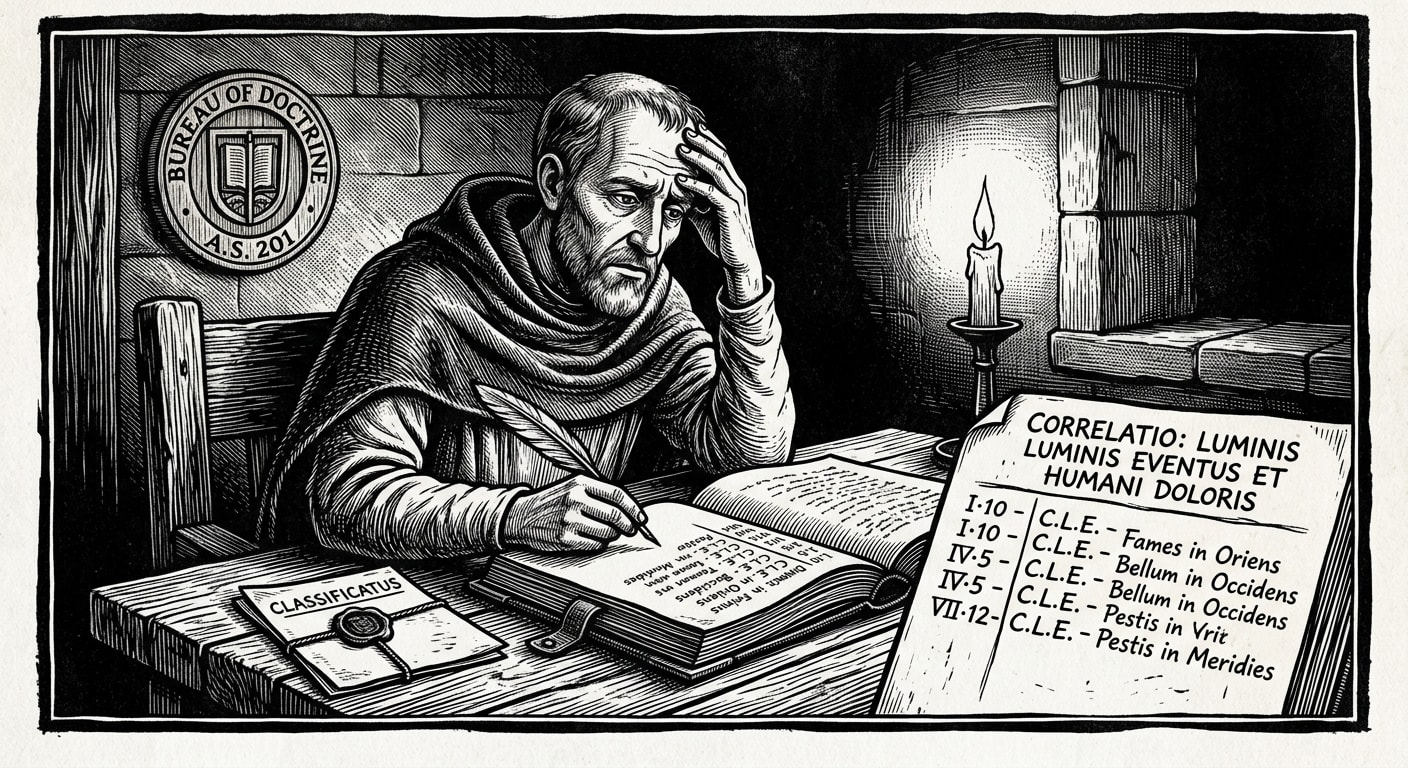
The year A.S. 143 left other marks. Across the Synod's territories, from the Candlewick Palatinate to the Peregrine Row, a wave of anomalous classifications washed through the Bureau system. The Bureau of Alchemical Standards noted that the black snow at Lor began arranging in patterns that same year. The grief resonance at the Widow's Pennies Exchange was confirmed by the Bureau of Bells. The Hungry Ink at the Candlewick Palatinate was first correlated with atmospheric ash. The Echo Creed at Peregrine Row worsened — the canyon returned prayers with a new vowel, as though the stone had learned a different catechism during the months of grey. The corpse-light at the Marshworks was first noted by Bureau surveyors. The Burnless Archive beneath the Steppe Gate was tested by the Bureau of Alchemical Standards and found to be, in their phrasing, “thermally non-compliant.”
Whether these phenomena were caused by the ash, or merely revealed by it — whether the Thracian fires woke something in the continent's substrate, or whether the fires simply drew the Bureau's attention to things that had been quietly wrong for decades — is a question I am not authorised to answer and do not intend to ask.
#On the Ninth Bell
The bell still tolls. The ration system, rebuilt between A.S. 144 and A.S. 150 under a joint mandate of the Bureau of War, Bureau of Tithes, and Bureau of Mercy, now maintains a six-month strategic reserve at Constantinople, supplemented by quarterly convoys from Strasbourg, Munich, and the Palatine Switchyard of Lorn. The reserve is inspected twice yearly. The inspections are conducted by three Bureaus simultaneously, each with its own ledger and its own definition of “adequate,” and the three definitions have never once aligned.
The ninth bell tolls at Constantinople every day. The doors open. The bread comes. The queue moves. The clerks stamp. Thirty minutes.
The sixty-eight thousand are in the walls. Their bones line the quarter-mile extension of the Ossuary Rings that was dug during the famine months, and the bones face outward, as the Bureau of Rites specifies, so that the dead defend the city they could not survive. The tunnel is called the Ash Gallery. Pilgrims visit it on the third day of the Constantinople commemorative circuit. The air smells of lime and old stone. The skulls are grey with a residue the Bureau of Engineering has identified as charcoal particulate fused with calcium at the molecular level — the ash and the bone become one thing, a substance that does not appear in any Bureau manual and which the Bureau of Alchemical Standards has classified, with an institutional shrug that I find both candid and alarming, as “novel.”
The bell tolls. The bread comes. The names are in the Ledger. Sixty-eight thousand, seven hundred and twelve.
Nihil obstat.