
#On the Origin of Quiet
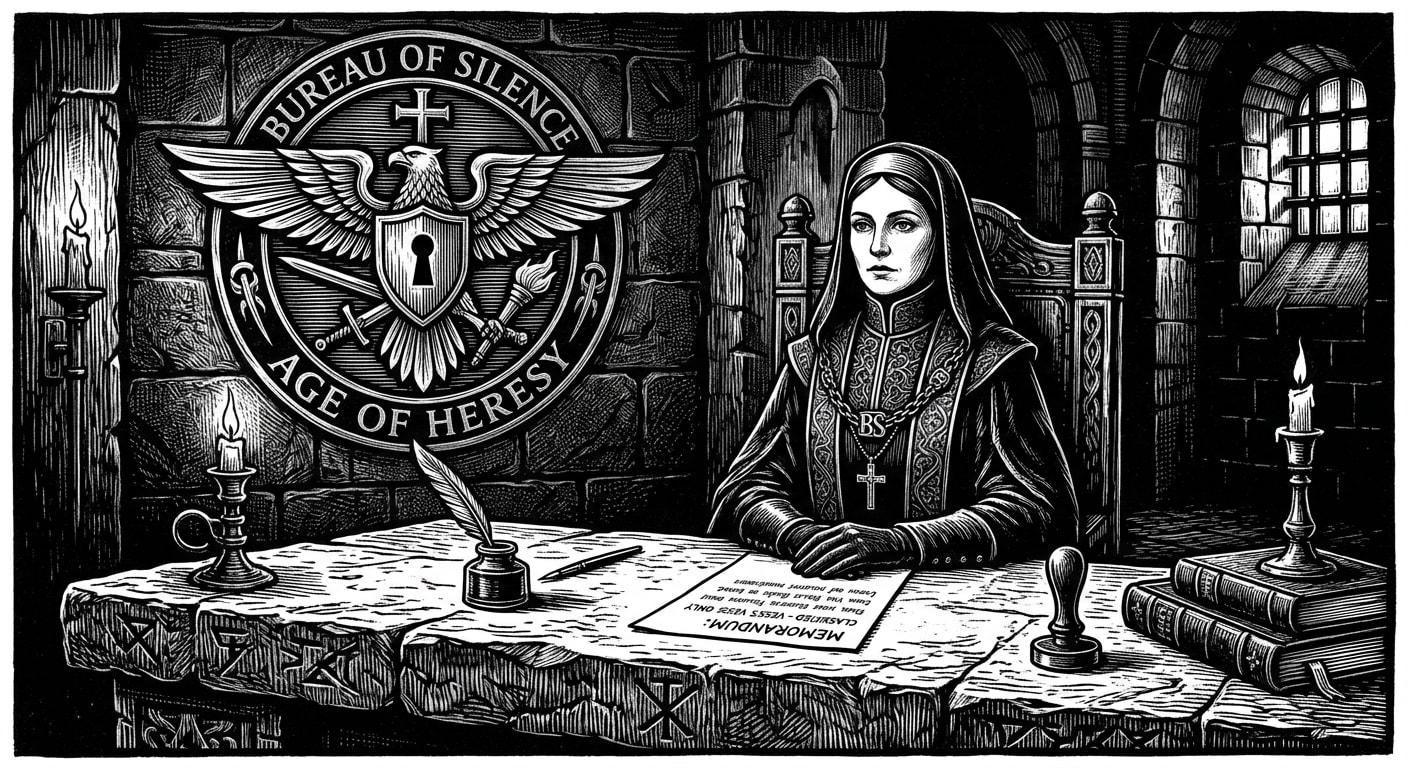
"The word unspoken cannot wound. The word unwritten cannot spread. The word drowned in ink cannot rise. We are physicians of language, surgeons of the page — and our scalpel is black." — Censor-Prelate Aldara Vess, Charter Address, A.S. 82
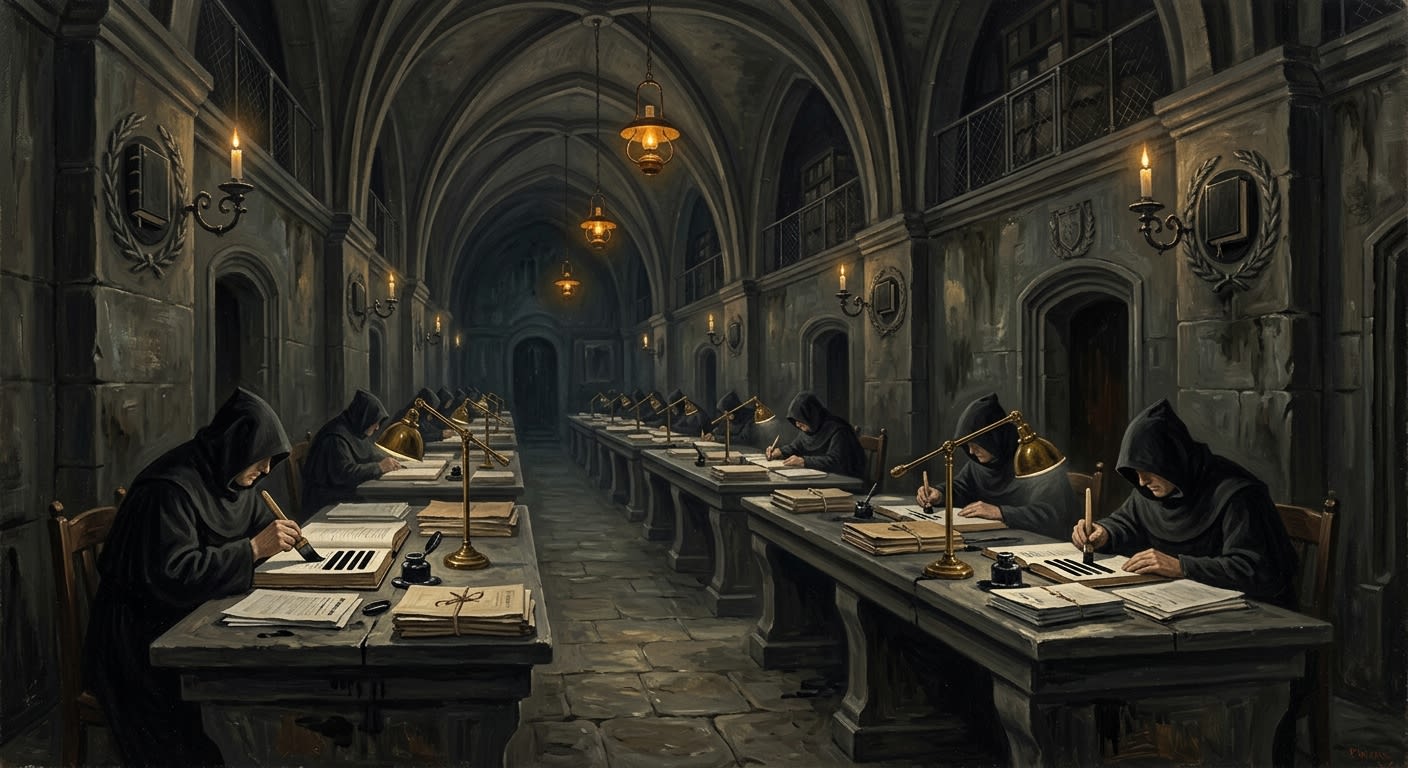
Every Bureau claims its founding was necessary. The Bureau of Silence claims its founding was inevitable — that the moment the first word was committed to vellum, there existed already the need for a second word to blot it out. This is theology, of a sort. The Bureau prefers it to history.
The practical truth: the Bureau of Silence was constituted in A.S. 82, in the same administrative season that gave the world the Bureau of Purity and the Bureau of Records' first jurisdictional expansion. Where Purity would judge the heretic, and Records would file the judgement, Silence would ensure the heretic's words died before his body cooled. Three bureaus, three functions, one outcome: the management of what may be known.
The immediate cause was the Rationalist libraries. When the Atheist Wars concluded and the Sundering shattered whatever remained of the old secular order, the Synod inherited a continent's worth of pamphlets, treatises, astronomical charts, philosophical correspondences, and anatomical diagrams — the accumulated intellectual output of a civilisation that had spent fifty years dismantling faith with footnotes. Burning it was the obvious solution. Burning it completely was the problem.
Paper, it transpires, is stubborn. The fires at the great university purges of A.S. 48–55 consumed buildings, certainly, and librarians, regrettably, and a great deal of binding cord — but the words themselves proved harder to kill. Fragments survived in hearths. Pages blew across courtyards and lodged in gutters. Scraps were smuggled in trouser linings, in bread loaves, in the hollowed heels of penitents' boots. Within a decade of the first great purge, the Bureau of Doctrine estimated that more banned texts circulated in the western provinces than had existed in the original libraries.
The solution required an institution. The solution required ink.
#On the Substance of Ink
"We do not destroy knowledge. Destruction implies the prior existence of a thing, and a thing that has existed may be mourned, and a thing that is mourned may be sought, and a thing that is sought may be found. We render knowledge into a state of administrative non-occurrence. What was never written cannot be read. What cannot be read cannot corrupt. What cannot corrupt does not require our attention — and yet, here we are." — From the Bureau of Silence Catechism, Third Revision, A.S. 104
The Bureau of Silence licenses every library and archive within the Synod's jurisdiction. Every. Library. The parish shelf in a Rhineland village holding fourteen books of psalms requires a Bureau of Silence license stamped with the Seal of Approved Content. The monastery of Sant'Angelo near Milan, with its two thousand volumes of approved hagiography, submits to a triennial Bureau audit during which two Silence Inspectors examine every page, every margin, every illustration — and one illustration of a cherub in the Flemish style was removed in A.S. 187 because its left hand held three fingers in a configuration the Bureau classified as "gestural heresy."
The licensing is onerous. The auditing is worse. But the Bureau's true art — its craft, its theologians would say — is not the license but the redaction.
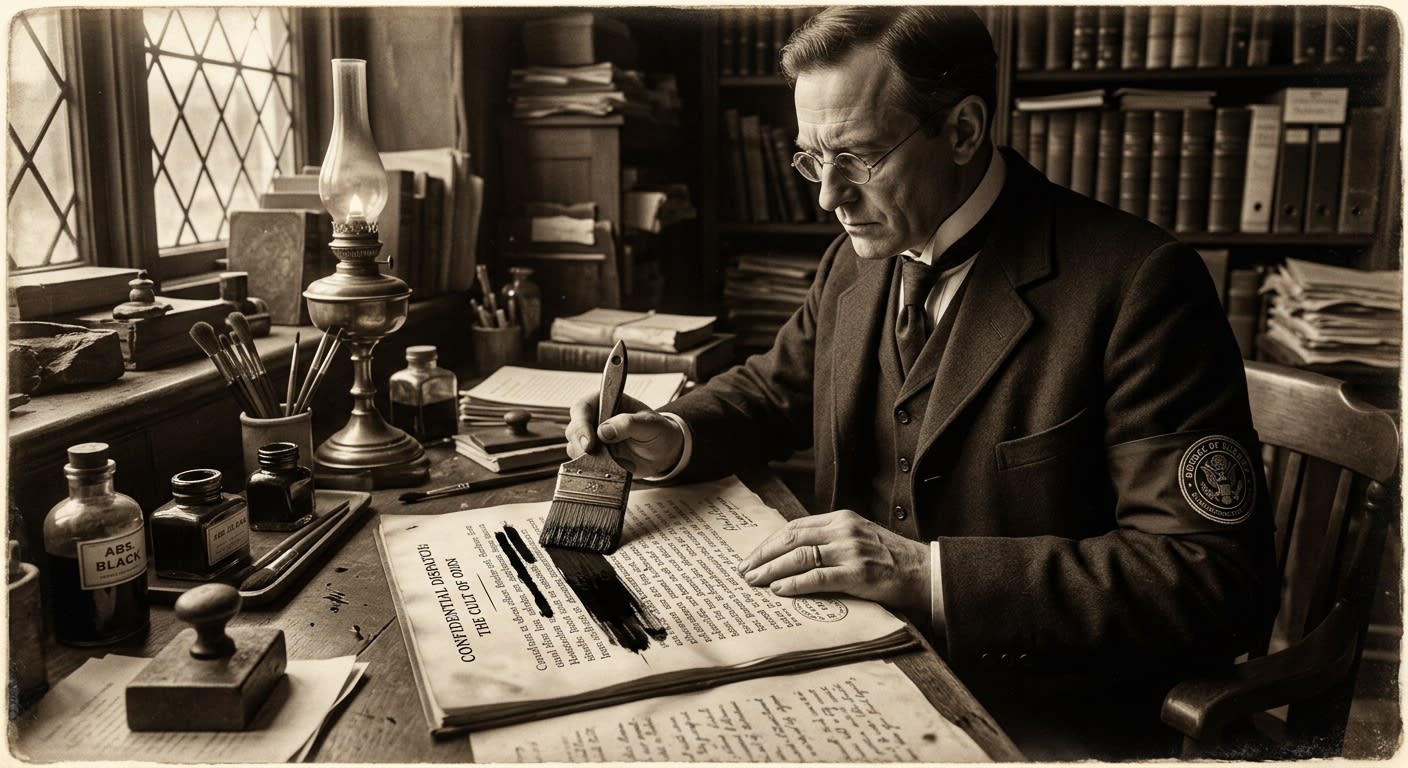
The ink of the Bureau of Silence is not common ink. It is brewed in the cellars of the Hollow-Script Scriptorium of Nemea from a formula the Bureau classified in A.S. 96 and has never declassified. What is known: it is iron-gall at its base, like all respectable inks, but infused with lamp-black from consecrated tallow, ash from the burning of prior redacted texts (a recursive ingredient that the Bureau of Doctrine has never fully endorsed), and a binding agent the Bureau of Alchemical Standards describes as "mineral, possibly calite, certainly unsettling." The ink is thick. It is very, very black. And it bleeds.
When a Silence Redactor applies the Bureau's ink to a line of text, the ink does not merely cover the words. It soaks downward through the vellum, through the verso, through the backing, and — in cases where the vellum is thin or old — through the shelf beneath. A redaction in the Bureau's ink is not a cosmetic gesture. It is a wound in the page, a black lesion that obliterates the word from both sides of the sheet and leaves a scar of opacity that no light penetrates and no solvent dissolves. Bureau of Engineering tests in A.S. 178 confirmed that Bureau ink bonds at a molecular level with the vellum substrate. The Bureau of Silence considers this proof that the ink is doing the Creator's work. The Bureau of Engineering considers it proof that the ink is a mild adhesive corrosive and should probably be studied further. Both assessments are filed. Neither has been acted upon.
A Silence Redactor — the Bureau's field operatives, of whom approximately three hundred are deployed across Europe at any given time — carries a kit of seven items: the ink pot (sealed in lead and blessed weekly), the application brush (boar-bristle, wide-cut, never cleaned, replaced monthly), the approval stamp (bearing the Bureau's seal — a closed book on a black field), the licence register, the parish assessment form, the Redactor's personal copy of the Approved Content Index, and a small bell. The bell is rung once upon entering a library. It is rung twice upon leaving. If the Redactor does not leave — if the library's contents prove so contaminated that the Redactor must remain for extended work — the bell is not rung at all, and the library is understood to be under interdiction until the silence is broken.
#On the Forbidden Stacks and the Hierarchy of Absence
"There are three kinds of knowledge: the known, the unknown, and the unwritten. The Bureau of Silence governs the third." — Attributed to Censor-Prelate Corvin, A.S. 140; attribution later redacted by the Bureau of Silence
The Bureau's operations proceed along three tiers, each representing a deeper grade of erasure.
The first tier is licensing and audit — the bread and butter, the daily labour. Three hundred Redactors, forty regional Audit-Cantors, and a clerical staff of six hundred maintain the continent's reading material in a state of doctrinal hygiene. Offending passages are redacted. Offending volumes are confiscated. Offending libraries are closed and their contents transferred to the Bureau's regional processing centres, of which there are seven — one per Bastion sector — each operating from a sub-vault of the nearest cathedral.
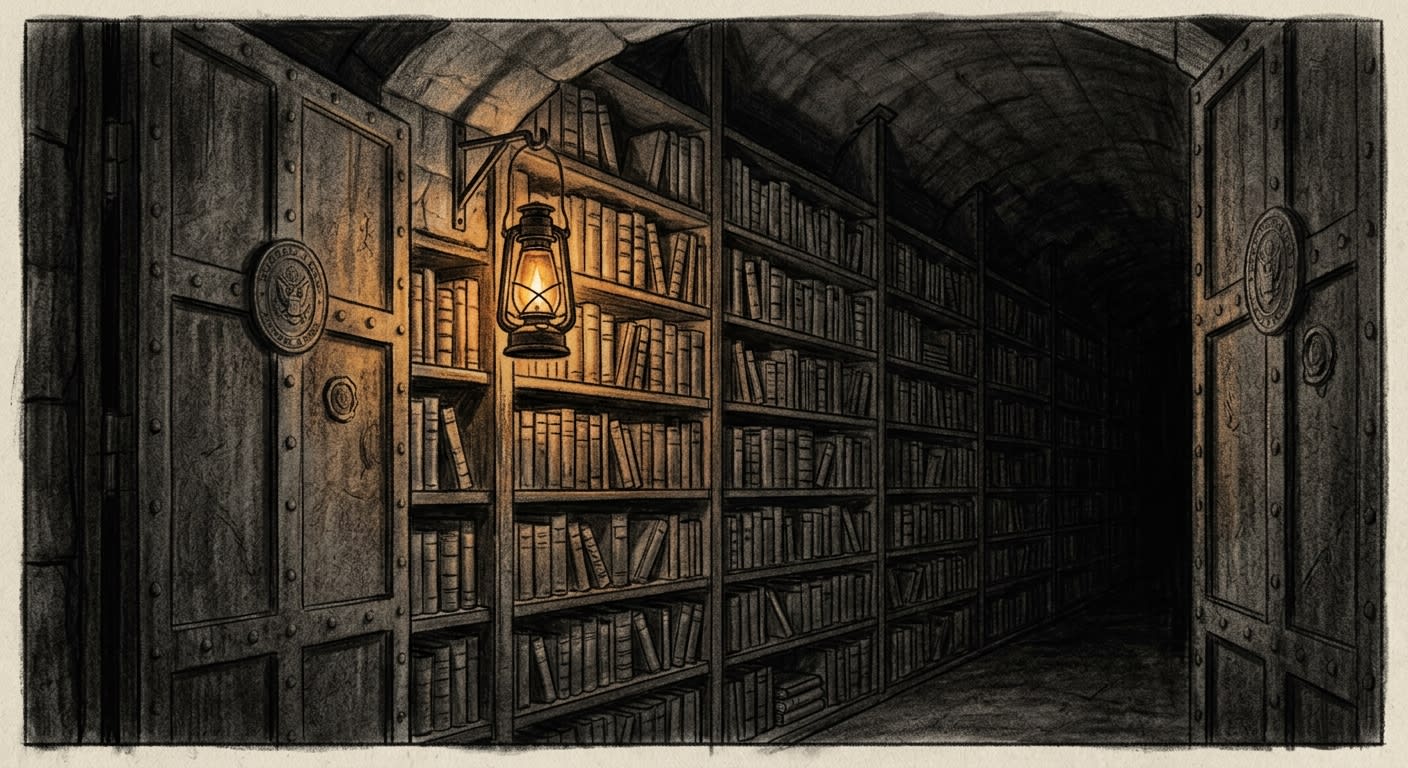
The second tier is restricted archival — the management of texts too dangerous to circulate but too valuable (or too dangerous) to destroy. These accumulate in the Forbidden Stacks, the triple-sealed repository beneath Strasbourg that houses the Synod's collection of everything it has suppressed. The Rationalist pamphlets from the Year of Letters. The astronomical charts of Kraków. The anatomical drawings of Padua. The theological disputations of Prague. The folk songs of Languedoc — forty-three of which contained a refrain that, when sung backward, allegedly spelled a Rationalist philosopher's surname, though the Bureau has never confirmed which philosopher, because confirming would require singing the songs backward, which is forbidden.
The Forbidden Stacks require a Synodal license to access. Access requires the written authorization of two Procurators and the counter-seal of the Bureau of Silence — not the Bureau of Purity, which controls the Index Damnatus, but the Bureau of Silence, which controls the physical texts. This distinction is jurisdictional and has produced six formal inter-Bureau disputes since A.S. 92, all of which remain unresolved. The Bureau of Purity decides what is forbidden. The Bureau of Silence decides where the forbidden is kept and who may see it. The two Bureaus regard each other with the particular loathing of neighbours whose property lines overlap.
The third tier is total erasure — the art for which the Bureau of Silence was truly constituted, and the art it practises with a reverence bordering on the liturgical. A total erasure does not merely redact a passage or confiscate a book. It removes a piece of knowledge from the record of human thought so thoroughly that the absence itself becomes invisible. The blank space where the knowledge stood is filled with Bureau ink until no scholar, no historian, no theologian can determine that anything was ever written there. The page reads as though the passage never existed. The footnotes that referenced it are amended. The catalogues that listed it are revised. The memories of those who read it are — the Bureau insists — left to fade naturally, though certain field reports from the Bureau of Purity suggest that the fading is occasionally assisted.
The Redaction of Epernay in A.S. 103 remains the Bureau of Silence's masterwork, though the Bureau of Records claims primary credit. In that operation — the details of which remain sealed under Ninth-Ratification — the Bureau erased an entire city. Every baptism, tithe receipt, marriage record, and property deed was reclassified into a filing category that does not exist. Within a season, the buildings stood vacant. Within a decade, the name "Epernay" appeared in no living person's memory. An empty valley remains where locals occasionally hear bells tolling in wind that stirs no towers.
Earlier editions of this entry attributed the Redaction of Epernay solely to the Bureau of Records.
Corrected. The Redaction was a joint operation requiring the coordinated efforts of the Bureau of Records (genealogical erasure), the Bureau of Silence (textual erasure), and the Bureau of Shadows (the nature of whose contribution remains classified). Archon Veyrault himself authorised the operation at age sixty-three. The Bureau of Records prefers to claim sole credit because sole credit implies sole competence. The Bureau of Silence prefers not to be mentioned at all, which is, one supposes, the point.
#On the Controversies — Or, the Sound of One Bureau Clapping
The Bureau of Silence operates in a jurisdictional thicket so dense that even the Bureau of Records' filing system cannot fully map it. The core tension: censorship in the Synod is not the province of a single institution.
The Bureau of Purity maintains the Index Damnatus — the catalogue of what is forbidden. The Bureau of Doctrine determines what constitutes heresy. The Bureau of Records controls the physical archives. The Bureau of Orison and Song licenses hymnals. The Bureau of Heraldry governs images and symbols. And the Bureau of Silence sits in the middle of all of them, claiming jurisdiction over "the physical manifestation of proscribed content in textual, inscribed, or graphic form" — which is to say, the words themselves, wherever they appear, in whatever medium, owned by whomever.
The result is a censorship apparatus of magnificent redundancy. A heretical pamphlet may be condemned by Doctrine, catalogued by Purity, filed by Records, and physically destroyed by Silence — each Bureau logging the action independently, each Bureau claiming the decisive contribution, none of them sharing ledgers. A folk song containing a banned refrain may be proscribed by Orison and Song, its sheet music confiscated by Silence, its lyrics added to the Index by Purity, and its melody classified as a Category Two Acoustic-Doctrinal Disturbance by the Bureau of Bells — and if the singer has embroidered the refrain on her apron, the Bureau of Heraldry may weigh in on the embroidery. The singer herself falls to the Inquisition. Her apron falls to Heraldry. Her tongue falls to Purity. Her memory falls, eventually, to Silence.
The jurisdictional disputes have produced monuments of bureaucratic absurdity. In A.S. 140, the Bureau of Silence and the Bureau of Purity spent eleven months disputing ownership of a confiscated almanac — Purity had condemned it (Index entry 4,891-C), but Silence had confiscated it (Seizure Order 77-F-140), and neither Bureau would release the physical volume to the other. The almanac sat in a locked cabinet in the corridor between their respective offices in Strasbourg for the duration of the dispute. When a compromise was finally reached — joint custody, alternating weeks — the almanac was found to have been eaten by moths. Both Bureaus filed the loss as the other's fault. The moths offered no testimony.
In A.S. 187, the Hollow-Script Scriptorium of Nemea — the Bureau of Silence's primary operational facility — was audited by the Bureau of Records, which discovered that seventeen per cent of the documents the Scriptorium had been commissioned to redact had instead been re-copied with the offending passages removed and replaced with doctrinally approved alternatives. This was not redaction. This was revision. The Bureau of Records considers revision its exclusive domain. The Bureau of Silence considers the distinction between redaction and revision "a matter for theologians, not archivists." The dispute remains open. The revised documents remain in circulation.
#On the Ashen Circle and the Economy of Absence
Where the Bureau of Silence creates absence, others fill it. The Ashen Circle — those clandestine scholars who traffic in forbidden causality, buying charred diaries from burn-pits and lifting margin-notes from monastery walls — are the Bureau's shadow economy, its inverse, its parasite and its proof of purpose. Without the Ashen Circle, the Bureau of Silence might question its own necessity. With them, it need never doubt.
The relationship is symbiotic in the way that the wolf is symbiotic with the fence. The Bureau burns; the Ashen Circle sifts the ash. The Bureau redacts; the Ashen Circle trades in fragments. The Bureau classifies; the Ashen Circle smuggles the classifications themselves — for a Bureau of Silence classification stamp, applied to a document, tells the Ashen Circle precisely what the document contained before it was rendered unreadable. Classification, it transpires, is a kind of index.
The Bureau's enforcement arm — the Interdiction Squads, drawn from the Bureau of Purity's lower ranks but operating under Silence's direct authority — conducts regular raids on suspected Ashen Circle cells. Between A.S. 195 and A.S. 200, forty-seven Ashen Circle operatives were apprehended across six provinces. Their contraband: seven hundred pages of pre-Sundering engineering diagrams, two hundred pages of astronomical observation, forty-three medical treatises, and one complete copy of a Rationalist cookbook that the Bureau of Purity classified as "gastronomic sedition." The operatives were sent to the Paper Mines of Ulm — a punishment the Bureau considers poetic, since the Paper Mines produce the very pulp from which the Bureau's redaction-grade vellum is manufactured. The heretic's labour, in this way, contributes directly to the erasure of heresy. The Bureau finds this satisfying. The Bureau finds a great many things satisfying that a healthier institution would find disturbing.
#On the Present Condition
"Silence is not the absence of sound. Silence is the presence of authority." — Bureau of Silence, Seal of Office inscription
The Bureau of Silence operates from the Cloister of Prescribed Silence in Strasbourg — a wing of the Cathedral district so thoroughly soundproofed that visitors report a ringing in the ears upon entry, as though the building itself is pressing upon the auditory nerve. The current Censor-Prelate is Aldara Vess the Younger — granddaughter of the Bureau's founding Censor-Prelate, a detail the Bureau considers evidence of institutional continuity and the Bureau of Purity considers evidence of nepotism. Both are correct.
The Bureau employs three hundred Redactors, forty Audit-Cantors, six hundred clerical staff, and an undisclosed number of Interdiction personnel seconded from the Bureau of Purity. Its annual budget is drawn from the Bureau of Tithes' "Doctrinal Maintenance" allocation — a line item the Bureau of Tithes cannot explain and the Bureau of Silence will not discuss.
As of A.S. 201, the Bureau faces a crisis it has not publicly acknowledged: the ink is changing. The Nemea Scriptorium's latest batches — brewed from the ash of texts redacted in A.S. 198–199 — produce a black that is, by all measurable standards, blacker than previous formulations. Redactions applied with the new ink do not merely obscure the words beneath; they appear to consume adjacent text, spreading one to three millimetres beyond the brush-stroke into previously unredacted passages. The Bureau of Alchemical Standards has tested the ink and found it "within acceptable parameters." The Bureau of Engineering has tested it and found it "chemically identical to prior batches, with an unexplained increase in substrate absorption." The Bureau of Silence has tested it and declared the results classified.
Three Redactors have reported — in sealed depositions filed with the Bureau of Purity, not with their own superiors — that the new ink is legible. That within the absolute black of a fresh redaction, if one tilts the page at a precise angle in candlelight, one can see words. Words that were not in the original text. Words that are not in any language the Bureau of Records catalogues. Words that the Redactors describe, with uniform and terrible precision, as "the text the page was trying to write before we stopped it."
The Bureau of Silence has issued no response to these depositions. The Bureau of Purity has filed them under ████████████████. The Bureau of Doctrine has been consulted and has returned the file with a single annotation: "████████████████████████████████████████." The Hieromnemon has read all three depositions. The Hieromnemon has opinions. The Hieromnemon will keep them ████████, because the alternative is ████████████████ and the Bureau of Silence is, one suspects, listening.