

#On the Precedent Without an Original
"If it is sealed, it is real. If it is too real, count the seals." — Registry Court proverb after A.S. 178
Every ruling cited in a citation pit claims an ancestor. The advocate who produces it says the law has already spoken and he is only repeating it. The clerk who admits it agrees to let a dead judgment decide matters among the living: rations, property, permits, a family's standing and, on the worst days, a name in the Ledger. The Citation Advocate calls this chain of rulings the spine. A spine with one false vertebra stands up perfectly well until someone leans on it.
In A.S. 178 fourteen advocates across three zones leaned on the same one. Within nine weeks each of them cited a ration-priority decree that no archive could produce. Every copy carried respectable wax and a witness who had seen that copy and nothing older. The Forgery Panic has its own entry, and I will not dig it up again here. Emergency Circular 178-F impounded the copies, suspended the rulings and isolated the advocates. The lesson the Bureau took from those nine weeks fits on one line. A witness to a copy is a witness to a copy.
Before the Panic, respectable wax counted for half an authentication. A sealed folio that arrived in a crate was assumed to have a mother somewhere on a shelf. Concordat Annex 14-C, ratified in A.S. 104, allowed each second one crate and said nothing about how the papers had got into it. The Scribe Licensing Reform withdrew that assumption. A document's authority now rests on its history: who made it, who carried it, where it slept, and who examined it on whose responsibility. The seal is still there, but it now serves as the label on that history.
#On the Licensed Hand
The reform did not invent the Records Scribe. The Bureau of Records was licensing scribes long before A.S. 178. Those scribes authenticated copied rulings with a seal, a witness, a shelf reference and the calm confidence of men who had never been audited by anyone who wished them harm. The provisional articles left the profession standing and raised the price of joining it.
Licensing examinations doubled in length. Ink recognition became mandatory, so a candidate who cannot tell one office's ink from another's on a dried page does not get a licence, however fine his hand. Shelf-call drills were added at dawn and again after Vespers. The drill names a shelf and the scribe must produce what is on it, at the two hours when a man is least able to lie about where he has been. The Bureau's reasoning was blunt and correct. A tired scribe can misplace a folio. A corrupt scribe can misplace a province.
All this effort serves one purpose. Under the reform, a scribe's licence is the first link in every chain he touches. When he authenticates a copy he certifies its descent, and his name stays in the record beside the document for as long as anyone cites it. If the ancestor turns out to be false, the inquiry starts with the hands that vouched for it. A scribe who certifies carelessly has signed his confession in advance and left the date blank.
This was also the reform's political purpose, and the Bureau has never been shy about it. In A.S. 178 the archives of Records had been made to speak a lie in fourteen courtrooms. After the reform, any later lie would have named authors, and none of them would be the Bureau.
#On the Chain Before the Clerk
Follow one precedent from shelf to lectern and the articles show their teeth.
An advocate needs a ruling, so he asks for a copy. Copying used to be one transaction with one signature. Now two licensed scribes must authenticate the copy, and each answers separately for its agreement with the source. If one of them is bought, the other has to be bought too. Two purchases cost more than one and are easier to find afterwards. That arithmetic is the whole of the first article.
The authentication needs a seal-chain record. This is a register sheet that travels with the document and records every stage of its custody: the copying, the carriage, the storage and each verification, with a hand and a place for each. Every seal on the packet is matched to a numbered wax chip, and the chip's number goes into its own register, so that a seal found later can be asked where it was issued and to whom. Registers now exist for the chips, and audit slips for the registers. The Bureau sees no absurdity in this. I see a little, and I approve of it anyway.
The record in turn needs a witness ribbon. The ribbons are coloured by office, so a clerk can read from across a room which branch of the Synod has answered for the knot. The witness who ties it can be anyone with eyes and a licence to use them, but he must have no stake in the quarrel. A party to the dispute may not tie the ribbon. This is the fourth article, and it is the one litigants hate most, because it means they must pay a stranger to swear that they themselves have not cheated.
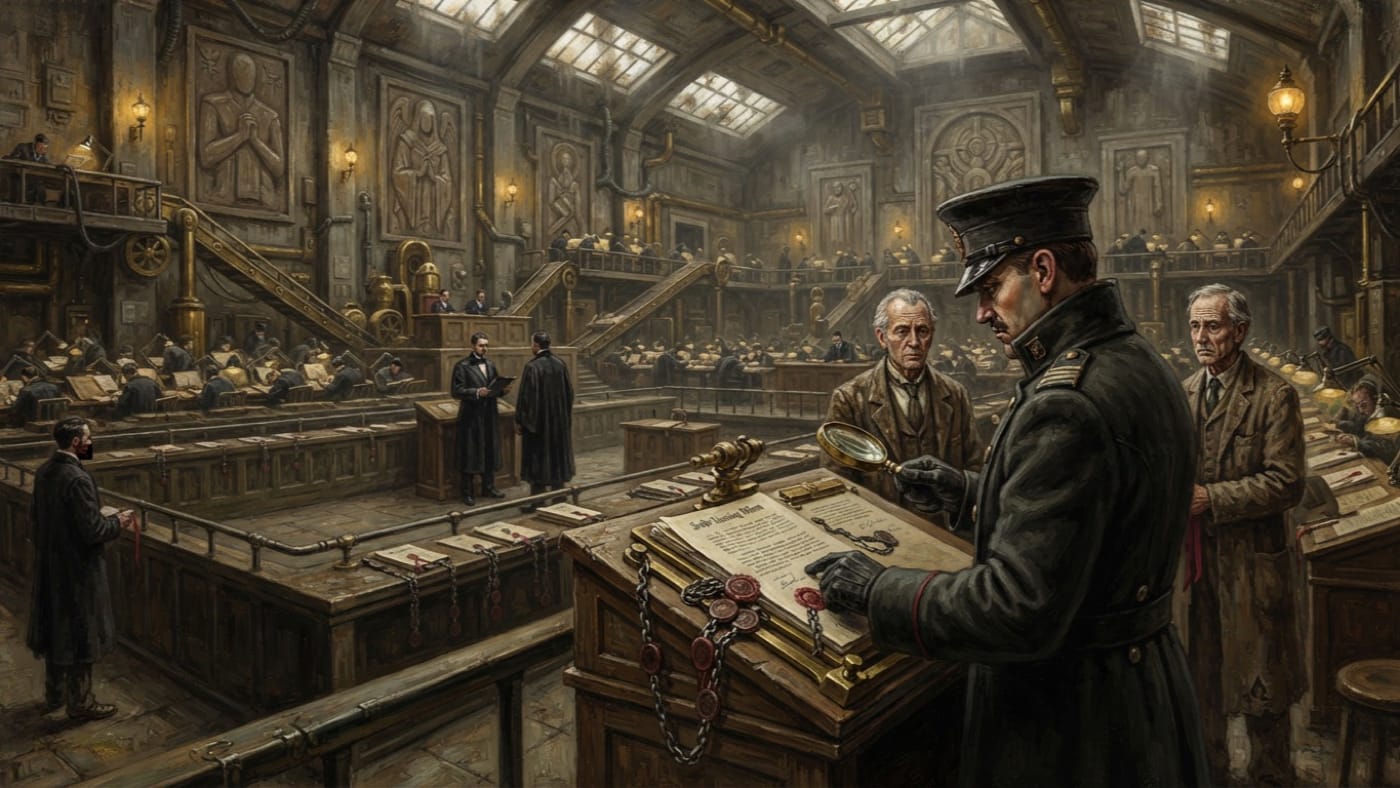
Then the clerk receives the packet. In the Registry Courts, contested papers now wait on custody rails, narrow desks along the rim of the pit where the documents lie under glass until called. The clerk compares the seals against an index arranged by pressure variance. Every hand presses wax a little differently, and a forger's thumb remembers his own habits better than his victim's. Roving Judge's Bailiffs carry portable custody boxes to itinerant courts. Each box has three locks and a bell that rings if the locks are opened out of order. The bell is shrill. It has saved lives and ruined breakfasts.
The last examination is the strangest. After the Panic, Codex Doubt Auditors gained the right to inspect phrasing logs, on the theory that a forgery gives itself away by being well written. The false decree of A.S. 178 was elegant. A real ration-priority ruling needs four subordinate clauses, two exceptions and at least one phrase ugly enough to curdle tea. The Auditors do not treat style as proof. It is one more reason to send a folio back to the scribes. Even so, every apprentice advocate now learns to flinch at a beautiful sentence.
#On Compliance and Its Price
The Advocates' Guild obeyed because it had no choice. Its own licensed members had carried the false decree into fourteen courts, and the Bureau of Doctrine said so, by count, whenever the Guild complained. The Guild stands under Bureau authority, and the reform made that plain to anyone who had forgotten.
Guild memorial tablets record the A.S. 178 reforms as "voluntary professional clarifications."
Withdrawn. Records and Doctrine imposed the articles jointly, after the Guild failed to detect a fabricated decree in its own members' citations. The Guild volunteered for nothing except embarrassment.
The Citation Purists did best out of it. They had practised strict custody before A.S. 178, often with three witnesses to a document's custody where none was required, and the profession had laughed at them. The reform did not adopt their number, but it made their temperament respectable. Audit courts prefer a Purist file because it can be inspected without a priest, a gossip and a shovel.
The Citation Pragmatists adapted more quickly, which irritated the Purists more than the original fraud had. They learned to argue from the protocols themselves. In their hands a broken chain becomes evidence that a document was moved in an emergency. A delayed ribbon becomes proof of battlefield disruption. A mismatch in seal pressure becomes clerical exhaustion during a crisis. A clerk can refuse every one of these arguments. Enough clerks accept them that the Pragmatists have never had to retire.
The litigant pays for all of it. The Registry Court records the plain case: a widow contesting a pension must find two licensed scribes and a witness, and pay all three, before she may stand at a lectern. Many widows have concluded that they have nothing to contest. A case that once took days to prepare now takes weeks, and those weeks are counted in fees and missed rations.
Expensive honesty creates a market for cheap custody that looks clean. Before the reform, a ghost precedent needed one obliging scribe. Now it needs two scribes, a witness, a quiet word with whoever keeps the chip register, and perhaps an Oaths Witnesser willing to be confident under pressure. Forgery has become a cooperative enterprise. Advocates call the protocols "charming," in the voice men use for gout.
#On the Discipline That Remained
The closure of A.S. 179 ended the Panic by declaring it over. It voided the decree and every ruling built on it, and it bound the courts to the custody discipline the provisional articles had begun. It did not name the first forger, then or since. The source folio of the false decree has never been identified to any tribunal's satisfaction.
In A.S. 201, twenty-three years after the provisional articles, the discipline is still in force. In the Registry Court of Strasbourg the rails are full every session and the ribbons are still tied by strangers. Forgery has not died out. It has become slower and more expensive, and it now drags more hands into the register when it fails. The Doubt Auditors still report gaps in the record that nobody can account for. They file them, and the files go into custody like everything else.
Cadets still copy the false decree by hand, mark where its joints were faked, and burn the copy in a tray while a scribe recites the four articles. The ash is weighed. The tray is signed. The signature is witnessed by someone with no interest in the matter, and that witness ties the ribbon.