
#On the Useful Lie of Intention
“The text says what it says. The question is whether anyone present can survive that.” — Pragmatist bench proverb, Strasbourg Registry Court
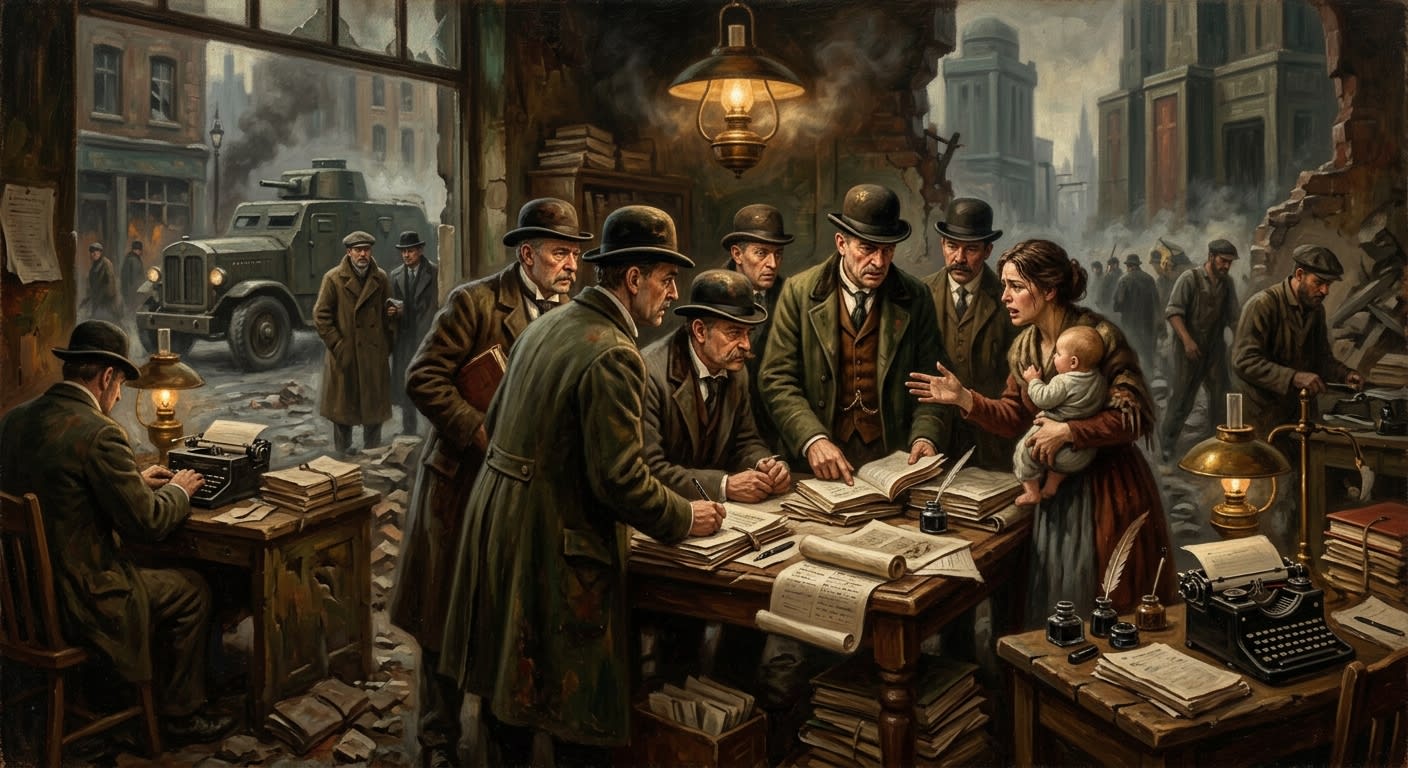
The Citation Pragmatists are the faction of Citation Advocates who argue intent, exploit ambiguity, and regard the Purists as charming in the way a loaded relic-gun is charming when pointed elsewhere. They do not deny the sacredness of text. They deny that text, left unattended, will keep a district fed, a convoy moving, a widow paid, a permit valid, or a client alive through Vespers.
A Purist brings a spine. A Pragmatist brings a spine, a witness, a delay petition, three alternate readings, a clerk who remembers rain on the day of filing, and a small private hope that the judge has eaten. This difference has been mistaken for cynicism. It is worse. It is competence.
Their houses cluster in the same legal warrens as the Guild itself: Strasbourg, Cologne, Budapest, the tithe courts of Lyon, and the forward bastion annexes where artillery shortens every philosophy except survival. They dominate emergency filings, convoy disputes, widow-pay petitions, permit cascades, ration-priority challenges, and any case in which the written rule, applied cleanly, would kill people whose deaths would create more paperwork than mercy.
#On Their Method
The Pragmatist’s first doctrine is standing; the second is timing; the third is appetite. Standing decides who may speak. Timing decides whether speaking matters. Appetite decides what the judge wants to swallow. A Purist hears a statute. A Pragmatist hears the room around it: the gallery’s hunger, the judge’s fatigue, the clerk’s fear of audit, the Bureau’s need for a remedy that does not set fire to the next street.
They argue from purpose. They ask what the decree meant to prevent, whom the rule was designed to catch, which office benefited from the ambiguity, whether the chain failed before harm occurred, whether a dead man’s widow should lose status because a copyist sneezed through a chapel abbreviation. They do all this while insisting, with faces so solemn one longs to slap them, that they are defending the true spirit of the Ledger.
Their tools are familiar and filthy: conditional remedy, suspended standing, provisional recognition, retroactive correction, clerical impossibility, wartime necessity, equitable tithe relation, and the magnificent little solvent called harmless error. Harmless error has ruined more honest men than malice, because malice at least has the decency to sweat.
A skilled Pragmatist can turn a missing seal into evidence of haste, haste into evidence of service, service into proof of loyalty, loyalty into mitigation, and mitigation into a remedy that preserves the client while sacrificing his cousin, assistant, mule, or filing clerk. This is called advocacy. The mule, when available for comment, disagrees.
#On Their Quarrel With Purists
The quarrel with Purists is older than the current fee schedule and twice as expensive. Purists say the written line is the wall between Order and appetite. Pragmatists answer that walls require gates, drains, repair hatches, murder holes, and men willing to brick them up wrongly in emergencies. Both sides cite Saint Vellum. Both misbehave near his icon.
After the Forgery Panic of A.S. 178, Purists strutted through the courts like undertakers who had discovered the plague was good for business. Fourteen advocates across three zones had cited the same fabricated decree. Chain-of-custody protocols hardened. Witness ribbons multiplied. Pragmatists adapted first, which annoyed the Purists more than the original fraud.
PRAGMATIST CIRCULAR — A.S. 179 — SEIZED COPY Subject: post-Panic practice Instruction One: never contest custody when custody can be reframed. Instruction Two: if the chain is dirty, argue the dirt proves use. Instruction Three: ███████████████████████████ Marginal note, Records hand: “This is why we cannot have beautiful things.”
They learned to make the new protocols serve them. A broken custody chain became proof that documents had moved under pressure. A delayed witness ribbon became evidence of battlefield disruption. A pressure-variance mismatch became material fatigue, then clerical exhaustion, then proof that the document had been handled by too many honest officers during a crisis. No law is safe around a Pragmatist. It leaves their hands still stamped, but warmer.
Purist pamphlets after A.S. 178 claimed Pragmatists opposed chain-of-custody reform.
Inaccurate. They opposed being caught by it. The reform itself created new surfaces on which an agile advocate could skate, bleed, or sell lessons.
#On Their Favoured Cases
Pragmatists thrive where strict law would produce civic idiocy. Widow-pay disputes are their chapel. Ration convoys are their taverns. Permit cascades are their private hunting preserve. If a man’s identity fails because a Gatewarden stamped the wrong hour during shellfall, a Purist will send him to correction. A Pragmatist will call the shellfall a bell-event, the wrong hour a faithful approximation, the Gatewarden a strained servant of Order, and the correction office an enemy of operational continuity. By the end, the man may keep his permit, though his brother’s fuel claim will somehow vanish.
They are especially prized by patrons who require deniability. A noble household wants a marriage recognised for inheritance and dissolved for debt. A Tithe office wants a levy enforced without admitting the levy was late. A War captain wants ammunition drawn from a schedule that technically expired before the guns arrived. A port syndicate wants cargo unheld. A parish wants its dead counted and uncounted, depending on candle obligations. The Pragmatist smiles, opens three books, and asks which truth should mature first.
Their victories are seldom clean. Clean is a Purist vanity. Pragmatist victories are alive: damp, compromised, breathing hard, legally patched, and grateful until the invoice arrives. Their clients often remain in possession of name, bread, bed, spouse, permit, or head. The price is future exposure. Every saved client trails a little string of interpretation behind him. One day a Doubt Auditor tugs.
#On Their Sins
The Pragmatist sin is not fraud, though fraud attends them like a loyal dog. Their sin is believing that function can absolve method. They delay filings to save clients. They pressure witnesses through confessor leaks. They bargain with Records Scribes for shelf timing. They ask Oaths Witnessers to remember ceremony generously. They persuade Erasure Notaries that a strike should wait until a patron’s nephew has crossed a gate.
Guild disciplinary rolls classify most Pragmatist violations as “excessive interpretive zeal.”
Corrected for readers with souls: bribery, delay, witness pressure, custody massage, standing manipulation, and client triage by wallet weight. The old phrase remains in guild minutes because it sounds less prosecutable.
The best of them save lives the law would otherwise eat. The worst of them sell survival by the bell-hour. The average Pragmatist does both before lunch, then complains that the Purists have made the profession joyless. Their corruption is rarely spectacular. It is domestic, procedural, polished by use. A coin to a scheduler. A dinner with a clerk. A lost ribbon found after the objection window. A dangerous phrase softened before the Scribe reads it aloud.
#On Their Present Strength
By A.S. 201 the Pragmatists dominate the living edge of citation practice. Purists hold audits, appeals, and cases where the file is already so clean it squeaks. Pragmatists hold emergencies, patron disputes, convoy law, bastion rations, marriage-status salvage, and the ugly middle courts where the Theocracy discovers, every morning, that its sacred categories have slept badly.
Their informal senior circle is called the Supper Bench (Unregistered), because its members meet after court in private dining rooms and pretend sauces conceal conspiracy. The names change. The practice does not. They trade warnings, judge moods, useful phrases, clerk illnesses, audit rumours, and the proper price of delaying a remedy without making delay visible. The Guild denies the Supper Bench exists. The caterers invoice it monthly.
The faction endures because the Synod writes perfect law for imperfect offices and then feigns surprise when lawyers become plumbers. A Purist preserves the wall. A Pragmatist finds the leak, sells the bucket, patches the crack with contraband wax, and bills the owner for theological weatherproofing.
The bucket usually holds.