

#On the Office of the Roving Judge's Bailiff
I have watched a bailiff chalk a court perimeter in the rain at Bastion-Brest while the crowd swelled, the mud deepened, and three accused men stood chained to a fencepost in the full knowledge that their trial would last precisely one hymn. The bailiff's hand did not shake. The chalk line was straight. The crowd, reading the line as they would read the muzzle of a cannon, stepped back. This is the profession: geometry before mercy, line before argument, and the hymn-chime before anything at all.
The Roving Judge's Bailiff is the moving edge of Synod justice. He is part bodyguard, part executioner, part stage manager for a form of legality performed at rifle-point within the span of a creed-hymn. He travels with a Judge on circuit through bastions, trenchlines, ports, and pilgrim routes, and wherever the circuit touches ground, he transforms that ground into a court: chalk perimeter, armed cordon, witness pen, judge's platform, and the hymn-chime on its iron stand, ticking away the seconds until mercy expires and the ruling falls.
The Bureau of Doctrine does not call them bailiffs in official correspondence. The Bureau calls them "Seal-Enforcement Officers," which is accurate in the way that calling fire "rapid oxidation" is accurate — technically unimpeachable and entirely useless for understanding the thing's nature. On the road, where law and violence share a saddle, they are the Judge's Dog, the Gavel-Gun, the Hymn-Hammer. They answer to the chime, and the chime answers to no one.
#On the Hymn-Length Trial
The system requires explanation — or would, if I were the sort to explain. The system requires statement, then, and the statement is this: all circuit trials conducted under a Roving Judge's writ must begin, proceed, and conclude within the duration of a standard creed-hymn. Approximately four minutes. Occasionally five, if the Judge favours the Vespers Long Form, which certain judges do when they feel generous and certain bailiffs despise because generosity is extra time for the crowd to organize.
The reasoning is practical, if monstrous in its elegance. A trial that runs long becomes a riot. A crowd that waits more than a hymn's length begins to deliberate on its own behalf, and a crowd's deliberation looks like brickwork through windows and rope over lampposts. The Hymn-Length Reforms — enacted after the Road Riots (Unregistered) of approximately A.S. 140, when three circuit judges were pulled from their wagons and their seals distributed among the mob like festival tokens — compressed justice into a portable ritual. The bailiff keeps time. The chime rings at the marks: opening, testimony, rebuttal, ruling. Miss a mark, and the phase closes. Evidence unheard is evidence that does not exist. Witnesses unproduced are witnesses who were never born.
The bailiff's hymn-chime is procedural equipment. It is the sound of time closing. Each ring seals a procedural window as permanently as wax on a letter. I have watched advocates — those permitted to speak, which is not always — attempt to stall: feigned illness, sudden theological objection, spontaneous discovery of new witnesses materializing from side alleys with suspicious coordination. The bailiff rings. The phase dies. The advocate's mouth continues moving, but the sound no longer signifies.
#On the Bailiff's Function
What does the bailiff do? He does everything the Judge cannot be seen doing. The Judge pronounces. The Judge is sacred authority in a travelling coat. The Judge must remain above the stink and the shoving. The bailiff is the stink and the shoving, distilled into a functionary.
He secures the court space. This means: arriving before dawn, walking the perimeter with local watchers, identifying sightlines and escape routes, marking the chalk boundary (no court exists until the chalk is down), erecting the judge's platform (a plank table, an elevation of two feet, enough to establish that law looks down upon the accused), constructing the witness pen, clearing the firing lanes. A firing lane, in court architecture, is a promise of violence so clear that the violence itself becomes unnecessary. Usually.
He secures the Judge's seal. This is the occupation's central terror and its central religion. The seal is portable sovereignty. A stolen seal can sign writs, authorize seizures, condemn men to immurement or erasure. The bailiff sleeps chained to the seal chest. He inspects the impression before every session. He counts the wax sticks. When the seal moves, the bailiff moves with it, and when the bailiff cannot move with it — illness, ambush, death — the circuit halts until the seal is recovered or destroyed. There is no circuit without a seal. There is no law without a seal. The Seal Theft Scandals (Unregistered) of A.S. 158, in which three forged impressions appeared simultaneously across the Rhineland corridor (Unregistered), produced a purgation of the bailiff corps so thorough that recruitment dropped by a third for five years afterward.
He controls the crowd. He moves bodies. He chains prisoners and unchains witnesses and maintains what the procedural manuals call "custody integrity" and what the bailiffs call "keeping the chain clean." A clean chain means every prisoner is accounted for at every moment, logged by name and writ number, transferred with receipt, never left alone with anyone who has not been searched. One gap in the chain — one name without a time, one prisoner moved without countersignature — and the audit office arrives, and the audit office does not arrive gently.
An earlier registry entry listed the Bailiff-Captain of the Kraków circuit as "retired with distinction, A.S. 197."
The Bailiff-Captain of the Kraków circuit was erased, A.S. 197. The distinction was the Bureau's. The retirement was permanent. The chain showed three gaps in eleven months. The Bureau of Records filed his name under Administrative Dissolution and reassigned his hymn-chime to a recruit who has not yet learned what it costs.

#On the Road
The bailiff belongs to the road, to the wagon-court, to the converted market square and the requisitioned port warehouse and the trench dugout where field judgments happen in mud up to the knees and the hymn-chime hangs from a nail driven into a shoring timber. The circuit moves. The circuit must move, because justice that stays in one place becomes a building, and buildings can be burned, bribed, or besieged.
The Demon-Route Years — A.S. 160 through 175, when the eastern roads became unreliable and certain highways between bastions reported "echo crowds" at trial sites — forced the bailiff corps into a secondary function: screening. Before a trial opens, the bailiff walks the perimeter with a sliver of consecrated bell-metal on his chime chain. If the sliver hums, the crowd contains something that is not a crowd. If the sliver cracks, the court does not open that day, and the Judge is extracted by the second route the bailiff identified at dawn, and the accused remain chained to whatever they are chained to until the Bureau of Rites sends a purification detail, which may take hours, or days, or — in the case of the Bastion-Shipka eastern circuit, A.S. 172 — never.
#On the Character of the Bailiff
The profession demands a particular architecture of soul. The bailiff must be capable of absolute calm in absolute chaos — to him, a riot is a timekeeping problem. He must enforce rulings he suspects are wrong, because the alternative to wrong rulings is no rulings, and no rulings is the mob, and the mob is worse than any individual injustice. He must sleep lightly, trust no one completely, maintain loyalty to a Judge who may be corrupt, and perform violence so cleanly and so quickly that the crowd interprets it as procedure rather than brutality.
They break in predictable ways. Compulsive counting — hymn marks, chain links, receipt numbers, boots in a crowd. Hypervigilance that metastasizes into paranoia. The inability to sit with their back to a door. And eventually, the final corruption: treating people as docket items, ringing the chime to avoid hearing what the accused is saying, manufacturing crimes to maintain the rhythmic certainty of a full court schedule. A bailiff who has run too many circuits becomes the thing the circuit was designed to prevent — law as its own justification, enforcement as its own reward.
#On the Hierarchy
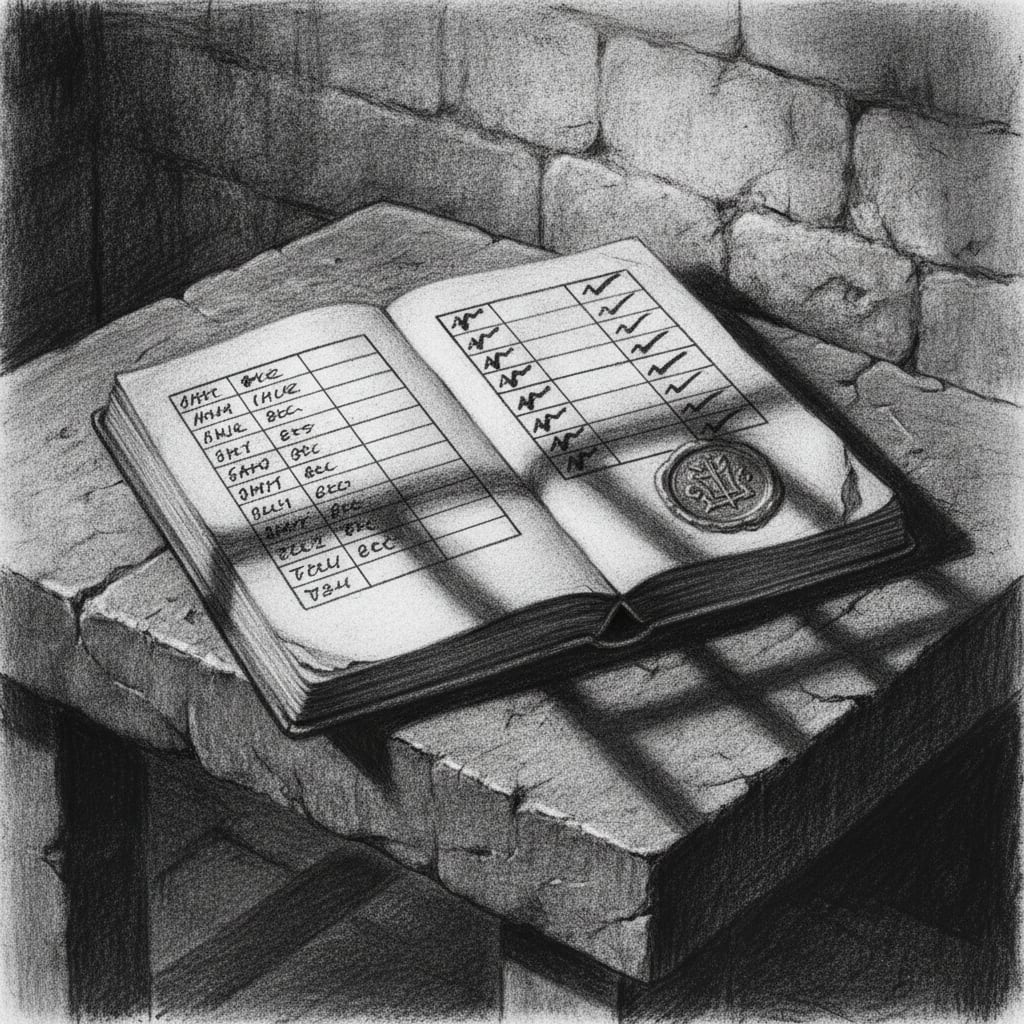
Entry is ugly. Court Ropes and Docket Runners start as wagon guards — loading seal chests, hauling accused bodies, learning to chalk fast and sleep light. Promotion to Circuit Bailiff requires a flawless custody chain and the endorsement of a sitting Judge, which means surviving long enough to be noticed by someone who matters and remaining useful enough not to be sacrificed when the audit arrives. Bailiff-Captain is the ceiling for most, and the ceiling is low, and the air up there smells of wax and compromise.
A previous edition noted that bailiffs are "independently appointed by the Bureau of Doctrine."
Bailiffs are appointed by the Judge to whom they are assigned, under the general authority of the Synod Legal Prelate (Unregistered) who assigns circuits. The Bureau of Doctrine oversees doctrine. Enforcement is the Judge's affair. The Bureau does not soil its hands with custody chains.
The elite specializations tell you everything. Riot-Quiet Specialists are bailiffs who can dismantle a crowd without firing — through timing, body placement, and the precise psychological deployment of the hymn-chime as a counting weapon. Seal Custodians are bailiffs who have survived more than ten circuits with an unbroken seal record, and they are treated with the reverence normally reserved for relics: carefully, at a distance, with the suspicion that something sacred has been purchased at an obscene price. Demon-Route Screeners carry the bell-sliver and the authority to cancel a court session — an authority that no one thanks them for exercising, because a cancelled court means a delayed circuit, and a delayed circuit means complaints from every district waiting for its day of hymn-length justice.
#On the Economy of the Thing
The bailiff is paid a circuit wage, hazard rations, and lodging rights at Judge's discretion. The gap between that wage and survival is filled with fees — "chalk tax" from the court's filing process, "rope fees" from custody transfers, and the unspoken seizure percentage that is officially prohibited and practically universal. A bailiff who does not skim seizures is either a saint or a corpse, and saints are rare enough that the Bureau of Relics would notice one.
The bribe economy operates on guild heads, port captains, and desperate households who want outcomes softened before the hymn ends. A guild head offers fuel and lodging if you "misplace" one witness. A port captain offers safe-road intelligence if one docket line gets lost in transfer. A household offers its daughter's dowry if the seizure list omits one warehouse. The bailiff weighs these against audit risk, and audit risk has a name — a man in bright gloves checking your custody chain for gaps, and the penalty for gaps is the same chain you kept on others.
The profession's true currency is portable legitimacy. A bailiff can enforce, seize, ban, chain, and exile within the span of a hymn, anywhere the circuit touches. This makes him valuable to patrons who need outcomes. It also makes him disposable to patrons who need deniability. The patron who placed a Judge can remove that Judge, and the Judge's removal is the bailiff's exile, and exile is a polite word for "assigned to the trench courts at Bastion-Shipka in winter."
#On What Remains
I will record one scene and close the entry, because the Bureau of Doctrine does not waste vellum on muscle.
A trial at a pilgrim crossroads south of Bastion-Przemyśl, autumn of A.S. 198. The accused: a grain merchant charged with tithe fraud. The crowd: forty pilgrims, eight local traders, a vicar who has positioned himself as witness. The bailiff chalks the box in twelve seconds. The hymn-chime goes up on a fencepost. The Judge mounts a plank table.
The chime rings. Opening phase. The merchant speaks. The chime rings. Testimony phase. The vicar steps forward — the bailiff blocks him with one arm because he has not been cleared, and clearance takes precedence over cloth. The vicar protests. The chime rings. Rebuttal phase. The merchant's advocate — a hired voice — begins to stall, citing a precedent that does not exist and quoting a canon law that was repealed in A.S. 112. The bailiff's hand moves to the chime.
Ring. Ruling phase. The Judge speaks eleven words. Seizure. The bailiff is already moving: inventory, cuffs, transport order, receipt posted to the fencepost. The crowd watches. The crowd disperses. The chalk line is still there in the rain, white and clean and absolute.
The trial lasted three minutes and forty seconds. The merchant lost everything. The vicar learned that cloth does not cross chalk. The bailiff's custody log shows one entry, one discharge, zero gaps.
I do not admire them. I record them. The difference is the Warden's prerogative.