

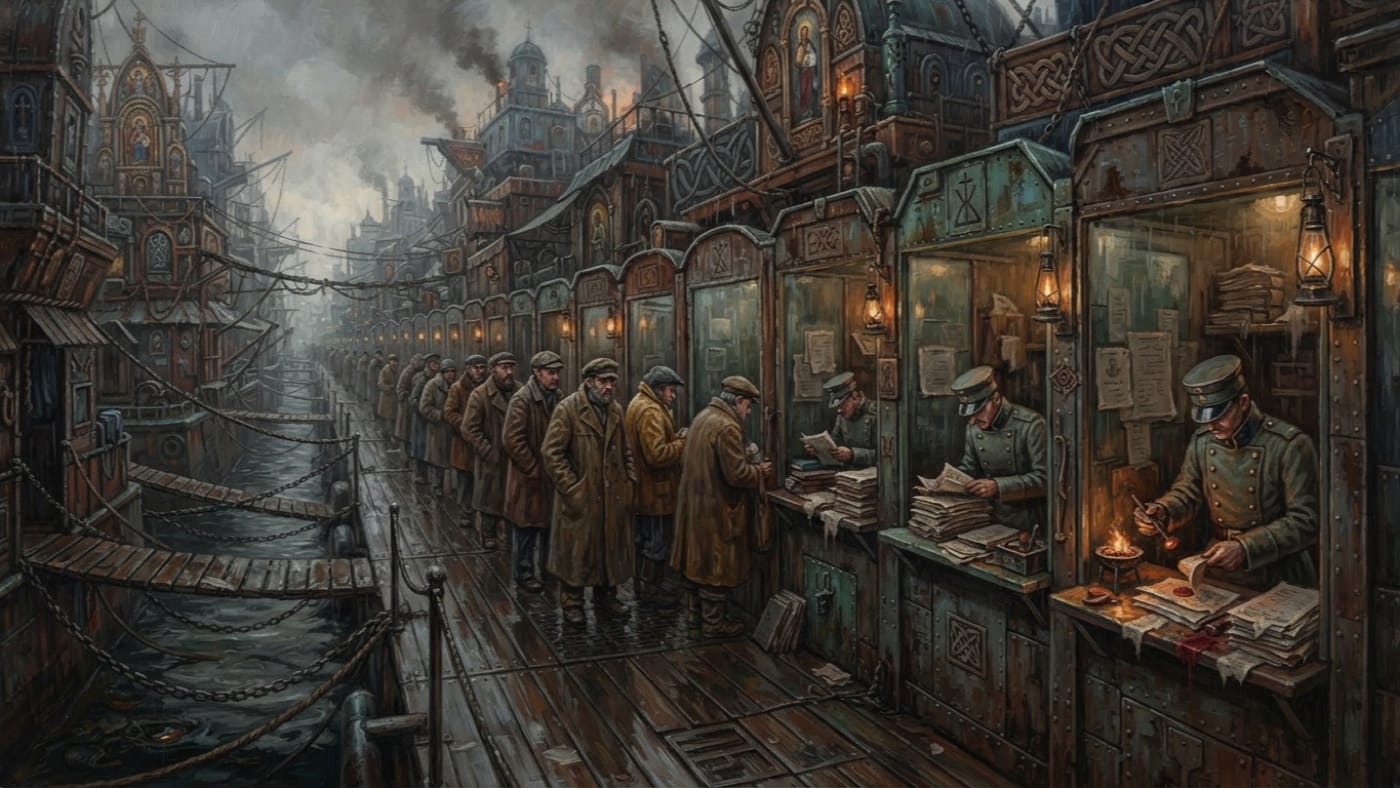
#On the Booths
Seal Row smells of vinegar ink and hot wax, and no other district of the Black Sea Reliquary Flotilla smells of its own purpose so honestly. Here the Flotilla issues passes, strikes stamps and keeps ledgers, in a row of booths set along wet planking. Each booth is a narrow cabinet holding a desk, a brazier, a seal-die and a clerk. The claimant stands outside under the drip of the awning. The clerk sits inside, warm, with the register open and a stick of wax softening over the coals. Between them is a ledge wide enough for one paper and one coin, which is the correct proportion of trust.
Beneath the planks is water. Behind the booths run rope crossings and chain to chapel-barges that sat somewhere else before the last storm and will sit somewhere else after the next. The city cannot hold its shape, so somebody must write the shape down. Seal Row writes it down and charges for the copy.
A row of stalls may look out of place in a tract on doctrine. It belongs here. The Flotilla teaches obedience as buoyancy, purity as anchorage and confession as navigation, and in Seal Row those phrases acquire a counter, a queue and a fee. No synod ever promulgated a doctrine called Seal Row, and none was needed. The booths perform the doctrine every working hour: a soul belongs where its papers say it belongs, a body may go where its stamps permit, and the gap between the two is administered at a profit.
#On Papers and Passage
The Flotilla's documents are distinct, and on the Flotilla people drown in the gaps between them. The parish paper says who a soul is, for administrative purposes, and which parish it answers to. The berth token says where the body sleeps. A married pair share one, which is the most romantic thing the clerks permit. The confession receipt, written in brine-ink, certifies that sins have been handed over to a competent hearer, and afterwards it serves as a travel token. Without a receipt a resident has no safe crossing. Without a parish paper a resident is Cut-Loose. The Flotilla uses the same word for a barge severed from the chain, and says it with the same tenderness.
Smaller instruments gather around these three: the Relic Transit Writ, the Skiff License, the Vigil Ticket, the drift-debt notice, the re-parish summons and the water-ration renewal. A family's whole standing can be folded into oilcloth and kept under a pillow. Local custom says it must be, since sleeping without a parish paper beneath one's head is taboo.
Every paper, token and clearance in the Flotilla is issued at Seal Row.
Correction. Seal Row issues and stamps passes and keeps the ledgers that make those passes answerable. The Quarantine Wardens of the Salt and Ash Office grant their own clearances, and the bell-keepers keep their own tones. The Row is where these authorities meet the claimant. It does not command them, whatever the senior sealers claim over their spiced tea.
A stamped paper also clears only one of three checks. Chainwardens inspect parish papers at the crossings. Quarantine Wardens test blood and taint, and their clearance answers to them alone. The deck calls it a salt-clear whether it is genuine or forged. Bell-keepers demand the correct call-and-response tones, and the finest seal on the Black Sea cannot sing the answer for its bearer.
Here is an illustration, and nothing more. A net-mender's papers are impeccable on the morning of a squall. By evening the lashings have parted and been remade, her barge hangs on a different ring, and her parish paper names a parish she no longer lives in. Every document she owns is genuine. Every document she owns is wrong. She goes to Seal Row. The clerk tells her that a correction needs a re-parish summons, a current confession receipt from the new parish, and the fees customary to both. She has already paid her old confessor. Her new confessor has never heard her sins and does not hear them on credit.
#On the Parish After the Storm
On the Flotilla a storm can change who a person is. When lashings snap and the barges are re-lashed, a resident can wake with a new parish, new tithes, new confession duties and new enemies without having moved a foot. The Flotilla calls this reparishing. The ledgers call it a revision. In skiff-cant it goes by coarser names.
The work of a revision is divided among several authorities, and the divisions decide who suffers. The Chainwrights maintain the physical lashings. The Knot-Scribes of the Parish Map chart the result and keep the parish books and registries, working from both the Map Loft and Seal Row. Their public office is mapping. Their ambition, as the Flotilla's own faction accounts record it, is to control jurisdiction by controlling the map. The Drift Court rules on what the new boundaries mean for jurisdiction and debt, and the name of Seal-Justice Miran Kest comes up in that work with the regularity of a bell. Quarantine keeps its cordons regardless. All four sets of consequences land on the claimant at Seal Row, across a single ledge.
Debt follows the parish. When the map changes, creditors hunt their debtors across the redrawn districts, and the Court reassigns each obligation to wherever the Scribes have put the debtor. A debt someone could manage in one parish becomes, by ink alone, a debt owed in another, with terms the debtor never signed.
After every storm the queue runs the length of the Row and back along the chain-walk, and everyone in it pays: confession fees, berth rent, fines where fines apply, and the private courtesy that shortens a wait. On the Flotilla the senior sealers are a protected class, ranked beside the Bell Choir. Below them stand the chain crews and ossuary porters, who die young, and the unpapered refugees, who simply stop being counted. Issuing passes and seals is one of the Flotilla's main industries. To a senior sealer, a storm is a harvest that happens to come with bad weather.
#On the Floor Beneath the Seal
A counterfeit ring operates under the floor of the Seal Row booths. The Flotilla's own survey places it exactly there, beneath the planks where the official seals cool, and records nothing more: no owner, no booth, no date. The Bureau would like to know who holds the false dies. It would also like to know why the forgeries come out so convincing, and it has its suspicions about the length of the ladder.
It is tempting to give the ring to the Grey Keel Syndicate. Nothing in the record does so. Grey Keel works lower down and by other means. It runs the Underkeel Lanes, the skiff alleys beneath the platforms, and moves people and papers without the receipts and tokens that Seal Row exists to sell. Its trade lives in the interval after a storm, when the official maps are stale and the Knot-Scribes have not yet caught up. In that interval a Grey Keel pass may carry a man further than an honest paper that names the wrong parish. Such a pass smells of tar and is folded twice, where a Drift Court writ is folded three times. Grey Keel also sells the quiet removal of a name from a list before the list reaches the Seal-Justice. That is one of Seal Row's own services, delivered by the back way.
The faithful should picture the arrangement in three layers. Official stamps sit on the deck, counterfeit stamps sit under the planks, and below both runs a skiff route for those who can afford neither.
Some of the Bureau's discussions of suppressing Grey Keel have included, among other measures, replacing half the Seal Row staff. That was a proposal made in the course of an argument, and it should be read as one. No audit has convicted half the sealers of anything. The proposal simply assumed the Row could not be cleaned without first being emptied, and nobody who drafted it thought the assumption needed defending.
Other ports keep their own ledgers against their own back ways. The Chalk Redoubt of Calais has its boat tunnels, and Thessaloniki has the paper of Ledger-Ghost Tamsin. What sets Seal Row apart is proximity: here the forger works close enough to hear the stamp come down.
#On Confessions Kept Dry
The Flotilla confesses in floating booths, and what is confessed there is kept from the water. It goes into tide files, which are stored in waterproof coffers, and the Flotilla's own account says plainly that Seal Row uses them as weapons. The Salt and Ash Office is charged with the same appetite: its faction record lists blackmail through tide files as a true goal, alongside its public goal of protecting the faithful from taint. Two offices draw on one coffer of sins. By what route, the record does not say.
How a confession travels from the screen to the coffer to a sealer's hand is not established. What is established is the value of the result. A receipt proves that a man confessed. A tide file proves what he confessed. The first gets him across a chain. The second makes him someone's property for as long as he holds a berth. A clerk who knows the sin behind a receipt never needs to refuse a pass. He grants it gladly and collects later.
Recorded names are worth more than the coin in the clerk's drawer, which explains why Grey Keel prices its storm-proof papers in names. The Bureau of Shadows watches whatever routes it can watch and would find such files useful. Whether it receives them is asked only in rooms without confessors. The Flotilla itself does not ask. It stamps.