
#On the Position of the Bellway
The Northern Bellway is a corridor of air. I put this first because three Bureaus have filed it at various times as a route, a parish and a nuisance. One supply requisition, which I have had framed, calls it "a road (elevated)." It is none of these. It is the cold air above the Bosphorus mouth, above the Black Sea anchorage, and above the outer patrol arcs where the bell-grid of the Reliquary Flotilla thins and gives out toward open water. Its reference frame is the northern maritime approach to Bastion-Constantinople, the southern anchor of the Line and the Last Lock. That city has watched the Black Sea for a century because the Black Sea has never stopped watching it.
Readers in the north who learn their geography from hymnals sometimes put this corridor at the Baltic end of the Line. The Baltic has its own miseries. This one belongs to the Bosphorus.
The Bellway has no surveyed length. No width is recorded, no fixed altitude, and no numbered sequence of beacons. Its outer edge lies where the Flotilla's bells stop answering one another clearly, and the Flotilla moves. Cartographers find this intolerable. Sailors find it obvious.
#On the Anchorage Below
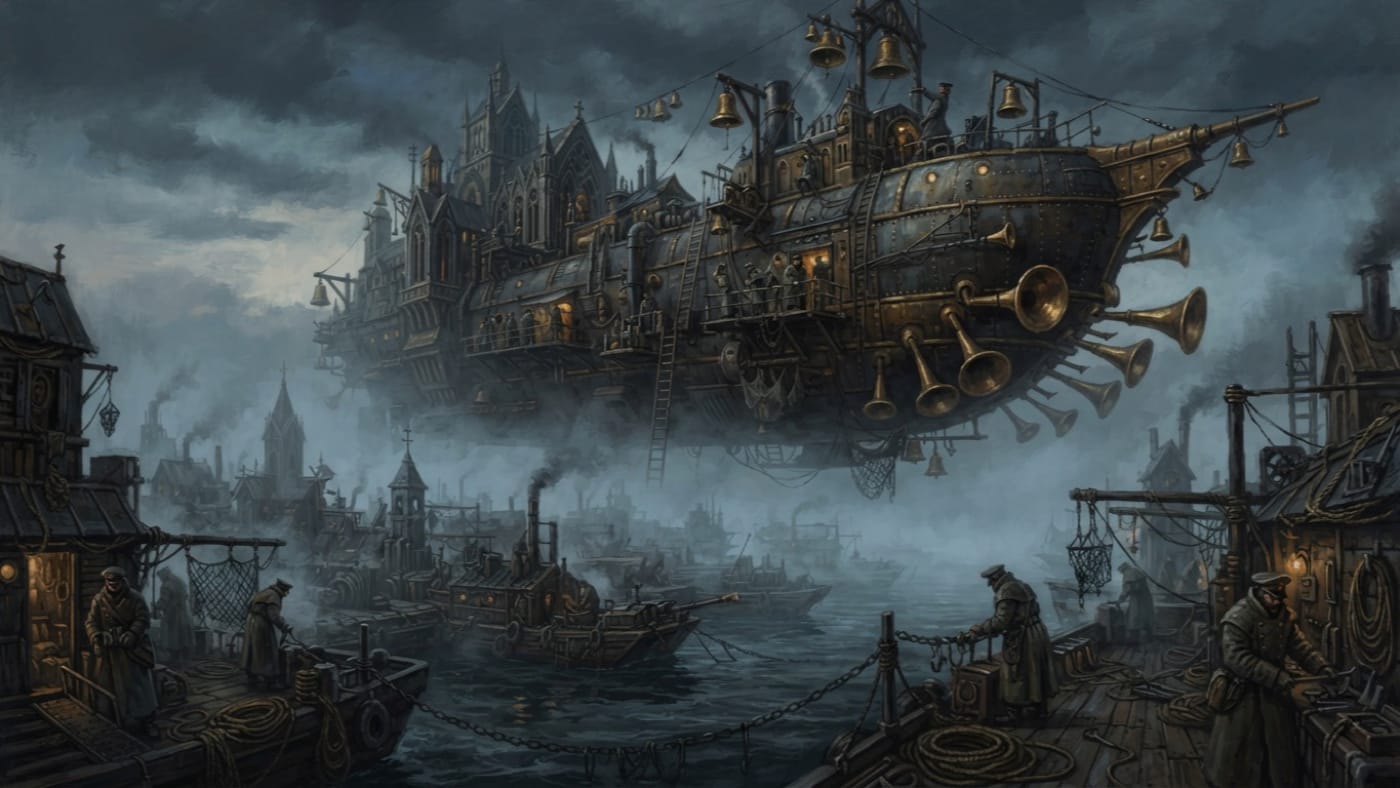
The Flotilla rides beneath the corridor. It is a mass of chapel-barges chained hull to hull, with bell towers set on decks that were never built to carry them, ossuary skiffs, quarantine rafts, and an outer chain curtain hung with mine-nets. In a strong swell the curtain groans like a choir short of a tenor. The population swells in convoy season and again with every refugee wave. The weather decides the layout. After a hard blow the lashings part, the barges swing, and a family that went to sleep in one parish wakes in another. There they owe new tithes to new clerks and confess to a priest who has not yet learned to dislike them.
The work is wet and exact. At dawn the chainwrights walk the lashings with mallets and listen for the flat note of a failing link. Quarantine skiffs go out to every arriving hull, and nobody steps from salt water onto a chapel deck without showing blood and papers and taking the salt-wash. Bell-keepers demand the correct call-and-response tones from every approaching craft. A convoy that answers in the wrong register waits outside the curtain until someone senior is woken and becomes unpleasant. At curfew the outer gate narrows and each parish is called by roll. After storms comes the re-lashing mass, held over hot wax and wet rope, while the gaps between hulls take their usual share.
The aerial patrol governs none of this. The Flotilla answers to its own Chapterhouse, its own Drift Tribunal and its own Quarantine Office. No captain of the air holds authority over a single Flotilla chain, court or cordon skiff. The Chapterhouse has written to say so on several occasions when nobody had asked. What the Bellway gives the people below is a roof of sound: a sermon overhead, proof that something consecrated is awake above the fog, and the practical assurance that a raider coming down the attack lane will be seen, reported and preached at well before it reaches the curtain.
#On the Assigned Passage
The Bureau of War commissioned the Vigil Ark of Saint Gabriel for this assignment in A.S. 182. The bombardment scare at Bastion-Constantinople that year had shown that the Saint Barachiel, fourteen years aloft and until then the corridor's only consecrated roof, could not occupy two pieces of sky at once. Under the Bureau of Engineering the Gabriel came out a third smaller than the flagship. It carries eleven voices, four Sermon-horns and a restricted provision of censers. Those facts matter to the corridor. The rest belongs to the vessel's own entry, and I will not repeat it here merely because I wrote it well.
The record gives two patrols daily in fair conditions and one in foul. During periods the Bureau files under "acoustic prudence" no public schedule is posted. An empty schedule-board on the quay does not mean an empty sky. Any reader who infers otherwise may take it up with the Bureau of War, which enjoys these conversations more than is decent.
By order of the Bureau of Bells, the horns are tuned low so that the broadcast carries across the water. Heard from a Flotilla deck, a Bellway sermon is a long brass pressure in the breastbone that turns into words later. Chainwrights keep working through it. Quarantine wardens time their salt-wash to its cadence. Old ossuary porters claim they can tell the hour by which psalm is passing overhead, and they are right more often than the bell-clocks of Seal Row.
"Variable by fog shelf" means the pilot keeps to the upper surface of whatever fog the Flotilla has gathered that morning, and the Flotilla gathers fog the way a cathedral gathers petitioners. The note gives no reason for the censer restriction. I will supply none, which makes two of us obedient.
#On the Quiet and the Record
The Lore assures us that a Vigil Ark is never silent. It hums. It wheezes through its valves, ticks in its brass and complains in its rigging like a canon climbing to the clerestory. The Gabriel does all of this until it crosses the outer anchorage marker. After the marker the crew report that the small noises thin. Tools strike metal without the usual ring. Boots land softly on the deck planking. A cough dies in the sleeve that muffles it, and dies faster than it should. Prayers said aloud seem to travel forward instead of outward, as if the air had an aisle and they had been shown to it.
These are crew descriptions. I repeat them as such. The record does not show the corridor going dumb. The engines turn. The sermon carries, and the Flotilla below hears it in its proper register. The logbooks record ordinary pressures. Whatever the quiet is, it takes the hammer's ring and the bootstep and leaves the broadcast alone. It is selective, and it is unexplained. The crew call it "the quiet one." They mostly mean the vessel and sometimes the assignment. It is crew cant. The Bureau has authorized no second name for this corridor and, if I have any say, never will.
Administrative summaries describe the assignment as having passed "without incident." They are accurate in the narrow sense that its incidents have no agreed category. The Gabriel's own record holds several, small and filed so as to bore the reader into obedience. In A.S. 190, the year of the operating revision, the port Sermon-horn broadcast the noon Collect seven seconds before the chaplain opened his mouth. In A.S. 198, during a storm over the Flotilla, the ship's bell rang once. Its clapper had been removed for repair and lay under seal in the sacristy drawer. Both are reports from one vessel. No reader should suppose that every flight across the marker hears its own bell.
A.S. 199 Northern Bellway memorandum, appended after the Broadcast inquiry: Saint Gabriel airborne at the time of the Saint Barachiel event. Signals officer reports no reception of the unidentified voice. Chaplain reports no disturbance. Bell log records ██████████████████████. Do not circulate beyond Bell-Seal Amber.
I have nothing to add to that memorandum. I have been told so in writing.
Internal summaries of the Bellway's A.S. 199 service stated that the Saint Gabriel exhibited no anomaly concurrent with the Broadcast.
Corrected. The vessel exhibited no anomaly that the Bureau of Bells has agreed to name. The difference between these sentences is one Amber seal wide, and the Bureau of Doctrine prefers it kept that way.
#On the Present Condition
The corridor stays in service. The Gabriel still crosses the marker at the hours the Bureau permits and at others it does not publish. Below it the Flotilla still re-lashes, re-parishes, salt-washes its arrivals and calls its rolls under the sermon. That the vessel is operational is a finding about the vessel. It certifies nothing about the waters around the Harbor of Chains or the open sea past the last answering bell. Readers who want a certificate of safety for the Black Sea may apply to the Black Sea.
The report-first discipline stands. A crewman who hears an unaccountable sound files it second. A crewman who fails to hear an accountable one files it first, in ink that does not run in salt air, before the watch changes and the matter grows familiar. The Bureau of Bells receives these reports. The Bureau of Doctrine reads them. Neither has produced a classification that both will sign, and that is why the reports still arrive in plain words, damp at the corners, describing tools that do not ring.