


#On the Lanes Beneath the Platforms
The Underkeel Lanes are the last of the nine districts named in the survey of the Black Sea Reliquary Flotilla, and the only one made of what the others leave out. Hulls are lashed gunwale to gunwale, platforms are laid across the lashings, and chapels, booths, courts and markets are raised on the platforms. Some water is left over. Everyone above has agreed not to look at it. That water is a system of skiff alleys: black channels between tarred flanks, roofed by planking and deck joists, lit by whatever lamp a pilot can afford to burn.
Clearance depends on the hull. Under a chapel barge riding high, a man may sit upright in a skiff and keep his hat. Under an ossuary lighter loaded with bone-lime, he lies flat on the thwarts with the deck a hand's breadth above his nose, dripping. The lanes narrow where fenders bulge and widen where a hull has been cut loose and not replaced. They close entirely when a storm presses two barges together, leaving a slap of water and a groan of timber where yesterday there was a route. Submerged hatches connect certain holds to the water below. Most of the Lanes, however, are open to the air. There is simply very little of it.
The smell is rot, tar, wet rope and fish oil, with damp paper underneath. Nobody in the Lanes keeps paper dry for long. This is the district's first lesson and its principal commerce.
Routes are chalked on the planking at the waterline: hooks, ticks, crossed bars, a sign like a broken bell. Salt should erase them within a week. The pilots renew them. The Bureau records the chalk as vandalism of consecrated timber. The charge is entered against nobody, since nobody has been found holding the chalk.
Above, the faithful cross by rope bridge, chain-walk and lift cage, and each crossing has a fee, a bell and an official. Below, a skiff slides beneath all of them in the time it takes a clerk to find his spectacles.
#On Passage and Its Receipts
Movement above is a liturgy of documents. Chainwardens check parish papers. Quarantine Wardens check blood and taint. Bell-keepers sound a tone and expect the correct reply. A wrong reply earns detention, quarantine or a musket, in whatever order the keeper's digestion prefers. Confession receipts serve as travel tokens. Seal Row issues passes, and after any weather the Drift Court decides which passes still mean anything.

Each document answers a different question. A parish paper says who you are and whose tithe you owe. A berth token says where your body sleeps. A confession receipt says your sins are current. A Quarantine Clear says your blood has been found merely mortal. Lose the paper and you are nobody. Lose the token and you are homeless. Lose the receipt and you may not cross the plank to the booth that would issue a new one. The Flotilla calls a man in this condition Cut-Loose, which is the word it uses for a barge severed from the chain and left to the sea. The word is accurate in both cases.
The Underkeel reduces all these questions to one: can you pay?
Skiff taxis work the Lanes openly as part of the Flotilla's ordinary transit, and the Chapterhouse thereby admits that people move beneath the decks. It prefers not to ask which people. Most fares are honest in the sense that matters on water: a porter late for his shift, a widow carrying fish paste three hulls over, a clerk avoiding a creditor. They pay the pilot and arrive damp.
Some fares come below because the decks have refused them. For those, the principal carrier is the Grey Keel Syndicate. Its public face is the skiff taxi. Its working business is moving people and papers without confession receipts or berth tokens. Its crossings are timed to the bell changes, when every keeper is singing and none is listening. The best pilots, by repute, run during the Re-Lashing Mass, while chaplains bless the chain crews and the crews lose fingers.
#On the Market Below
The Lanes keep a market without stalls. Goods change hands on landing ledges a plank wide, in the lee of rudders, and in skiffs rafted together beneath a quiet barge. They also change hands in the Underkeel taverns, which are lower holds rented by the night to owners who swear to the Chainwardens that the hold is for ballast. The ballast drinks. On certain nights it also bets on unsanctioned skiff races beneath the platforms. The course is set in chalk, and the wagers are held by men who cannot swim and therefore never compete.
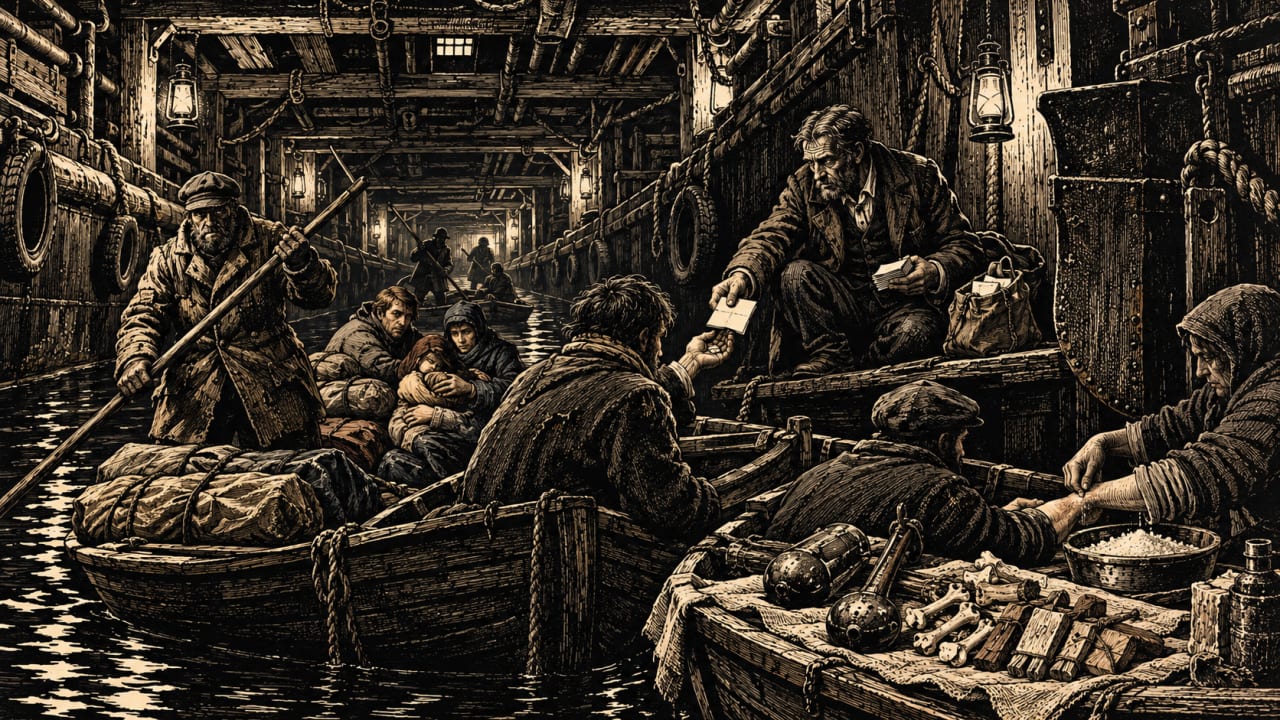
The Flotilla's survey lists the inventory with a frankness I find almost devotional: forged parish papers, skiff routes, relic shards, taint cleans and stolen bell clappers.
Forged papers are the staple. By the Syndicate's published description, a Grey Keel pass smells of tar, because tar hides damp, blood, fish oil and nervous handling. It is folded twice. Drift Court writs are folded three times, and the forger who overfolds deserves the fire he will receive. The better passes carry one small doctrinal error in a margin. A tired inspector sneers at it and corrects it with his own pen, and by correcting it he approves the rest.
Routes are sold as knowledge: which hull rides low this week, which hatch is unsealed, which bell-keeper sleeps through Compline. They lose value by the hour.
Relic shards are sold as holy. They are fragments of bone, wood, cloth and wax, and each comes with a story that begins with a barge that sank. Some may be what they claim. The Lanes keep no provenance ledgers, however, and no Bureau of Relics clerk has come down to authenticate anything. For doctrinal purposes the shards are bone of uncertain parish. The buyer pays for the story. The bone comes free.
Taint cleans are a service sold to people who expect to meet the white gloves of the Quarantine Wardens and fear what the gloves will find. The service consists of brine, salt, a muttered rite and sometimes a forged clearance, as the price allows. No office has tested whether it cleans anything. The Wardens' opinion of the customers they catch is on file.
Stolen bell clappers are the strangest stock. A bell without its clapper cannot sound the tone that would challenge a passing skiff. I leave the arithmetic to the reader.
The Lanes and the Market of Anchors are separate districts, and everyone who profits from crossing between them keeps the separation with care. In the fish oil, spice and rust of the Anchor bazaar, relic fragments are sold as prayer beads and prayer beads as relic fragments. The brokers sit among the salt-chit sellers and say nothing about boats. A customer who asks wrongly buys rope. A customer who asks correctly is followed down the steps.
#On Storms, Maps, and Debts
Chapterhouse ledgers describe the Flotilla's parishes as "stable and ordered."
Clarified. The parishes are ordered. The Knot-Scribes revise the order after each storm, and the Drift Court enforces it retroactively. "Stable" refers to the ledger, which has not moved.
Storms on the Black Sea unpick the Flotilla more often than they sink it. Lashings snap and barges swing on their remaining chains. A chapel that sat between two markets at sunset rides beside the Quarantine Rafts at dawn. Chainwrights re-lash what they can reach, in the order Chainmaster Olt Rosary-Iron sets, and the result is a different arrangement of the same hulls. Parishes are defined by hulls and their lashings. Change the lashings and you change the parish, and with it the tithe, the court, the creditor, the curfew bell and the clerk with authority to hang you.
After each storm the Knot-Scribes revise the parish map by ink, registry and procession, and the revision takes time. In the interval, a family's parish paper names a parish that no longer adjoins its berth. Its berth token names a berth that has moved. Its debts have been carried three decks away. Seal-Justice Miran Kest holds the Drift Court's authority over jurisdiction after storms, and the court's bailiffs reassign debt by parish. Admiral-Prior Veyra Salt-Crown's docking permits decide who may berth anywhere at all, and none of them is reissued at the speed of a skiff. Creditors call this interval a hunt. Debtors call it something less printable.
The Grey Keel works in that interval. While the official map is devotional fiction, a skiff can carry a man from the parish where he is wanted to one where he is not yet known. The published account says the Syndicate's "storm-proof" papers are priced in names rather than coin. The name may be the buyer's own, surrendered for later use, or it may be someone else's, sold onward from a list of debtors, witnesses or kin. The papers protect nobody from weather. They protect the bearer from the paperwork that weather produces, which on the Flotilla is the more lethal of the two.
The Re-Lashing Mass follows every storm and is a rite and a work order at once. Chaplains bless the chain, crews haul it, bells sound the sequence, and the faithful stand at roll-call while the Chapterhouse confirms who is still aboard. Every keeper and warden is busy for the hour, and the water below is as quiet as it will be until the next storm.
Spring brings the Chain Blessing, when papers across the Flotilla are renewed. Violence in the Lanes rises with it. Renewal sorts the papered from the unpapered, and knives are cheaper than receipts.
The roll-calls have lately turned up names that answer to no one. Some belong to the drowned and some to people living in the Lanes. Others have been listed Cut-Loose by clerks who did not see the barge cut. Flotilla folk call this Parish Drift, and they say that when your parish changes three times in a month, the sea is counting you. The Bureau records the saying as superstition. It does not record the count.
#On the People Who Go Below
The pilots are the first class of Underkeel and the most respectable, which is a low bar laid on wet planking. Keelman Jory is one name attached to the Grey Keel. The only thing said of it with confidence is that its bearer is always wet. Whether this is description or title, the Lanes see no reason to tell me.
The children find their way by smell and by the drips from the deck above: the slow drip of a chapel barge, the quick tar-drip of a fresh-caulked hull, the sour drip of the ossuary lighters. They are hired by the trip. No office employs them, and several offices would be poorer without them.
Brokers pass between the Lanes and the Market of Anchors. Debtors come below when the Drift Court finds them. Refugees and the Cut-Loose come below because they have nowhere else to go. They carry no paper, token or receipt, and sometimes a child in sailcloth who has not yet been declared to the pilot. The Grey Keel's terms are known. The Syndicate moves the named thing and only the named thing. The passenger owes silence. Afterward the Syndicate owns the route by which the passenger survived, and with it a claim on the passenger's future obedience. The Flotilla's survey lists the Syndicate's methods as routes, bribes and kidnaps. The same skiff may carry a plague witness to safety on one tide and a debtor into chain labour on the next. The water keeps no record of which.
The methods travel. Skiff-Sister Lune, the Grey Keel affiliate who smells of tar and perfume, is the network's published face beneath the Chalk Redoubt of Calais, where she works the boat tunnels under the Chalk Warrens. The Flotilla's survey records only rare contact with Calais and no regular trade. The Calais tunnels are cut in chalk, and the Lanes are water between hulls. What passes from one to the other is technique: the twice-folded pass, the debt held as collateral, the mercy that is genuine and invoiced. Lune's civil name and her person remain unconfirmed. Her methods have been confirmed many times.
#On What the Water Returns
The Lanes kill by ordinary means first. A pilot slips between two hulls in a swell and the hulls close. A passenger falls in during winter and the cold takes him before the tar does. Rot-fever breeds in the bilge-damp. Chains shift during re-lashing and crush whatever lies beneath them, which in the Lanes is often a skiff. Knives settle in a moment disputes that the courts above would take a season to hear. Drownings are common enough that the taverns keep dry cloth by the door. A host who will not share his lamp and a cloth with a soaked stranger is thought worse than a thief.
Enforcement adds to the count. In audit week, Chainwardens seal hatches and trap whoever is below. On a report of taint, Quarantine Wardens take a whole tavern to the Rafts for testing. The Bureau of Shadows watches the routes it can watch and seizes selectively, taking brokers before inspections and caches before audits. The arrest record is always full, and the Lanes are always open.
The Flotilla records undertide pressure as a hazard of the anchorage. In the Lanes it is described less precisely. People report water between the hulls going still and black while the sea outside runs, and bells overhead sounding the wrong sequence. The Bureau records these as conditions. I record them as reported.
UNDERKEEL RECOVERY LOG — A.S. 200 (as published under Grey Keel Syndicate) Location: beneath Barge Saint Odran. Recovered: five berth tokens; two confession receipts; one child's shoe; one waterproof packet containing names already marked drowned. Observed: Grey Keel chalk-mark drawn on inner hull at a point no dry hand could have reached. Diver response: inspection diver refused second descent. Replacement diver returned speaking in tide counts. Further action: ███████████████████.
The log does not say whose shoe it was, who drew the mark or how they reached the spot, or what the second diver was counting. I have been asked whether the packet was a Grey Keel ledger, a debt list, or a register of people already removed and sold onward. The packet was waterproof. Its explanation was not.
#On Present Condition
As of this survey in A.S. 201, the Underkeel Lanes remain open, active and uncharted. They lie beneath a city whose A.S. 200 census registered two hundred and thirty-seven hulls and which rearranges itself with every storm. Skiff taxis run. The Grey Keel moves people and papers on the bell changes and in the Re-Lashing hours. The chalk marks are renewed. The taverns rent out their ballast. The children count drips.
Above, Seal Row issues passes, the Drift Court reassigns debts, the Knot-Scribes redraw the map, and the Chapterhouse records the city as stable. The Lanes are the city's opinion of that record.
The Flotilla rides the approaches to Bastion-Constantinople, where every hull is useful and every soul aboard is supposed to be accounted for. On the Strait, the Bosporus smuggler-sailors have long understood that contraband becomes revenue once it is caught. The Lanes have learned the corollary: passage becomes order once it is denounced. Full suppression would mean sealing every hatch, searching every alley, replacing half of Seal Row and asking the Drift Court where its information comes from. It has been proposed. It has been costed. It has been filed.