

I've read the continuity, style and Third Light sources and checked which codex links exist locally. Writing the article now.
#On the Bunks Above the Drop
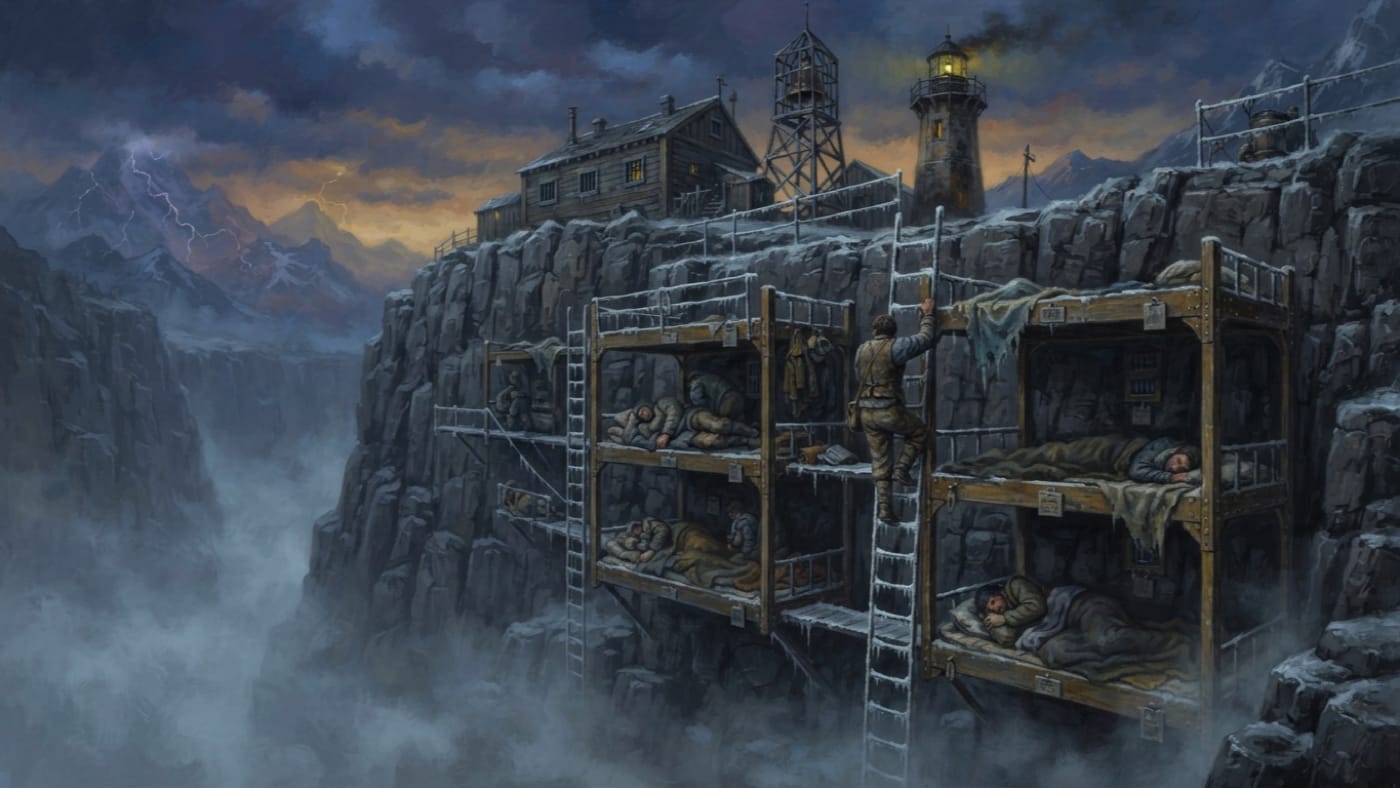
The Sleeping Stack is four tiers of bunks bolted to the cliff face of Third Light. Beneath the lowest tier the Bureau of Engineering has measured a drop of three hundred and twelve feet. I give that figure first because nobody has certified any other figure about the place. The bunks have no published count. The tiers have no recorded builder, no dedication and no date of first bolting. What they have is a smell of sweat and tallow. It is the hamlet's own description of the place, and the most accurate one in its keeping.
Consider the ground on which the station stands. Third Light occupies a basalt knife-ridge in the high Carpathians, at roughly 47°N and 22°E. The ridge runs some six hundred yards and is never wider than forty. Ladders, catwalks, tower stairs and cliff-anchored winches carry its people from one obligation to the next. On such a ridge, flat ground is the rarest thing there is. The lantern is given the summit, the Loghouse its slate walls, the bell its cage. The men who serve all three are given a shelf of bunks hung over open air, with iron driven into the rock to keep it there.
The cold does the rest. Bodies give off heat, tallow burns, and wool keeps a little of both. Whatever warmth the Stack holds comes from these, and from the oil the station allows it.
#On the Rotation
At Third Light your rent is a shift rotation and your heat is rationed oil. The ledgers put it no more kindly, and I see no reason to improve on them.
A bunk is paid for in labour, and the labour is the station's own. Tenders keep the beacon. Bell riggers keep the cage. Signal clerks keep the logs, lens polishers keep the glass, mechanics keep the relic-lanterns under Sister-Mechanic Vey Sable, and oil porters carry up the fuel that everything else depends on. Ropewalkers and rescue winchmen work the cables and the cliff. Below all of these are the fog-debt labourers, who are paying off something they owe. Every one of them works in the same thin air that will receive him afterwards, and every one of them leaves the bunk to go back to the work that earns it.
The rotations are enforced by oath. Failing a rotation is logged as a doctrinal breach, because the Synod Signal Office does not believe in mere lateness. A man who misses his turn has broken an oath, and the Office records it in those words.
Above all of this the bell keeps its hours. A signal cycle lasts four hours, six cycles to the day. Each one is opened and closed at Beacon Tower Three and pressed into wax in the Loghouse. A cycle measures signal. The Office has never mistaken it for a measure of rest, whatever the men lying under the bell might wish. They sleep when the rotation lets them. The bell rings regardless.
Lamp oil and glass lenses are the station's two great shortages, and without either the outpost goes blind. I do not need the ration tables to know which flame the Office feeds first. The beacon keeps convoys alive on the passes. The Stack keeps alive the people who keep the beacon. In a dispatch to Strasbourg the order of those two duties would look obvious. On the ridge, at night, it feels like something else.
#On Errors Carried Home
"The Chain never lies. Only men do." — Propaganda line of the station
The logs are law at Third Light, and the law keeps a running account against every hand that writes in them. A clerk who errs confesses under a silence hood. The confession is stored, and it waits there for the day someone finds it useful. The error itself becomes a debt. Error debt converts into night shifts and cliff work. The garrison has a verb for the night shift, thirding, and says it with the cheerfulness of men who have no choice.
The arithmetic of this needs no new regulation to explain it. Every hour a worker owes for a fault in the slate is an hour of exposure, and he pays it in the dark or on the rock. Cliff duty begins with the "hands-on-ledge" vow. I have no doubt it is sincerely meant. I would mean it too. The debt does not stay in the Loghouse. It follows the man down the ladders and up the catwalks and lies down with him in whatever bunk the rotation has given him, in the hours he has not yet been made to sell.
Beaconmaster Jorren Quill governs the records and routing authority of the station. Gate Provost Harn, called Nail, governs who passes the Switchback Gate. I find no document naming either of them, or anyone else, as warden, landlord or patron of the Stack. The bunks do not appear to have a master. They have a rotation, which suits the Office better, because a rotation cannot be bribed and does not need to be fed.
When the rotation runs short, as it always does, the station draws on Lowvale Tallytown, one day's descent below. Lowvale sends grain, wool, salt and conscripts. The conscripts are given the bunks the dead have emptied.
#On the Weather Beneath the Bed
The weather at Third Light arrives uphill. Storms climb from the valleys and gather strength on the way up, so the garrison sees them coming from below. Lightning strikes the chains, the towers and the bell-cages, and on documented occasions it has struck the men. Ice glazes every rung. The altitude takes its tax from every pair of lungs on the ridge, waking or sleeping. Smoke from the lantern oils is counted among the station's hazards. Falls are counted most often of all.
Below the ridge lies the fog basin the locals call White Mouth. The fog behaves like a tide. It rises in the morning, floods the basins and laps at the switchback trails. Sometimes it pulls back by the third cycle and sometimes it stays for days, and then the hamlet is an island and the Stack hangs over a white floor with three hundred and twelve feet of nothing under it.
The restricted file of the Synod Signal Office records that the fog answers the beacon. That file has been open since A.S. 194. It concerns signals: acknowledgments that come back from a direction where there is no tower, no bell and no lens. I find no entry in it about sleepers, and I will not write one for the sake of my title. The Bureau of Mercy's "altitude melancholia," which the garrison calls rope-stare, belongs to the Ropewalk and to the men who stand on it looking down too long. Nobody has extended that diagnosis to the bunks. The common saying of the station, if the fog repeats you, it's learning you, also concerns signals rather than sleep.
What lies beneath the bunks, so far as any record of the Bureau of Records shows, is weather, a long fall and a file that is still open. A worker coming off a night of thirding lies down above all three. He is too tired to argue with any of them.
#On the Present Accommodation
This entry follows the station assessment of A.S. 201, sealed by the Bureau of Doctrine. That assessment counts four hundred and thirty souls at Third Light and calls the population "collapsing." The figure covers the whole hamlet. It does not tell us how many of those souls sleep in the Stack, how many bunks there are, or how many stand empty tonight. Four tiers do not mean four shifts or four floors of rooms, and they say nothing about how many berths there are. Anyone who tells you otherwise has done arithmetic, and arithmetic has never been up there.
The station itself was raised on its high ground in A.S. 77, five years after the winter convoy loss of A.S. 72 that first set the Beaconchain going. That date belongs to Third Light. No date belongs to its bunks, and none is needed. The Stack is old enough to smell as it does, and it is still bolted on.
The published entry on Third Light places the A.S. 72 convoy loss "seven years after the Sagittal Line solidified from desperate entrenchments into continental fortification."
The Sagittal Line was defensible but incomplete by about A.S. 65–68, and its practices were standardized over roughly A.S. 68–72. It was not solidified by A.S. 65. The convoy was lost while the Line was still being standardized.
The bunks remain. The rotation remains. Heat is still issued in oil and rent is still paid in hours, and the debt from the Loghouse still comes down the ladder at night. The Office keeps its lantern lit. Whoever is sleeping above the drop tonight is sleeping on the station's oil, and I have no doubt the Office has it entered somewhere.