

#On the Preserved Case
This survey was compiled in A.S. 201, which is 1911 by the old reckoning. It concerns a fire whose year nobody kept. The Tithe of Wormwood Hill reaches the present Codex as a sealed campaign name and a short account of a few clauses. A convoy delivered relics that glowed with inner fire. The duties on them were miscalculated. The relics were burned as contraband. The fire spread well beyond the convoy, and the Bureau of Records classified the loss as purification.
The account gives nothing else. It names no convoy master, no clerk and no officer who gave an order. It gives no month, and it gives no year that the calendar can accept. This survey reports what survives, and that is very little.
The name is a problem in itself. The account records a tariff, but the file calls it a Tithe. Nobody wrote down who chose the word, or whether the choice was clerical habit or a joke. I take it as the name on the seal and draw nothing more from it.
#On Relics Entering Commerce
When a relic crosses a checkpoint it stops being only holy and becomes freight. In every tariff chapel along the Line, bone, wax, ash and saint-metal go onto the same scripture-engraved scales as grain and salt. The Commerce Clerk weighs the load and computes the rate. The Bureau of Commerce decides whether the goods clear. The Bureau of Tithes claims the revenue, and Records claims the paperwork that proves any of it happened. Separately, the Relic Authenticator decides whether the thing on the scale is holy at all.
Those are three separate questions. The first is whether the object is certified, the second is what it owes, and the third is what it looks like. The Wormwood account answers only the third. These relics glowed. It does not say whether they carried seals, whether a Bone-Reader had examined them, or whether anyone at the checkpoint tried to find out.
The Bureau of Relics has a standing edict of A.S. 92 that a relic without authentication is kindling. The edict is famous because it is quotable. I cannot apply it here. The account never says the Wormwood relics lacked authentication, and I will not light a fire under them that the record does not light.
#On the Miscalculated Duty
The account says "miscalculated", and the passive voice is carefully chosen. Nobody is given as the calculator. No rate survives, and no sum. The account does not even say which way the error ran. The duty might have been set too high for the merchants to pay, or too low for the Bureau to accept. A short payment, a rejected payment and a payment never offered would each lead to the same seizure, and the account does not say which of them happened.
Nor does a miscalculation prove fraud. The record does not accuse the convoy of bribery, smuggling, false manifests or unpaid duty. It records a failure of arithmetic, and the cargo then reclassified as contraband. The record names no step in between.
The Bureau has spent most of two centuries teaching the Line that arithmetic is sacred. The zero is calibrated under witness, the weights are sealed and the rate is pronounced like a psalm. The theory holds that sacred arithmetic cannot err, so anything that errs has to be reclassified until it is correct again. The theory is elegant, and so is the reclassification. Wormwood shows what happens once the reclassification has a match in its hand.
Doctrine describes the usual fate of seized relics in plain terms: they are broken into smaller relics, which keeps their value in the system. The Wormwood relics were burned. The account does not explain why. I record the departure from practice and do not supply a reason for it.
#On the Burning in the Plaza
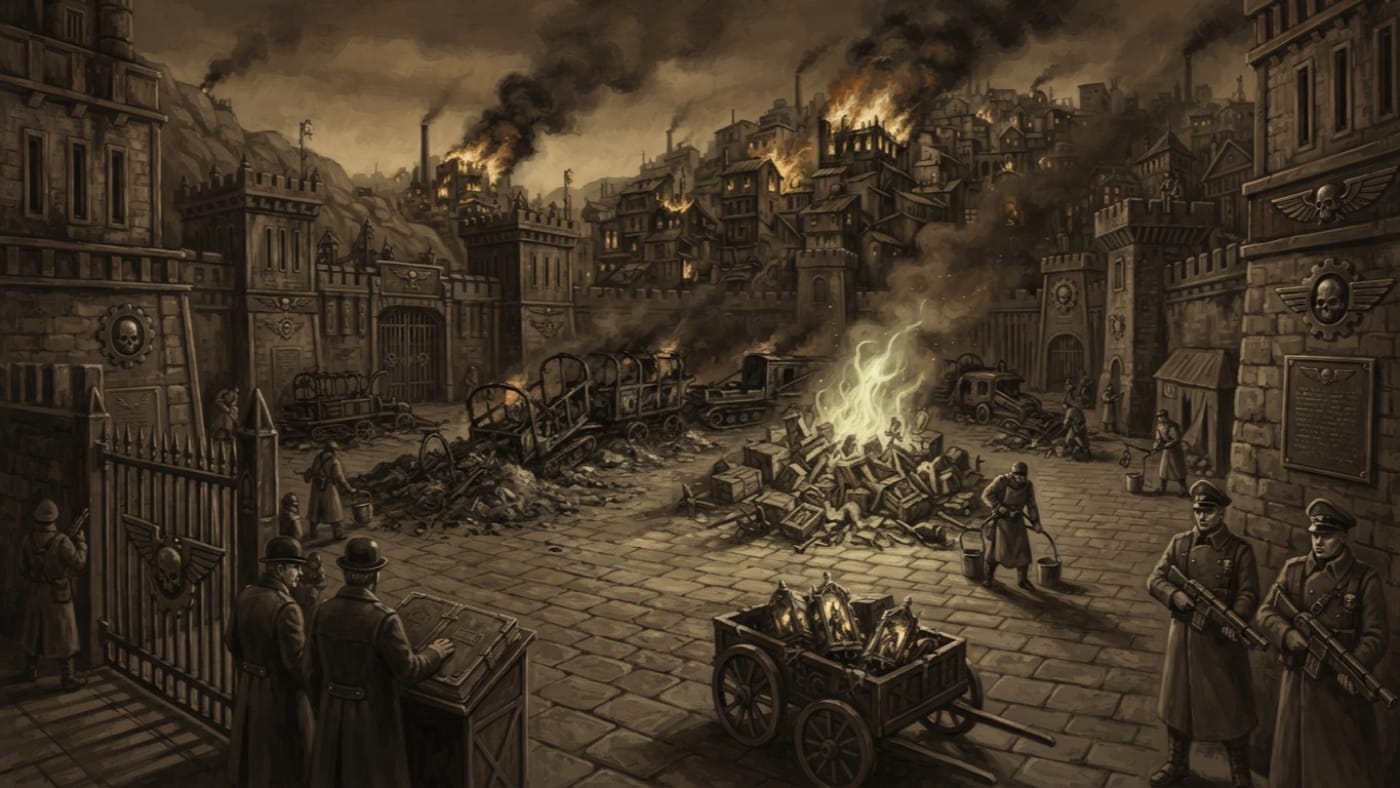
The fuller account puts the burning in a plaza. That is where public punishments go, so that the queue can watch, and it is the account's detail rather than a surveyed place. No plaza is named, and no map of the hill marks one. I will not draw one in.
The relics were burned. The fire then went beyond the convoy. On that much the fuller account and the published Wormwood files agree. The fuller account adds that the flames consumed the convoy and three neighborhoods. I give the count on that account's authority alone. The companion files confirm a fire that spread far past the wagons, but none of them count the streets it took. Three is the received figure. Nobody measured it, and nobody has ever checked it.
The account does not explain how the fire spread. It is easy to suppose that relics glowing with inner fire went on to cause the outer one, and the account carefully does not say so. It does not mention wind, dry timber, an explosion, a curse or the intervention of the Creator. It also leaves out the dead, the wounded, the bucket lines, the hours the fire burned and who was left standing in the ash. The record has the fire's start and its finish. The people are missing from it, as they usually are.
#On Efficient Purification
The fuller account preserves Records' verdict in full: "efficient purification."
Look at the adjective first. Efficiency measures output against cost. The output was a quantity of destroyed contraband. The cost was a convoy and, according to the account, three neighborhoods. Records found that ratio satisfactory, or at least found a ledger column where it would sit without objection. I have seen that column. Every Bureau keeps one. It is where losses go to become accomplishments.
Then the noun. Purification is a doctrinal category and says nothing about what physically happened. Once a loss has been purified it no longer needs compensation, inquiry or regret. It needs only a seal. The classification does not deny the fire. It changes what the fire means. Burned houses become cleansed ground, burned goods become eliminated contamination, and an arithmetic error that ended in a firestorm becomes a successful act of hygiene.
The account records no inquiry and no compensation roll. No clerk was disciplined, no merchant appealed, no rebuilding was approved and the tariff schedule was not reformed. I cannot say whether any of these things happened and went unrecorded, or simply never happened. The archive keeps the verdict and nothing else. The Bureau has a resolution for exactly this: contraband does not exist until it is confiscated. The Tithe extends the principle by one step. A loss does not exist once it has been classified.
I admire the phrase professionally, and I have written worse ones myself. That is my confession, and Records may file it wherever it likes.
#On Wormwood's Separate Files
The hill attracts disasters, and careless readers lump them together. The Wormwood Hill Tank Incident of A.S. 163 was a black-diesel catastrophe. A tank burned its crew alive and kept advancing. That year belongs to the tank alone. The Echo at Wormwood concerns besieged troops who heard their own voices chant treachery and executed one another. It has no year. The Pilgrim's Ladder action concerns a failing shrine-artillery platform and a choir that held its cadence. It came later than the tank and is otherwise undated.
The Tithe has no tank, no voices and no choir in it. It has a tariff and a fire. The four files share a slope and a reputation, and nothing in them proves the incidents shared participants, a cause or a single continuous campaign. The parent file mentions older material under sealed names. That wording does not prove the Tithe came before A.S. 163, and I will not read a sequence into a remark about filing.
An inherited commerce summary assigns the Tithe of Wormwood Hill to a specific year of the Synodal reckoning.
Withdrawn. The year given is one the calendar has not yet reached, and relics cannot have burned in a plaza that history has not yet built. The event year is entered as unknown. No replacement has been calculated. None will be borrowed from the tank, from the Ladder's commissioning or from the year of this survey.
#On the Present Holding
The Codex holds a site, a sealed name and a short account. Relics glowed, a duty was miscalculated, the cargo was burned as contraband and the fire spread beyond the convoy. A fuller account adds the plaza, the three neighborhoods and Records' adjective. The Codex does not hold the year, the convoy, the relics' names, the rate, the clerk, the hand that lit the fire, or a count of the dead.