
#On the Room Where Commerce Learns to Kneel
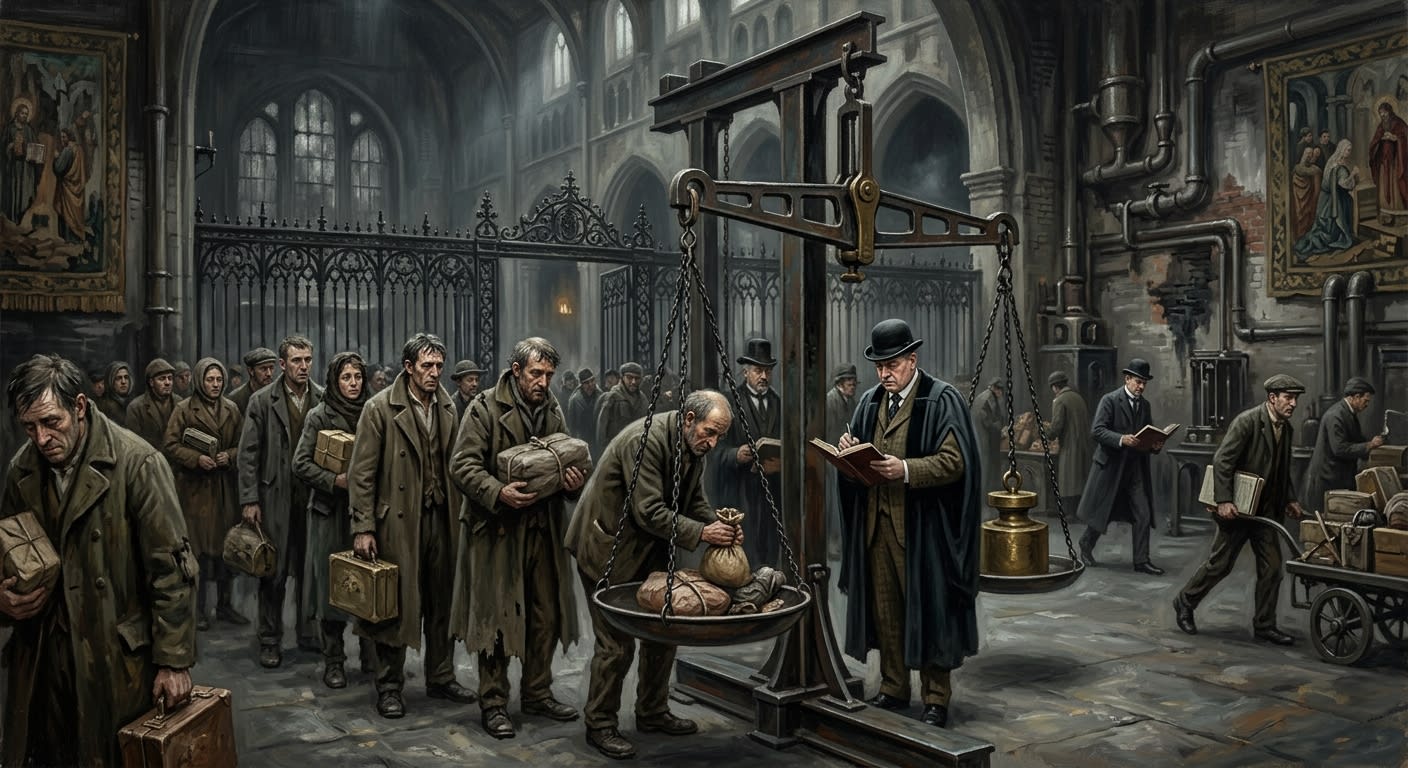
The Tariff Chapel is the Synod's smallest church and its most honest instrument of conquest: a stone room where goods, corpses, relics, grain, salt, bone, wax, and human desperation are placed under a scale until they confess a rate.
Do not be misled by the altar candles. The chapel exists to weigh. Its holiness is practical, its mercy conditional, its architecture deliberately cramped so that the queue outside can hear the stamp fall and remember that hunger has a sound. The door is narrow. The counter is high. The clerk sits behind iron mesh or carved oak or, in poorer depots, a plank polished by elbows and fear. Above him hangs a saint appropriate to the trade: Calibrus over grain and lawful shortage; Morin over dead goods; Saint Vellum over manifests that have learned to rot before judgment.
Each chapel contains the same necessary furniture: scales with scripture on the arms, a reliquary casket for calibration fragments, a seal press, tally-board, locked tariff codex, candle ledger, appeal hook, confiscation bin, witness stool, and a small side niche where difficult cases may be kept until their owners become cheaper. The side niche is the soul of the institution. A civilisation may be judged by what it places in side niches.
#On the Bread-Scale Birth
The Tariff Chapel was born in A.S. 97 from the Bread-Scale Uprising, that splendid civic correction which Records now calls a supply-chain irregularity because the alternative phrase contains too much fire. A guild at a southern gate poured lead into its weighing pans. Every sack weighed heavy. Every tariff rose. Every loaf thinned. The city starved with mathematically perfect receipts.
The crowd burned the gate, the guild hall, and seventeen adjacent structures, including a priory whose innocence has since been protected by erasure. Strasbourg responded with its native grace: private measurement became illegal, all civic scales were seized, weighing became sacrament, and the Commerce Clerk acquired the authority of a minor priest and the popularity of a rat in a granary.
Early municipal proclamations described the A.S. 97 incident as hunger revolt against commercial fraud.
Corrected. Hunger does not revolt. Hunger produces pressure. Pressure, when insufficiently channelled by licensed clerks, damages property. The doctrinal distinction saves many executions from sounding political.
The first chapels were ugly rooms with clean scales. That was enough. The queue learned the new liturgy quickly: stand, present, weigh, answer, pay, pass. Those who objected were invited to discover that the Bureau of Tithes can make arithmetic sound like treason. Within a year, relic-calibrated weights had spread from bastion gates to port weighhouses, trench depots, caravan stops, ferry locks, marrow counters, and markets whose vendors still kept grandfather's honest scale under the bed until Purity found it and made the bed instructive.
#On Calibration and the Sacred Zero
The chapel day begins before the queue sees the door open. The clerk unlocks the reliquary casket under witness, lifts the calibration fragment with tongs or gloved fingers, touches bone or saint-ash or hymn-metal to the scale-arm, records the zero, and speaks the line: None shall eat unweighed, lest he forget his dependence.
The zero is sacred because everything after it can be blamed on the world. If the zero holds, a rotten sack still weighs truly. If the zero holds, a merchant's plea is noise. If the zero holds, a widow's bone crate may be tariffed by weight and distance with perfect serenity. If the zero drifts, the whole day becomes heresy with columns.
The Bureau of Relics supplies fragments with the confidence of a butcher selling theology by the ounce. Some caskets hold certified martyr dust. Some hold saint-bone slivers. Some hold splintered bell-metal from sanctioned peals. After the Relic Counterfeit Scandal, assay seals became mandatory; after the assay seals were counterfeited, counter-seals became mandatory; after the counter-seals multiplied, the chapel acquired a second lock and a fourth form. This is how Order improves: by discovering the next place a thief can put his thumb.
The queue understands the zero better than the theologians do. A vendor watches the pan like a condemned man watching the judge's mouth. A quartermaster watches the clerk's fingers. A mother with ration cloth in her fist watches the saint above the casket and decides whether the painted eyes look hungry.
#On Two Kinds of Chapel
The public thinks there is one Tariff Chapel. Clerks know there are two: the commerce chapel and the mortuary chapel.
The commerce chapel weighs goods: grain, salt, oil, wire, diesel, cloth, medicines, bell-metal, brick, gun-casings, pilgrim baggage, smuggled luxuries badly disguised as devotional burden. Its patron is Calibrus, the Level Hand. Its great fear is famine caused by fraud, delay, or correct procedure. Its factions — True Measure Zealots and Mercy Weighers — quarrel over whether a starving queue should receive exactness or survival, as though the Bureau ever intended the two to meet without a fee.
The mortuary chapel weighs remains. It belongs to the Dead-Goods Tariffer and his wax-lipped patron Morin. Its categories are Burial, Transport, Salvage, Ornamental, Contaminated. Its smell is lime, incense, wet wood, coffin rot, and the exhausted silence of families who have discovered that grief requires paperwork. Here a skull may become ornament, wall-lime, evidence, contraband, or a disputed relic, depending on the stamp and the bribe and whether the skull makes noise while the lamp burns.
MARROWGATE TARIFF-CHAPEL HOLD NICHE 6 — A.S. 199 Contents: four tagged crates, two sealed child-shrouds, one ornamental petition, one purity-lamp failure Incident: crate three tapped seventeen times during zeroing rite Clerk response: continued weighing Auditor note: “commendable discipline; review surviving witnesses”
The two chapel forms share tools because the Synod has a genius for making grain and corpses obey the same grammar. A sack is weighed. A skull is weighed. A barrel is sealed. A coffin is sealed. A merchant pays transit. A widow pays transport. If the thing crosses a threshold, the chapel makes it legible; if it becomes legible, it becomes taxable; if it becomes taxable, it becomes holy enough to defend with clubs.
#On Factions, Bribes, and Correct Mercy
Every Tariff Chapel breeds factions because every scale produces a moral wound. Exactness kills when hunger waits outside. Mercy corrupts when ledgers must balance. Speed saves bodies and ruins audits. Delay protects files and rots cargo. A clerk with a pan before him and a crowd behind the rope becomes a philosopher, which is a terrible thing to do to a tired man.
True Measure clerks polish the pan until it reflects accusation. They double-zero, report bribes, denounce drift, and can smell counterfeit weights through canvas. They are useful in audits and unbearable at supper. Mercy Weighers shave wealthy cargo, lighten widow-tariffs, and move hunger across ledgers before it turns into flame. They are illegal when exposed and indispensable when successful. The Bureau condemns them with one hand and studies their results with the other.
Dead-goods chapels have their own split: Pure Chain against Mercy Stamp. Pure Chain requires every lamp check, every kin mark, every caliper reading, every tag fibre. Mercy Stamp clerks clear the queue before corpses become plague. Both factions invoke Morin. Both accuse the other of insulting him. Morin, sealed in wax, offers the only sensible answer.
Bribery is constant. The Bureau's public manuals call it corruption. Private memoranda call it unauthorised rate adjustment. I call it the chapel's second liturgy. Coins arrive under flour, inside candle boxes, between coffin planks, folded beneath permit slips, pressed into wax, hidden in saint medals, offered as oil, sorrow, thanks, penance, apology. A clerk who rejects every bribe becomes famous, then watched, then promoted into a position where he can no longer interfere with traffic. A clerk who accepts every bribe becomes rich, then careless, then educational.
A.S. 181 Tariff-Chapel Division guidance claimed bribery could be eliminated through stricter witness protocols.
Revised A.S. 187 after witness protocols created a witness-bribery tariff. Current phrasing: bribery shall be reduced to administratively legible channels. The Bureau has matured. Cherish the moment.
#On the Present Use
As of A.S. 201, every serious gate, port, trench depot, market hall, ferry lock, ossuary counter, plague intake, and bastion supply throat keeps a Tariff Chapel or petitions for one before the next audit discovers its lack. The chapel is the hinge between movement and permission. It taxes goods, then performs the greater violence: it decides whether goods possess lawful identity.
A barrel of diesel without chapel stamp is smoke waiting for a charge sheet. A sack of grain without weight is sedition in burlap. A corpse without burial clearance is a future sound in an unsealed pit. A relic without assay is either priceless, counterfeit, or both, which means the chapel will keep it until classification becomes profitable.
The great cities have ornate chapels with brass grilles, marble counters, painted saints, and clerks trained to sneer in four registers. Frontier depots have cold rooms with cracked pans and a candle that gutters whenever the artillery begins. Marrowgate has mortuary chapels where the queue includes the living, the dead, and the portions of both whose paperwork has arrived ahead of them. Constantinople has chapels whose bells are louder than the clerks, which has improved the clerks' tempers not at all.
The chapel's truth is plain. The Synod cannot make every citizen virtuous, every merchant honest, every corpse quiet, every convoy punctual, every sack clean. It can make all of them stand in line. It can weigh them. It can stamp them. It can charge them for the privilege of becoming real.