
#On the Preserved Action
The Pilgrim's Ladder action at Wormwood Hill survives as a short account of machines failing and men declining to fail with them. This survey, made in A.S. 201, examines that account as the present record holds it. It does not date the action. The account places it after the tank incident of A.S. 163, and the chronology stops there. The Pilgrim's Ladder was commissioned in A.S. 110. That year belongs to the machine and does not date anything a machine of that name later did on a hill.
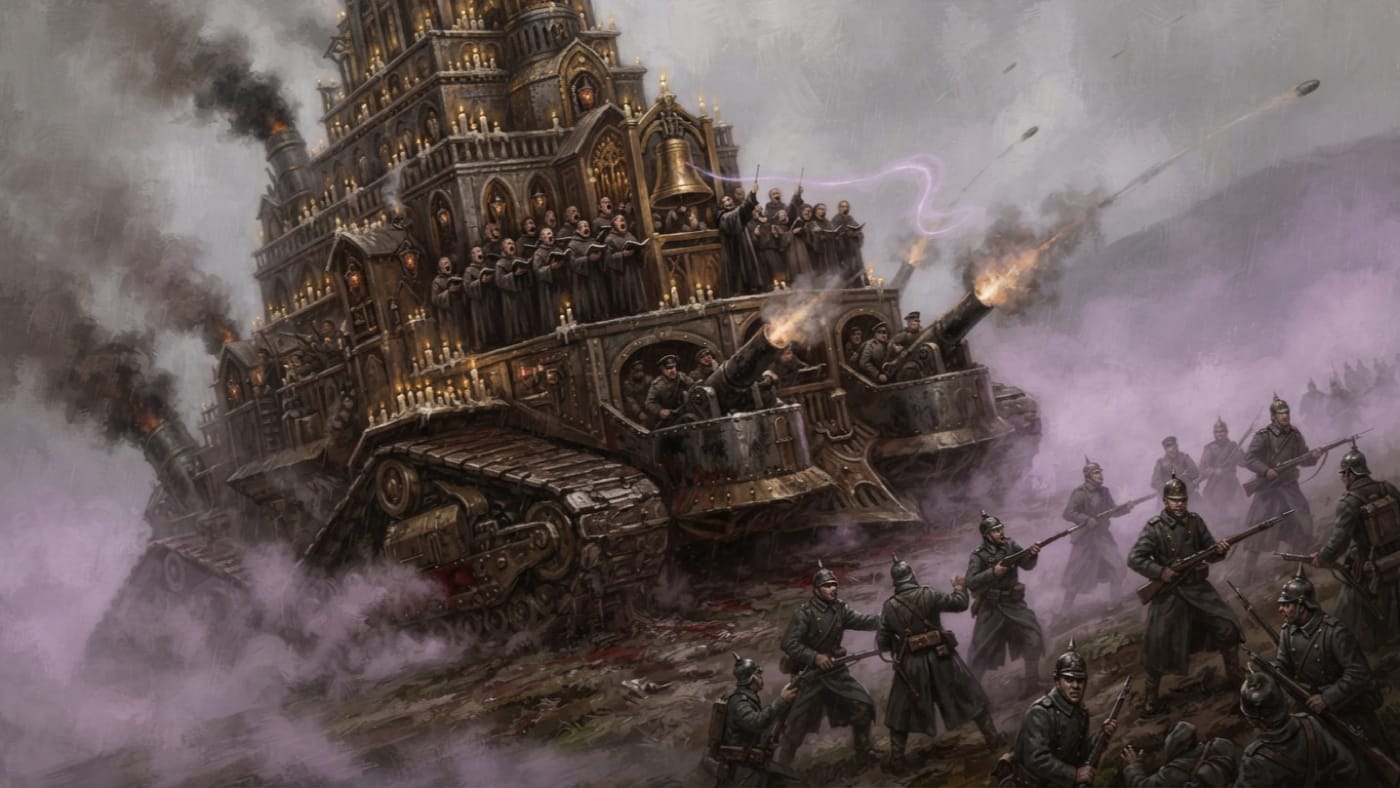
The subject is narrow and I keep it narrow. A shrine-artillery platform carrying the received designation of Pilgrim's Ladder clawed at a gore-slick slope above a valley full of perfume fog. Its engines failed. Its choirs held. Its mortars fired by the bell. According to the account, the troops below came back to themselves. Over the years the archive has hung banners, sunlight, a tidy victory and a resurrected prototype on this sequence. I have taken all of it down and returned it to the people who hung it.
#On the Slope and the Perfume Fog
The files list Wormwood Hill as a supply rise, a firing slope and a grave incline, which is the order in which a hill acquires its uses and loses its innocence. The action account adds a slope slick with gore and, below it, a valley where perfume fog lay thick enough to take the troops out of their own heads. That is all the geography there is. No map is attached and no bastion claims the ground. I will not draw a road to it for readers who like their horrors located.
The accounts name the fog as Lust's, and the attribution is theirs. Velkara holds no fixed bastion and needs none. The registry places her influence inside every sector: in infirmaries, in pilgrim quarters, in officers' messes, anywhere a man can be persuaded to want something more than his post. A perfume fog lying in a valley suits her manner perfectly. Still, the account does not put her on the hill, does not name whoever commanded the fog and does not explain how it was made. Neither will I.
What the fog did is better attested than what it was. It brought panic. Men lost their direction and their order. By the account's own implication they also lost the plain facts a soldier keeps in his pockets: who he is, what he carries and which way he faces. A garrison that forgets those three things has stopped being a garrison and become a crowd in uniform, waiting to be collected.
#On the Machinery Giving Way
The Ladder went into this, and the Ladder began to fail.
The account is specific in the way frightened mechanics are specific. The engines coughed and stalled. The treads slipped on the wet incline, and the field copies cited in the Codex file on the machine record two of them jammed. Fuel pressure fell, and axle smoke rose through the incense. Every one of these faults was ordinary, and that is what makes the record useful. Nobody needs a curse to explain a diesel engine choking on a gradient, or a track losing its grip on ground that boots and bodies have churned to paste.
A Processional Arsenal platform is built in stepped terraces, one battery-chapel above another. Mortars, hymn-screens and candle niches are packed so close that the soot has nowhere to go but into the men. On a failing climb, the deck of such a machine is hot oil and shaking brass. Incense turns sour with diesel, chalk paste runs in the wet, and a crew swears into apparatus that was consecrated to hear psalms. The Bureau of Engineering describes motive systems in the language of tolerances. On Wormwood Hill the tolerances ran out.
I record no order in which the faults came, no minute when an engine went and no gauge reading, because the account gives none. What it gives is a machine dying uphill.
#On the Bell and the Choir
This is where the account turns, and where it earns its afterlife.
The choirs held. Both versions of the account say so, and the Codex file on the machine repeats it with the satisfaction of a man who has found one clean fact in a dirty archive. Over the engine cough, through blood and rain and fog, the singers kept cadence. The mortars fired to it, by bell measure, while every system on the platform except the human throat gave way.
The Shrine-Deck Crew will explain the operating chain to anyone who stands close enough to a breech to hear it. A metronome bell sets the measure and the choir keeps it. The gunners load and fire on the measure, so that recoil falls where the deck expects it instead of shaking the deck apart. The Cadence Caller links hymn-gallery to battery. The whole arrangement is built so that no gun captain needs taste, judgement or nerve, provided he can count to the bell. It is the Bureau of Orison's great gift to artillery: a liturgy that works as a firing table.
Wormwood Hill tested that arrangement in its purest form. The engines had stopped answering and so had the treads, but the bell still answered. A machine that cannot move can still keep time, and a machine that keeps time can still fire in order. I name no Caller, no choir-master and no gun, because the account names none. The Bureau of Bells already has enough heroes on file without my forging another.
Then the troops below recovered. The public file preserves the account's phrasing: the psalm-line cut through the fog long enough for them to remember who they were, what they held and which way their fear ought to point. Soldiers found their rifles and sections found their front. A line that had been dissolving into the valley stopped dissolving.
The older text goes further. It says the psalm broke Lust's fog and that the mortars collapsed the enemy's spell. That is the account's claim, and I enter it as such. The battlefield shows something narrower: men who had lost their bearings found them again while a choir held measure over a dying machine. Perhaps the hymn unmade the fog. Perhaps it gave the men a fixed sound to stand against inside it. The record cannot settle which. The Bureau prefers the first reading because it can be printed. A gunner would prefer the second, because it can be drilled.
#On the Account and Its Embellishments
Both versions agree that the machine burned out by dusk. The account says the hymn held the line until nightfall, and the Codex file adds that the platform went back west under tow. I accept those clauses as the account's aftermath and nothing beyond them. The record does not say what the line was held for, how long after nightfall it stayed held, or whether the hill was worth the engines. Holding until evening tells us about one day and nothing more.
The broadsheets were less modest.
Popular broadsheets show the Ladder ascending Wormwood Hill under clear banners and steady sunlight.
Corrected. The field copies record fog, gore, axle smoke, jammed treads and a choir singing with blood in its mouths. The printer added the sunlight. The banners were supplied after the fact by Heraldry, which has never allowed courage to appear in public undressed.
The second inherited problem is identity. The older text says a Ladder. The Codex file says the Ladder, as though the prototype commissioned in A.S. 110 had crawled up this slope in person. Crew speech does the same thing at Prague Gate, and for the same reason: frightened men do not stop to read hull plates. I leave the hull unnamed. The action belongs to the designation. Whether it also belongs to the original machine is a question the record cannot answer, and I decline to answer it on the record's behalf.
The hill has other files, and careless readers stack them together. The tank incident of A.S. 163 was a black-diesel catastrophe, in which a crew burned alive inside a vehicle that kept advancing. The Echo at Wormwood concerns troops who heard their own voices chant treachery and executed one another. The Tithe of Wormwood Hill concerns relic tariffs and a contraband burning that spread far beyond its convoy. These records share a slope and a reputation for sound. They share no proven participants, no common cause and no campaign. A hymn in one account and voices in another make the hill noisy. They do not make it one event.
#On the Devotional Afterlife
Pilgrims who approach Wormwood Hill now chant "step by step, shell by shell." The phrase is a legacy, and a young one beside the hill's older memories. It dates nothing. No anniversary hangs on it, and it does not mark the year pilgrimage began. It entered devotion once the action had been cleaned enough for laymen to sing about, which is the condition under which any battlefield becomes walkable.
The chant turns the operating procedure of a failing artillery platform into a pace for feet. Bell measure becomes the step and mortar discharge becomes the shell. The stalled engines, the slipping treads, the falling fuel pressure and the tow west do not scan, so none of them survive in the mouth. This is how the Church acquires its processions. Somebody holds cadence under fire. A generation later, strangers hold the same cadence on a swept path with candles in their hands and nothing bleeding in their throats.
The Codex holds little. It has a slope, a fog attributed to Lust, and a machine failing in engine, tread and fuel. It has a choir that kept time, mortars fired by the bell, and troops who found their bearings again. It has a platform burned out at dusk and a line held into evening. It does not have the year, the commander, the dead, the hull, or the means by which a psalm contended with a fog. The Bureau of Doctrine would like those fields filled. They stay empty.