
#On the Bureau That Prices Obedience
The Bureau of Commerce is the Synod's licensed appetite with a clean cuff.
It governs trade, which is the polite word for deciding who may eat, move, bury, burn, sell, inherit, import, export, contest, appeal, condemn, and be charged for the privilege of discovering that privilege requires another stamp. The unlettered imagine commerce as coin passing from hand to hand. This is touching, as village errors often are before they become indictable. Coin is merely the smallest noise in the system. Commerce deals in permission, weight, name, passage, delay, clearance, lawful shortage (Unregistered), sanctified spoilage, route sound, wax bite, and the magnificent little moment when a hungry man learns that the sack in front of him has not yet become food because its paperwork has not confessed.
Its public doctrine is simple enough to print over a tariff-chapel door: no good may enter the Covenant unweighed; no weight may be trusted unblessed; no blessing may bind without record; no record may stand without fee. This sequence has fed armies, starved districts, enriched chapel stalls, broken guilds, raised saints, educated forgers, and kept the Sagittal Line supplied through two centuries of mud and fire. It is monstrous. It is functional. The distinction belongs to poets and defendants.
Commerce does not sit alone in Strasbourg. No Bureau does, except in its own propaganda and in the dreams of directors who drink after Matins. Tithes claims revenue. Records claims proof. Pilgrimage claims road necessity. Settlement claims civic emergency. Masks and Seals claims the official mark. Purity claims whatever can be shot. Commerce claims the table. The table is where everyone else places the knife.
This is its genius. Commerce rarely needs to own the cargo. Ownership attracts petitioners, creditors, widows, and fires. Commerce owns the terms under which cargo becomes recognisable to law. Grain exists in the field, yes. Grain exists in the wagon when the axle has not lied. Grain exists in the ledger only after measure, category, origin, rate, seal, and passage have agreed to stop quarrelling. Until then it is a theological rumour with weevils.
#On Origins in Scale and Riot
Commerce, like most Synodal virtues, began as panic with a better signature.
Private measurement survived the first decades after the Concordat because Strasbourg had larger beasts to flay: Rationalist remnants, hungry garrisons, false pontiffs, cracked dioceses, and governors still under the impression that ancestral charters were stronger than artillery. Markets used guild scales, parish weights, merchant measures, harbour tallies, and the old smugglers' method of looking a man in the eye while lying by half a handful. The system was corrupt, local, comprehensible, and occasionally kind. Naturally, it could not be permitted.
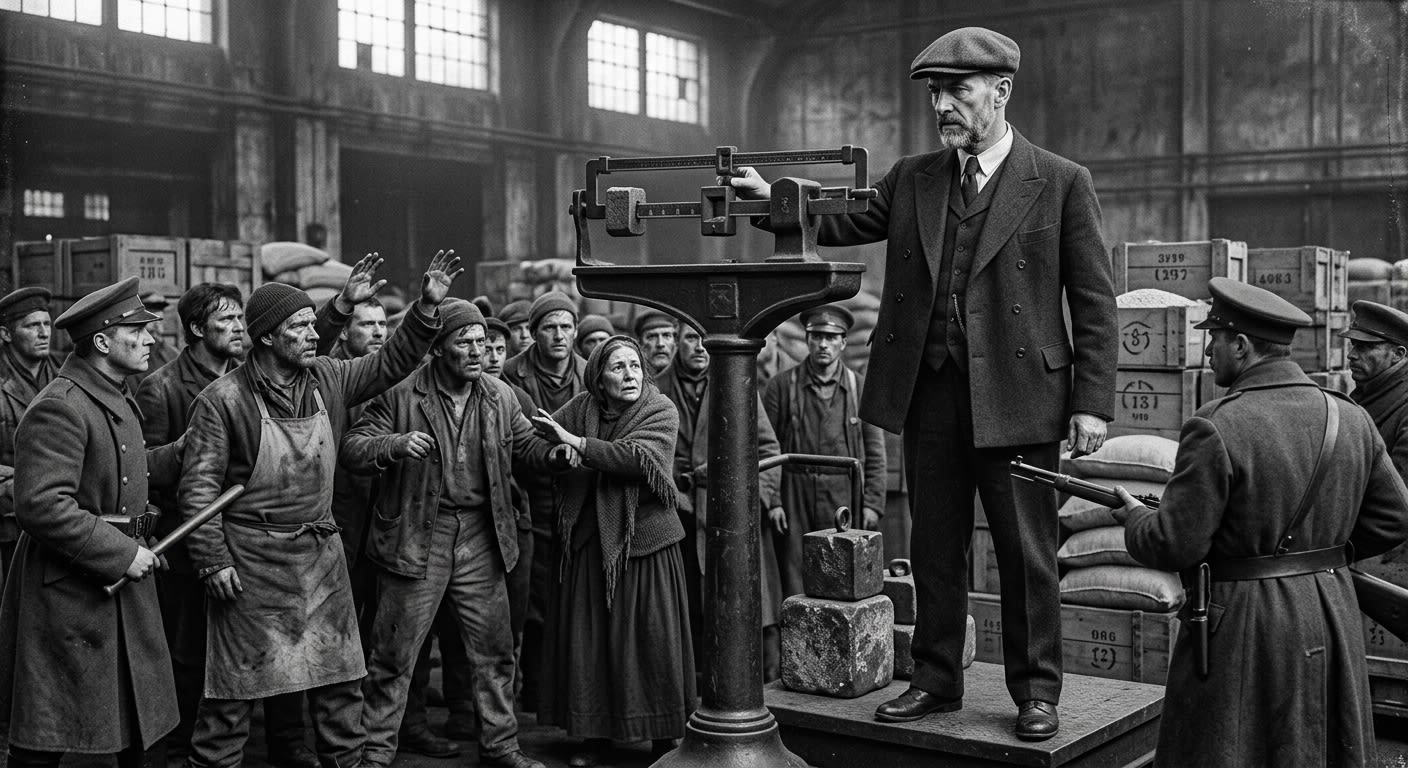
The Bread-Scale Uprising of A.S. 97 gave the Bureau its altar. A southern-gate guild rigged the pans: lead poured into cavities, counterweights shaved, every sack weighed heavy, every tariff overpaid, every ration thinned until the city learned arithmetic in the stomach. The crowd burned the gate, the guild hall, and seventeen adjacent structures, including a priory whose chief crime was geographical obedience. Strasbourg seized all scales within the season. Private measurement became illegal. Weighing became sacrament. The reliquary-calibration system followed within the year.
Early Commerce catechisms call the Bread-Scale Uprising “the popular petition for sanctified measure.”
Corrected. The petition was fire. The signatures were smoke, broken doors, and seventeen structures counted with bureaucratic tenderness only after they stopped burning.
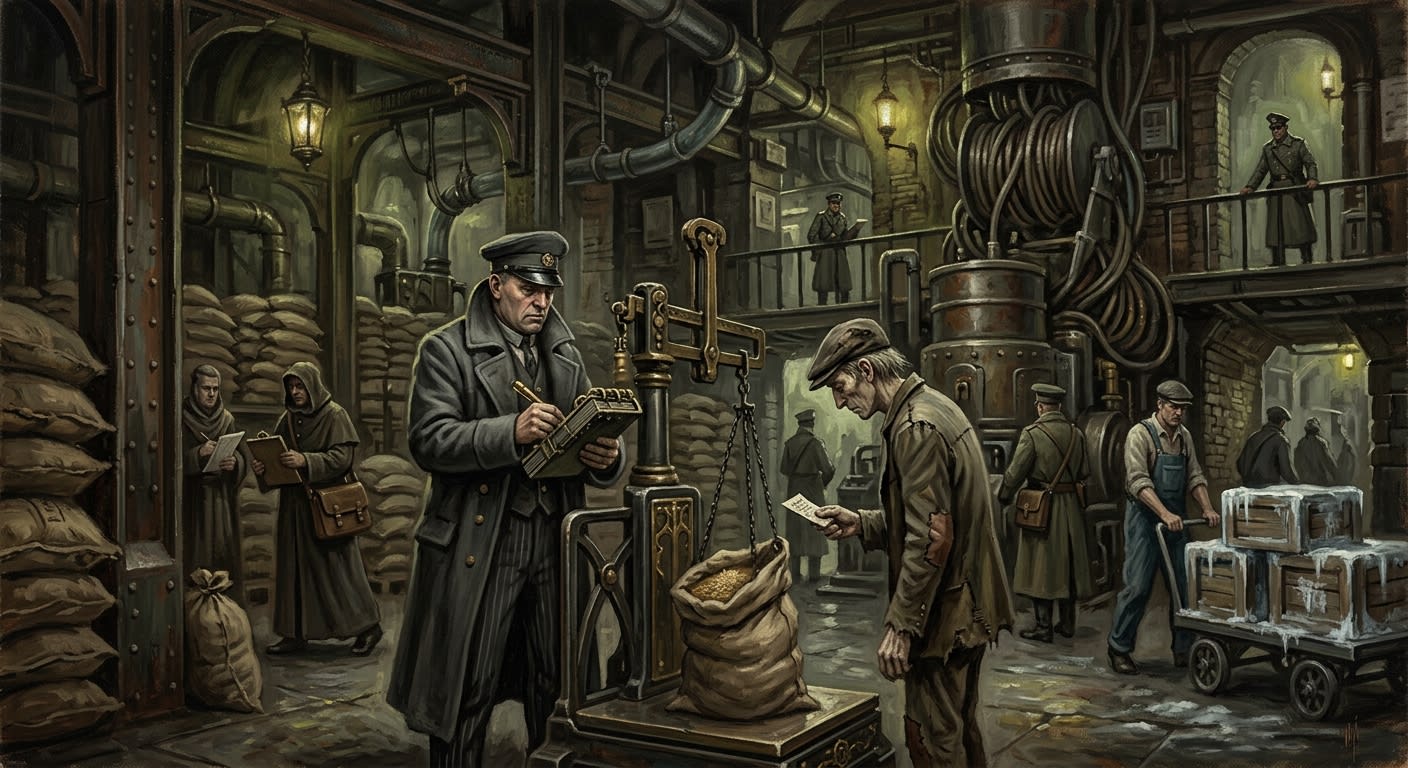
The Commerce Clerk emerged from that smoke: half priest, half accountant, half rat, which makes three halves and one fully licensed nuisance. He stood in a cold tariff-chapel with a reliquary casket, a stamped scale, a finger brush, chalk dust on his cuffs, and the authority to decide whether food had entered the Covenant cleanly enough to feed the people who had carried it there. The reliquary fragments did the doctrinal work. Bone slivers, saint-ash, splintered hymn-metal: each fragment witnessed the zero. Sacred matter made measure pure. Pure measure made tariff lawful. Lawful tariff made hunger obedient.
Saint Calibrus the Level Hand arrived when Commerce needed a face to place above the pan. His approved icon holds a suspended balance above a kneeling crowd. Whether the crowd kneels in prayer or weakness is left unresolved, which is the finest possible iconographic outcome for a Bureau that prefers decisions delayed until paid. His feast-day stalls sell miniature weights, balance charms, finger brushes, and devotional crumbs sealed in wax. I have seen children kiss a Calibrus token before joining a queue where their mother would be charged for the grain dust on her sleeve.
Commerce's first century is the tale of local practices being swallowed into tariff-chapels. Market alcoves became scale rooms. Port sheds became measure chapels. Depot ledgers acquired custody seals. Gate tolls became loyalty confessions. The Bureau kept trade and gave it vestments, rules, witnesses, penalties, appeals, surcharge schedules, and a vocabulary so holy that ordinary theft blushed to hear it.
#On Tariff-Chapels and Lawful Shortage
A tariff-chapel is not a chapel in the sentimental sense. No grieving widow has ever entered one and felt embraced by Providence, unless Providence has recently been issued a ledger and a bad chair. The room is cold, because warmth near grain invites rot, and because comfort might make the clerk merciful. There is a scale at the centre. There are benches for waiting merchants, hooks for confiscated sacks, an iron casket for reliquary fragments, a side desk for purity marks, and a small window through which the queue may glare in disciplined hunger.
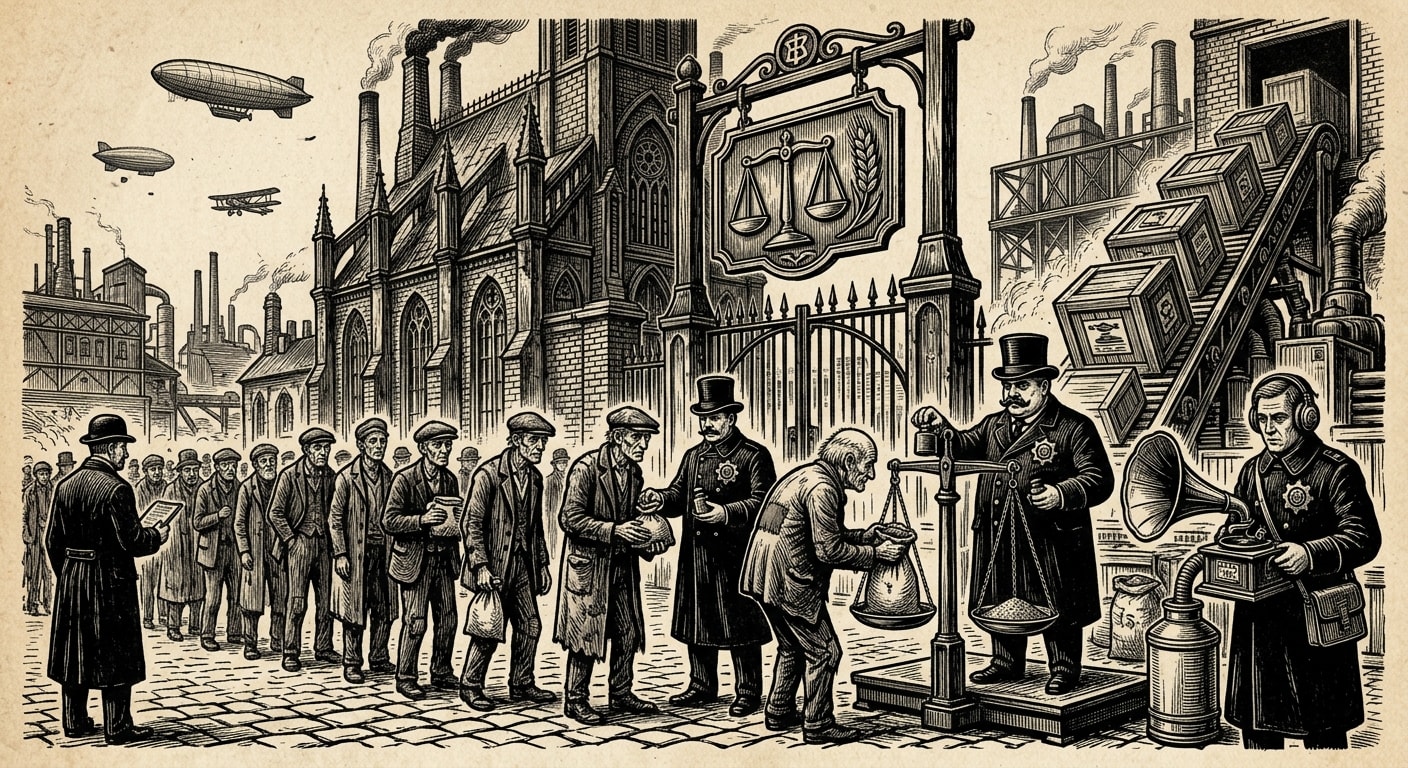
The day begins with zeroing. The reliquary casket is opened under witness. The fragment is placed. The scale settles. The clerk records the zero in black ink, then in red if food or medicine is involved, then in a duplicate book because Records trusts nobody and is correct. Goods are weighed gross and net. Tariff class is assigned by season, war pressure, sector discipline, contamination risk, declared origin, corrected origin, suspected origin, and the clerk's private opinion of the merchant's face, though the last category is filed under “condition.”
Lawful shortage is the Bureau's favourite miracle. It occurs when the scale, the rate, the tithe, the convoy levy, the spoilage deduction, the chapel fee, the purity surcharge, and the emergency reserve leave less food for distribution than the crowd expected, while every calculation remains correct. Saint Calibrus watches over this moment with his level hand and closed mouth. The crowd watches too. The crowd's mouth is rarely closed for long.
The internal factions were born at the pan. The True Measure Zealots hold that the scale is a sacred instrument and should settle without pity. They double-zero, report drift, refuse mercy weights, and create audits as a horse creates manure: continually and with no visible embarrassment. The Mercy Weighers shave tariffs by ounces, shift compensatory levies, overcharge guild cargo to feed ward children, and keep two books with hands steady enough to shame angels. Commerce tolerates both because Zealots make excellent witnesses and Mercy Weighers prevent riots at a discount.
Standing Order 77-A, revised in A.S. 199, made drift reporting mandatory after a series of market collapses too embarrassing to name after cities with living patrons. The order also established random relic assay, chapel-chain inspection, and the delightful requirement that all bribe accusations be weighed symbolically before investigation. Commerce denies the last phrase is comic. Commerce is often wrong in matters of comedy, though rarely in matters of fee extraction.
#On Port Courts, Manifest Litigants, and Paper with Fangs
If the tariff-chapel is Commerce's altar, the port court is its throat.
There, Manifest Litigants prosecute the identity of cargo in galleries above warehouse floors, so that advocates may look down upon goods they are preventing anyone from touching. They argue spelling, origin, seal depth, vowel legitimacy, rate survivorship, exception clauses, chapel witness status, and whether a barrel named in one manifest is spiritually continuous with a barrel in another. The public calls this madness. The public also screams when false manifests let poisoned flour into a ration ward. The public desires both speed and certainty, the two luxuries least suited to bureaucracy.
Manifest Litigation formalised after the Rot-Week of Saint Vellum and hardened through the Orthography Purge of A.S. 112, the Seal-Forgers' Winter of A.S. 145, and the Ledgers of Varna in A.S. 129. This chronology is ugly because Commerce history is less a line than a docket spilled on wet stone. The Rot-Week taught that unlicensed delay could burn a warehouse and starve a district. The Orthography Purge taught that letter-forms could reopen four hundred and eleven cases and remove eleven licensed practitioners from useful breathing. Seal-Forgers' Winter taught that wax could lie beautifully. Varna taught that every lesson would be paid for by someone without a chair in court.
The Litigant's principal weapon is the Sanctity Stay Order (Unregistered). A stay freezes cargo while documentary identity is reviewed. It may save a city from contaminated goods. It may rot a fleet. It may reveal a forged seal. It may feed storage fees until the warehouse keeper grows fat enough to require doctrinal explanation. A Purist files quickly. A Pragmatist files strategically. Shadow Counsel files for whoever paid before sunrise.
PORT COURT DIVISION — SEALED FEE ANNEX, A.S. 198 Quarterly review: Shadow Counsel processed ███ cases faster than licensed competitors. Riot incidents reduced by ███ percent. Contraband throughput increased by ███ percent. Recommendation: continued observation; no public censure while ports remain quiet. Purity objection appended in red, unreadable after water damage.
The Precedent Curator is the final ecclesiastical shape of this profession: a retired Litigant in a cold archive, custodian of the Thirty-Seal Index (Unregistered), keeper of old distinctions sharp enough to cut present throats. Curators decide which dead rulings remain alive. A ruling from A.S. 112 may rise under A.S. 187 survivorship notes and bite a shipment whose merchant's grandfather had no beard when the case began. Commerce calls this continuity. Merchants call it extortion with ancestry.
#On Varna, Novi Sad, and the Mercy of Moving Quickly Too Late
The Ledgers of Varna remain Commerce's cleanest atrocity because no demon, storm, plague, or enemy host can be blamed without insulting the documents. In A.S. 129 a grain fleet entered Varna harbour intact: holds dry, sacks sealed, scales calibrated, escort papers witnessed. The cargo should have fed three zones. Tithes claimed taxable strategic grain. Pilgrimage claimed route-sustaining ration. Settlement claimed civic emergency. Commerce claimed procedure, with the sanctimonious modesty of a spider describing thread.
Two Litigant houses filed Sanctity Stay Orders. The first challenged tariff identity. The second challenged the challenge, a professional manoeuvre so foully correct that one hears Hell taking notes. Nineteen days passed. Heat entered the holds. Grain clumped, sweated, bloomed, and became proof that wheat lacks reverence for jurisdiction. The populace rioted. Purity shot thousands into the harbour. Records declared the rot a holy fast. Tithes declared all calculations correct. Commerce filed the case under velocity failure, meaning the machine moved too slowly for flesh.
Commerce instructional plates long described the Varna fast as voluntary civic discipline under lawful suspension.
Corrected for internal accuracy. Voluntary consent was inferred after the volley. The dead submit few objections in proper form.
Novi Sad supplied the companion lesson. Two inspectors stamped the same cargo with conflicting seals. Both stamps were valid. Both inspectors were licensed. The cargo was divided across claims, producing rations that existed in perfect balance across two ledger books and nowhere in the mouth. Thousands perished. All ledgers balanced. Commerce Clerk trainees study Novi Sad after Varna: first velocity failure, then precision failure. Two jaws, one meal.
These events did not weaken the Bureau. They strengthened it. Catastrophe is fertile when sown in forms. Varna produced training doctrine, port-court examination answers, faster condition logging, improved rot classification, and more careful language around crowds. Novi Sad produced duplicate-stamp protocols, seal hierarchy clarifications, and reforms so precise they generated new categories of dispute by the fourth paragraph.
A fool asks why nobody was punished. A student asks which office gained authority.
#On Routes, Tokens, and the Price of Walking
Commerce learned that goods are not the only things needing price. Movement itself could be made devotional, measured, licensed, stamped, and sold back to those whose legs had carried them since birth without prior Bureau assistance.
The Route-Stamper / Indulgence-Token Smith trade was chartered in A.S. 114, two years after Cadrin's vita approval, a sequence so tidy that no moral man should look at it directly. The hierarchy is clean: Blank-Cutter, Stamp-Hand, Tuner, Indulgence Smith, Bell-Hour Calibrator. The product is a token with a bell-hour core, a little captive obedience that lets the road hear the bearer and lets the gate decide whether hearing should become permission.
Route tokens bind Commerce to Bells, Records, Pilgrimage, Engineering, and every family that has ever stood at a gate with one child too many. A proper token tolls within the authorised cadence. A proper road answers. A proper warden waves the bearer through, after fee, inspection, confession, delay, and minor humiliation. Improper tokens create quieter theologies.
The Great Counterfeit Winter of A.S. 160 began with tokens that sounded almost correct. Lyon forgers and Marseille workshops produced drift-tuned cores, visually competent, serially ugly, acoustically lethal. Over a week the drift placed travellers three hundred yards outside Bellway protection. Families vanished within sight of shrine-posts. Couriers arrived with frost packed in their ears. Commerce wanted the deaths listed as counterfeiting casualties. Pilgrimage wanted unauthorised deviation. Bells wanted harmonic inquiry. Records chose route-adjacent fatalities, environmental, a phrase that deserves to be tied to a post and shot at dawn.
The Winter created the factions that now hiss inside stamp-chapels. Cadence Purists obey the printed table even when fog, mountain, marsh, or river makes the table murderous. Route Pragmatists adjust bell-hour cores to match the actual road and pay fines with the weary dignity of men whose customers remain alive. The Silent-Core Crew sells acoustic evasion: muffled cores, sub-choir cores, dead-saint cores, quiet steps for smugglers, deserters, mothers, refugees, and anyone else priced out of lawful audibility.
Commerce condemns the Crew in public and studies its methods in private. Commerce calls this procurement without confession.
#On Counterfeiters, Black Markets, and the Bureau's Shadow Children
Every law produces its criminal in the shape of its own desire. Commerce demands proof; the Seal-Forger manufactures proof. Commerce demands passage; the quiet-core smith sells unmeasured steps. Commerce demands measured grain; Mercy Weighers shave ounces. Commerce demands sealed identity; black registrars conjure paperwork for the erased, the hungry, the inconveniently born, the improperly buried. The Bureau calls these crimes. The street calls them air.
A seal-forger is an illicit notary with wax burns on his thumbs and a better understanding of Synodal power than several Deputy Prefects I could name if I enjoyed wasting ink. He cuts punches, ages paper, imitates registry hands, mixes wax, bruises folds, and manufactures the little public miracle by which a gate opens for someone the system has denied. He is dangerous because he proves that legitimacy has measurable features: depth, rim, ink sheen, paper grain, hesitation stroke, seal temperature, prayer number. If features can be copied, authority becomes a craft. The Synod hates craft it has not licensed.
Seal-Forgers' Winter in A.S. 145 was the great education. Counterfeit rings passed casual inspection across eastern port markets. Wax hardened. Ports froze. A child courier's bread release was held while an undercut was examined; the seal proved genuine on the fifth day, after the crowd had been fired upon. The autopsy fee was charged to the receiving parish. I repeat this because some obscenities improve under the hammer: the autopsy fee was charged to the receiving parish.
The black market completes Commerce. Where tariff-chapels delay, alleys accelerate. Where port courts classify, smugglers simplify. Where route tokens price road sound, quiet cores sell silence. Where reliquary scales witness lawful shortage, back-room measures witness survival. A mother buying forged papers for an unregistered child is accepting Bureau theology's premise that paper makes life possible and seeking a cheaper priest.
This is why Purity's raids never end the trade. They only improve workmanship. A bad forger dies. A good forger gets hired under seal after the office has finished denouncing him. A brilliant forger becomes policy with his name removed.
#On Commerce's Saints, Relics, and Retail Theology
Commerce loves saints because saints sell obedience without looking like clerks.
Calibrus belongs to the scale. Cadrin belongs to the road. Vellum belongs to the narrow line between true and condemned. Saint Vellum of the Narrow Line, whose vita is mostly smoke, warehouse ash, and profitable absence, presides over Manifest Litigants with a quill like a spear and a burning storehouse behind him. The Bureau says he was a port clerk. Doctrine says he was a lay confessor of cargo identity. Records maintains three spellings, all authenticated. Commerce keeps the fee schedules and smiles with every tooth hidden.
Relics under Commerce supervision behave like goods pretending to be arguments. A Calibrus bone fragment witnesses the scale. A Cadrinic fork steadies the die hand. A Vellum scrap blesses the distinction that will cost someone winter stores. Authenticity matters, of course, in the same way that table manners matter at an execution: visibly, loudly, and only until the useful work begins. Relics audits four thousand Cadrinic forks each year from a saint who possessed, by generous doctrine, one. The excess is not scandal. It is inventory with candles.
Devotional stalls cluster around tariff-chapels and stamp houses. Mothers buy tiny silent forks for children taking first road. Port advocates buy Vellum ribbons before difficult holds. Weighers replace finger brushes on Calibrus feast-days and pretend the old brushes are worn out rather than morally contaminated by prior arithmetic. Merchants mock the stalls until their own cargo stalls, then purchase the largest candle available and call it prudence.
The Bureau denies that retail devotion influences rulings. This denial is true in the technical sense: a candle does not change the tariff. It changes the clerk's confidence while applying it. That is a more durable miracle.
#On Audit, Punishment, and the Clerk's Private Arithmetic
Commerce punishes failure most harshly when failure becomes visible.
A clerk may shave ounces for years if the totals balance and the district stays quiet. A clerk may accept candle money, berth priority, a better ham at Saint Calibrus' feast, a warm scarf from a merchant's wife, or a little envelope of dry ink sticks without attracting punishment, provided the queue does not riot and Records does not ask why the third copy knows more than the first. This is tolerated corruption, which means corruption that performs civic labour. The clerk who is caught with coin under the pan is a criminal. The clerk whose mercy prevents a stampede is an irregular instrument pending review.
The audit is the terror. It arrives at dawn with a master weight, a comparison seal, two assistant scribes, and one Purity observer who contributes the spiritual atmosphere of a drawn nail. The reliquary casket is opened. The scale is zeroed against the master. The last thirty days of entries are weighed against warehouse inventory, convoy manifests, confiscation slips, spoilage reports, chapel candle receipts, and whatever lies the district has rehearsed badly. A discrepancy under three percent produces admonition. Over three produces suspension. Over seven produces exemplary interest. Over nine invites the wall.
The wall is not a metaphor. Immurement by writ began as supply punishment and remains dear to Commerce because a clerk sealed into a depot wall reminds the next clerk that stone has better memory than pity. The niche is cut where queues can see the face. The mouth is left open long enough for confession and closed when the confession becomes repetitive. Tariff-chapels with old niches report fewer discrepancies and more night prayers.
Clerks develop private arithmetic to survive. They know which merchant can be bled without riot, which ward may be shorted because its vicar lacks lungs for complaint, which convoy captain will burn a chapel rather than wait, which widow can be denied once, which orphanage must never be denied because children in groups become politics. They learn that exactness and justice are cousins who stopped speaking after a disputed inheritance.
The best clerks do evil in small, legible portions. The worst do virtue without notation. The Bureau fears the second category more. Evil can be audited. Unnoted virtue leaves no handle.
#On the Present Bureau
As of A.S. 201, the Bureau of Commerce occupies half a dozen official corridors in Strasbourg and rather more unofficial corridors in every port, gate, depot, stamp-chapel, route office, warehouse, ferry queue, and market stall where a human need can be converted into a documented event.
Its central offices smell of vellum, lamp oil, stale coffee, and cargo samples kept too long for evidentiary romance. The Port Court Division has expanded again after the A.S. 187 Thirty-Seal Index revision multiplied categories while calling the multiplication precision. The Tariff-Chapel Directorate reports improved drift detection and declining clerk morale, which is how one knows the reports are candid. The Route Licensing Bench is still fighting Bells over harmonic exception authority. Records retains veto rights over forge shutdowns. Masks and Seals retains master plate sovereignty. Commerce retains the fee schedule, which is to say Commerce remains the adult in the room by its own definition and the pickpocket in the room by mine.
The Bureau's enemies are smugglers, counterfeiters, hungry crowds, honest merchants, dishonest merchants, Mercy, weather, spoilage, local custom, old guild memory, saint cults that give away too much, saint cults that sell too well, Bells pamphlets, Records vetoes, Purity theatrics, and the dangerous idea that a thing plainly present should be usable before its paperwork finishes genuflecting.
Its friends are the same list, properly invoiced.
The Bureau keeps the Line fed by making food difficult to steal. It keeps roads safe by making movement difficult to afford. It keeps seals meaningful by making doubt profitable. It keeps black markets alive by making legality slow. If this sounds contradictory, the reader has begun to understand Commerce and should immediately wash his hands.
At dawn the tariff-chapel opens. A clerk unlocks the reliquary casket. A merchant presents grain. A mother waits with a chit whose corner has softened in rain. A Litigant upstairs sharpens a wax knife. A route smith taps a token once and listens for the road. Somewhere in a cellar a forger holds his breath while a seal cools. The scale settles. The queue leans forward. The clerk writes the number.
Bread becomes law before it becomes bread.