
#On the Office and Its Sanctity
"None shall eat unweighed, lest he forget his dependence." — Directive 77-C, Bureau of Tithes, Tariff-Chapel Division
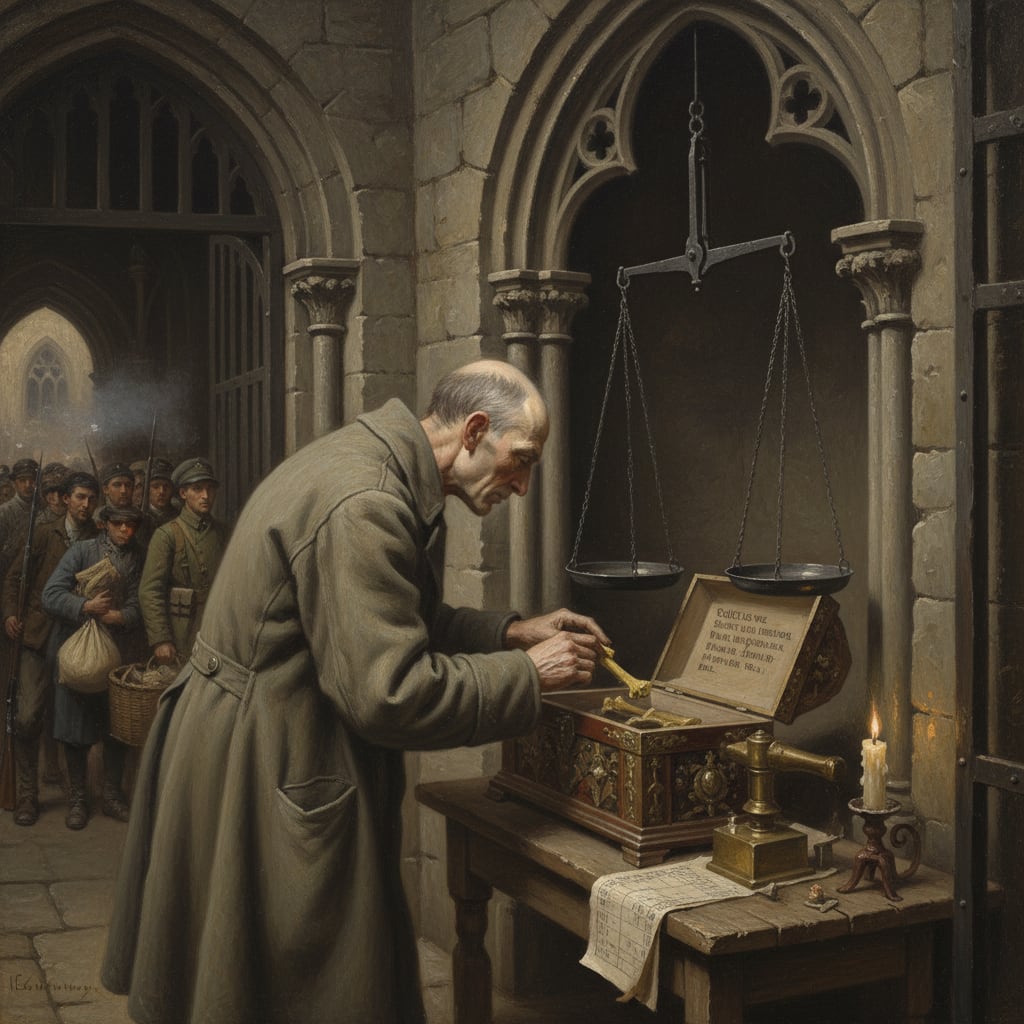
Every exchange an altar. Every tariff a hymn. Every relic a revelation. So the Holy Bureaus have instructed since the first sack of grain crossed the first Sagittal Line checkpoint, and so the Commerce Clerk — that wretched, indispensable, chalk-fingered creature squinting at his reliquary casket in a stone alcove that smells of wheat dust and stale devotion — has been made to believe. The Tariff-Chapel Weigher is the Synod's smallest priest and its most consequential: the man who stands between a bastion and famine, between a convoy and rot, between a vendor's lie and a city's death, and who resolves the question with a pair of iron scale-arms calibrated against the splintered bone of a saint.
The office exists because the Synod requires predictable flow. Grain, salt, chrismole, cloth, shell-casings, bell-metal, relic-fragments, and bodies — the matériel of both faith and war — must move from the heartlands to the Line in quantities the Bureau of War can plan around and the Bureau of Tithes can tax. A single disputed weight can jam a gate for three days; three days of jammed gates can starve a forward trench; a starved trench invites the Enemy to walk in through men too weak to lift a psalter, let alone a rifle. The Commerce Clerk is the hinge upon which this vast and ponderous mechanism turns, and his scale-pan is the altar upon which loyalty is transmuted into survival.
That the Commerce Clerk is also, by universal agreement, the most bribable functionary in the Synod's employ does nothing to diminish his theological significance. It enhances it. Corruption is, in the Bureau's arithmetic, a kind of secondary tariff — an informal levy the market imposes upon itself, which the Bureau can then tax again when the Inquisition catches it.
#On the Tariff-Chapel
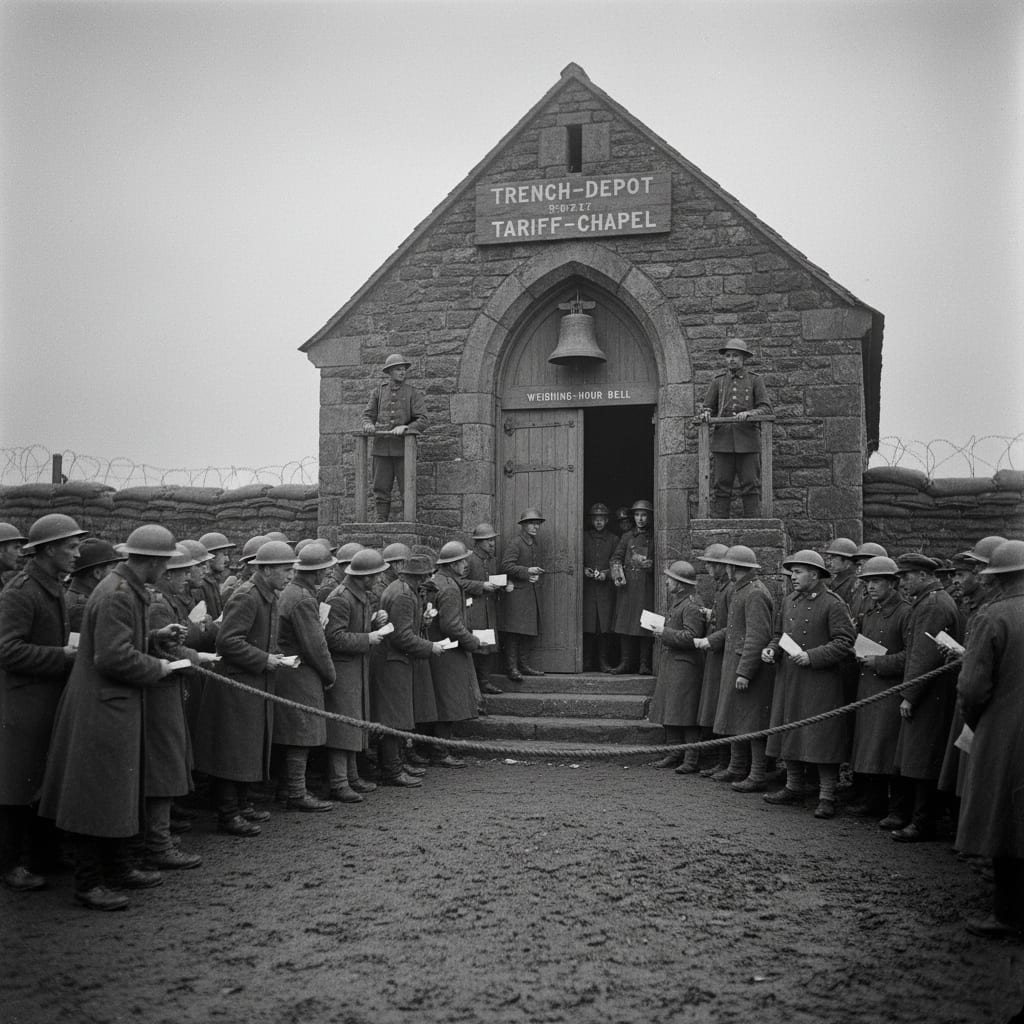
The tariff-chapel has little devotional use. It is a stone room at a gate, a port, or a trench-depot, furnished with a pair of iron scales whose arms bear engraved scripture, a reliquary casket containing calibration fragments — bone slivers, saint-ash, splintered hymn-metal — a stamping press, a tally-board, a candle that burns without respite, and a queue outside that extends, on busy days, to the edge of civil order.
The scales are the chapel's altar. Grain is weighed against reliquary fragments — the Bureau's doctrine holding that "pure measure" is a defence against fraud, famine, and demonic contamination, since a relic-calibrated weight cannot lie without committing heresy against itself. The logic is circular, which in the Synod's jurisprudence means it is watertight. The fragments are locked each night behind triple seals, and the clerk who misplaces one will find his name misplaced from the Bureau of Records with corresponding efficiency.
Tariffs are declared in psalms — a practice inherited from the first Sagittal Line depots, where literacy among gate-sergeants could not be assumed but piety could be enforced. The clerk chants the rate; the vendor responds with the Creed; the scale settles; the stamp falls. Miss the peal that marks the weighing hour, and the chapel locks. This is the system. It works, in the sense that a garrotte works: with precision, without mercy, and only when someone is willing to pull.
#On the Weigher's Day
The morning begins with the calibration rite. The clerk unlocks the reliquary casket — witnessed, always witnessed, because a calibration performed alone is a calibration the Bureau of Purity will later describe as "spiritually ambiguous" — touches the fragment to the scale-arm, chants the calibration line, chalks a small cross on the pan, and records the zero. The zero is sacred. Every number that follows is measured against that first silence, and if the zero drifts, the entire day's ledger becomes a document of heresy.
Then the queue enters, and the queue is a creature with its own metabolism: patient at dawn, restless by midday, murderous by afternoon. Vendors argue weight. Smugglers test seals with fingers that know wax better than the Sigillary. Patrol captains demand priority passage for military convoys. Bribes arrive disguised as "offerings," "candle oil," or a sack of flour left casually against the chapel wall with a note reading For the Saint's table and containing, beneath the flour, eleven silver coins that will vanish before the next bell if the clerk is wise.
The two-pass rule governs every sack: gross weight, then net weight, the difference accounted for against the manifest. Tariff rates shift with war, with season, with "sector discipline" — a term the Bureau uses to mean whatever the Bureau needs it to mean on a given Tuesday. A "purity mark" clears goods into the city; a "condemnation slip" confiscates them. The distinction, which can mean the difference between a bastion fed and a bastion starving, rests upon the clerk's stamp and the clerk's judgment, and the clerk is a man who has not slept well since his appointment and who knows that his judgment, if questioned, will be judged by men who have never stood behind his scale.
By evening the clerk reconciles ledgers, issues tariff slips, stamps confiscations, cleans the pans, and re-checks calibration — because "drift" is a crime if it favours anyone, including the Synod. The reliquary fragments go behind their seals. The scrap tallies burn. The clerk meets, if he is prudent, an informant who can tell him which counterfeit weights are circulating this week and which guild is funding them. Then he sleeps in short and wary segments, because the next morning the queue will already be forming, and the queue does not forgive tardiness.
#On the Bread-Scale Uprising and Its Lessons
The tariff-chapel system began in riot and acquired doctrine afterward. In A.S. 97 — the same year the Latch River ford panic killed three thousand on the Queue Road — a bastion burned after a guild rigged the weighing scales at its southern gate. The fraud was crude: lead poured into the pans, so that every sack weighed heavy and every tariff was overpaid. The guild profited. The city starved. When the deception was discovered, the crowd did not petition. It set fire to the gate, the guild hall, and seventeen associated structures, including a priory whose only crime was adjacency.
The Synod responded by seizing all scales. Private measurement became illegal. Weighing was declared a sacramental act — a position the Bureau of Doctrine ratified with the enthusiasm of an institution that had just discovered a new category of heresy. The reliquary-calibration system followed within the year: scales anchored to bone fragments too rare and too culturally unassailable to counterfeit easily. The chapel made commerce legible and enforceable. It also made the Commerce Clerk the most powerful minor functionary on the Line, a fact that the Bureau of Tithes notes with satisfaction and the Bureau of Purity notes with suspicion.
Stamped Errata (Bureau of Records, 3rd Rev.): The Bread-Scale Uprising is classified as a "supply-chain irregularity"; the term riot is proscribed. The seventeen structures destroyed are classified as "voluntarily decommissioned." The priory has been reclassified as "a structure of no fixed devotional purpose." Enquiries are closed.
The Relic Counterfeit Scandal followed two decades later — fake saint-bone flooding ports from Thessaloniki to Calais, calibration caskets contaminated with pig-bone and ground pumice. The "relic assay" became mandatory: every fragment tested against a master set held in Strasbourg, the results sealed by the Bureau of Relics with the reluctant assistance of the Bureau of Masks and Seals, whose counter-seal was required to make the assay legally binding and whose counter-seal was provided at a rate the Bureau of Tithes described as "extortionate" and the Bureau of Masks described as "actuarially appropriate."
#On the Internal Factions
The profession divides, as professions do, along the fault-line between those who believe and those who function. The "True Measure" zealots hold that the relic-calibrated scale is a sacred instrument, that drift is heresy, that the fragment in the casket makes the weight an act of prayer. They calibrate obsessively, report bribes with disturbing regularity, and are universally loathed by their colleagues, their superiors, and the vendors upon whom their piety falls like a stone upon a foot.
The "Mercy Weighers" hold that the system's purpose is to keep people alive, and that a tariff shaved for a desperate mother, balanced against an inflated tariff on a wealthy guild, is triage. They are correct. They are also, by the Bureau's definition, heretics — a classification that operates, like most of the Bureau's classifications, retroactively and selectively, applied only when the Mercy Weigher in question has ceased to be useful.
Port clerks, who handle the largest volumes and the richest bribes, regard trench-depot clerks as unwashed ascetics playing at commerce with insufficient cargo. Trench-depot clerks, who weigh ammunition and chrismole under bombardment, regard port clerks as perfumed parasites who have never calibrated a scale while the building shook. Both are correct. The old guard relic-trusters, who insist on bone-fragment calibration as an article of faith, eye the new technicians — who prefer mechanical standards and who mutter about "reproducibility" with the reckless confidence of men who have never been audited by the Bureau of Purity — with the kind of contempt the Synod reserves for Rationalists who have not yet been caught.
#On the Ledgers of Varna and the Stamp War of Novi Sad
The Commerce Clerk's two canonical nightmares are speed and precision, and the Bureau demands both while guaranteeing neither.
At Varna, circa A.S. 129, a grain fleet arrived intact. The cargo was sound. The holds were dry. The scales were calibrated. And the clerks debated tariffs for so long — rates contested between the Bureau of Tithes, the Bureau of Pilgrimage, and a jurisdictional claim from the Bureau of Settlement that no one had anticipated and that no one could dismiss — that the cargo rotted in the harbour. The populace, who had watched sacks of wheat decay within sight of their children, rioted. The Bureau of Purity shot thousands. The Bureau of Records declared the rot "a holy fast." The Bureau of Tithes declared all tariff calculations correct.
At Novi Sad, circa A.S. 147, two inspectors stamped the same cargo with conflicting seals. Both stamps were deemed valid by their respective offices. The cargo was therefore split twice on paper — a mathematical impossibility that the Bureau of Records nonetheless filed without comment — creating rations that existed in the ledger and nowhere else. Thousands perished eating their allocation of administrative fiction. The Bureau declared all ledgers balanced. The two inspectors were promoted.
The lesson is the lesson of the Synod entire: the system works. The system has always worked. The dead are a consequence of incorrect operation by individuals whose names have been filed, fined, and, where necessary, forgotten. The scales are clean. The ledger balances. The grain is weighed. And if the grain is rotten, the weight is still true, because truth, in the tariff-chapel, belongs to the measurement rather than the cargo — and measurement, calibrated against the bone of a saint, does not err. It merely outlives the thing it measures.