

#On the Night Routes
"No sin, no step." — Proverb of the Ribs
At the hush bell the Ribwalk stops being a street.
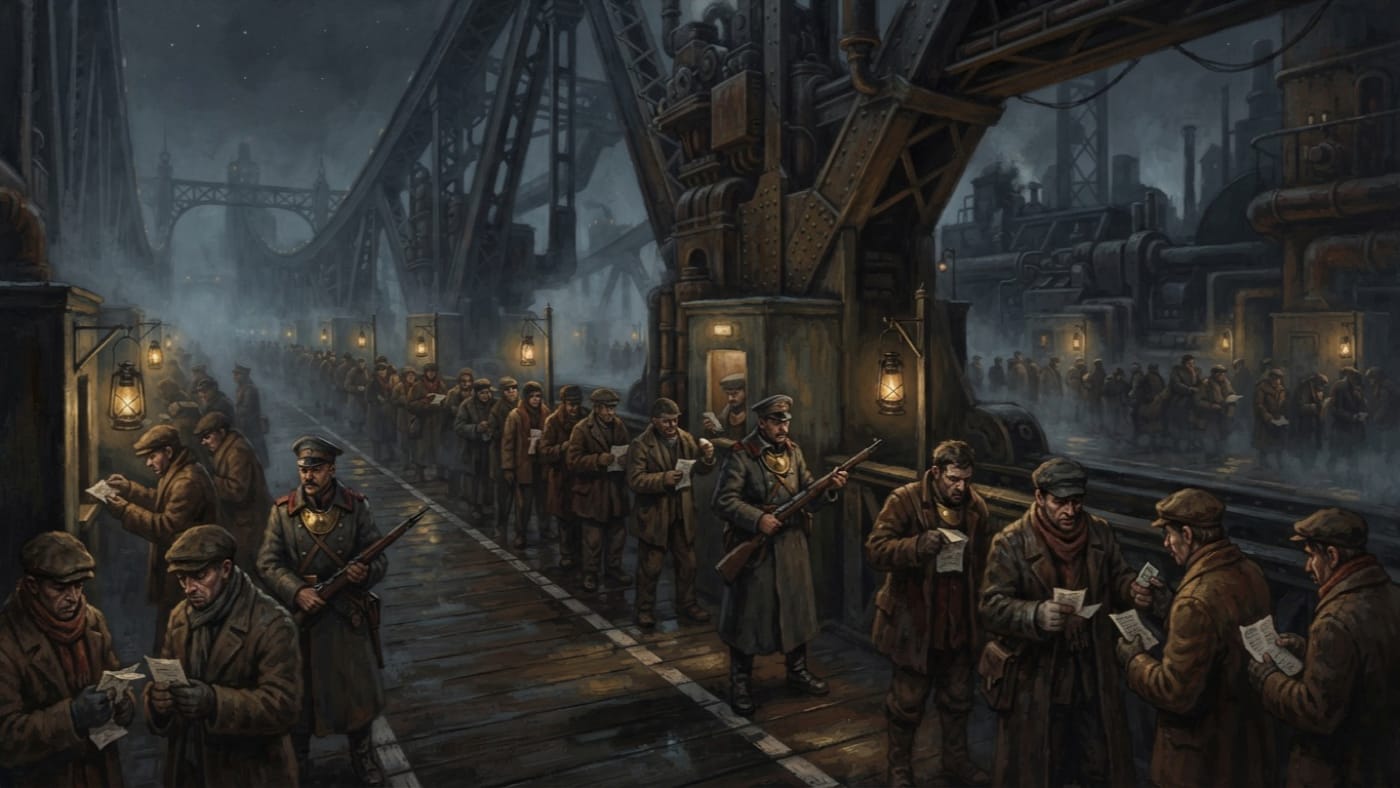
By day the upper deck of Bastion-Brest is a market a thousand paces long. It is crowded with convoy grain, brine-sellers, levy boys off the Warsaw rail and the Bureau of Purity's daylight patrols. At curfew the cordon goes up and the stalls are struck or chained. Everyone still on the deck kneels on the wet planking for the curfew kneel, the bell sounds, and the lantern keepers go out along the span to hang their lamps. A deck that held a crowd at noon is reduced to a few lantern-marked files. A person may walk along them one behind another, and nowhere else.
The garrison calls these files the truth lanes. I have not found the phrase in any ordinance. It turns up in field chaplains' testimony, in patrol slang and in the mouths of the Queued. It now appears in this Codex as well, which gives it a dignity it never asked for.
The lanes run above the Confessional Lanes proper, the candlelit booth-corridors set down into the bridge's interior, and they feed those booths. Nobody on a truth lane simply crosses the bridge. The walker goes down to confess, climbs back to the lantern line, walks on and goes down again. The stops are mandatory and repeated. The lanterns mark where a person may stand, and that is all they do. They are tallow behind glass, trimmed by men paid in ration chits. The judging happens below.
#On Permission to Proceed
"Present your papers before you are asked." — Social code of the Ribs
The procedure is simple in the way a gallows is simple. The walker enters a booth, names a sin to the scribe and, if the scribe is satisfied, leaves with two objects. The first is a confession receipt, written against the walker's identity file and checked by the Bridge Tribunal's clerks. The second is an absolution token, a wax-sealed disc bearing the Triune Knot, which the Gun-Cantors at the next lantern will want to see. The walker must already carry a third paper, the crossing writ with its seals. It comes from the Crossing Bureau and decides whether the walker had any lawful business on the span to begin with. That makes three documents, three offices, and three chances for a wax-stained glove to make a mistake.
The authorities divide along the same lines. Presiding Judge Elsbeth Krail's Bridge Tribunal hears disputes over identity and passage, and a confession that fails to match the file goes on record as "manifest irregularity." Seal-Registrar Hett Ruis's Crossing Bureau keeps the stamps, the identity files and the writs. Gun-Cantor Marshal Vonn's command keeps the curfew, the bells, the patrols and the guns. Its Cantors check tokens at the lantern's edge with brass plates at their throats and do not hurry.
Failure is routine. A token is cracked, or damp, or sealed in the wrong wax. A receipt was copied with a slipped numeral. A sin declared tonight sits badly beside the sin declared last week, and at Brest a "repeat sin" means lane denial. The walker is halted where they stand. They might be a dredge hand on the way to the night shift or a mother carrying bread down to the Pylon Warrens. Without the next stamp they cannot go forward, and without a stamp for going back they cannot go back. So they wait in the mist between two lanterns, papers going soft in their hand, until a Cantor decides what they are.
Some are sent to the Absolution Hall for the morning sitting. Some are "processed." Asking where the processed go is a forbidden thing at Brest, and I will not ask it in print.
#On the Sins That Travel
"Speak your sin concisely." — Social code of the Ribs
To claim you have nothing to confess is to speak "clean," and speaking clean is forbidden. The Church holds that no living person is without sin. The Tribunal holds that anyone who says otherwise is a liar or a heretic, and either way a file. Yet a sin spoken too frankly carries its own danger. It goes into the identity file, it is compared with what came before, and the comparison can cost a person their writ. The walker must confess enough to move and little enough to keep their papers.
Brest's residents have solved this problem the way every population governed by forms solves it: they have learned to fill them in. Soldiers who walk the lanes every night keep a stock of safe sins, things like impatience with a sergeant, a curse at the cold or an extra ladle of brine porridge. They rehearse them until each one takes about as long to say as a scribe takes to dip a nib. In the Warrens a host offers a guest a warm candle cup and a safe sin to declare, and a polite guest does not ask what the host declared on their own crossing. Children raised on the bridge learn their safe sins before their catechism. I am told they deliver them beautifully.
Anyone without a talent for composition can buy what they need under the deck. The moorings sell sin-scrip, which is a prewritten confession suited to the buyer's trade. They also sell edited transcripts and forged tokens. The Bureau of Purity raids the moorings, and the moorings reopen.
The scribes have discretion, and they use it. A scribe may accept a thin sin from a tired gunner and refuse the same sin from a stranger whose vowels come from the wrong bank. Discretion of this kind is a clerk's tool. Absolution in the full sense is a priest's office, and the priest is elsewhere, asleep.
Far from all of this is the clean lane at the West Gatehouse. Officers whose confession files the Bureau of Doctrine has pre-certified pass there, among the smells of gun oil and hot bread. It is a separate arrangement and has nothing to do with the truth lanes, except that the people on the truth lanes can smell the bread.
#On the Watch and the Returning Voice
"Never confess a name you love — the river will take it first." — Proverb of the Ribs
The patrols keep bell-time. They pass each lantern at the stroke assigned and turn at the stroke assigned, and anyone on a lane when the patrol arrives had better be standing where the lantern says. Marshal Vonn's command holds the curfew and also the bridge's capacity for what the Bureau of War calls "safety salvos." The walkers know the casemates under their feet are crewed through the night. When a gun fires somewhere down the span, the recoil comes up through the decking and into the knees, and nobody on a truth lane takes it for weather.
Since A.S. 199 the lanes have carried a second hazard. The garrison calls it the Confession Echo. Sins spoken into the booths come back, hours or days later, as whispered voices on the deck, in the cadence of whoever confessed them. Consider what that does to a night walker. They have confessed three times since the hush bell, safe sins every time. Then, between one lantern and the next, a voice like a neighbour's comes out of the mist and repeats something never meant for the deck. Candle flames below lean toward the booth doors, and the ink on a fresh stamp beads. Chaplains are under orders to describe the shapes under the ribs as "atmospheric condensation." Some walkers panic and confess again on the spot. Some jump. The Bug is cold, and it keeps them.
The cause is unknown to me. The Tribunal has an explanation: it calls the Echo a demonic answer to the nameless crossings of the Blank-Sheet Circle. That is the Tribunal's view and I attribute it to them. The countermeasures are salt-wax on the booth seams and shock bells rung to break an Echo loop. The Bridge Tribunal sealed one booth below, Booth 77, in the Echo's first week. The garrison reports that it repeats confessions nobody has spoken yet. I record this as reported and move on.
Some people will not walk the lanes at all. They pay the Under-Deck Moorers for a skiff through the fog, at a price, with nobody to appeal to if something goes wrong. Their lamps belong to the moorings. The Marsh Lanterns are a separate approach militia, and their lights have nothing to do with the lantern keepers' lamps on the deck, although visitors confuse them.
#On the Present Application
In this two hundred and first year of the Synod's calendar, the lamps go up every night. The kneel is held, the hush bell rings, and the files form. A gunner coming off watch may confess several times before reaching his bunk, rattling off a safe sin at each booth in the voice other men use to read a ration slip. The Bureau of Doctrine has begun to suspect that Brest is producing a new error: a confession said by reflex, with nothing in it, which serves only to get a stamp. The Bureau built the booths, chose where they stand and set the requirement that walkers stop at them. It now finds the results theologically troubling.
The Queued bear the rest of the cost. In winter the mist settles on the brass and the brass settles into the hands of anyone holding the railings. People wait between lanterns while a token is examined or a receipt is sent back for checking. Hypothermia is listed among the bridge's killers. So are falls from rib ladders and drownings. The lanes are slick, and the river is close.
The arrangement continues, and the papers keep getting wet.
The entry on Bastion-Brest, as sealed, states that the truth lanes carry "mandatory booth stops at every third pylon," so that the night walker confesses "six times in eight hundred metres."
The bridge has fourteen pylons. A stop at every third pylon gives four stops, five if one counts generously, and six only with pylons the Bug does not contain. The interval and the total are struck. What the record does establish is that the stops are mandatory and repeated. Whoever supplied the original figure was confident about the arithmetic. I have checked it.