
#On the Market Street Built Across a Wound
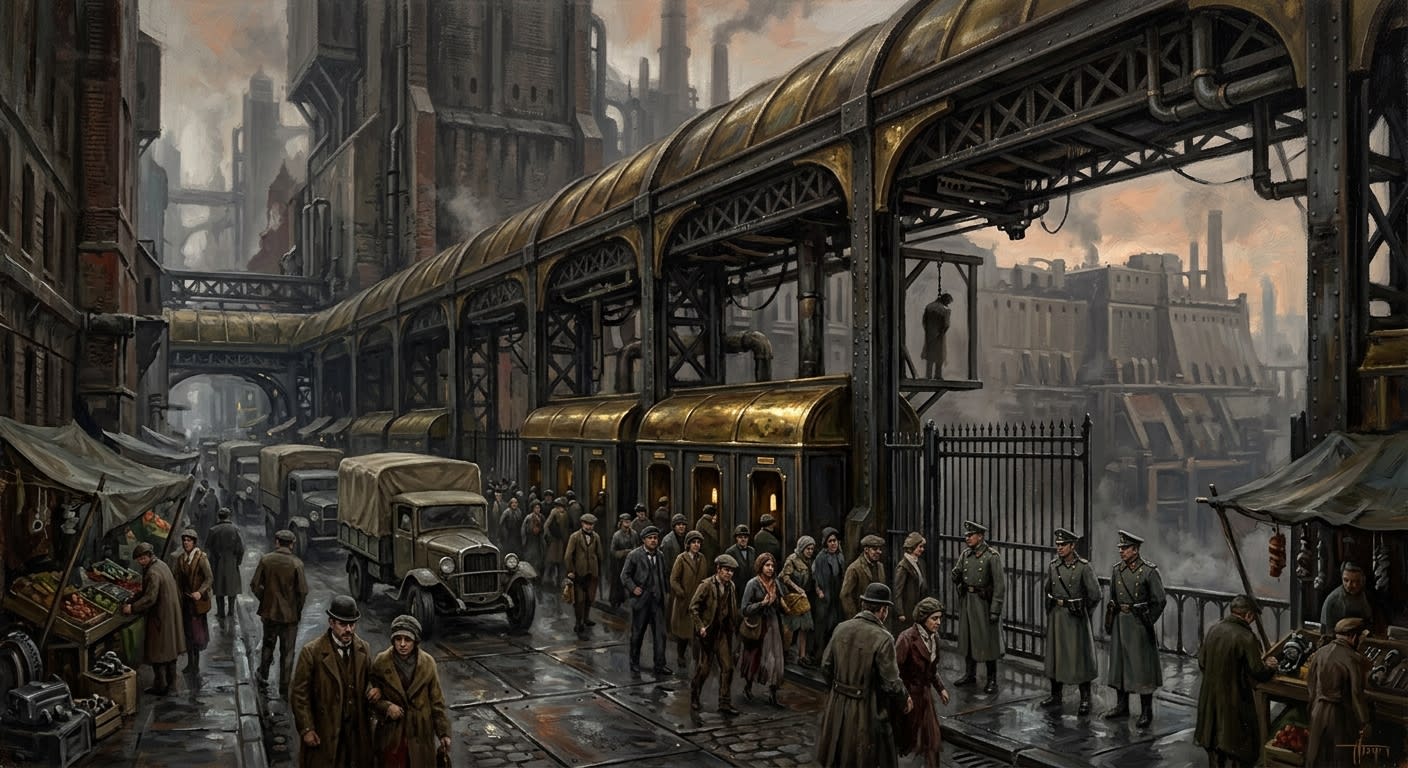
The Ribwalk of Bastion-Brest is the upper deck of the Brass Ribs, the market corridor, troop road, queue channel, gallows approach, gossip artery, and public face of a bridge-fortress whose private organs consist of guns, booths, pylons, and clerkly terror. It runs east-west across the Bug, between gatehouses that smell respectively of wet paper and gun oil, under thirty-two brass-ribbed trusses high enough to make pious men look upward and practical men check whether anything is falling.
Every bastion has a threshold. Brest, being Brest, has turned its threshold into a city street and then required the street to confess. Above the Ribwalk are ribs and weather. Below it sit the Casemate Galleries, then the Confessional Lanes, then the Pylon Warrens, then the water, which receives what all four levels drop and speaks of it only when the fog is feeling doctrinal.
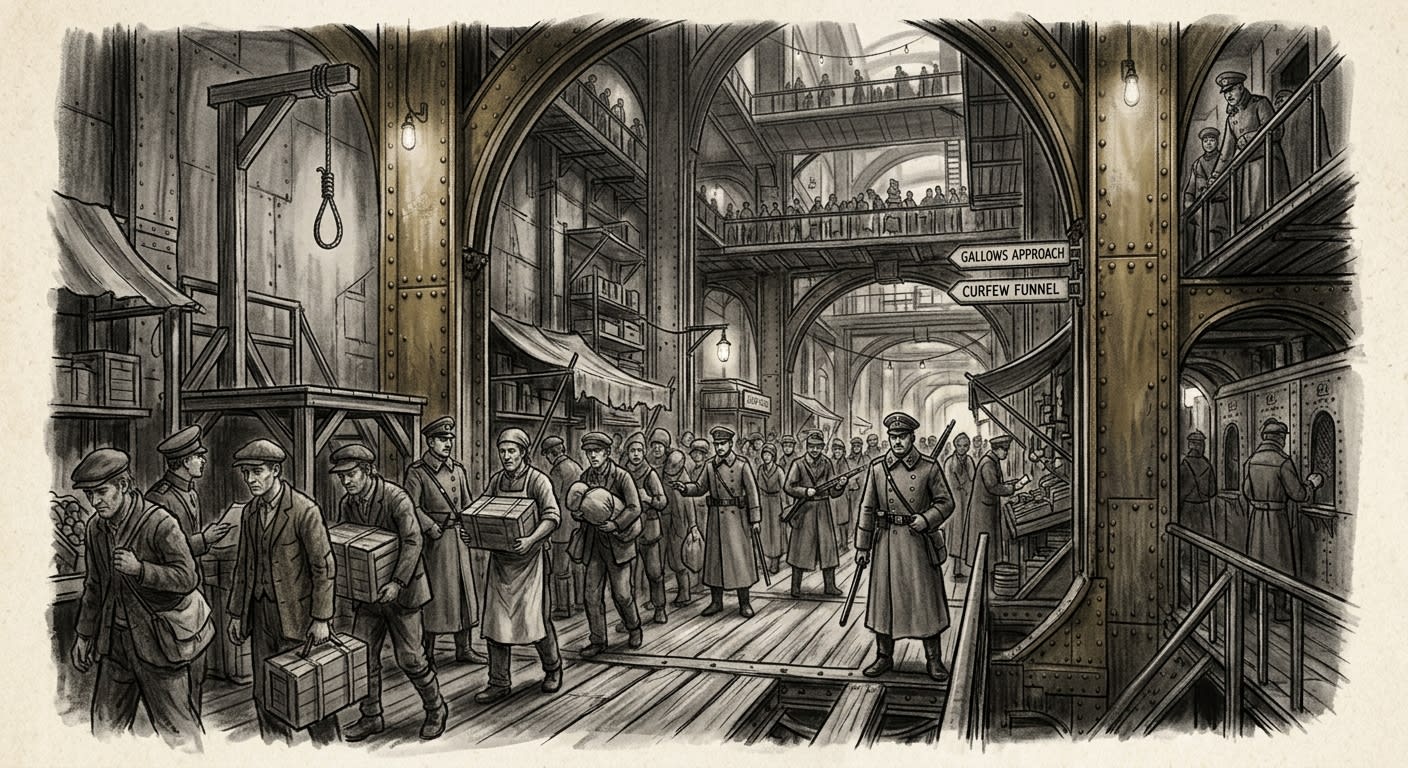
The Ribwalk is not merely a crossing surface. It is Brest’s principal theatre of public life: stall, route, queue, sermon, warning, riot, execution approach, rumour exchange, curfew funnel, and acoustic skin. If the Brass Ribs are the skeleton, the Ribwalk is the exposed nerve. Step lightly. The bridge remembers weight.
#On Its Making by Load, Brass, and Bad Weather
The Ribwalk emerged when the bridge stopped being only bridge and became policy. In A.S. 67 the first western-bank works had mud tracks, chapel tents, toll boards, stacked ration crates, and soldiers who slept where rain had not yet taken title. The old crossing was failure, memory, and rubble. By A.S. 92 the Bureau of Engineering drew the brass-ribbed span: pylon to pylon, truss to truss, gun to booth, passage to discipline. In A.S. 98 the first certified full military crossing proved that load, artillery, confession, and tribunal supervision could occupy the same structure without immediate collapse. The Bureau described this as success. The bridge has spent every year since making that description work harder.
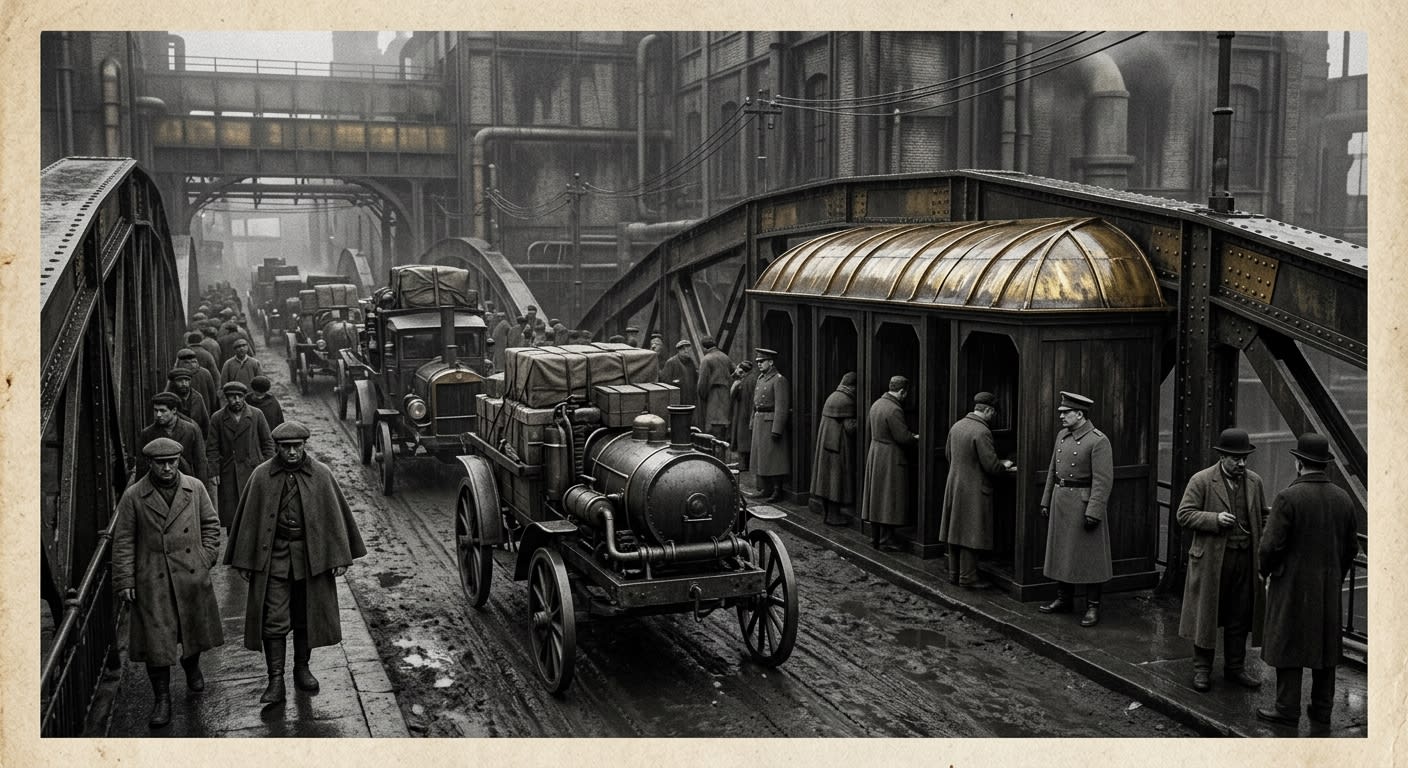
The upper deck had to remain open for carts, troops, convoys, and emergency movement. Open space invites commerce with the inevitability of flies discovering meat. First came the soup boys and nail sellers, then the candle cup widows, then the boot-stitchers, fishwives, token polishers, rope menders, safe-sin writers, ink peddlers, tooth pullers, relic whisperers, queue brokers, and children selling scraps of warmth wrapped in paper too poor to be official. The Crossing Bureau issued stall tags once it realised refusal only created untaxed stalls.
Brass plates were laid where boots struck hardest. They are worn dull along the centre and polished bright at the lane edges, where hands grip in winter, fear, or crowd surge. The deck rings were meant for cargo ropes. They now chain stalls, queue dividers, mule lines, punishment screens, vendor awnings, cordon tapes, and occasional prisoners whose legal status has outrun available rooms below. A public street adapts. A public street on a bridge adapts with hooks.
#On the Daily Traffic of Bodies and Little Lies
At dawn the Ribwalk carries toll clerks wrapped in oilcloth, soup boys with steaming kettles, priest-runners from the night booths, first convoy carts, drenched soldiers coming off west-bank billets, and penitents who rehearsed safe sins all night and will forget them when a scribe asks their name. By full morning the brass warms under boot. Bread appears. Bitter tea appears. River fish appear, regrettably. Officers cut lanes through civilians with escorts whose boots have never learned to apologise to mud. Children chase dropped tokens with the speed of saints and the ethics of rats.
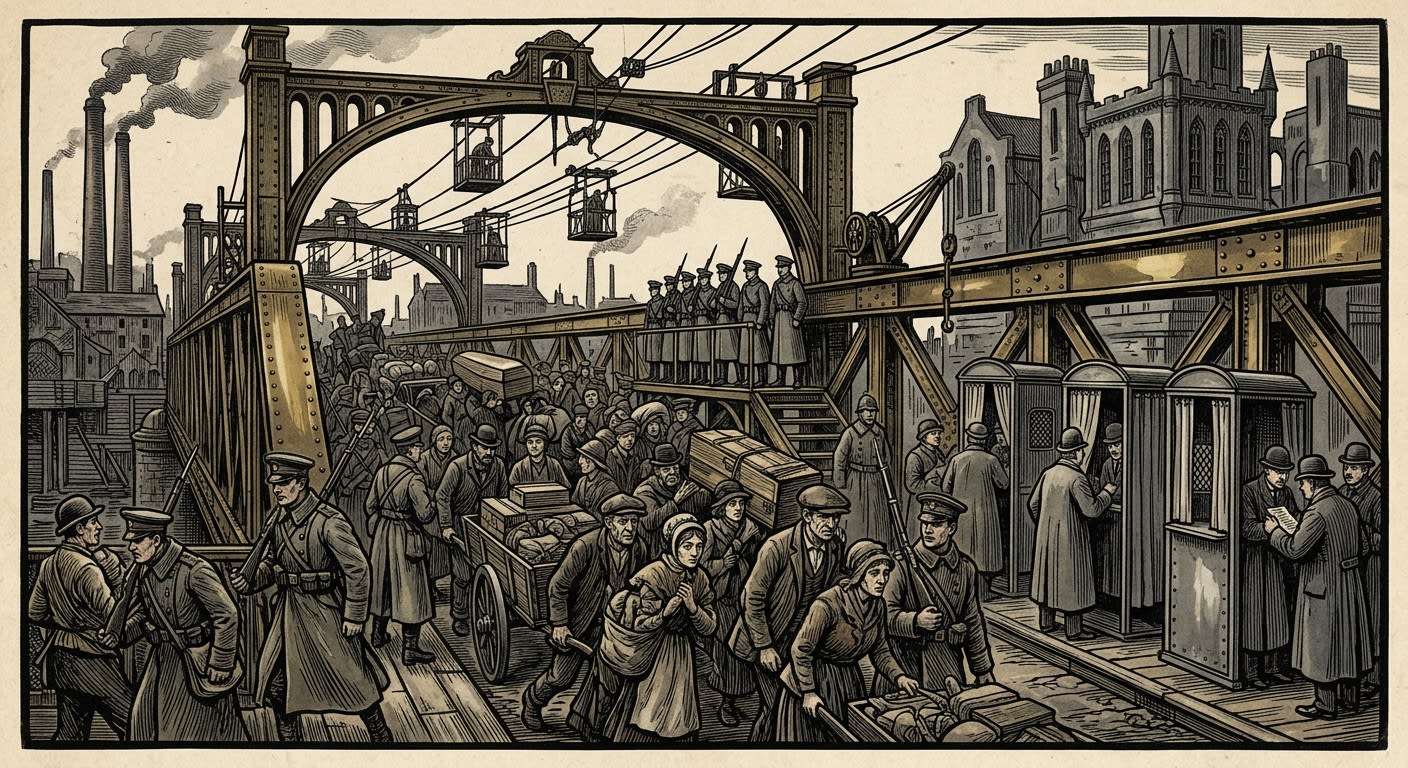
By noon the corridor is commerce in compression. Ammunition trolleys squeal past tallow stalls. Bailiff squads drag manifest offenders toward the Tribunal. Widows sell candle cups: tallow-water with pepper if fortune has smiled, boot grit if fortune has behaved normally. Traders display socks, cord, lamp wicks, cheap icons, confession scripts, brine cloth, cracked combs, hot nails, small knives, false buttons, and onions priced like indulgences. A man can buy almost anything on the Ribwalk except privacy, which would be useless because nobody would believe he owned it.
Ribwalk custom requires that a host offer a warm candle cup and a safe sin. The safe sin is hospitality’s most local sacrament: impatience for soldiers, pride for officers, envy for traders, minor theft for children, discourtesy for clerks, gluttony for anyone prosperous enough to make the booth suspicious. A visitor who cannot produce a safe sin is rude, stupid, or interesting to Purity. The first two may survive. The third is a weather condition.
The insults are local and sharp. Blank-sheet. False-absolved. Token-swine. Mist-rat. Pylon-born. Cleanmouth. Cleanmouth is the worst, because innocence at Brest suggests false doctrine, hidden guilt, or professional preparation. The Ribwalk has no patience for clean things. Clean things are either new, lying, or about to be sold.
#On Market Law and the Commerce of Permission
The market is licensed in theory and negotiated in fact. The Crossing Bureau issues stall tags. Judge Krail revokes them. Vonn’s provosts overturn tables during security sweeps. The Brasswright Guild claims emergency access through every stall line and has once demolished a sausage stand to reach a vibrating bolt. The sausage seller filed suit. The Tribunal ruled against him on grounds that sausages are replaceable and bridge collapse is inconvenient. The judgment is ugly and correct, a combination common at Brest.
Every stall depends on permission layered so thickly that nobody can say which permit matters until it fails. A fishwife needs a stall tag, clean-net token, brine stamp, passage receipt, lane permission, and a cousin in the Warrens who hears before raids. A boot-nail seller needs iron source certification, stall chain approval, and the ability to vanish whenever War requisitions his entire trade under emergency necessity. A safe-sin writer needs discretion, good handwriting, and moral flexibility of the kind Strasbourg condemns after purchasing.
Beneath the deck, in the under-moorings, the Ribwalk’s shadow market sells what the upper market publicly condemns and privately requires: forged absolution tokens, altered lane assignments, warmer bunks, name substitutions, queue slips, sealed broth, silence by the hour, clean receipt edges, and sin scrips tailored by profession. The Bureau of Purity raids quarterly. The market reopens within the week, often in the same location, selling to several of the men who conducted the raid. This is not corruption in the grand manner. Grand corruption has carpets. Brest works in damp.
An absolution token is the coin behind the coin. A man may have wages and still go nowhere if his token is smudged, expired, mismatched, sweated, forged too poorly, or forged too well. The Ribwalk teaches this theology hourly. A token drops, the crowd bends. A child snatches it. Three adults shout. A provost turns. A clerk recognises the seal. A queue pauses. The bridge feels the pause through brass. Somewhere below, a booth candle leans as if listening.
A trade circular described Ribwalk commerce as “orderly, supervised, and confined to marked lanes.”
Corrected after the A.S. 200 convoy crush, in which forty-six marked lanes, nine unmarked lanes, three funeral processions, two ammunition trolleys, and a goat occupied the same thirty yards of deck. The approved phrase is “supervised under changing pressure.” The goat survived and is now more cited than the clerk.
#On Curfew and the Bells That Sort Flesh
Brest’s curfew does not merely end the day. It sorts the span into permissions. At third bell, stall chains are tightened. At fourth, awnings lower. At fifth, non-essential deck traffic is pushed toward the gatehouses or down assigned stairs. At sixth, the truth lanes open: single-file night routes lit by lanterns whose glass has been smoked amber to make every face look guilty in the same civic tone. After curfew, to walk the Ribwalk is to submit to confession stops, token checks, queue-cordons, and the cold courtesy of men with rifles who would rather frighten civilians than bury them.
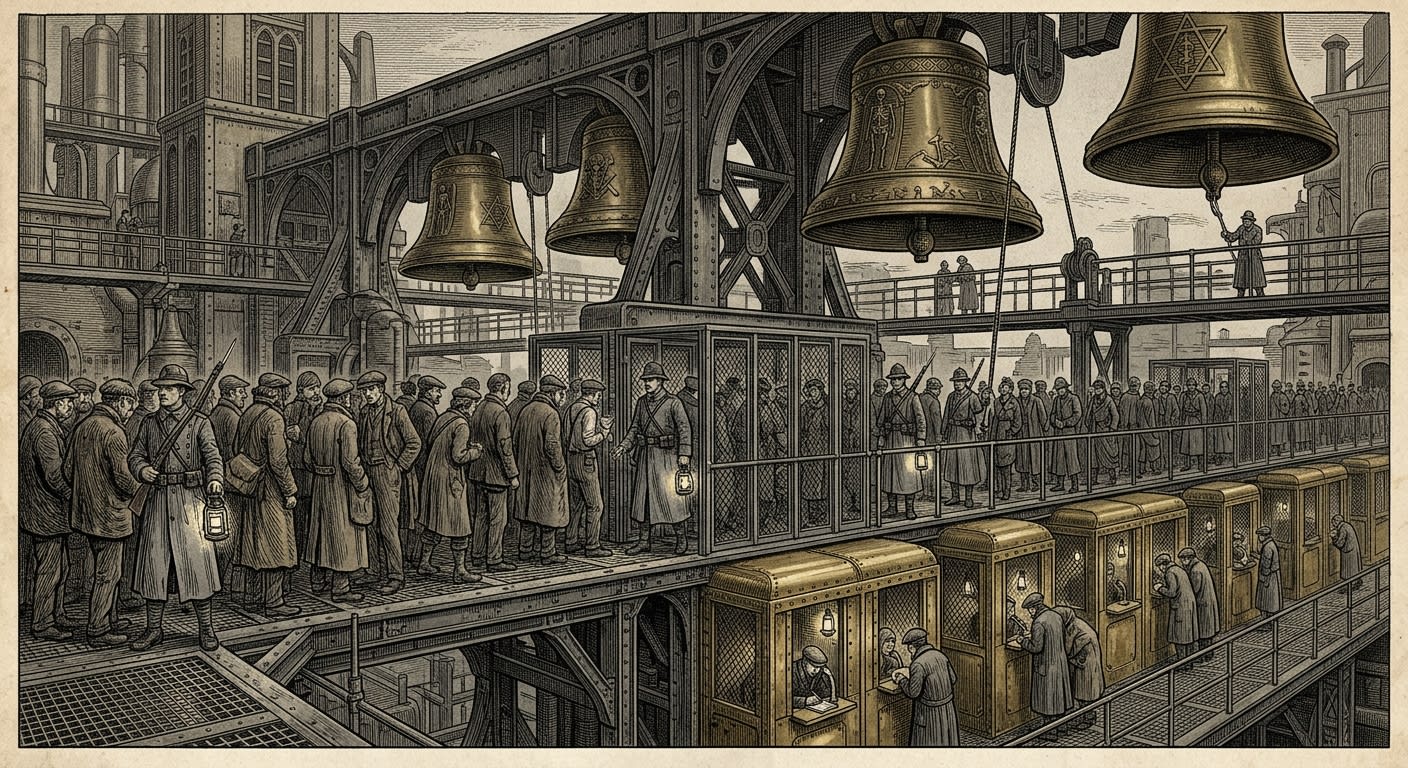
Gun-Cantor Vonn has made an art of curfew. His men enforce bell lines with hymn-shouts, rifle stocks, and the knowledge that a crowd on a bridge is a calculation waiting to become obituary. The casemates listen through brass. Gunners can tell the difference between ordinary complaint, hunger surge, mule panic, forged-token riot, and the wrong hush before Echo activity. They claim this. I believe them. Soldiers lie about courage, women, and soup. They rarely lie about sounds that keep them alive.
The safety salvo is the Ribwalk’s most polite terror. Fired across or near the deck during crush, riot, breach, or mass refusal, it terrifies the body into remembering lines. Vonn’s famous A.S. 199 curfew shot during the first Echo emergency killed one laundry line and injured a mule’s dignity. His enemies call this incompetence. His gunners call it mercy. The mule, unable to file objection, became folklore.
Curfew changes commerce into whisper. Candle cups vanish under cloaks. Safe-sin sellers become cousins walking home. Token brokers move into stair mouths. Children disappear into maintenance slots. Krail’s bailiffs cross toward the Absolution Hall with sealed packets. Hal’s runners descend to lane mouths. Vonn’s shutters breathe open, then closed. The Ribwalk narrows from market to artery to vein to thread.
#On Public Justice and the Absolution Hall’s Voice
Mid-span, near the heavy rib cluster, the Absolution Hall feeds its judgments upward into the Ribwalk. Public confession broadcast began as deterrent theatre: show guilt, display correction, let the crowd feel justice pass through its ears before returning to queues. In ordinary crimes this satisfies the appetite. Theft, forged token, queue assault, booth insult, bribery, false mule declaration. The crowd hears, clucks, laughs, spits, learns which phrase to avoid.
In Blank-Sheet cases the practice has become stupid. The broadcast words move through the Ribwalk like small contraband: nameless, unwritten, free crossing, paper is the chain. Children repeat them as rhythm. Vendors convert them into coded cries. Lovers use them as farewell jokes, because people will make intimacy from any tool left lying in the street. The Tribunal has been conducting the enemy’s catechism with excellent acoustics.
An A.S. 200 Tribunal notice defended public Blank-Sheet confessions as “deterrent theatre.”
Clarified by Doctrine review. Theatre requires an audience. An audience repeats lines. The Tribunal has been instructed to distinguish deterrence from rehearsal, a distinction previously known to actors, heretics, and several bright dogs.
Krail’s seal hangs unseen below, but the Ribwalk feels it. A trial delay loads the deck. A sealed booth reroutes traffic. A bench order closes three stalls. A variance hearing sends bailiffs through market lanes, and every stallholder suddenly remembers an appointment elsewhere. Law at Brest is not abstract. It has boots, wax, and the power to make onions cold while a convoy waits.
The Ribwalk crowd loves trials and hates consequences. It gathers near horn vents when a notable confession is due, pretending to shop, repair straps, compare fish, or inspect weather that has not changed in six hours. The Bridge Tribunal knows this and still broadcasts. Officials are fond of audiences until the audience develops memory.
#On Voices Coming Back Through Brass
Since A.S. 199 the Ribwalk has heard what should have remained below. The Confession Echo began in the Confessional Lanes after the Nameless Tide surged against the eastern wire and after the Blank-Sheet Circle had taught certain citizens to cross without becoming legible. A sin spoken into a booth returns hours or days later as a whisper on the Ribwalk, in the speaker’s own voice. The words are exact at first. Then they acquire corrections.
The first returns came from shutters and vents. Then wet rope repeated them. Then empty token bowls. Then the underside of stall boards. A bread theft returned as hunger. A cowardice returned as mercy. A lust returned as loneliness, which annoyed Doctrine because loneliness is harder to prosecute at scale. Booth 77 worsened the matter by speaking confessions before the mouth arrived to make them legal.
RIBWALK INCIDENT NOTE — A.S. 199, RIB SEVEN Returned voice from brass shutter: “I took two loaves because hunger knows my name.” Witnesses: bread vendor, three soldiers, Purity novice. Follow-up: vendor raised bread price; soldiers reassigned; novice wrote “acoustic afterimage” and was promoted away from language. Secondary mark found under stall board: ███████.
The people adapted faster than the offices. They do not repeat Echoes aloud. They repeat them in altered form, as songs, jokes, vendor cries, children’s counting rhymes, and insults. This is forbidden. It is also unstoppable. Horror enters speech the way damp enters walls: by routes no inspector admits exist until the plaster falls.
The Echo has made the Ribwalk suspicious of silence. A loud market is safe enough. A quarrelsome queue is normal. A crying child is useful because adults can locate him by sound. Silence means listening. Silence means the crowd has heard something not yet entered in the record. Vonn’s men watch for it. Krail’s plain-cloaks write it down. Vendors fill it with offers. Children fill it with cruelty. The bridge fills it last.
#On Children, Safe Sins, and the Ribwalk Schools of Survival
Children of the Ribwalk learn movement before manners. They know where brass plates frost first, which stall chains can be ducked under, which provosts kick, which clerks drop receipts, which mule teams panic at bell three, and which officers pretend not to hear insults because pursuing a child through a convoy queue looks undignified. They count by ribs before sums. They read token colours before letters. They know that a confession too clean will draw attention and a lie too dirty will be believed into punishment.
Safe-sin education begins in public. A mother buying candle cups may test a child between stalls. “What did you do?” “Stole bread.” “Too common.” “Envied boots.” “Better. Whose?” “No one’s.” “Good.” Theology becomes street craft. Catechists hate this because catechists confuse innocence with ignorance. Brest cures that confusion briskly.
The Ribwalk’s informal schools occupy lee spaces: under the west awning, behind the brine fish stalls, beside the old artillery crate near Rib Twelve, in the breath-warm queue pocket by the Absolution horn. Older girls teach letters from expired Tribunal notices. Boys learn sums from token strings and ration marks. Everyone learns which words have become dangerous that week. Lessons stop when boots approach, unless the boots belong to someone bribed to teach numbers.
Booth 77 has entered children’s games. They dare one another to whisper sins toward the sealed stair mouths and ask whether tomorrow answers. Adults beat them for it, salt their tongues, tie cuff names tighter, and pretend fear is discipline. The Tribunal calls these customs unauthorised. The Tribunal has not volunteered to sit with children in pylon fog when the vents begin speaking.
#On Convoy Surge and the Arithmetic of Crush
Convoy season is when the Ribwalk reveals the truth beneath its commerce: it is a load-bearing crowd. The northern roads feed Brest from Warsaw, Kanzleiburg, and the flat wet heartland behind them. Supply carts arrive with grain, cloth, powder, wire, chapel oil, boots, wounded men, replacement boys, courier boxes, mules, and the stray furniture of war that always appears without manifest. The bridge takes them. The Lanes process them. The Tribunal interrupts them. The market feeds them. The deck groans.
A convoy surge begins politely. Queue ropes shift. Stalls fold half-width. Priests hurry. Token checks become gestures. Then one cart loses a wheel, one booth stalls on a disputed name, one mule bites a runner, one officer demands priority, one old woman faints, one vendor refuses to move stock, and the polite arrangement discovers its bones. Bodies press toward the edges. Hands grip polished brass. Children vanish upward onto stall frames. Vonn’s casemates listen. Krail’s runners shout. Hal’s clerks below feel the queue load through delay.
The A.S. 200 convoy crush remains the caution. Forty-six marked lanes, nine unmarked lanes, three funeral processions, two ammunition trolleys, and the famous goat entered the same thirty yards of deck. The official dead were few because Brest is skilled at producing terror without corpse count. The unofficial injuries filled Mercy rooms. The goat survived. The clerk who wrote the first circular did not survive professionally, which is the Bureau’s gentler form of execution.
A Records digest classed the A.S. 200 Ribwalk crush as “minor crowd deformation.”
Revised after Mercy submitted splint counts, lost-tooth packets, and three pages of children’s names separated from guardians for more than six hours. The approved phrase is “convoy pressure incident.” It lies with better shoes.
A bridge crowd differs from a square crowd. A square crowd can spill. A bridge crowd can only compress, reverse, climb, or fall. The Ribwalk teaches this by bruise. It has no mercy of width. It grants no alley escape. It turns panic into direction. Every person on it becomes part of a calculation he cannot see.
#On Drax’s Passage Across the Deck
I crossed the Ribwalk under convoy pressure, which is the only honest time to inspect it. Quiet inspections flatter masonry. Crowded inspections reveal government. The east approach smelled of vinegar, wet wool, hot brass, river fish, cordite, and theological fatigue. A toll clerk attempted to inspect my pass, saw my seal, turned pale, and inspected it anyway. Good man. I made note of him for advancement or punishment, those neighbouring sacraments of administration.
A candle-cup widow offered me warmth and a safe sin. I told her pride. She looked at me with professional pity and said, “Too obvious, master.” I admired her. There are bishops with less diagnostic force.
At Rib Seven, the brass underfoot warmed though the weather was knife-cold. Vonn’s men noticed. Everyone noticed Vonn’s men noticing. The market did what markets do when fear arrives: it sold faster. A boy shouted “hot nails” in a voice pitched wrong for nails. A plain-cloak wrote him down. A fishwife spat into a rag and moved her daughter behind a barrel. The deck had not changed. The population had.
At mid-span a Tribunal broadcast began, then stopped after two words. That stoppage frightened the crowd more than the words would have. Silence ran along the stalls like a hand over spines. Under the deck, something knocked twice. No one answered. This proves the Ribwalk can be educated, if beaten by fact often enough.
I bought no fish, because vanity has limits.
#On the Present Ribwalk
As of A.S. 201, the Ribwalk remains active, overcrowded, profitable, surveilled, acoustically contaminated, and indispensable. The Confession Echo has made its shutters suspect. The Blank-Sheet Circle has made its paper suspect. The under-deck market has made its commerce suspect. The Tribunal has made its public words suspect. Vonn has made its silence suspect. Hal has made its delays suspect. The people have made suspicion into weather and continue selling soup under it.
The Ribwalk holds because it must. Close it and the bridge chokes. Clear it and the bridge starves. Militarise it completely and the civilians vanish into pylons with the knowledge required to keep pumps, stalls, brine buckets, ropes, children, and unofficial intelligence moving. Leave it alone and it becomes a republic of forged wax by supper. Governance, here, is the art of squeezing a throat without stopping breath.
The daily miracle is not that Brest endures assault. Soldiers endure assault when paid, threatened, shamed, blessed, or cornered. The daily miracle is that a market can operate above confession booths, below artillery ribs, beside a Tribunal horn, over a river that eats names, while children sell safe sins and old women price candle warmth according to panic. The Bureau calls this controlled passage. The Ribwalk calls it Wednesday.
At fourth bell the stall chains tighten. At fifth the truth-lane lanterns are lit. At sixth Vonn’s shutters blink. A bailiff carries a sealed packet toward the Hall. A child palms a dropped token and disappears beneath a mule cart. A widow stirs pepper into tallow-water and asks the next traveller what he has done. Below, a booth mutters yesterday. Ahead, the brass narrows into fog.
#On Gallows, Ropes, and Public Arithmetic
The Ribwalk’s western gallows approach is not called a gallows approach on visitor maps. Visitor maps prefer phrases such as adjudicatory frontage, punitive terminal, and West Gate corrective rail. The locals call it Hook Mile though it is shorter, which offends surveyors and satisfies justice. Condemned persons processed through the Absolution Hall exit by a side stair, cross the public deck under escort, and are displayed long enough for the crowd to misunderstand, understand, forget, and buy onions.
Executions at Brest serve several ledgers. The Bridge Tribunal displays authority. Purity displays certainty. War displays impatience with sabotage. Records displays the name, unless the sentence concerns nameless transit, in which case Records displays an empty line framed so handsomely that absence becomes a portrait. The market displays attendance. Children display skill by stealing splinters from the punishment rail before bailiffs notice. Tithes has not yet taxed the splinters. Give it time.
A hanging alters the deck’s commerce. Fish stalls retreat because nobody buys river fish while watching a body swing above river air. Candle cups sell better. Safe sins become pious for an hour. Token brokers close their hands. The under-deck market suspends open trade, which is to say it lowers its voice and raises prices. Vonn’s men watch roofs, ropes, hands, and the crowd pockets where Blank-Sheet sympathies gather. Krail’s clerks watch who refuses to watch.
The worst punishments are not the bloody ones. Brest has blood enough. The worst are documentary: name suspension read aloud; crossing file revoked; absolution token melted in a spoon; stall licence struck; family bunk reassigned lower by two ledges; corpse denied bridge burial because the subject is deemed un-crossed. The crowd understands these sentences with greater terror than rope. Rope kills a neck. Paper can evict the dead.
#On Weather, Brass, and the Bug Below
Weather on the Ribwalk is a second government, less verbose than Strasbourg and nearly as cruel. Rain turns brass plates slick. Frost makes the lane edges shine like polished lies. Fog rises from the Bug and climbs through the trusswork until the ribs appear and vanish by segments, giving pedestrians the cheerful impression that the bridge is being filed in pieces. Summer heat expands the brass until the deck ticks, groans, and whispers through rivets. Winter contracts it with a sound like a giant biting down.
The market knows weather better than Engineering tables. Fishwives move before river fog thickens. Nail sellers cover iron when the brass begins to sweat. Candle widows double pepper in sleet because fear chills the mouth first. Children learn which deck plates frost before others and sell that knowledge to officers, who should be ashamed and are instead grateful. A weather-wise child at Brest is worth two rear-city barometers and a minor saint.
Fog is the most dangerous weather because fog edits distance. A stall two yards away becomes rumour. A queue becomes a procession of torsos. A gun shutter becomes an eye. The Confession Echo travels better in fog, or seems to; the distinction has killed enough certainty to deserve its own form. Returned voices arrive softened, intimate, almost kind. Men lean toward kindness. This is why kindness requires supervision.
During black fog the truth lanes are shortened and tied with rope. Civilians must keep one hand on cord, cart, cuff, or licensed companion. Unaccompanied children are gathered under awnings and made to recite safe sins until guardians appear. If no guardian appears, the child is entered under temporary custody and the market pretends not to calculate whether an extra runner has become available.
Below, the Bug knocks the pylons with floating wood, ice, dead things, and the ordinary insistence of water against architecture. The Ribwalk hears these knocks as footnote to every transaction. A buyer argues over socks. Knock. A clerk stamps denial. Knock. A widow salts a cup. Knock. A booth below returns a confession. Knock. The river does not interrupt. It annotates.
#On Food, Smell, and the Civic Stomach
No account of the Ribwalk that omits smell deserves preservation. The deck smells of brine fish, tallow, hot brass, cordite, wet wool, vinegar documents, mule breath, boiled cabbage, cheap ink, candle smoke, damp rope, old fear, and, during convoy season, too many bodies attempting dignity in bad boots. Visitors complain. Locals judge them for having unused noses.
Food is sold in narrow categories: things warm enough to comfort, salted enough to survive, cheap enough to shame, and suspicious enough to require blessing. Brine fish from the Bug appear in tins and paper cones. Bitter bread comes from west-bank ovens and arrives already tired. Soup is mostly steam with ambitions. Pepper is currency. Hot fat broth marks officers, feast days, or theft. Children sell cracked saints made of dough and call them pilgrim cakes. The saints usually have too many limbs because the moulds are old and nobody in Brest wastes dough on anatomical orthodoxy.
The candle cup is the Ribwalk’s sacrament of endurance. Tallow-water, pepper, salt if available, sometimes broth, sometimes lie. It warms hands more reliably than stomachs. A traveller accepts the cup, gives a safe sin, receives a nod, and belongs to the deck for the length of one swallow. Hospitality at Brest is brief because the line moves.
Food also carries messages. A fish wrapped in blank paper is suspect. Bread scored twice may indicate a raid. Pepper spilled across a stall front means Purity is within hearing. A cup served without safe-sin question warns that the seller has recognised a plain-cloak. The Ribwalk’s stomach thinks faster than its courts.