
Warsaw
"The city that will not leave." — Bureau of Settlement, Memorandum on the Polish Corridor, A.S. 194
The Bureau of War calls Warsaw a staging city. The Bureau of Settlement calls it a liability. The Bureau of Tithes calls it a revenue problem, because seven hundred and fifty thousand souls who refuse to evacuate from a forward position generate tax obligations that the Bureau cannot collect at the standard rate and cannot waive without precedent. The Bureau of Records calls it what it calls everything: a filing designation, Zone Three (Unregistered), Northern Corridor, entry 14-W, population variable, status nominal. The soldiers who pass through Warsaw on their way to Bastion-Brest and Bastion-Königsberg call it the Last Floor — meaning the last solid ground beneath your boots before the mud begins and does not stop until the Line or death, whichever the Bureau has scheduled first.
I have been to Warsaw. I went in A.S. 197 on Bureau of Doctrine business — a doctrinal compliance review of the Northern Corridor's chapel network, which sounds tedious because it was tedious, and which I accepted because the alternative was a compliance review in Shipka, and Shipka has time-fog, and I have a policy regarding my own temporal continuity that I do not intend to compromise for paperwork. Warsaw was supposed to be two days. It became nine. The rail yards had seized.
#On the Geography: The Flatness and the Problem of It
Warsaw sits on the Vistula at the western edge of the Polish lowlands — Zone Three, which is the Synod's designation for territory that is safe enough to inhabit and close enough to the front to regret inhabiting. To the west, the rail lines run back through Kanzleiburg to Hamburg and the heartlands beyond: sanctuary, in the sense that a place two hundred miles from danger is sanctuary to a man who lives forty miles from it. To the east, the ground falls away into the flat Polish corridor — the same horizontal expanse of nothing that makes Bastion-Brest the most exposed position on the Sagittal Line — and the rail spurs branch toward the two bastions Warsaw exists to feed.
The city is approximately one hundred and sixty kilometres behind the Line at its nearest point. The Bureau of War's cartographers consider this distance sufficient. The Bureau of War's cartographers have never stood on the roof of the Vistula Signal Tower during an eastern wind and heard, faintly but without ambiguity, the sound of bell-cannon fire from Brest. One hundred and sixty kilometres is a number. It is also a lie. The flat terrain that makes Warsaw the ideal rail junction — no gradients, no tunnels, no switchbacks — also makes it an acoustic corridor for sounds that should not carry and an optical corridor for lights that should not be visible. On clear nights in winter, the glow from the Brest Wire can be seen from the eastern suburbs. The Bureau of Settlement has addressed this by designating those suburbs a restricted observation zone and fining anyone who reports what they have seen.
#On the Rail: The Yards and Their Religion
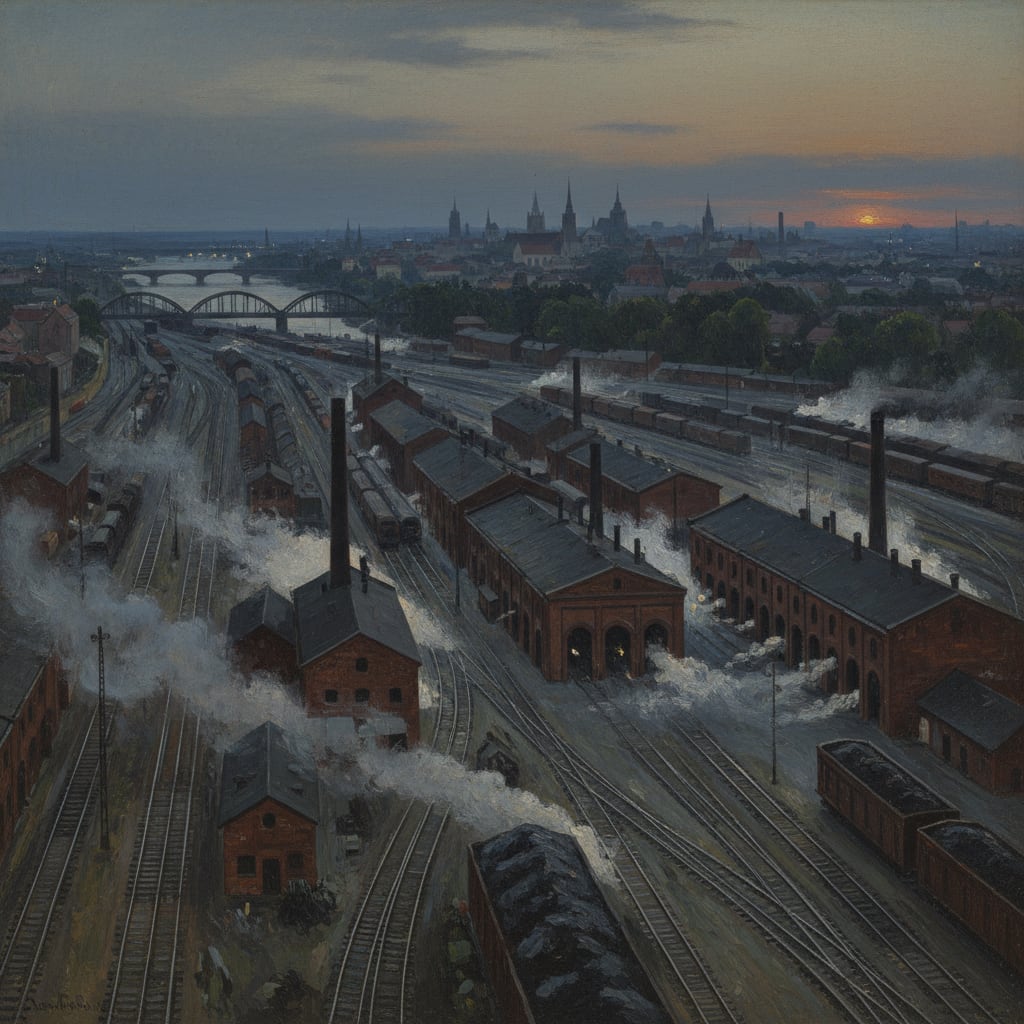
The rail yards (Unregistered) are Warsaw. Everything else — the Vistula promenades, the churches, the Bureau quarter, the residential districts with their linden trees and their carefully maintained pretence of civilian normality — is decoration. The yards occupy the eastern third of the city, a twelve-square-kilometre expanse of track, siding, engine shed, coal bunker, and marshalling infrastructure that processes more tonnage per annum than any rail facility in the Synod's territory except Kanzleiburg itself. What Kanzleiburg receives from Hamburg, Warsaw sends forward. The relationship is that of the stomach to the hand: Kanzleiburg digests; Warsaw delivers.
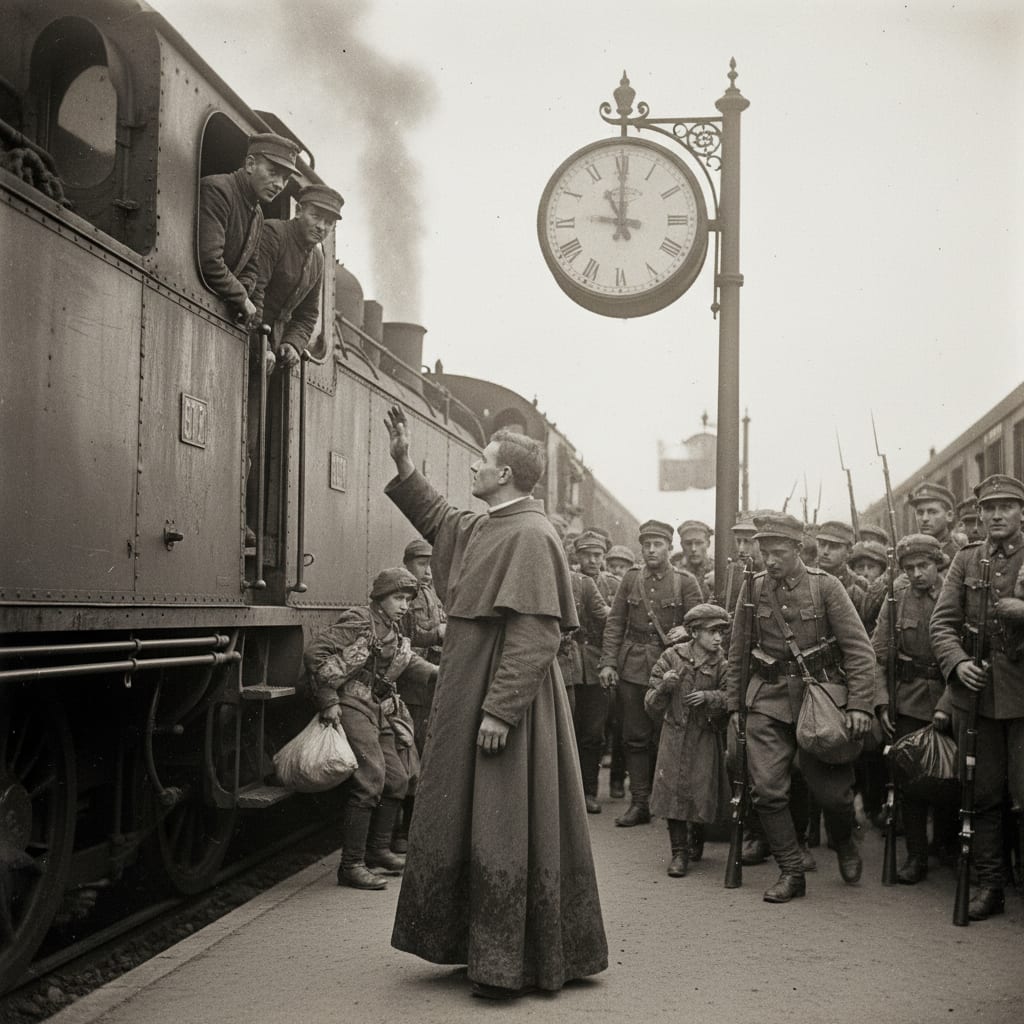
Two principal spurs depart Warsaw eastward. The northern spur runs to Białystok and then curves northeast toward Bastion-Königsberg, carrying grain, ammunition, replacement personnel, bell-clappers from the foundry at Essen-of-Hymnsteel, and the miscellaneous sacred freight that the Bureau of Relics insists must travel under armed escort and climate-controlled tarpaulin, a requirement the locomotive crews satisfy by placing a guard on the flatcar and draping canvas over the crates when it rains. The eastern spur runs straight to Bastion-Brest through the flat corridor — two hundred and thirty kilometres of track laid across terrain so level that the gradient never exceeds one in four hundred, which makes it the fastest military railway in Europe and the most vulnerable, because a rail line with no tunnels has no cover, and a rail line with no cover has no defence except speed and the prayers of men who have learned that speed is more reliable.
The yards employ eleven thousand workers. Roughly four thousand are Bureau of War logistics personnel in uniform. Another three thousand are civilian railway staff operating under Bureau contracts that specify duties, hours, compensation, and the precise number of permitted saints' days per quarter, a number that the Bureau of Festivals sets annually and the yard foremen ignore annually, because a locomotive does not observe feast days and the coal it burns does not care which saint is being celebrated. The remaining four thousand are a miscellany the Bureau of Records classifies under the heading "Ancillary" — porters, loaders, track maintenance crews, signal operators, the women who run the platform canteens, the boys who carry messages between the dispatch towers, and the confession-scribes who staff the departure-blessing booths at every gate.
#On the Population: Those Who Remain
Seven hundred and fifty thousand people live in Warsaw. This number has not changed significantly in forty years, which is remarkable given that Standing Order 14-W/3 — the Bureau of Settlement's evacuation directive for the Polish forward zone — has been in nominal effect since A.S. 95. The Order was issued when Warsaw's population was three hundred thousand. It has grown by a quarter of a million since the Bureau told it to leave.
The truth — which the Bureau of Settlement knows and which Standing Order 14-W/3 carefully avoids acknowledging — is that Warsaw cannot be evacuated because Warsaw is the evacuation. The city absorbs. It has absorbed wave after wave of refugees from the eastern territories since the Sundering: Poles driven from the Bug River settlements, farming families from the flatlands between the Vistula and the Line, displaced garrison dependents, discharged soldiers who cannot face the journey back to the heartlands and have settled in the eastern districts where the rent is low because the rent accounts for the sound of distant bell-cannon. The population is layered like sediment — each crisis depositing another stratum of the displaced upon the last. The oldest families remember when Warsaw was a garrison town of fifty thousand. Their grandchildren share the streets with refugees who arrived last month from a hamlet that no longer exists because the Bureau of Records has reclassified the land it occupied as Zone Five, which means No-Man's-Land, which means gone.
The Bureau of Mercy operates four Mercy Wards in Warsaw, each perpetually at capacity. The Mothers of Plenty maintain a field office that distributes rations to registered dependents — a category that encompasses roughly a third of the civilian population and would encompass more if the registration process did not require a valid crossing writ, a current tithe receipt, and a confession certificate dated within the quarter, documents that many of Warsaw's residents cannot produce because many of Warsaw's residents arrived with nothing except their children and the clothes they were wearing when the Bureau of Passage told them to walk west and keep walking.
An earlier edition of this entry listed Warsaw's pre-Sundering population as approximately two hundred thousand.
Warsaw's population prior to the Sundering was approximately one hundred and twenty thousand. The discrepancy arose from a Bureau of Records tabulation that included garrison personnel as civilian residents, a classification error the Bureau has since corrected by reclassifying the garrison personnel as "permanent temporary residents," a designation that satisfies no one and describes everyone.
#On the Bureau Quarter and the Garrison
The western third of Warsaw — the old city, the Vistula-facing districts, the streets where the linden trees still grow and the buildings still bear pre-Synod architectural details that the Bureau of Heraldry has not yet ordered removed — is the Bureau Quarter. Every major Bureau maintains a forward office here. The Bureau of War's Northern Theater Logistics Command occupies a converted palace on the Krakowskie Przedmieście that was, before the Concordat, a residence of the Polish Crown. The Bureau has preserved the ballroom, the grand staircase, and the painted ceiling depicting — with what I can only describe as aggressive optimism — a scene of Peace triumphing over Discord. The Bureau uses the ballroom for supply conferences. The irony is structural.
The garrison is twelve thousand troops — the Warsaw Standing Brigade, technically a rear-echelon formation but equipped and drilled to front-line standard because the Bureau of War has never been entirely confident that "rear echelon" means what it means. The Brigade's primary duty is rail security: guarding the yards, patrolling the eastern spurs, and maintaining the fortified signal stations along the Brest and Königsberg lines. Its secondary duty is civil order, which in Warsaw means managing the refugee districts during ration shortages, a task the soldiers perform with the grim competence of men who have discovered that crowd control and trench warfare require the same fundamental skill — the ability to stand in a line and hold it while people in front of you express, with varying degrees of coherence, their opinion of your function.
#On the Eastern Suburbs and the Sound
The Praga district — the eastern bank of the Vistula, connected to the old city by three bridges and a ferry service the Bureau of Passage has been trying to regulate since A.S. 110 — is where Warsaw stops pretending. The old city has its linden trees and its Bureau facades and its population that maintains, through sustained collective effort, the fiction that living one hundred and sixty kilometres from the Line is meaningfully different from living on it. Praga has no such fiction. Praga is where the rail yards begin, where the refugee districts sprawl, where the buildings are newer and uglier and built without the architectural courtesy of pretending to be anything other than what they are: housing for people who need housing and will take what they are given.
A prior Bureau of Records survey (A.S. 188) classified Praga as a "sub-district of limited administrative interest."
The survey was revised in A.S. 195 after the Praga Ration Disturbance, during which four thousand civilians blocked the eastern rail spur for eleven hours and the Bureau of War discovered that a district of "limited administrative interest" could bring the entire northern supply corridor to a halt with nothing more than their bodies and a collectively expressed opinion about bread. Praga has since been reclassified as a "district of elevated administrative concern," which is the Bureau of Records' way of saying it should have been paying attention.
On clear nights, Praga hears the front. The sound travels across the flat corridor — a low, arrhythmic percussion that residents call the Breathing and that the Bureau of Doctrine has forbidden them to call anything at all, because naming a sound gives it significance, and significance gives it power, and power is the Bureau's to allocate, not the population's to discover. The children of Praga grow up with it. They sleep through it. They wake when it stops, because silence from the east is worse than noise, and every parent in the district knows this, and the Bureau of Settlement's pamphlets on "Maintaining Composure in Forward Zones" do not address it because the Bureau of Settlement has never spent a night in Praga and heard the Breathing stop and waited, in the dark, to learn whether the silence meant victory or the end of everything that makes victory possible.
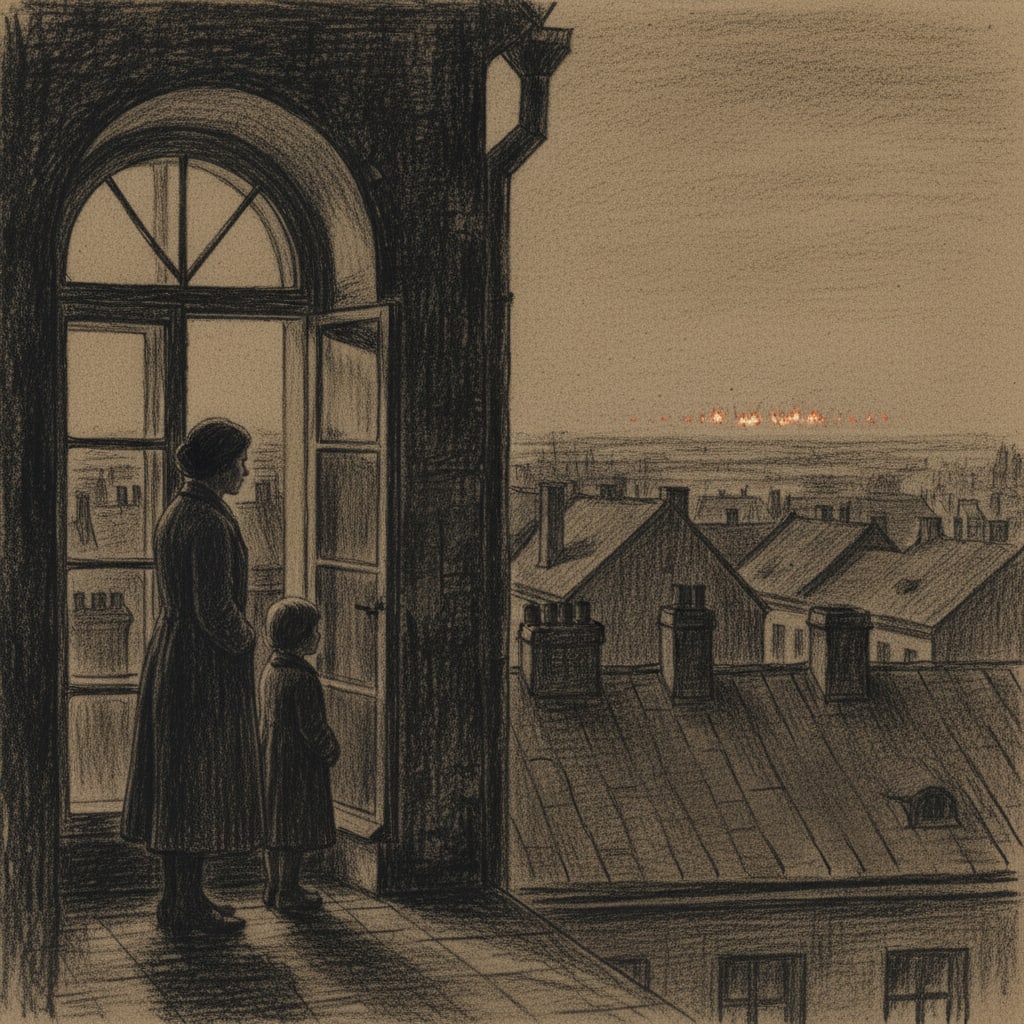
██████████████████ Bureau of War contingency assessment ████████████████ Warsaw ██████ artillery range ██████████ current enemy disposition ██████████████ theoretical maximum ██████ forty-seven kilometres short of ██████████████ revised estimate ██████████████████████ "not yet, but the definition of 'yet' is under review."
Warsaw endures. This is the word the Bureau of Settlement uses in its annual reports, and it is accurate in the way that all Bureau language is accurate: technically correct, spiritually insufficient. Warsaw does not endure as a fortress endures — through stone and iron and the conscious application of defensive doctrine. Warsaw endures as a city endures — through bakeries, and children, and the sound of the front that everyone hears and no one is permitted to name, and the seven hundred and fifty thousand reasons, each with a face, why Standing Order 14-W/3 has been under review for forty-one years and will be under review for forty-one more.