

#On the Survey and the Cup
This survey is entered at A.S. 201. That is the year of the inspection and nothing more. The custom it describes is older than my visit, and the file holds no founding date, no founder and no first host. When I asked Ribwalk residents where it came from, they answered with a shrug, a price, or a cup. I have recorded all three.
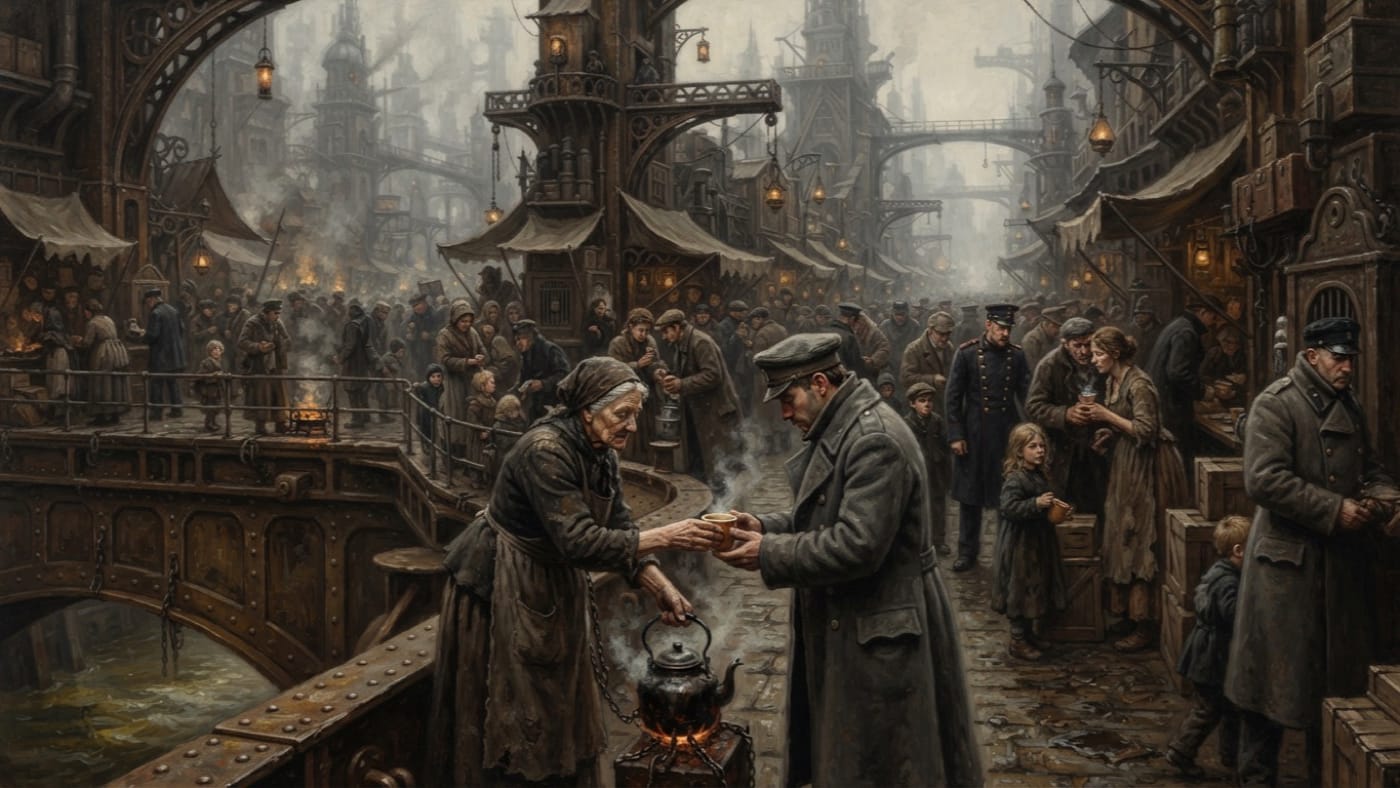
The Ribwalk is the upper deck of the Brass Ribs at Bastion-Brest. It is a market street laid over the Bug, with the Confessional Lanes and Pylon Warrens beneath it. On that deck a host who wishes to be thought decent offers a guest two things: a warm candle cup and a safe sin. The cup is tallow-water with pepper, salt or broth when the week allows, sold by widows from kettles chained to deck rings. The safe sin is a small admissible fault, offered for the guest to declare. The cup warms the hands. The sin warms the clerk.
The dedicated Brest record gives the rule in one line: the host offers the cup and a safe sin to declare, and the guest never asks the host's true crossing history. The two clauses belong together. One party supplies a usable guilt, and the other declines to ask after the real one. The record does not say whether the guest must declare the exact sin offered or may substitute a better one, and the deck does not agree. I watched both happen within a single stall's length. Neither host took offence. One looked relieved.
#On the Substance of a Safe Sin
A safe sin is a minor offence one can admit. That is the whole definition the local glossary bothers to give, and it is enough for people who must use the thing before breakfast. The difficulty lies in the word minor. At Brest that judgment belongs to a tired scribe behind a grille, a provost at a lane mouth, or a widow with a ladle.
My own Ribwalk account set down the common assignments: impatience for soldiers, pride for officers, envy for traders, minor theft for children, discourtesy for clerks, and gluttony for anyone prosperous enough to make the booth suspicious. These are examples heard on the deck, not a schedule. No office publishes them. They work because they fit the face presenting them. A soldier confessing envy of a trader's boots is believable. A clerk confessing gluttony is either lying or embezzling, and the booth will want to know which.
A safe sin has to survive two dangers at once. If the confession is too clean, it draws attention. Brest forbids speaking clean, and the insult cleanmouth is kept for those who try. If the lie is too dirty, it is believed into punishment. Between the two runs a narrow lane of believable, forgettable fault, and the whole bridge walks it in single file.
The visitor's position follows from this. My earlier account warned that a visitor unable to produce a safe sin is "rude, stupid, or interesting to Purity," and that the first two may survive. I let that sentence stand as a warning. I found no uniform penalty for the third condition, and no standing order that the Bureau of Purity receive the names of the sinless. I found only that nobody on the deck wished to test it.
The Ribwalk account called the safe sin "hospitality's most local sacrament."
Clarified for the Bureau of Doctrine. The word was ornament. No candle cup confers grace, and no safe sin declared over one has been shown to absolve anything. The cup is grease with witnesses. The sin is a sentence with good manners. Both remain hospitable, neither is sacramental, and the author regrets lending them vestments they had not earned.
#On Children and the Witness Rule
Ribwalk children learn the practice in public, before letters and often before sums. The account records a mother buying candle cups and testing her child between stalls. "What did you do?" "Stole bread." "Too common." "Envied boots." "Better. Whose?" "No one's." "Good." Bread theft invites a ledger entry. Envy of no one's boots names nobody, injures nobody and cannot be traced to a stall.
By my account of the Warrens below, the matrons hold the same examination at soup. A Warren child who cannot produce a safe sin is reckoned sheltered, stupid, or already in someone's dangerous employ.
Children also sell safe sins. The Ribwalk public conduct extract, posted for visitors, deals with that trade in one line:
I record its scope exactly, because visitors enlarge it and residents shrink it. The line covers buying from children under eight. It sets no witness requirement for sales by older children. It names no licensing office, describes no licence, and states no penalty or enforcing officer. A child of nine may sell a sin to anyone on the deck, and the extract does not care. A child of seven may sell one too, if some licensed adult stands near enough to count as a witness. The extract does not say what the witness attests to, whether the sale, the age or the quality of the sin. That is left to whoever is doing the witnessing.
The deck adds its own uses. During black fog, unaccompanied children are gathered under awnings and made to recite safe sins until their guardians appear. Around a hanging, safe sins become more pious for an hour. Nobody I asked could say who decides the change. Everyone made it.
#On Scrip, Scribes and the Confession Economy
A spoken safe sin costs a breath. A written one costs coin. Among the deck's trades are safe-sin writers, who sell discretion, good handwriting and moral flexibility. Beneath the deck, the under-deck market sells sin-scrip: prewritten confessions tailored to a profession. They are sold alongside forged absolution tokens, altered lane assignments, queue slips and clean receipt edges. Purity raids the moorings every quarter. The moorings reopen.
Selling side by side does not make these goods one commodity. I enter the distinctions plainly, since several buyers have not grasped them.
What links the cup to the booth is rehearsal. At Brest the booths feed to scribes, and sins are indexed to identity files. Repeat sins cost lane rights and labour. Someone who declares a safe sin over a cup at noon has practised the sentence they will need at a booth grille by curfew, in a voice that does not shake. Penitents rehearse safe sins all night and still forget them when a scribe asks their name. The cup gives them one more rehearsal, before a friendly audience.
Whether the scribes accept such offerings at the grille is a question for the Lanes, and the Lanes answer it booth by booth. The custom guarantees nothing there. It only makes it more likely that the penitent arrives fluent. Brest's economy runs on fluent sinners. They keep the queue moving, the Tribunal calendar thin and the indexers bored. A booth that hears too many safe sins delivered too smoothly has other troubles, which belong to other files.
#On the Present Practice
At the time of this survey the custom is active on the deck. Candle-cup widows sell from the dawn bells until the stall chains are tightened. Hosts offer, guests declare, and the line moves on before anyone can admire the exchange. Under curfew the cups vanish beneath cloaks and the safe-sin sellers become cousins walking home. By the time the truth lanes are lit, the deck has stopped offering, though not stopped rehearsing.
I tested the practice on myself. A candle-cup widow offered me warmth and a safe sin. I gave her pride. She looked at me with professional pity and said, "Too obvious, master." I have no record of her name. I did not ask her crossing history, which I am told was the correct form. I accept her judgment in full. Pride was my true sin, and so it was useless: anyone who had met me would believe it at once and wonder what else I was hiding behind it.
The deck reports one more use. A cup served without the safe-sin question tells the guest that the seller has recognised a plain-cloak. In this the custom works like the other shibboleths of Brest: people notice when it is left out.
At fourth bell the chains tighten. A widow stirs pepper into tallow-water and asks the next traveller what they have done. The traveller says envy. Of whose boots, she asks. No one's, they say, and she pours.