

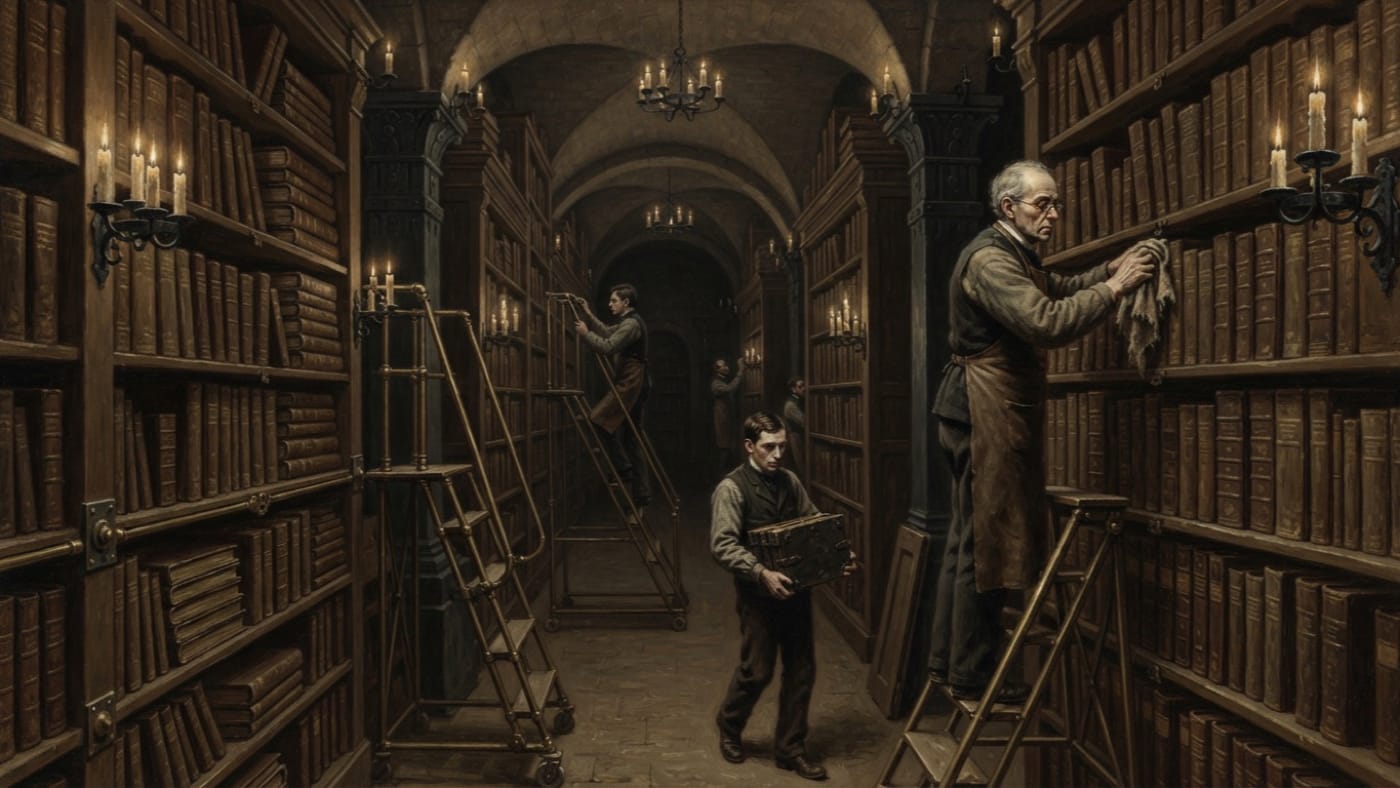
#On the Keepers Beneath the Basilica
This survey covers the vault-keepers of the Bureau of Records as they serve in A.S. 201, which the old reckoning calls 1911. It was commissioned as a present-role survey and keeps to that. The keepers are Records' custodians of the lower levels of the Basilica of the Ledgered Saints in Strasbourg. They answer to the Archon of Records. The Archon's name is classified and the Archon's authority is not. Their documented work is the tending of shelves.
The Bureau's published account of its own staff gives the keepers one line of duty and two lines of condition. Many have not seen daylight in years. This is considered a mark of devotion, not deprivation. I quote it because I could not improve it. I also distrust any sentence I cannot improve.
This entry gives no year for the first appointment, because I have been shown none. Veyrault gathered the scattered registers of Records under one hand around A.S. 78. The Great Ledger of Souls opened its unbroken column in A.S. 80. The Concordat of A.S. 90 and the successor council of A.S. 93 then dignified machinery that was already running. None of those dates records the first person sent downstairs to keep a shelf. I leave the gap open, and Records will no doubt keep it for me.
The name covers Records' keepers only. Other Bureaus hold repositories in the substructure of the Cathedral and its precinct, and Purity keeps its Vault of Silences under the Basilica's own north transept. Whoever minds those doors serves another seal. Sharing a cellar with someone gives you no claim to his keys.
#On the Records Kept
Records preserves baptisms, tithes, excommunications, pardons, census material and recantations. All of it takes up shelf room, and all of it has to be shelved by somebody. The account does not say that every keeper tends every collection, and I will not pretend that every keeper has walked every aisle. The Great Ledger is a living archive rather than one book. The census-scribes add to it every day from the dioceses, and the keepers receive what the roads deliver.
The best documented floor is the first sub-level, the Recantation Vaults, where volumes as thick as a forearm hold nothing but the words I recant. My survey of that floor put the division of labour in one line: vault-keepers tend the shelves, and seal-binders tend whatever must be shut. This makes the floor a workplace of the keepers. It does not make it their school, their headquarters or the cradle of their trade.
The keeper should be kept separate from what he keeps. A recantation records a decision that a penitent made and a notary attested. An excommunication records a tribunal's ruling. The keeper made neither of them. He keeps the volume dry and in its bay, and he keeps it findable. Findable carries the most weight of the three. In a Church where appearing in the Ledger is to exist within grace, an entry nobody can find is a theological problem with a shelf-mark. The keeper does not decide who exists. He makes sure the record of that decision can still be found the next time someone asks.
#On the Other Hands of Records
Records employs some fourteen thousand scribes, notaries, census-takers and archival custodians. That is the figure for the entire Bureau. Anyone who divides it to estimate the keepers is doing sums Records has not authorized, and I have watched clerks lose their stools for less.
The Bureau's own list separates its people by what their hands do.
The census-scribes travel. They carry portable desks strapped to their backs, go from hamlet to hamlet and are fed by parishes as a tithe obligation. They bring the Ledger the living. The keeper has no road to walk, and many keepers, by the Bureau's own count, have no sky above them either.
The redaction clerks work with replacement texts, pre-written passages that fill the gap left by an excision. Their skill is in making things have not happened. The keeper's work is the opposite. He makes sure that what is shelved stays where it was shelved.
The notaries authenticate. On the first sub-level they press the tremor of each penitent's hand into seal wax beside the stroke. That attestation is theirs. A keeper who has dusted ten thousand recantations has attested none of them.
The seal-binders close classified volumes with wax, wire and prayer, and their knot outranks every hand below the Archon. The knot is theirs and does not come with a keeper's appointment. I wrote of the binders that any vault-keeper with a dry shelf and a steady pulse can keep a book. Some keepers took offence. They should not have. Any fool can keep a book for one night. Keeping it for years, in the same bay and the same order and the same dryness, is a long vigil. The Bureau does not stamp vigils, so nobody notices them.
General accounts of the Records scribe describe the pens and practices of the wider Bureau. They do not describe the keepers' tools, dress or advancement, so neither does this survey.
#On the Archon's Authority
The Archon of Records commands the vault-keepers of the lower levels. The office's published profile says so in the same list that gives the redaction clerks, the census-roads and the Great Ledger itself. Between the chair and the shelf there must be clerks, deputies and someone who signs for candles. The Bureau has published none of them, and I will not invent a ladder so that I have something to climb.
Command does not confer clearance. Clerks below Archon tier may carry Archon-tier folios and may not read them, and the folios are catalogued by weight. That rule shows how Records divides handling from reading. It does not tell me that any particular keeper has carried such a folio, so I will not assign every keeper a folio under his arm. Where a keeper does carry one, he knows its weight to the ounce and its contents not at all.
No hand below Archon rank may undo a seal-binder's knot. The keepers fall below that rank, as almost everyone does. Lesser officials who attempt the knots are prosecuted for fraying. The Bureau has not said whether the prohibition rests on law alone or on something in the prayer, and I file both readings without choosing between them.
The Archon's hand has a ceiling of its own. It yields to Ninth-Ratification and to any office that asserts a superior hazard. The chair that commands the keepers can therefore be refused, which should comfort the man on the lowest stool more than it does.
#On Daylight and Devotion
The working air of the lower levels tastes of iron gall and tallow. Vellum lines the walls. Candles light the aisles, because Records forbids lanterns near vellum and considers fire too imprecise a means of destruction. That rule belongs to the Bureau and its vellum. I do not extend it to every cellar in the Church.
Here many keepers have not seen daylight in years. The Bureau says many, and the word is precise. It means more than a few and fewer than all. I will not turn it into a vow, a sentence of confinement, a residence rule or a term of service, because the account names none of these. It names no blindness, no pallor worth a physician's fee and no altered body. A keeper might, for all the record says, simply have had no errand that took him up the stairs.
The Basilica's published survey describes a six-month rotation for census-level clerks. That rotation applies to census clerks. It does not change the Bureau's statement about the keepers, and it gives the keepers no schedule of their own.
The Bureau calls the condition devotion. I am a state theologian and I know a reclassification when one is placed in front of me. Records has taken a lack of sky and filed it under virtue. It may even be correct. The Creator is said to see in every room, and a keeper's vigil among closed ledgers is as much prayer as a monk's at Lauds. Still, I took my breakfast this morning under a window, and I would not trade the window for a commendation.
#On Present Custody
How far down the keepers' charge goes depends on whose account you trust. The Bureau's description and the Archon's profile give three levels beneath the street, and say nobody claims to have walked to the end of the lowest. The Basilica's own survey acknowledges seven sub-levels and denies an eighth. The Lower Vaults entry certifies no complete depth and notes jurisdictions that are not Records'. I certify the first sub-level, where the keepers are documented, and I leave the rest of the stair to men with better lungs.
In A.S. 201 the vault-keepers of Records tend the shelves beneath the Basilica under the Archon's command, by candlelight, in air that smells of ink. They do not bind or attest, and they do not redact or open. They keep the archive where it was put, so that when the Church asks what it once decided, the answer is still on the shelf.