
#On the Vaults Beneath the Basilica
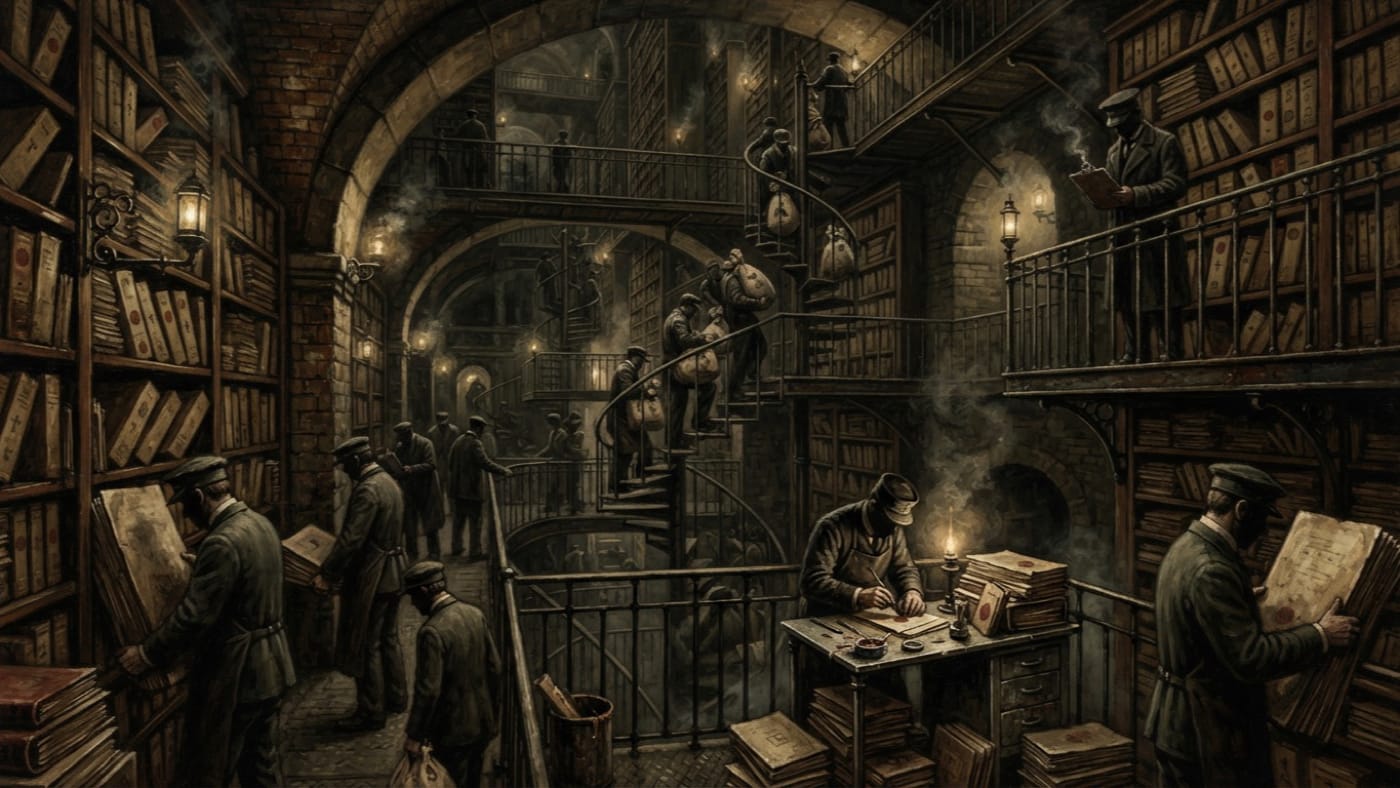
Beneath the Basilica of the Ledgered Saints, under a nave whose windows show columns of numbers where other churches would show martyrs, the Bureau of Records keeps the Lower Vaults of Strasbourg. The name is a clerk's convenience. No survey I have been shown fixes how many chambers there are, how deep they go, or the year the first shelf went up against the first wall, and I have been shown a great many surveys. The work itself is certain. Every baptism, tithe, excommunication and pardon that Records sets down on vellum is copied into the subterranean vaults of this city. Once a copy has gone down, it is the version Heaven is expected to consult.
Two kinds of report concern the place. The first is ledger fact: registers, abstracts, seals, and the census of the living shelved beside the absolutions of the dead. The second is what clerks say on the stairs. This Codex keeps the two on separate shelves, as Records would wish and does not always manage.
#On What Records Preserves
"Nothing is forgotten." Records carves its motto over doors and into the minds of children, and the faithful repeat it with equal parts pride and terror. In the Lower Vaults the motto becomes a filing obligation.
A baptism entered below is proof that a soul was received. A baptism left unentered becomes a dispute with a parish, then with a magistrate, and in the end with a Purity examiner who wants to know why a grown man has no beginning. Tithe entries settle what a household owes the altar and what it has already paid. Excommunications are copied down so that the cut cannot quietly heal. Pardons are copied down for the opposite reason: an absolution nobody can produce at a tribunal is a rumour of mercy, and rumours carry no seal.
Above all of it stands the Great Ledger of Souls, which the Bureau says lists every living adherent by name, birthplace and confession. I record the claim as the Bureau's claim. A Warden who certified a census he had not personally counted would deserve the same dismissal he hands out to others, and I do not go to tribunals without my sums.
The appetite behind all this belongs to Archon Benedict Veyrault, whose obsession the Bureau became in its transformation of A.S. 78 and whose taste for cataloguing it has never lost. No document I know of says he dug, designed or consecrated these chambers. He made Records into an institution that could not bear an empty shelf. The vaults followed the way cellars follow wine.
Some of the books down there contain nothing but the words I recant, written ten thousand ways, every stroke notarized and every tremor of the pen kept in seal wax. Recantation is the Church's most common literary form. Its readership is small and very attentive.
"Every Synodal decree, every tithe, and every baptism since the Concord of Cologne."
This old line about the Basilica's holdings flatters the archive and slanders the calendar. The First Council of Cologne sat for nine days in September A.S. 27, and there was no formal Synod to decree anything until the Concordat of Strasbourg in A.S. 90. Anything shelved here from the Cologne years is a Church record. Where it now carries a Synodal label, someone added the label later. Records has never objected to backdating, but it insists the backdating be filed properly.
#On the Hands That Keep the Entries
The vaults are made of stone, but the archive is made by hand. In every Records house the scribe's day goes the same way, and nothing suggests the Basilica is exempt. Ruling grids are pressed into blank vellum before first light. Reed pens are cut and recut. Wax is softened in little pans that give the corridors their smell of a smothered chapel. Births are checked against the midwives, deaths against ossuary intake, and confessions against attendance at penance. Spoiled drafts go to the fire. Priority pages are copied again for the secondary shelves, because Records trusts one copy the way a sergeant trusts one sentry.
You can tell a vault-clerk by the cuffs. The ink on them is never quite washed out, the wrists are freckled with wax, the thumbs are permanently blue, and the cough comes from twenty years of breathing paper dust. Iron keys go cold in the hand within a minute of leaving the pocket. The only sounds are pens scratching, stamps falling, and now and then a supervisor breathing through his nose over someone's stroke thickness.
None of this is mechanical, whatever the catechism says. A clerk decides which abstract counts as a confession and which is merely a complaint, and whether a smudged birth year is a seven or a one. On that judgment a family may keep its ration cards or lose them. The Ledger is infallible. The hand that feeds it is underpaid.
#On the Volumes Denied
Now for the books that do not exist.
The Codices Obscurae are said to be supplementary volumes recording the things the Great Ledger cannot hold as facts: a doubt mumbled to a confessor, a hesitation over the response at Mass, a blasphemy thought and swallowed before it reached the teeth. The rumour puts them under or beside the Ledger, which in Strasbourg means here. Records denies them. The denial has a name.
Bureau Circular 447-R, first formally issued in A.S. 138, declares in exactly four hundred and forty-seven words that Records catalogs facts, not speculations. Its recensions vary by audience: gentle in the parish, sharp in the seminary, and armed when it reaches Purity. The Bureau of Doctrine's copy keeps the rumour alive on purpose as a test of loyalty, which is the most honest thing any of the copies says. The Circular hangs beside confessional screens. The Index Damnatus cites it whenever someone is caught selling forged Obscurae extracts.
What the Circular leaves out matters most to this article. It makes no mention of a seventh vault, of Obscurists of the Third Ink, of conscience slips, shadow entries or corded tags, or of a southeast stairwell beneath the Basilica. I repeat these items only as the Circular's omissions, the one form in which they may be cited. They are not a floor plan, a staff roster or an inventory. Anyone who sketches them as a map will be filed as a cartographer of nothing, and Purity keeps a drawer for those.
There is also the story of Archon Veyrault locked in the Lower Vaults with a candle, a census knife, and the name of every man who ever disappointed him, writing the original denial in four hundred and forty-seven heartbeats. Novice conspirators love it. I enjoy it the way one enjoys a forged relic with good joinery. It has no witnesses, no date and no seal.
#On the Depth of the Archive
The archivists say the Basilica's lower vaults go down far enough to reach chambers where censers are still burning from the age of Hierarch Augustinus.
I give the story in their words because I have nothing better. I have not seen those censers, and nobody has asked me whether I have. Nobody has told me what feeds them, who trims them, whether anyone is meant to, or how far down a man would have to walk before the smoke changed its century. The story outlives every attempt to check it because no one with a lantern and a mandate has come back with a measurement. Measurements here belong to whoever orders the walk. The orders, I assume, are filed.
What I can certify is how the archive grows. Paper descends every day. Old shelves are shifted to make room. Chambers that were once working rooms become storage, and storage becomes somewhere clerks no longer go. An archive that forgets nothing still forgets where it put things. The deeper levels of this one are known mostly by rumour, by the draught on the stairs, and by the incense on the cuffs of clerks who swear they never went below the copying floors.
The Bureau prefers it that way, and so, on reflection, do I. A vault with a known bottom can be emptied by anyone with enough carts. A vault without one can only be obeyed.
#On the Present Custody
In A.S. 201 the Lower Vaults are full, cold and working. Baptisms still come down by the sackful on feast days. Tithe rolls arrive with Assessors' seals and leave carrying Records'. Pardons are copied, cross-checked and shelved, and the pardoned sleep better than they should. Framed excerpts of Circular 447-R hang in the Basilica vestibule, so every pilgrim on the way to the nave walks past the official statement of what is not underneath it.
The ordinary custody stands certified. The census, the absolutions, the recantations and the tithes are all present, all sealed, and all descending. Everything else about the Lower Vaults stays exactly where the Bureau has put it: under denial, under seal, and under your feet.