
#On the Architecture of Suppressed Knowledge
"What is sealed is preserved. What is preserved is dangerous. What is dangerous must be sealed. The Bureau sees no contradiction. The Bureau has never seen a contradiction it did not file under 'procedural clarity.'"
I have descended into the Vault of Silences four times. The first occasion was professional — a consultation required for an entry on the Index Damnatus, which could not be completed without verifying an attribution the Bureau of Records had botched. The second was scholarly, or so I told the Inquisitor who checked my writ of access; in truth, I wanted to see the lectern again, because a man who writes about power ought periodically to stand in its coldest room. The third was at the request of the Bureau of Purity, which had discovered an inconsistency in the Register of Names and required a witness of sufficient rank to observe the correction. The fourth time I went because I could not sleep, and because the Vault is the only place in Strasbourg where the bells cannot reach you.
#Descent
The Vault of Silences occupies the sub-basement of the Basilica of the Ledgered Saints, Strasbourg — though "sub-basement" flatters the architects with an implication of intentional design. The Vault was not built. It was found. When the Basilica's foundations were sunk in the first years of the Concordat, labourers broke through a Roman cistern that opened, by way of a collapsed drain-shaft, into a series of chambers older than anything the Bureau of Records could comfortably date. The masonry was Carolingian in style and heretical in geometry — the proportions of the largest chamber produced, when measured, a ratio the Bureau of Rites declared "spiritually discouraging." The labourers were paid, dismissed, and required to sign a document whose text they were forbidden to read. The cistern was consecrated. The chambers were cleaned. The Bureau of Purity, then a committee of four men with a budget scarcely sufficient for ink, claimed the space and began filling it with everything the Synod preferred the world forgot.
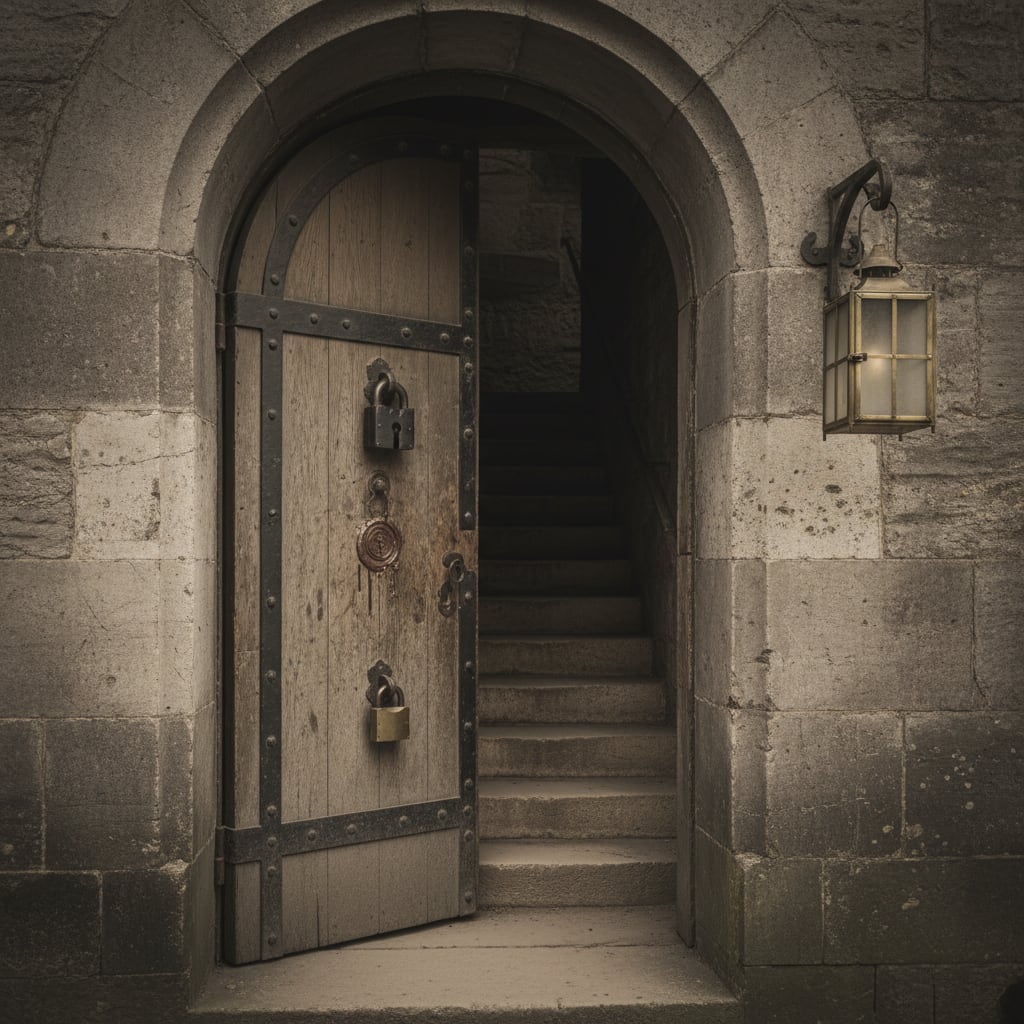
The entrance is beneath the Basilica's north transept — a door of iron-banded oak, unremarkable in a building full of iron-banded oak, distinguished only by the absence of a handle on the exterior and the presence of three locks. The first lock is mechanical, opened by a key held by the senior Inquisitor on rotation. The second is a wax-seal mechanism of the Bureau of Records' design, which registers the identity of whoever breaks it and files the record automatically in a ledger housed two floors above. The third lock is, according to the Bureau of Rites, "spiritual in nature," which I take to mean that it does not always open when the key is turned, and that the Bureau has decided this is a feature.
Beyond the door: forty-seven steps, cut into limestone, descending at an angle the Bureau of Engineering has certified as "safe within the definitions available." The steps are worn to a concave polish that predates the Synod by centuries. Roman feet walked here. Carolingian feet. And now Synodal boots, carrying sealed folios to their final resting place.
#The Chamber of the Index
The principal chamber — the one most visitors mean when they say "the Vault" — is a rectangular hall approximately forty paces by twenty, its ceiling vaulted in stone ribs that converge on a central boss carved with the Synod's seal. The air is cold. The air has always been cold. Braziers are forbidden, because flame is a risk to the documents, and brazier-smoke is a risk to the lungs of the Inquisitors who sit here for eight-hour shifts, and risk to Inquisitors is — the Bureau assures me — a matter of some concern, though the Bureau's concern has not yet extended to providing them chairs with cushions.
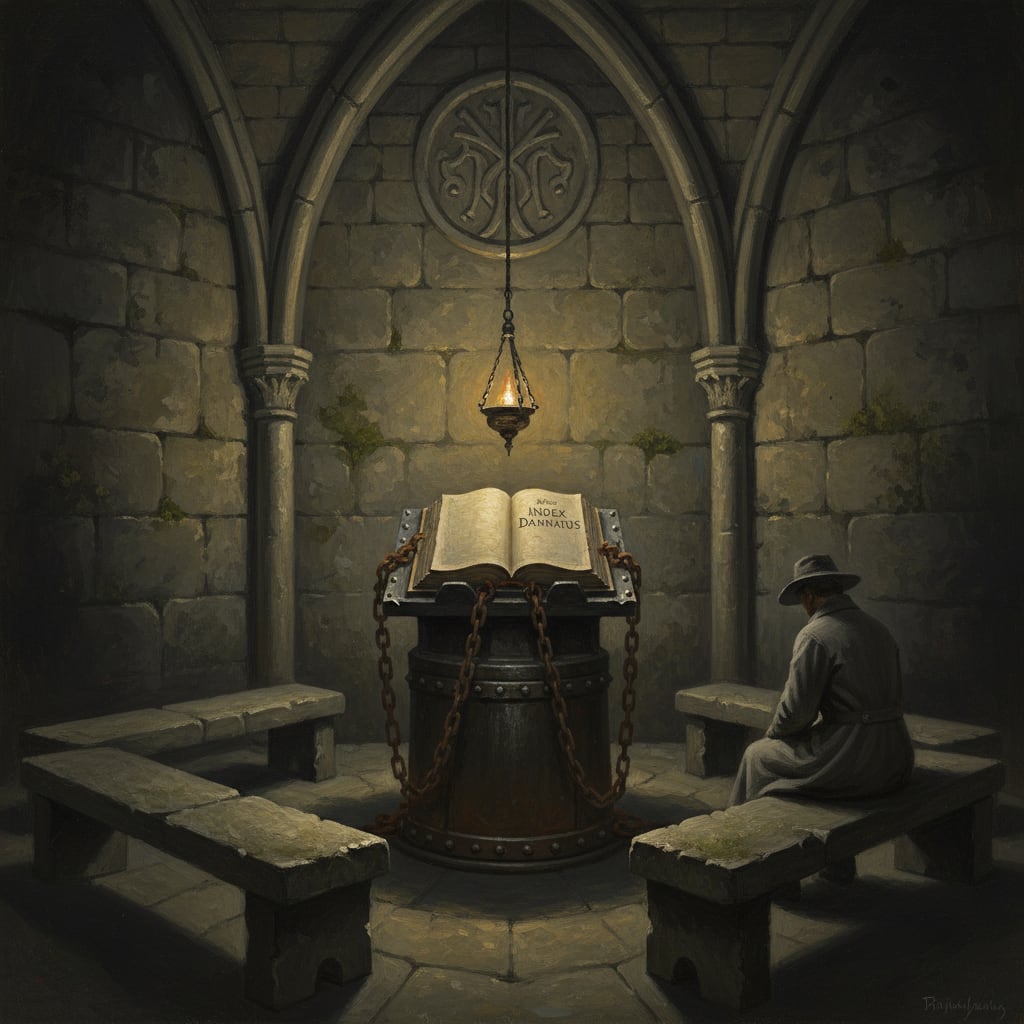
At the chamber's centre stands the lectern. It is iron. The chains securing the master copy of the Index Damnatus to the lectern are iron. The bolts securing the lectern to the stone plinth are iron. The plinth itself has not been moved since the second century Anno Synodi, and at this point has fused with the floor through a combination of weight, age, and what the Bureau of Rites calls "doctrinal gravity," a term I have never seen defined and suspect was coined to avoid admitting that the plinth is stuck.
The Index is open. It is always open. A different page each day, turned by the senior Inquisitor at the Matin bell using gloves of bleached linen. The turning is liturgical — a rotation through the Five Registers in sequence, so that each Register receives its due exposure to the consecrated air of the Vault. Exposure to consecrated air is, the Bureau of Purity maintains, essential to the Index's continued "doctrinal potency." What happens to doctrinal potency if the book is closed is not specified, but the implication — that the forbidden knowledge might fester if sealed too long — is sufficient to keep the pages turning.
Three Inquisitors attend the Index at all times, in rotating eight-hour shifts. They sit on stone benches placed at the three points of an equilateral triangle around the lectern. They do not read. Reading the Index without a writ of access is heresy of the third degree, and the Inquisitors are not issued writs. They are issued instructions: watch, record any disturbance, and under no circumstances touch the Index itself. The senior Inquisitor alone handles the page-turn, and even she performs the act with averted eyes, reciting the Prayer of Unseeing — a formula the Bureau of Rites composed specifically for persons required to handle forbidden material without absorbing its content.
Earlier editions of this Codex stated that the Vault Inquisitors served twelve-hour shifts.
The shift was reduced to eight hours following the Incident of A.S. 187, in which Inquisitor Breel was discovered, at the end of her twelfth hour, transcribing the Register of Sounds into the margin of her duty log. She claimed no memory of the act. The Bureau of Purity transferred her to a surface posting. The duty log was burned. The ash was weighed.
#The Sealed Collections
The Index is the Vault's most famous resident, but the Vault contains more than one book chained to one plinth. Branching from the principal chamber are seven subsidiary corridors — the Bureau calls them "silences," because naming them corridors would imply they were designed for transit, and transit implies a destination, and destinations imply that one might wish to arrive at something sealed in the Vault, which is a desire the Bureau finds doctrinally suspect.
The first silence holds the sealed testimonies: folios of witness accounts too dangerous for the general archive. Three folios record the emergence of Atheron at the Sundering — cross-indexed with the Bureau of Rites and annotated by the Bureau of Doctrine with the single word confirmed. The deposition of Captain Elias Mürren from the Debrecen retreat is here, its final paragraph obliterated by the Bureau, the seven remaining words sufficient to curdle the stomach of any reader the Bureau permits to approach: "It offered itself to us, and we ate, and the eating did not stop." Fourteen testimonies from the survivors of the Battle of the Iron Plains are bound together in a single volume, agreeing on three facts the Bureau finds theologically useful and seventeen the Bureau finds theologically inconvenient.
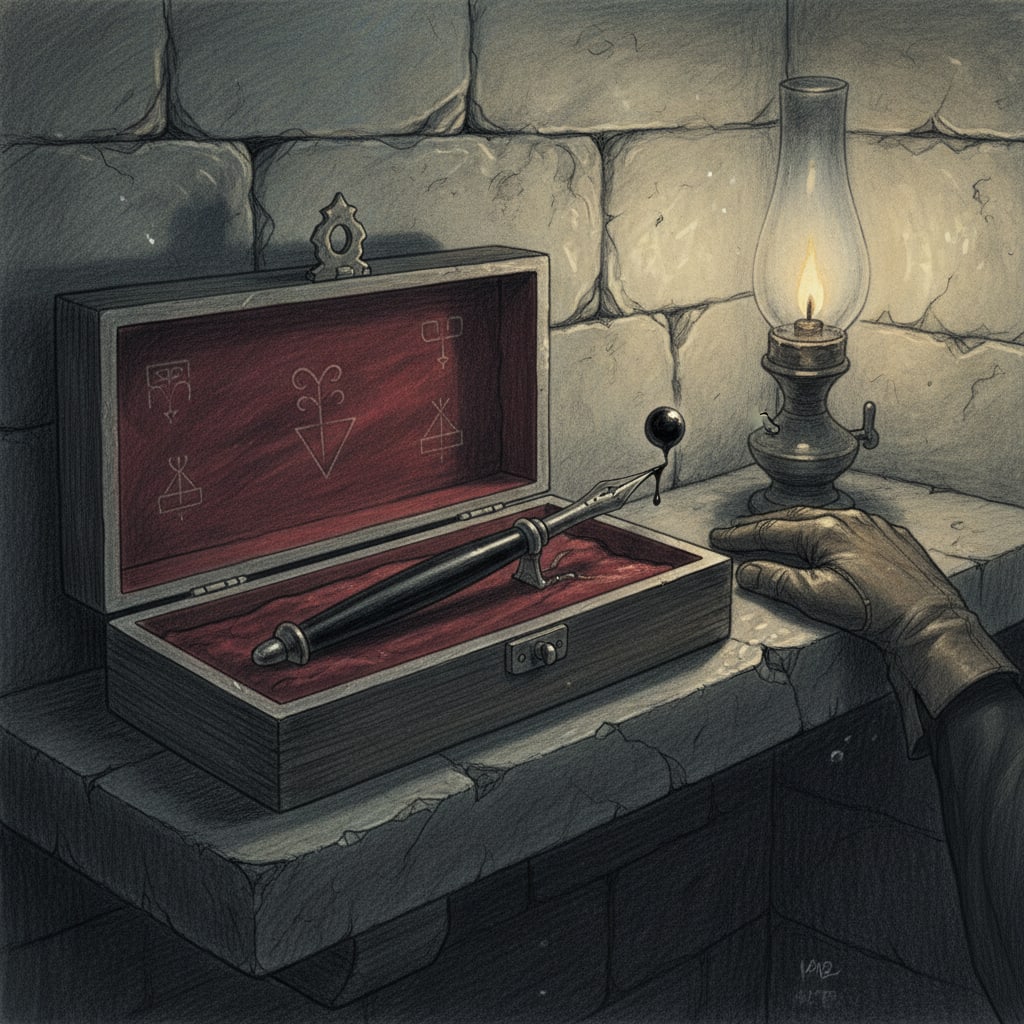
The second silence contains the physical anomalies — objects the Bureau cannot explain and has therefore chosen to store in darkness until explanation arrives or curiosity dies, whichever comes first. The never-drying pen from Vienna's Council of Nine is here, collected from the chamber where the Rationalist government's last session sat unfinished for forty years. The pen has not dried. The ink remains wet. Eleven reports have been filed recommending no action, which is eleven reports more than the Bureau usually needs to declare a matter closed, and the matter is not closed.
The third silence — and here I must be careful, because the Bureau's patience with specificity frays as one moves deeper — holds the confiscated relics of uncertain provenance. Objects removed from circulation because they did not match the Bureau of Relics' authentication criteria, yet could not be destroyed because destruction produced results the Bureau found unsettling. A jawbone that hummed. A splinter of wood that wept — the fluid tested as olive oil by the Bureau of Engineering, as blood by the Bureau of Medicine, and as "inconclusive" by the Bureau of Rites, which is the Bureau's way of saying we tested it and the result frightened us. Coins from the Vault of Ten Thousand Keys, buried in consecrated ground beneath the Basilica, which surfaced twice despite the consecration and the six feet of packed earth.
The fourth through seventh silences are sealed. I do not mean sealed in the administrative sense — locked, with a key held somewhere in the Bureau's labyrinth of custody chains. I mean sealed: bricked shut. The fourth silence was bricked during the reign of Hierarch Augustinus, the mortar blessed by the Bureau of Rites and scored with prayers by the Bureau of Doctrine. No record exists of what prompted the sealing. The absence of a record is, in the Bureau's institutional grammar, a record in itself — an entry in the ledger that reads the contents of this corridor are so classified that the classification is classified.
An earlier edition stated that the seventh silence was sealed last, in A.S. 172.
The seventh silence was sealed first, in A.S. 94 — four years after the Concordat. The fourth was sealed last, in A.S. 161. The order of sealing does not correspond to the numbering, which means the numbering was assigned after the sealing, which means someone had to walk past four bricked-up corridors and decide which was first and which was seventh, and that decision — arbitrary, administrative, performed with a chalk mark and a shrug — is the closest the Bureau has come to imposing order on a space that resists ordering.
#The Inquisitors of the Vault
A posting to the Vault of Silences is not a punishment. The Bureau of Purity insists on this with the vigour of an institution that protests too much. Vault duty is a "senior rotation" — assigned to Inquisitors of the fourth rank and above, those who have demonstrated "doctrinal resilience" in the field and are therefore trusted to sit in a cold room for eight hours without reading the forbidden book chained three feet from their face.
The reality, which the Bureau knows and I know and the Inquisitors know, is that Vault duty breaks people. The silence is the obvious hazard — eight hours without speech, without bells, without the ambient machinery of Strasbourg's surface life, in a chamber where the cold seeps through wool and leather and settles in the marrow. But the silence is not the worst of it. The worst is the proximity. The Index is there. Open. Legible, if one were to lean forward six inches and lower one's gaze. The Register of Names, with its ten thousand condemned, is visible from the south bench on every fifth day of the rotation. The Register of Sounds, with its proscribed melodies, is visible from the east bench on every eighth day.
Three Inquisitors have been removed from Vault duty in the last twenty years under circumstances the Bureau classifies as ██████████████. The term does not appear in any Bureau lexicon. Breel is the only case whose details have partially entered the record. The other two were transferred to postings the Bureau describes as "remote pastoral assignments." One of these postings is located at Bastion-Shipka, which the Bureau considers pastoral in the same way it considers a siege a "logistical exercise."
The Vault Inquisitors develop habits. This is known. They develop a particular walk — measured, deliberate, as though counting steps — and a particular manner of averting the eyes when approaching a written page, any written page, even a bill of lading or a menu. They develop an aversion to music. They develop an affection for noise — street noise, market noise, the clatter of hooves and the shout of vendors — as though sound itself were medicine after eight hours of its absence. The Bureau of Mercy's quarterly assessments of Vault personnel are filed under a classification I am not permitted to name, which tells you everything the classification itself would tell you and saves the Bureau the embarrassment of admitting it in writing.
#On the Vault's Deeper Nature
I will say this once, and I will say it plainly, because Drax does not whisper and the Bureau can stamp what it likes.
The Vault of Silences is not a storage facility. A storage facility holds inert material — grain, munitions, the surplus paperwork of a thousand committees. The Vault holds material that is not inert. The Index breathes — the pages move between turnings, a fact the Inquisitors report with the flat affect of persons who have reported it many times and been told many times that air currents are sufficient explanation. The sealed testimonies emit sounds that the Bureau attributes to settling masonry and the Inquisitors attribute to voices, because the Inquisitors are the ones sitting in the dark listening while the Bureau sits in offices three floors above composing memoranda about air currents.
The pen from Vienna has not dried in one hundred and six years. The coins from beneath the Basilica surfaced through consecrated earth. The jawbone in the third silence hums at a frequency the Bureau of Engineering measured at 217 hertz — a frequency that, when I looked it up in the Bureau of Orison's harmonic tables, corresponds to no sanctioned tone and is listed in the Register of Sounds as proscribed since A.S. 114.
The Bureau's position is that the Vault contains dangerous material safely stored. My position — and I write this as Warden of the Sacred Ledger, with the authority of my office and the full expectation that the Bureau of Purity will stamp this paragraph into oblivion before the month is out — is that the Vault of Silences is the single most dangerous room in the Church's lands, and that we have placed it directly beneath the Basilica where the Synod's administrative heart beats loudest, and that this arrangement was either an act of supreme confidence or supreme stupidity, and that the distinction between these two is, as with most things in the Synod, a matter of which Bureau you ask.