

#On the Women Who Approve
Dateline: Bureau of Doctrine. Documentary survey compiled in A.S. 201 / 1911 CE. That is the year this survey was compiled. It is not the year anything was founded, and it does not date any woman's birth, any widowhood or any first refusal.
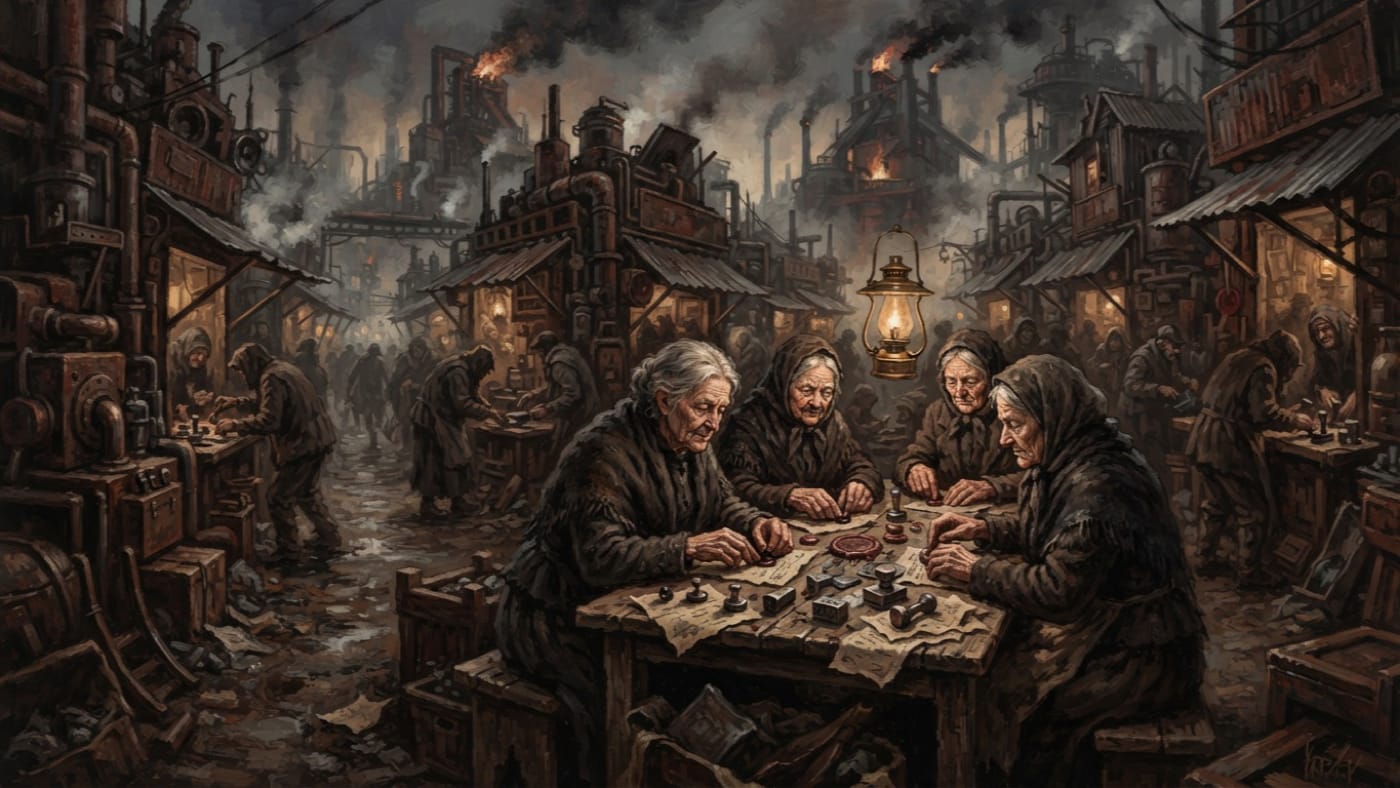
The Wax Aunties sit in the Slag Market, in the outer ring of the Chrismole Furnaces of Brast. The streets there are furnace waste walked flat, and the air smells of vinegar, wet rope and burnt fat. The published market account describes them in one plain sentence, and I have no wish to improve it: old women, mostly widows of furnace men, whose hands know seal pressure by touch and whose memories hold more dead signatures than the local Records annex. They do not cut all seals. They approve which seals may be cut without bringing the market down.
That is the whole of their recorded authority. It is more than most bishops hold. A bishop may forbid a sin. An Auntie decides which crime the street can afford.
I file them under factions because the Codex needs a drawer for them and the market knows them by a common name. Nobody should mistake the drawer for a constitution. Doctrine has received no charter, no roll of members, no meeting place, no order of seniority and no rite of admission. Their names are unrecorded. I would not print them if they were known, because a widow whose name appears in print soon has an appointment at the Manifest Court.
#On Pressure and the Dead
A seal is a pressure first and a picture second. Any apprentice with a borrowed die can make the picture. The published account lists what Brast drum wax carries beyond the image: scent-trace, pressure memory, fibre inclusion, prayer pattern and serial impression. The Aunties are reported to read pressure by touch. I accept the report as given. The account does not say how they learned, and I will not invent a widow's apprenticeship because it would make good reading.
Their second store of knowledge is the dead. The account credits them with more dead signatures than the Records annex holds. The comparison is unkind to Records and is probably fair. An annex keeps the signatures someone sends it. A furnace widow has kept others that nobody sent: the signature on her husband's last allotment slip, the foreman's mark that docked his shift, and the clerk's countersignature on whatever form closed the matter. Multiply that by every neighbour she has buried and the annex looks thin.
A dead man's signature is the safest hand a forger can borrow, because its owner cannot deny it. It is also the most dangerous, because some ledger has already closed his line. A living stroke on a closed line is the kind of error that makes clerks start counting.
"The forgers are supervised … by the Wax Aunties." — Slag Market, A.S. 201.
Corrected in my own hand. The next sentence of that same paragraph says what the supervision consists of: they approve which seals may be cut. The cutting, stamping and selling are done by other hands. "Supervised" made readers picture a foreman walking the benches, and no account has ever shown one.
#On Cutting and Consent
The cutters belong to the wider trade. According to the market account, its seal-forgers cut wax prayers for sealed drums, stamp heat chits, repair pass slips, alter accident confession forms, and forge the small compassionate papers that let a person survive bureaucracy without becoming legally visible. The account names the smaller mercies the forgers prefer: a corrected warm chit, a widow's ration extension, a labour exemption slip, a false cough certificate, and a clean departure stamp for a child whose real name has become too expensive. Those are the market's examples. No source says an Auntie approved any one of them, and I have attached no Auntie to any of them.
The reasoning behind consent is collective. A false ration extension feeds a household. If it is discovered, the household is ruined. A drum seal is a different matter. A good drum forgery passes the weigh-bridge and may fail three provinces east, where someone counts backward through corpses. When it fails, the Manifest Court does not audit one bench. It audits the ring. Stalls shut, names are taken, ledgers are seized, and people who never touched the wax pay for it.
That collective ruin is the risk the Aunties are reported to price. Any competent cutter can judge whether a forgery is good. The question the account gives the Aunties is whether the street can survive the forgery being found out. The profession at large lives with the same arithmetic of one bench's survival against a quarter's punishment. Its ranks, legends and methods belong to that profession. I do not lend them to these women.
#On the Warning in the Gutters
The market account also records a penalty. It says a young forger who counterfeits a drum seal without Auntie consent "may be found in the condenser gutters with his tools pushed into his mouth," and it calls this an educational arrangement that is widely understood. I give the warning as the account gives it. It names no victim, no hand and no night, and I supply none. The record leaves several readings open. The Aunties may order such deaths, or only predict them. Their name may also be what a frightened market calls its own reflexes.
#On the Dies Beneath the Altar
The account puts their buried dies beneath the Scrap Altar, the rusted sorting table at the centre of the market. Some of the dies are ordinary. Some are official dies stolen from minor offices. The Codex's later survey of the table declined to extend the word "their" to every die under every plate. I keep to that ruling: dies are there, and the Aunties' authority is a matter of consent, not proven ownership.
The same account reports an episode from A.S. 198 / 1908 CE. A die was found bearing the countermark of a shift that no lawful table had yet scheduled. Records seized it, sealed it and later denied having seized it. The Wax Aunties stopped using that alley, and the account adds that no one told them to. I record the report as published. I do not explain how a die could carry a shift that did not yet exist. The Bureau of Records has declined to explain it too, which is the first point on which Records and I have agreed in some years.
In the present compilation year, the account says, the Wax Aunties have moved three die-caskets. It does not say where the caskets went, who carried them or why. I enter the observation and nothing more.
#On Knitting in Audit Weather
The Manifest Court's audit bell carries over the outer ring, and the market closes in order of guilt. Both published accounts describe the same moment. Children vanish upward. Seal presses become soup boards. The Wax Aunties sit in plain view, knitting with hands that have just hidden a felony. Provosts enter and find enough contraband to justify the sweep, never enough to damage next week's heat.
"Wax Aunties knit in public with hands that have just hidden a felony." — Warmth Thieves, A.S. 201.
Clarified. The sentence describes a scene during audits. It does not prove that every Auntie knits, that every pair of needles has just put something away, or that knitting is a badge of membership. Provosts reading this tract are asked not to arrest wool.
Commander-Auditor Sorn Vale audits to remind the market of the gallows, not to empty it. He takes bodies, ledgers and tools, and he leaves the market able to keep working. His restraint and the Aunties' consent follow similar sums: how much sin a quarter can carry before the punishment costs more than the crime. I record the resemblance. No source shows any word, payment or understanding passing between them, and I do not invent one.
#On the Neighbours
The Warmth Thieves work the same lanes. Their published tract describes dispersed networks rather than one gang: siphon crews, pipe-tappers, seal lifters and warm-chit counterfeiters. Their forgery overlaps the Aunties' territory the way two parishes overlap at a crossroads. Sharing a bench is not membership. No account makes the Aunties a Thief crew, puts them in command of one, or holds them answerable for every chit a thief has pressed.
Seven sealed drums disappeared from Manifest Court inventory in spring A.S. 201. The drums remain missing in every account Doctrine holds. No account names the people who took them, and none establishes that the Aunties approved, opposed or knew of the theft. If someone had cut a drum seal without consent, the market account's warning would apply. Nothing on file says that anyone did.
Pex Ruln's Distillers' Compact and Ilyra Kest's Calibration Choir rule other parts of Brast's heat. Both look down on the market and use it. No arrangement between either of them and the Aunties has been recorded. I leave the blank where it is.
#On the Present Compilation
This survey was compiled in A.S. 201 / 1911 CE. It records old women at the benches of a scrap market. They know pressure by touch and keep dead men's signatures in memory, and they give or withhold consent to forgeries that could bring the Court down on a whole quarter. Doctrine has no charter, names or founding year for them, and no method for how they decide. The market obeys them all the same, and no office has managed that without paperwork.