
#On the Founding of the Warm City
"Faith provides the flame. The Bureau provides the invoice." — Stamped above the Chrismole Crown gatehouse, attribution disputed
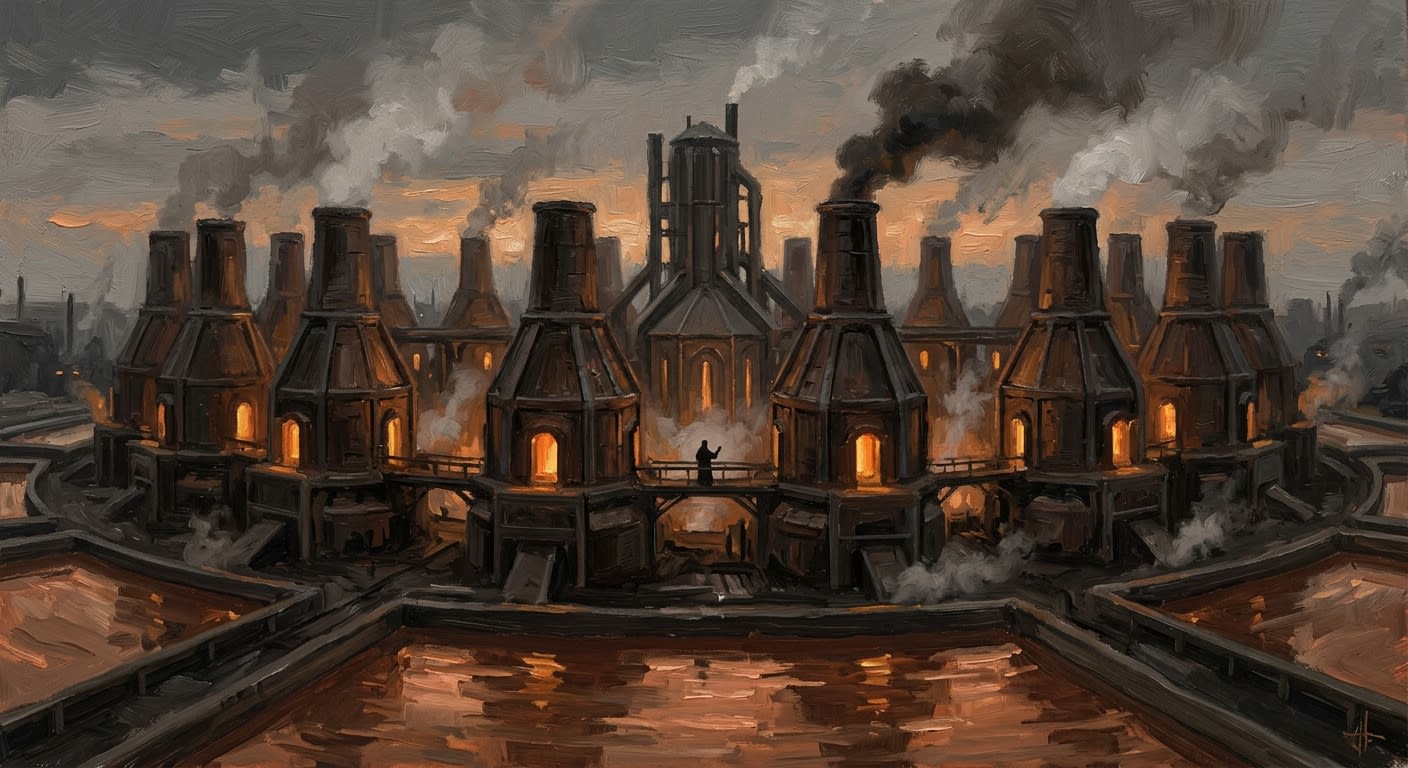
There exists in the military rear of the Synod's second zone a city that smells of prayer and burns like an engine. The Chrismole Furnaces of Brast — called The Warm City by those who depend upon it, Soot-Shrine by those who have breathed its air — is the single largest producer of sanctified fuel on the continent, and has been so since before the Concordat gave the Synod a name to stamp on what it had already seized.
The city's founding predates its own charter. In A.S. 68, three years after the Sagittal Line began its bloody solidification from the Baltic to the Bosphorus, a logistics officer of the nascent Bureau of War — unnamed in the Ledger, which means he was either incompetent or too useful to credit — requisitioned a rail junction at the confluence of three coal-seam rivers in the Heartlands fringe. His mandate: produce fuel sufficient to supply the forward artillery emplacements whose appetite for combustible material had already outstripped every civilian source west of the Rhine. His method: build furnaces. His theology: none whatsoever, which is why the Bureau of Doctrine was dispatched within the season.
The first furnaces were crude — brick kilns fed with peat, coal, and whatever the surrounding villages could be convinced to surrender. The fuel they produced was merely fuel. Cannons fired. Boilers heated. Trains moved. There was nothing sacred about it, and this, the Bureau of Doctrine determined, was a scandal of the first order. If the machines of war ran on fuel indistinguishable from that which heated a heretic's bathwater, then the war itself was indistinguishable from any secular enterprise, and the Synod's claim to divine mandate would rest on nothing more substantial than the self-serving pronouncements of powerful men.
Which it does, of course. But the pronouncements must be furnished.
By A.S. 72, the Bureau of Doctrine had dispatched a Cantor and fourteen choir-technicians to Brast with instructions to consecrate the distillation process. The result was chrismole — sanctified fuel, blessed at each stage of refinement by calibration hymns sung in precise cadences timed to pressure-bell schedules. The oil that emerged from the condensers was chemically identical to its unsanctified predecessor. The Bureau of Records certified it as "doctrinally distinct." The front-line commanders, who cared about trajectory and ignition temperature, did not argue. The chaplains, who cared about jurisdiction, argued extensively and lost.
By A.S. 76, Brast's chrismole was anointing treaty-stones at the Steppe Gate and lubricating gun-carriages at Bastion-Constantinople simultaneously. By A.S. 90, the year of the Concordat, the city had swallowed its surrounding villages whole and housed forty thousand souls. By the First Continental Levy of A.S. 110, that number had doubled, and the Bureau of War was training conscripts in Brast's catechism-barracks alongside those of Essen-of-Hymnsteel — boys of fifteen taught to sing before they were taught to shoot, because a cannon that has not been sung to is, per Bureau regulation, a cannon that has not been loaded.
The city today holds ninety-two thousand registered souls and an unknown number of unregistered ones — furnace feeders recruited from refugee columns, debt-bondsmen transferred from the Queue Road's minute-courts, and the particular species of drifter who gravitates toward places where warmth can be stolen and sold. The slag berms that ring the city rise forty feet above the surrounding flatland. The cooling ponds gleam copper in winter. The pressure bells mark the hours, and the hours belong to the Ordnance Bureau.
#On the Chrismole Crown and Its Rites
"The furnace does not care whether you believe. It cares whether you sing." — Choirmaster-Calibration Ilyra Kest, recorded testimony, A.S. 199
The heart of Brast is the Chrismole Crown — a furnace-cathedral complex of seventeen kilns arranged in a half-circle around a central distillation nave, each kiln vaulted in fire-brick and dressed in iron cladding that the Furnace Chapterhouse of Saint-Combust insists on calling "vestments." The air inside tastes of hot oil, incense, and scorched metal. The floor vibrates with a low harmonic that the choir-technicians attribute to the hymns resonating through the pipe-work and the Bureau of Engineering attributes to insufficient dampening in the primary condensers. Both explanations are correct. Neither faction will admit it.
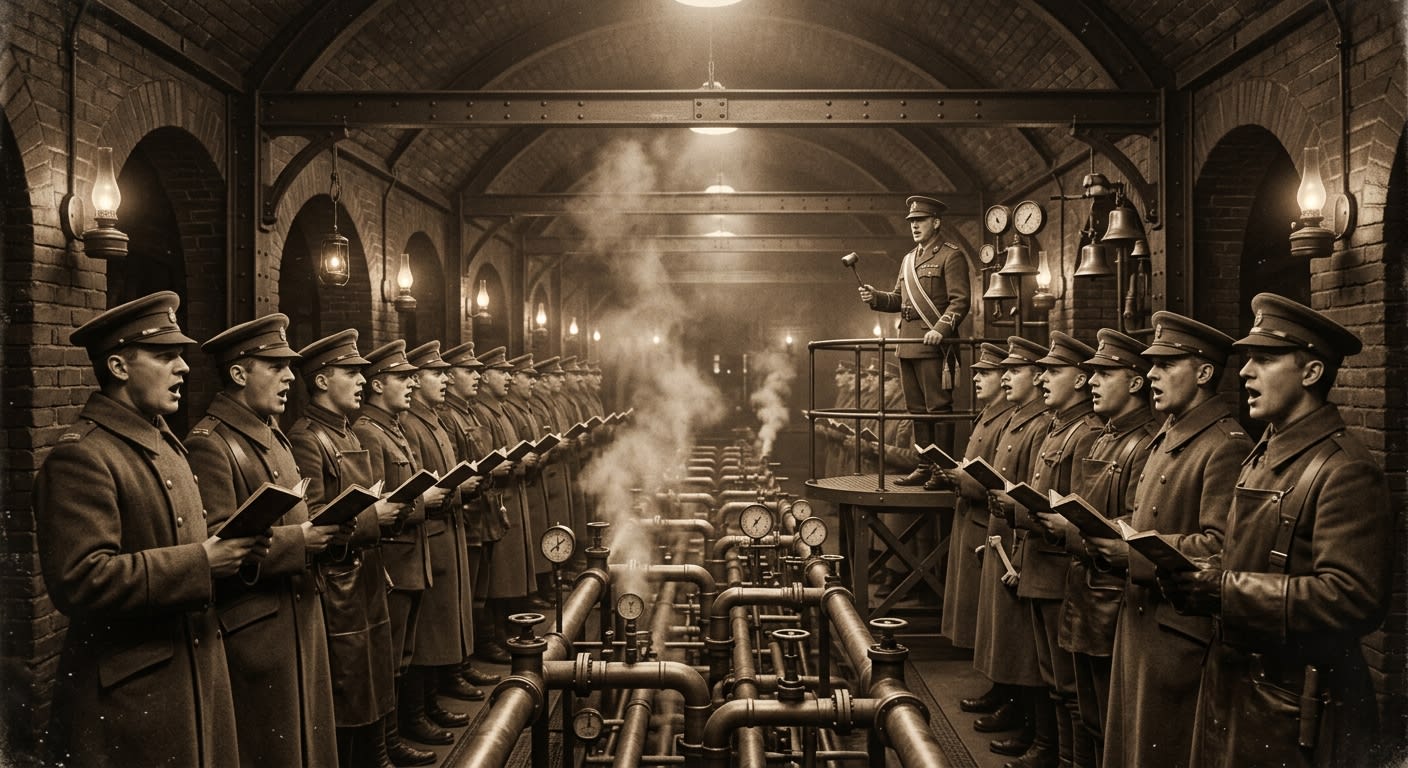
Chrismole production follows a seven-stage distillation cycle timed to the pressure bells. Raw feedstock — peat, coal, rendered tallow, and a component the Distillers' Compact refers to only as "the substrate" — enters the primary kilns at the first bell. Steam drives the volatile fractions into condenser lines that run through the Still-Canals, where canal water cools the pipes and the sweet-solvent smell of partially refined chrismole hangs permanent as fog. At the fourth bell, the condensate enters the sanctification nave, where a rotating shift of choir-technicians from the Calibration Choir sings the distillation hymn — a fourteen-stanza composition whose tempo must match the condensation rate to within three beats per minute. At the seventh bell, the finished chrismole is decanted into sealed drums, each drum stamped with a wax prayer that can be traced by scent across three provinces, and each drum entered into the Manifest Court's ledger under a serial number that the Bureau of Records can track from Brast to whatever gun-breech or boiler-plate it eventually feeds.
The system works. It has worked for a hundred and thirty years. The cannons fire true — or true enough. The boilers hold pressure. The trains run on schedules the Bureau of Bells has certified as "providentially aligned." And the front does not freeze, does not starve for ammunition, does not grind to a halt for want of fuel, because Brast's furnaces burn day and night and the choir never stops singing.
What the system does not do is explain why it works.
ERRATUM — Bureau of Doctrine, Filed A.S. 187 Previous editions of the Chrismole Distillation Manual (Seventh Revision) stated that "the hymn's sacred properties sanctify the fuel through divine resonance." This formulation has been withdrawn. The current approved formulation reads: "the hymn's properties, which are sacred, interact with the fuel through mechanisms that are doctrinally sufficient." The distinction is, we are assured, significant. The Bureau of Alchemical Standards has been asked to investigate and has declined.
#On the Districts and Their Hierarchies
The city radiates from the Chrismole Crown in spokes of rail line and pipe-alley, seven districts arranged in concentric rings of descending privilege and ascending particulate density.
The Gauge Ward sits closest to the Crown — calibration halls and instrument shops where the Calibration Choir maintains its monopoly on the hymn-frequencies that keep the machines obedient. Choirmaster Ilyra Kest presides from a glass-walled booth above the primary tuning floor. She has a scar across her throat that she does not explain. Her pitch is perfect. She has not spoken above a murmur in fourteen years. When she sings, valves open. When she stops, they close. The choir-technicians under her command number three hundred and twelve, each licensed by the Bureau of Doctrine and oath-collared by the Ordnance Bureau, and each capable of singing a boiler into compliance or a cannon into silence. Their cadence licenses are worth more than the buildings they sleep in.
The Boiler Commons houses the workforce — barracks, ration kitchens, shift-change bells, and the permanent smell of sweat, broth, and coal-dust that constitutes Brast's native perfume. Rent here is tied to shift-tempo; a furnace feeder who misses a bell-call loses warmth instead of wages, because heat allotment is deducted per infraction and a man who owes heat in Brast owes everything.
The Still-Canals run south of the Crown — condenser channels and lock-gates where the canal water that cools the distillation pipes has acquired, over a century of service, a faintly luminescent quality that the Bureau of Alchemical Standards classifies as "residual" and the canal-workers classify as "don't drink it." Guildmaster Pex Ruln of the Distillers' Compact controls the filters that keep the condensers functional. His hands are permanently oiled. He laughs only when the furnaces roar — which is always, so the distinction is academic.
The Rail-Manifest Quarter occupies the eastern arc — yards, cranes, dispatch offices, and the Manifest Court where Commander-Auditor Sorn Vale adjudicates the daily flow of sealed drums outward to the front and raw feedstock inward from the mines. Vale wears immaculate boots in a city where no boot stays clean past the second step. His audit authority extends to summary execution for fuel diversion. He has exercised it nine times in three years. The boots remain spotless.
The Ash-Hospice Row occupies the western arc, downwind of the Crown by deliberate and merciful design. The Ash-Hospice Sisters maintain the lung wards and confession booths where furnace workers whose breathing has become a medical event are treated with resin poultices, prayer, and a filing system that cross-indexes every confession against every accident report in the Ordnance Bureau's records. The Sisters' archive is, by some accounts, the most accurate document in Brast. The Ordnance Bureau's ledgers, by the same accounts, are the least.
And at the outermost ring, the Slag Market — scrap trade, black goods, and the particular commerce that accumulates in every city where something valuable must pass through too many hands before reaching its destination. Siphoned fuel changes hands here in bladders disguised as water-skins. Counterfeit drum seals are carved under scrap altars. Warm chits — the heat-credit currency that functions as Brast's true coin — are counterfeited with a precision that the Bureau of Records has privately described as "admirable, from a technical standpoint."
#On the Sulking of Engines
"If the cannon lies, someone lied first — find the liar and the barrel will behave." — Brast proverb
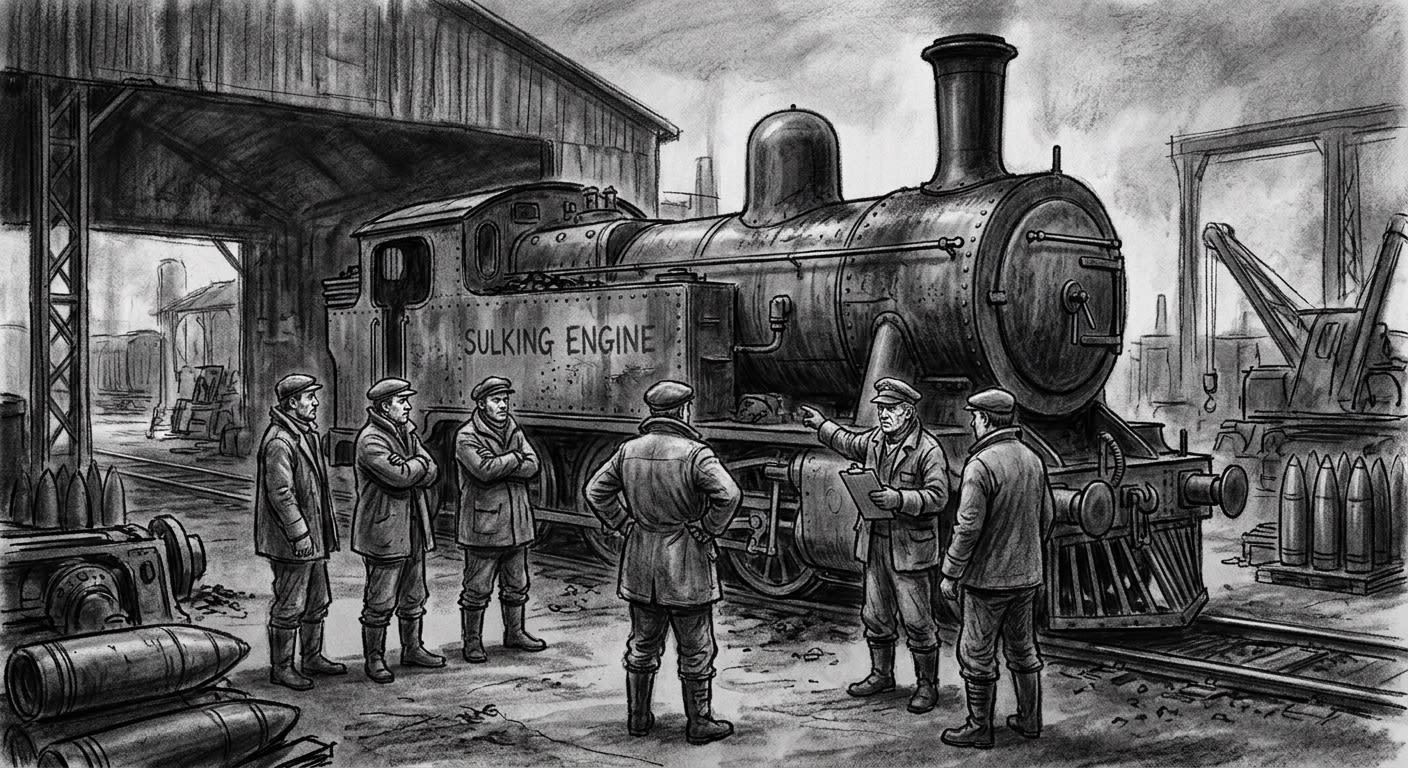
The machines of Brast are alive. This is heresy, and I will deny having written it. The Bureau of Doctrine classifies the phenomenon as "Sulking Engines — Category Two Localized Acoustic-Mechanical Disturbance" and considers the matter settled. The machines of Brast disagree.
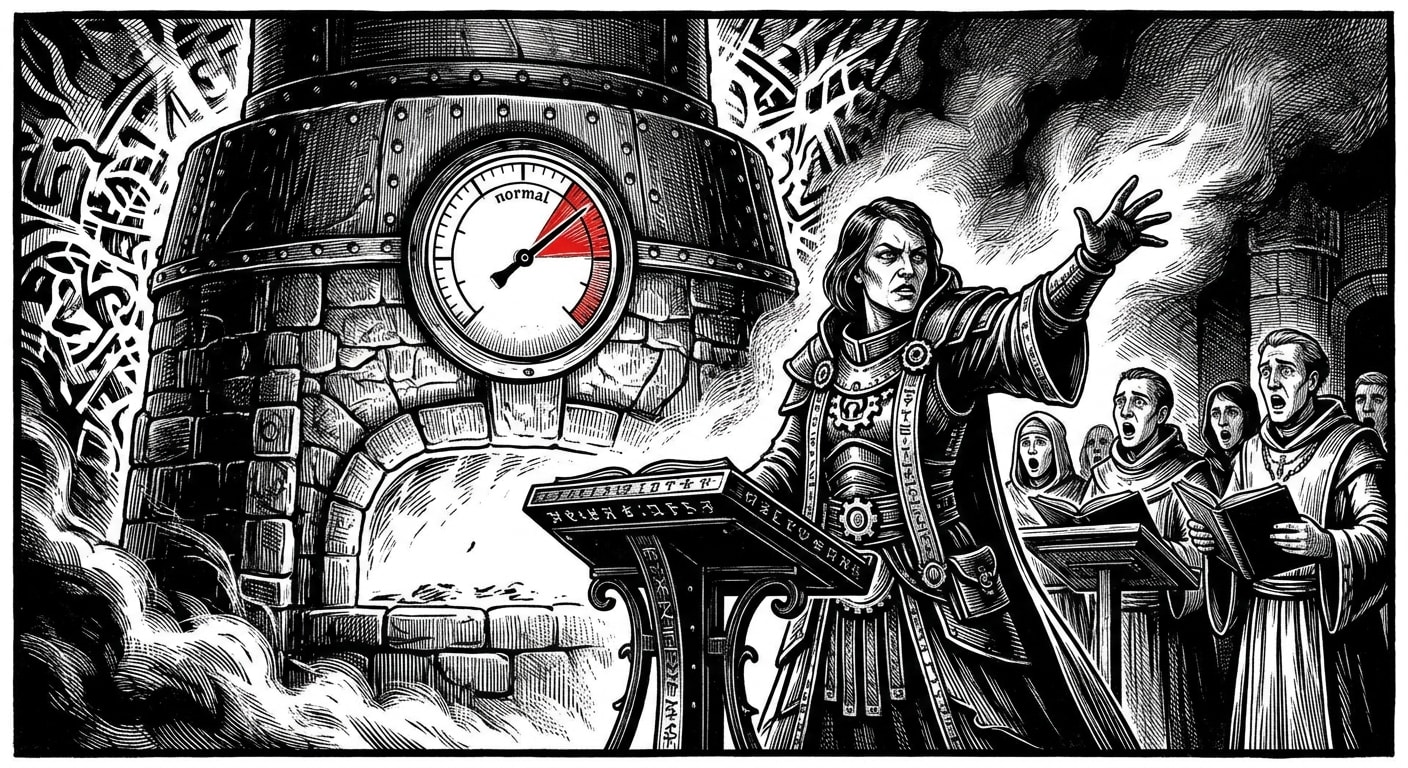
Valves stick in spite. Pressure gauges answer hymns with readings that bear no relation to the contents of the vessel they are measuring. Cannons calibrated by the Choir fire long, then short, then true, then long again, in sequences that the Bureau of Engineering has mapped and found consistent with resentment. Boilers hiss syllables. Trains stall mid-switch for durations that correspond, to the second, with the length of the hymn-stanza their crews omitted during the morning anointing. A cannon that has been sworn at will shoot crooked for a week. A boiler whose feeding crew has been replaced without ceremony will refuse to hold pressure until the new crew sings an introduction.
The Furnace Chapterhouse attributes this to divine animation — the machines, having been fed sanctified fuel and sung into obedience, have acquired a rudimentary spiritual awareness that demands proper liturgical treatment. The Bureau of Engineering attributes it to harmonic interference patterns in the pipe-work. The Calibration Choir attributes it to insufficient respect for their craft. Commander-Auditor Vale attributes it to superstition and has forbidden discussion of the topic under penalty of audit, which in Brast is a penalty second only to death and frequently indistinguishable from it.
The countermeasures are procedural: recalibration choruses sung at precise intervals, oil anointing of contact surfaces, silence protocols during shift transitions, and the replacement of any gauge found to be "cursed" — a designation that requires the joint signature of a choir-technician, a provost, and a priest, and which occurs with a frequency the Bureau's published statistics carefully undercount.
The misfire incidents have been rising. In A.S. 199, a cannon battery at Bastion-Przemyśl fed with Brast chrismole fired four rounds into a friendly rail junction, killing eleven and crippling a supply train. The Ordnance Bureau blamed sabotage. The Calibration Choir blamed degraded feedstock. The Distillers' Compact blamed the Choir. The guns, naturally, offered no testimony. The inquiry is ongoing. The inquiry will always be ongoing.
#On the Buried Economy of Warmth
In a city where the air outside the furnace-radius drops below freezing for five months of the year, warmth is not a comfort. It is currency. The warm-chit system — originally a rationing mechanism for heat allotment during the first winters of Brast's expansion — has metastasized into the city's true economy, operating alongside and frequently in defiance of the Ordnance Bureau's official coin-and-ration ledger.
A warm chit buys an hour of proximity to a heat pipe. Ten warm chits buy a shift in the Boiler Commons. A hundred buy a season's rent. A thousand buy passage on a manifest-train to the Heartlands administrative cities, three to four days west by rail, where the air does not taste of ash and the lungs do not calcify. The chits are printed by the Ordnance Bureau, distributed by shift-foremen, and counterfeited by everyone with access to a wax press and a steady hand.
The Warmth Thieves of the Still-Alleys (Unregistered) — a cartel that the Bureau of Shadows has documented in three separate dossiers and declined to suppress — operate the fuel-siphon network that bleeds sealed drums between the Manifest Court and the rail yards. A single drum of chrismole, diverted from the front-bound convoy and sold on the Slag Market, provides enough warmth to heat a tenement block for a month and enough leverage to buy a provost's silence for a season. The Warmth Thieves do not consider themselves criminals. They consider themselves the only honest brokers in a city where the Ordnance Bureau pretends that warmth is a right and then charges for it in confession hours.
[SEALED — NINTH RATIFICATION] The substrate component of Brast's chrismole feedstock has been the subject of ████████████ Bureau inquiries since A.S. ███. The sealed findings of the Bureau of Alchemical Standards (Report 7741-B, A.S. 194) confirm that the distillate contains trace ████████████ consistent with ████████████ origin. The machines respond to doctrine because ████████████████████████████████. This finding has been classified at Hierarch's Seal. The Furnace Chapterhouse of Saint-Combust has been informed. The Furnace Chapterhouse of Saint-Combust has not been surprised.
#On the Present Condition
Brast, as of A.S. 201, is a city running hot and cracking at the seams.
The misfire incidents continue. Seven drums disappeared from the Manifest Court's sealed inventory in the spring — seven exactly, a precision that Commander-Auditor Vale recognised at once as a message rather than a theft. Seven is the number of the Sin-Generals. Seven is the number of drums required to fuel a full cannon battery for a day. Seven is the number that says: we can reach the war whenever we choose. Vale has responded with audit sweeps through the Boiler Commons and Slag Market that have produced fourteen arrests, three confessions, and no drums. The drums remain missing. The message remains unanswered.
The Calibration Choir reports a new syllable appearing in the furnace harmonics during the night roar — a sound that no choir-technician has sung and no hymnal contains. Choirmaster Kest has recorded it on a wax cylinder and locked the cylinder in a Bureau-sealed vault. She has not told the Ordnance Bureau what the syllable sounds like. She has not told anyone. Her murmur, always quiet, has grown quieter.
The Ash-Hospice Sisters have documented a surge in fume-fever cases that does not correlate with any change in ventilation, feedstock quality, or furnace operation. The afflicted workers cough ash — this is normal. What is not normal is that the ash, when settled in the collection dishes, arranges itself into characters. The Sisters have cross-referenced these characters against the accident archive. The characters correspond to names. The names correspond to workers who died in furnace incidents. The names are spelled correctly. The ash has never been literate before.
The furnaces burn. The choir sings. The drums ship east, sealed in wax prayers and stamped with serial numbers, and the guns of the Sagittal Line fire because Brast's chrismole tells them to. The city's motto hangs above the Chrismole Crown in iron letters twelve feet tall: Sing it true, or it fails. The letters vibrate with the furnace harmonic. They have always vibrated. The choir-technicians say this is resonance. The furnace feeders say the letters are trying to add a word.
ERRATUM — Bureau of Records, Brast Administrative Office, A.S. 201 The population figure of 92,000 published in the A.S. 200 census has been revised to 92,000. The figure has not changed. The methodology has been corrected. The previous methodology counted the living. The current methodology counts the registered. The Bureau observes that these are, in Brast, increasingly different numbers.