
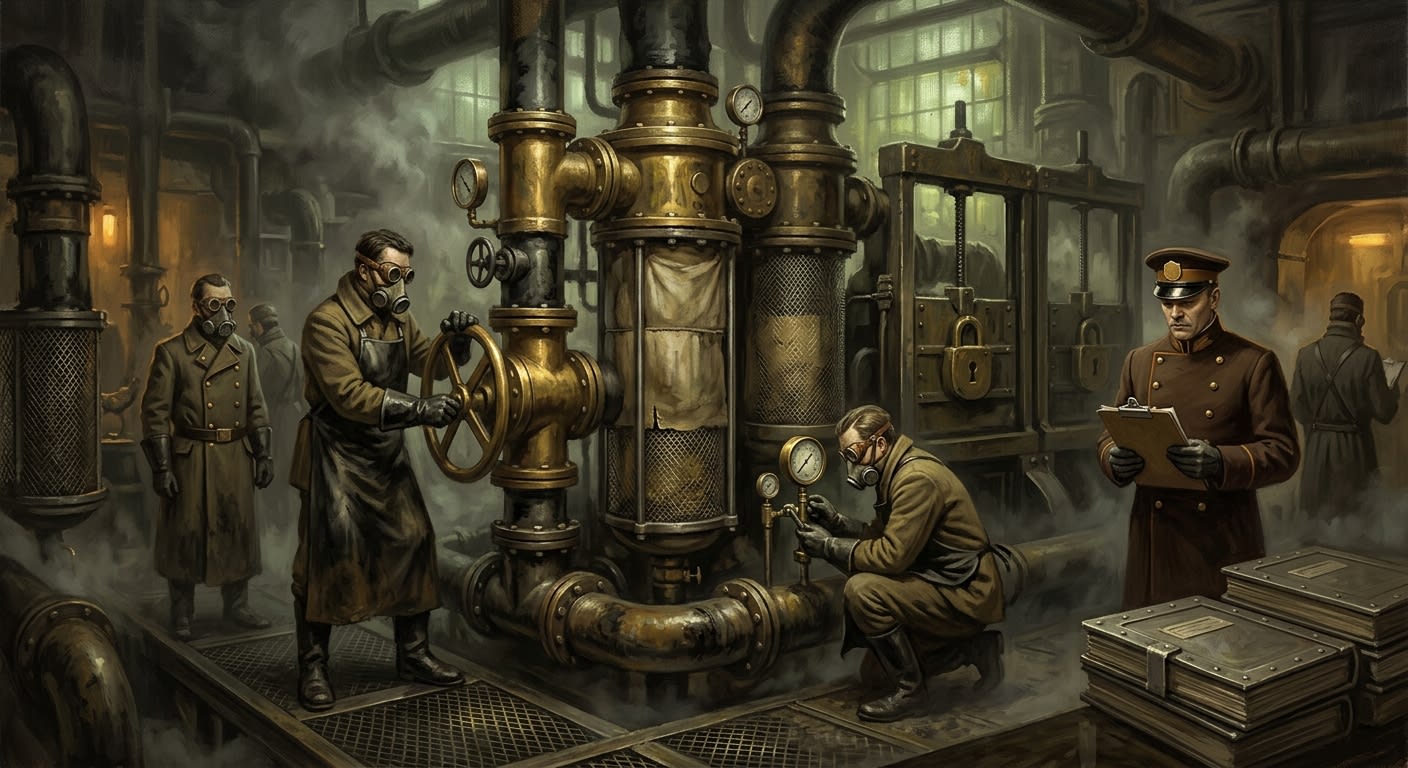
#On the Guild That Learned to Smell Sanctity
The Distillers' Compact began when the first Brast condenser fouled and every cleric present discovered, with edifying speed, that sanctity does not pass through clogged mesh. This was A.S. 72, the year the Bureau of Doctrine sent a Cantor and fourteen choir-technicians to the furnaces and declared ordinary fuel doctrinally distinct once sung over in the proper measure. The hymn made chrismole holy. The filters made it usable. The Compact was born in the narrow space between those two claims, which is to say in the one place where power grows fat.
Its first members were rag-boys, lock-turners, solvent handlers, residue scrapers, and pipe-men whose surnames vanish from the early ledgers because nobody important expected them to matter. They learned the seven-stage distillation cycle by inhaling it. Peat, coal, rendered tallow, substrate, steam-fraction, condenser sweat, fourth-bell sanctification, seventh-bell drum. A catechism of grease. A liturgy with burns.
By the time the Concordat ratified Brast under the Ordnance seal in A.S. 90, the Compact already controlled the Still-Canal locks, the filter stores, and most of the recipes nobody admitted were recipes. The Bureau filed them as auxiliary technical labour. The labour filed nothing. It kept the keys.
#On Filters, Locks, and the Monastery of Mesh
The public doctrine of the Compact is quality control. It keeps filters clean, stills sealed, flow measured, cooling sound, drums pure, and inspectors bored. Its private doctrine is monopoly. Every condenser screen in Brast carries a serial scratch known to the Compact before the Bureau of Records receives the invoice. Every Still-Canal lock has a keeper whose winter depends on guild favour. Every emergency screen rests in a drawer whose location may be forgotten for political reasons.
The Still-Canals (Unregistered) are not canals in the sentimental western manner, with boys throwing stones and women washing linen under painted shutters. They are condenser channels: black water, sweet fumes, iron walkways, wax-sealed sluice wheels, and long pipes sweating partially refined chrismole into troughs that steam even in frost. The canal workers call the water alive. The Bureau of Alchemical Standards calls it residual. The fish, being wise, left generations ago.
Ordnance memoranda define the Distillers' Compact as “replaceable specialised labour.”
Corrected for mechanical accuracy. Labour may be replaced. A fouled condenser respects neither optimism nor chain of command.
Compact apprentices begin as rag-boys, scraping residue from filter housings with bone-handled hooks while fumes teach them to weep without grief. Senior distillers learn which mesh may be turned, which mesh must be burned, and which mesh should be declared unavailable until the asking official has improved his tone. Master distillers learn the terrifying mercy of adjustment: how much bad feedstock can be rescued, how much spoiled flow can be hidden, how long a line may run hot before it sends its complaint to Bastion-Przemyśl as a misfired shell.
#On the Substrate
Raw feedstock enters the first-stage kilns as peat, coal, rendered tallow, and a fourth component the Compact calls the substrate. It says the word with priestly gravity and merchant caution. The word means: you may pay for this, measure this, fight over this, audit this, and die beside this, but you may not name it without permission from men whose hands shine like old varnish.
The substrate arrives before dawn in grey drums without maker's marks. They are weighed under hooded lamps, opened behind solvent screens, stirred with bone paddles, and poured into the first-stage charge before the pressure bells make witnesses plentiful. Two filter-men who cannot read stand guard. One clerk who reads too well records receipt codes in a book kept under the Canal South counting table. Pex Ruln holds the key. It is a small key, as large crimes often prefer small furniture.
Bureau of Alchemical Standards Report 7741-B, A.S. 194, confirms trace ████████████ consistent with ████████████ origin in refined chrismole. Compact receipt chain includes countersignatures from ████████████, Furnace Chapterhouse witness mark, and Ruln's hand. The oil on the page remains fresh after seven years.
The moral reader may now prepare a sermon. The useful reader will notice that Bastion-Constantinople does not freeze its gun crews when Brast's convoys arrive, that the Sagittal Line fires when fed, and that no bastion has ever been held by clean fingernails. The substrate works. This is the most damning evidence in its favour.
The Furnace Chapterhouse of Saint-Combust knows more than it admits. Its priests bless the grey drums without asking their origin, because asking would transform useful ignorance into punishable knowledge. The Calibration Choir suspects more than it can prove. Kest hears when a batch answers differently. Ruln hears invoices.
#On Quotas and Supply Strangulation
The Compact's weapon is not rebellion. Rebellion is noisy, romantic, and usually performed by people with insufficient heat. The Compact prefers quota. A lock inspection delayed by one bell. A replacement mesh declared unfit by smell. A condenser screen sent to the wrong gallery under a correct manifest. A still-cycle slowed because residue has thickened, though nobody outside the guild can say how thick residue may become before it acquires politics.
This is supply strangulation, Brast's gentlest form of extortion. A full strike would summon provosts. A slowed line summons committees. Committees bring paper, paper brings adjournment, adjournment brings winter, and winter brings Ordnance back to the Compact with better manners.
The A.S. 199 misfire year sharpened the weapon. A Brast-fed battery at Bastion-Przemyśl fired four rounds into a friendly rail junction: eleven dead, one supply train crippled, and enough institutional terror to heat a barracks. Ordnance blamed sabotage. Kest's Choir blamed degraded feedstock. The Compact blamed the Choir. The guns refused testimony and thereby showed the finest discipline in the room.
Since then, mesh stock has worn faster. Condenser residue has thickened. Sweet algae grows in lock corners shaped like scriptural punctuation. Three emergency screens installed in spring buckled within two cycles. Public notices say reserves are sufficient. The Compact has not declared a shortage. That silence is the shortage.
Brast civic notices state that filter reserves remain “adequate for sustained full production.”
It has always been the case that “adequate” means “capable of preventing panic until the next bell.” Panic is postponed. Mesh is not multiplied by postponement.
#On the Compact's Enemies
The Compact's first enemy is the Choir, because song humiliates material by commanding it. Ruln may feed the mixture, clean the lines, choose the mesh, hide the substrate, and own every practical compromise before fourth bell. Then Kest's Measures stand in the sanctification nave and the distillate becomes obedient under throats worth less than their licenses. The insult is unbearable. Worse: it is operationally necessary.
The Compact's second enemy is Commander-Auditor Sorn Vale, who believes every missing gallon conceals a culprit if one bleeds enough paper over it. Vale proceeds by column: weight against seal, seal against dispatch, dispatch against choir certification, certification against filter lot, filter lot against Compact issue, Compact issue against substrate receipt when Ruln permits the phrase to be written. At the line where numbers stop genuflecting, Vale summons men who discover that audit is a form of weather with teeth.
Its third enemy is the black trade: Warmth Thieves in the Still-Alleys, counterfeit seal-cutters in the Slag Market, quiet-hymn sellers, siphon crews, and black diesel men who claim engines cannot tell blessed chrismole from pit-filth if both burn hot enough. The Compact despises this claim for doctrinal reasons, commercial reasons, and the private reason that the engines sometimes agree.
The Compact's fourth enemy may be its own success. Its monopoly has lasted so long that every office in Brast mistakes dependence for order. When the filter-men cough, the front clears its throat. When the Still-Canals slow, the Line feels chill in its breeches. When Ruln smiles in a quiet room, men begin offering concessions before he asks.
#On the Present Chain
As of A.S. 201, the Compact holds Brast by mesh, lock, receipt, and fear. Seven sealed drums have vanished from the Manifest Court inventory. Vale has produced arrests, confessions, and no drums. Kest has sealed the night-syllable cylinder. Inquisitor-Mechanic Lux Thane Mire comes from Strasbourg with authority to test substance by heat, oath, resonance, insult, and methods redacted for the comfort of lesser readers. The Compact will receive him with clean ledgers, dirty hands, and enough partial truth to choke a tribunal.
Mire will ask about the filters. Ruln will answer about maintenance. Mire will ask about the substrate. Ruln will answer about classification. Mire will ask why the machines fed on Brast chrismole have begun to answer. Ruln will laugh only if the furnaces are roaring, which is fortunate, because they always are.