
#On the Theft Called Heat
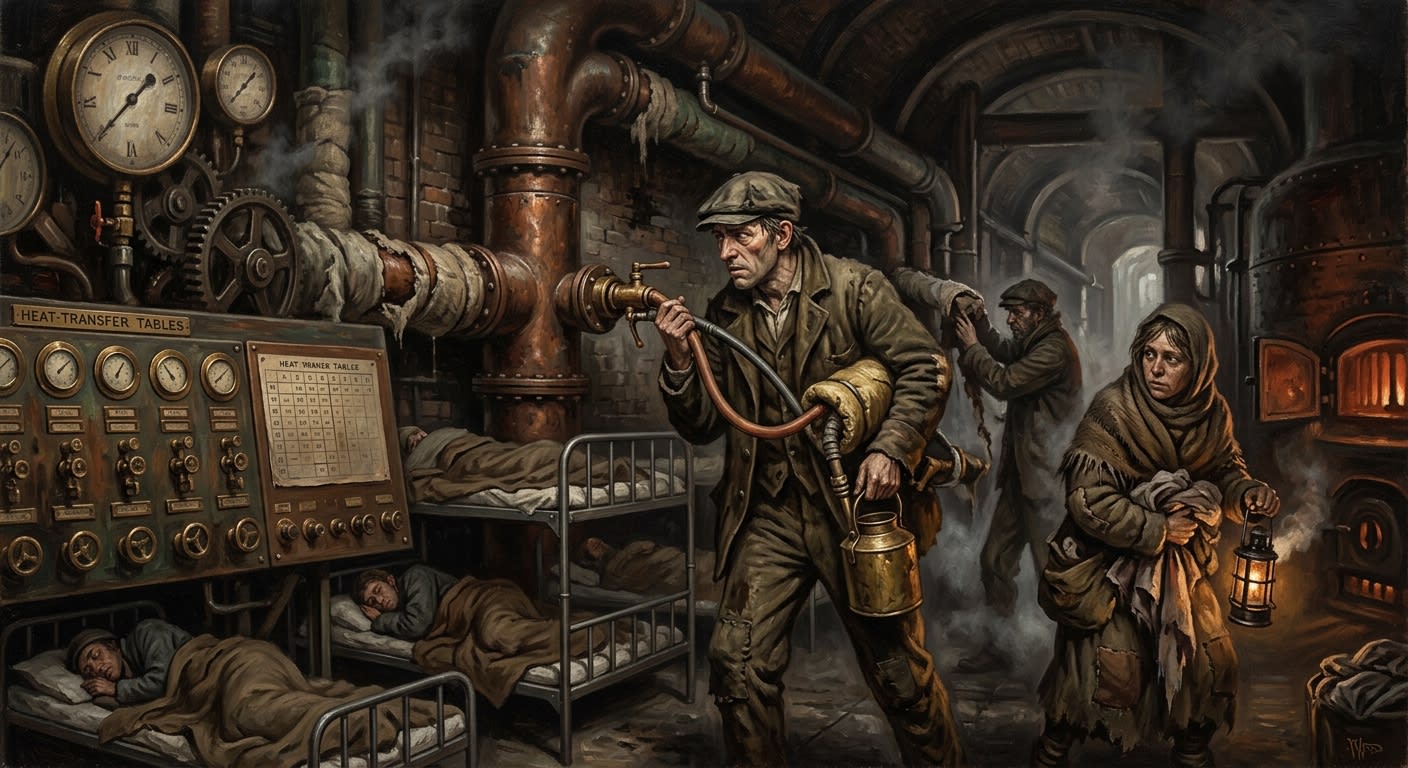
The Warmth Thieves of Brast are neither guild, fraternity, riot, nor single gang, whatever tidy little square the Bureau of Shadows has drawn around them this season. They are siphon crews in the Still-Canals, warm-chit counterfeiters in the Slag Market, pipe-tappers in the Boiler Commons, rail bribers along the Rail-Manifest Quarter, false hospice porters under ash-laundry carts, seal lifters, wick-line girls, widows with maps, and mothers whose theology has been reduced to a fevered child and a cold pipe.
Their unity lies in appetite for heat and hatred of official arithmetic. Brast calls them criminals because Brast cannot call them necessary without indicting its own heat allotment tables. The Synod sends official warmth eastward in sealed drums to feed guns, trains, treaty-stones, field boilers, and barracks full of men whom policy has decided deserve to remain unfrozen. The city that makes that warmth receives rationed proximity to pipes, warm chits measured by shift, and the privilege of coughing under notices explaining sacrifice. Between production and survival stands theft, wearing a vinegar mask and carrying a tallow-lined bladder.
A Warmth Thief does not steal warmth as metaphor. Spare me that sentimental slop. He steals chrismole, steam, pressure, pipe access, hot residue, kiln spill, furnace timing, warm-chit validity, and the minute during which a guard turns away because the Crown roars loudly enough to forgive sin. A stolen gallon may heat a tenement. A stolen spoon may warm a brick under a child’s blanket. A stolen drum may cripple a battery at Bastion-Przemyśl and kill eleven men whose names arrive later in settled ash.
#On the First Bladder and the Warm City
Brast created the Warmth Thief the moment it made heat taxable. The Chrismole Furnaces of Brast began in A.S. 68 as a coal-seam rail seizure and became, by A.S. 72, a doctrinal refinery where oil learned hymn and iron consented to kill on schedule. By A.S. 90 the place had been folded into Concordat order, sealed by Ordnance, blessed by Doctrine, counted by Records, and poisoned with the ordinary consequence of all four offices operating in one room: queues.
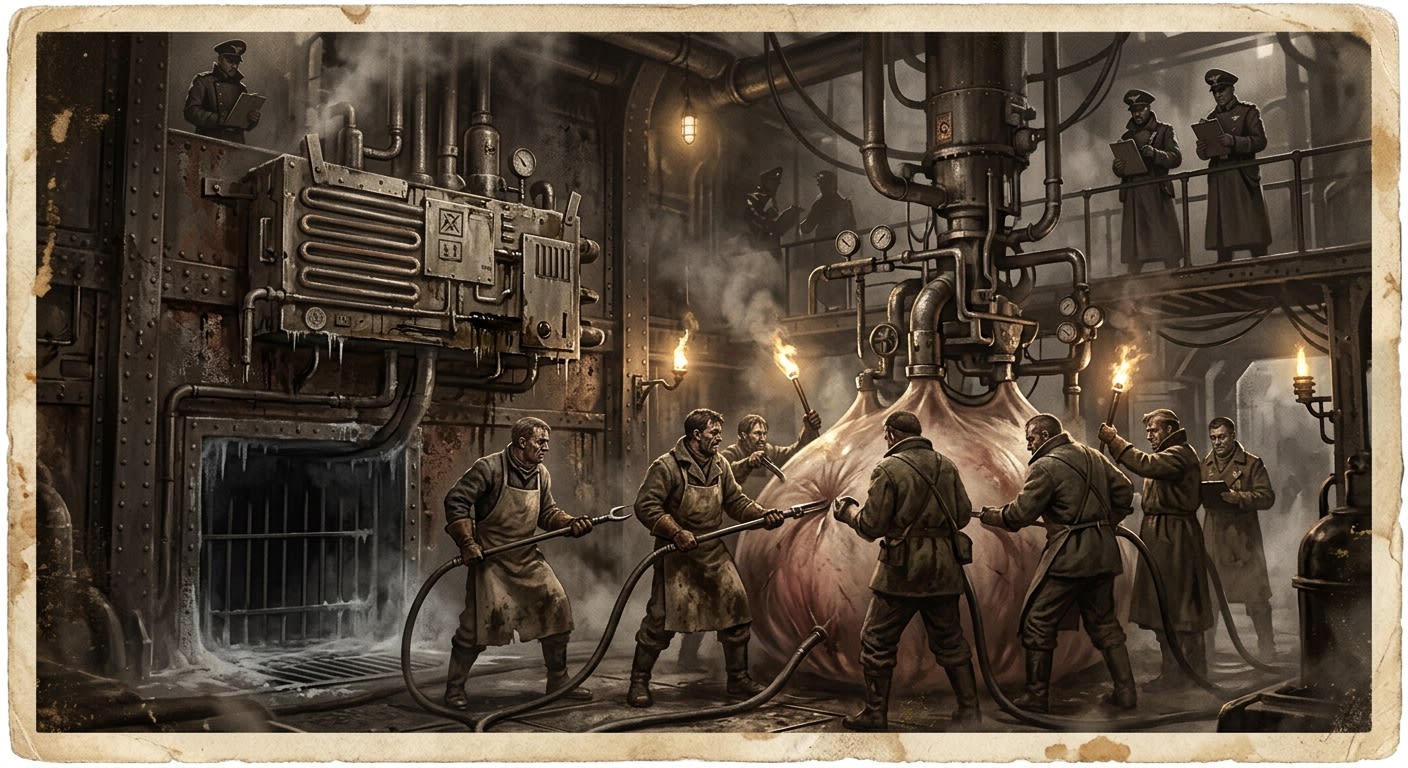
The first winter taught the lesson. Furnace workers slept near heat they could not own. Rag-boys scraped warm residue from housings that would have bought bread if residue had been lawful property. Widows watched pipe trunks cross streets toward officer rooms while their own walls furred with frost. The Heat Allotment Office called this distribution. Brast called it weather. Somebody drilled a condenser elbow with a brass worm and filled a bladder lined with tallow. No founding charter survives because founding charters are written by victors and the first thief was probably hanged, frozen, or hired by a better thief.
The warm-chit system made the trade literate. A chit bought an hour near a heat pipe, a shift in the Commons, a better bunk, or the beginning of a passage west. Chits were printed by Ordnance, distributed by foremen, hoarded by kitchens, counterfeited by anyone with wax, nerve, and a hand steady enough to imitate misery. Heat became paper. Paper became debt. Debt became routes. Routes became families. Families became silence.
The Thieves never needed a master. Cold recruits faster than any guildmaster and punishes disloyalty with admirable speed. The Still-Alleys supplied technicians; the Commons supplied clients; the Slag Market supplied tools; the Ash-Hospice Sisters supplied, by refusal to see, the mercy that made survival possible. The Furnace Chapterhouse supplied sermons, which were less useful but warmer when burned.
#On Tools, Routes, and the Etiquette of Siphoning
Their tools are small because hunger enters sideways. Brass worms thin enough to hide in boot soles. Rag clamps dipped in ash paste. Wick lines pulled through cracks and sucked like obscene rosaries. Skin bladders lined with tallow. Vinegar masks against sweet solvent. False residue pans. Warm bricks wrapped in hospice cloth. Wax seal lifters shaped from stolen prayer metal. Prayer scraps for burns, because even criminals prefer their blasphemy with paperwork nearby.
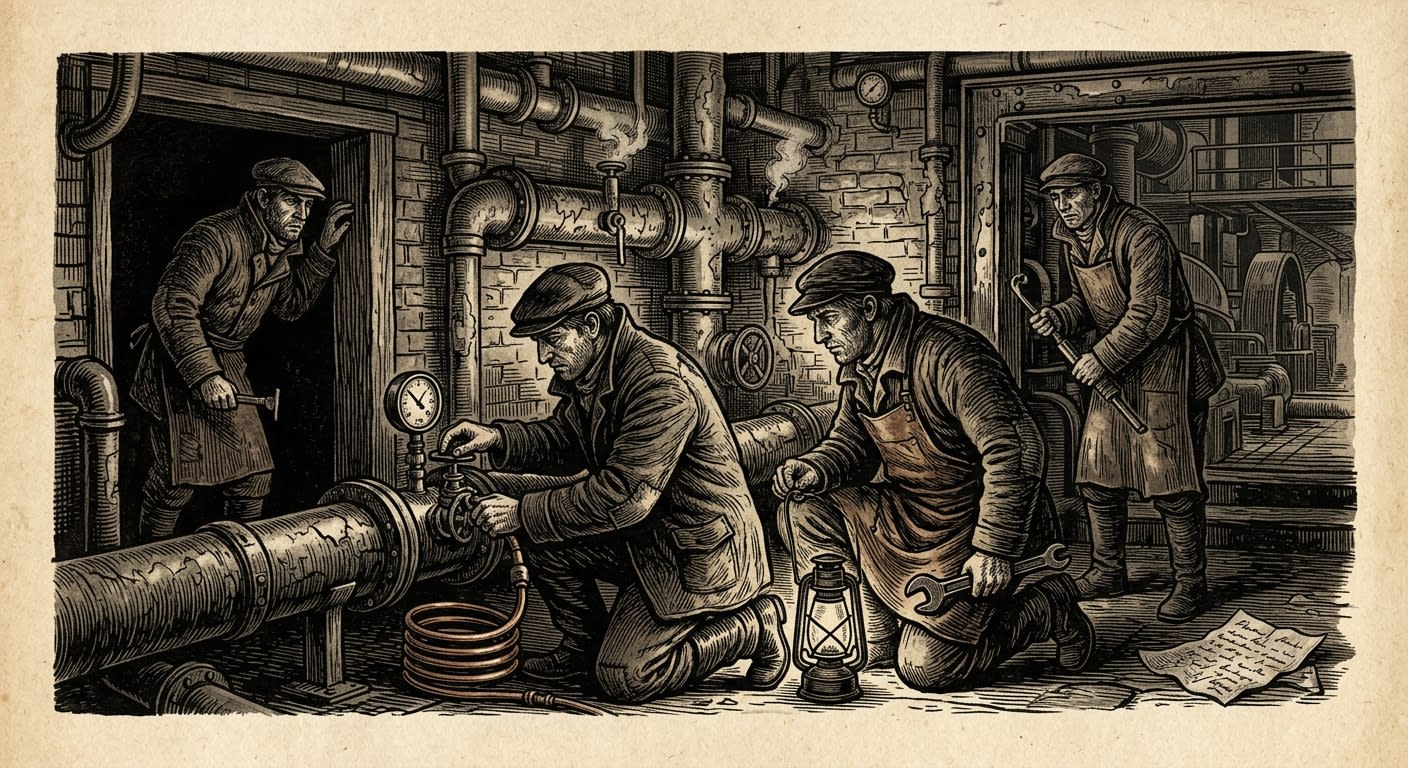
A proper siphon begins with listening. The thief listens to pressure bells, valve chatter, guard boots, choir cadence, and whether the pipe has begun that low inward knock which means the distillate is moving thick and hot. Too early, the line is watched. Too late, the valve cools. During furnace roar, everything is possible until the roar changes syllable. The thief drills, bleeds, plugs, wipes, warms the bladder under his coat, and leaves no wet shine for line auditors to smell. Bad thieves leave scent. Good thieves leave doubt. Masters leave an official variance explanation in another office’s handwriting.
Routes run through under-locks, pipe tunnels, ash-laundry carts, kitchen bottoms, widow sledges, roof crawlways, and the warm crawl beneath the Rail-Manifest bridge where small children learn to hold breath while carts pass overhead. The Thieves call this the lower map. Records does not possess it. Ordnance possesses three inaccurate versions. Sorn Vale possesses enough fragments to frighten fools and enough ignorance to keep wiser men employed.
The etiquette is severe. Do not tap a pipe feeding a hospice ward unless the Sister has marked the slack hour in chalk. Do not sell hot bladder to a drunk boiler-man unless his wife signs receipt. Do not move a child runner after third bell without someone watching the north stairs. Do not hum a quiet measure near a stolen drum unless Kest’s listeners are farther than bell range. Do not betray a route for coin when broth will expose the hunger more accurately. The rules are not noble. Noble rules do not survive under hot pipes. These survive because breaking them kills trade.
#On Markets, Customers, and Dirty Mercy
The Thieves sell where lawful warmth arrives late. A widow may buy one bladder for freeze-night and pay with a wedding spoon. A hospice child may receive a warmed brick paid for by three orderlies who would deny the purchase under oath because oath has never cured fume fever. A foreman with bad books may buy illicit pressure to complete quota and blame efficiency. A kitchen supervisor may keep soup hot past ration hour. A provost may warm his own barracks with stolen chrismole, then arrest a boy carrying lamp heat in a cabbage basket. This is not hypocrisy. Hypocrisy requires embarrassment.
The market tariff is understood without posted board. One bladder: a room through hard frost. Two: a fever child. Three: a foreman’s silence. Five: a false western departure. A full gallon: negotiation under witness chosen for poor memory. A sealed drum: politics, murder, or miracle. The seven drums that vanished in A.S. 201 sit above all prices like a saint’s skull above a chapel door: proof that somebody once crossed the line and survived long enough to become everyone’s problem.
Records memoranda classify Warmth Thief trade as principally anti-military contraband.
Clarified. Much of it is domestic, medical, marital, funereal, culinary, and pathetic. The military portion becomes visible because guns complain in reports. Children complain in coughs, and coughs file badly.
The Ash-Hospice Sisters condemn the trade at morning sermon and buy illegal resin by noon. This is not a charge against them. It is an endorsement. Medicine under the Synod has never been permitted the vanity of cleanliness. A Sister who lets a child freeze because the heat came through an unlawful bladder has mistaken law for the Creator, which is common in the capital and fatal near pipes.
The Furnace-Hardliners use the same channels and despise the Thieves as sentimental. They move engine-grade heat to kitchens, pumps, ward generators, and guns. The Thieves move cup heat, bunk heat, child heat, fever heat. The distinction is measured in burns, money, and mourning. A Hardliner refuses a household job because the pressure value is low. A Warmth Thief takes it because his sister sleeps in that block. This is why Hardliners survive longer and receive colder funerals.
#On Quiet Hymns and the Temptation of Obedient Fuel
The Warmth Thieves began by stealing heat. They became dangerous when they began buying sound. A stolen bladder warms a room; a stolen measure persuades a machine that room possesses authority. That is the step from crime into doctrine, and Doctrine dislikes competition from people with soot under their nails.
Quiet hymns reached the Still-Alleys from failed choir apprentices, Compact workers who felt flow-rhythm in their hands, and black diesel men whose gutter fuel burns hot enough to shame respectable drums while refusing polite obedience. The fragments are sold as valve phrases, condenser lulls, pressure calmings, line-start murmurs, half-stanzas, tap patterns, and breath marks scratched onto slate. Most are frauds. One true fragment is enough to open a closed line, calm a stolen boiler, teach black diesel a hymn, or persuade seven missing drums to burn for someone else’s gun.
Ilyra Kest understands this better than Orison. Money embarrasses the Calibration Choir. Music mutinies. A false warm chit steals ration order; a leaked measure teaches iron that the Gauge Ward is optional. Kest’s listeners buy fragments in the market, burn some, seal some, and let some circulate as bait to learn which engines answer. It is cruel work, which means it resembles all competent containment.
The A.S. 201 night-syllable turned the trade rabid. The wax cylinder rests in Vault Brast-4; counterfeit versions appeared within weeks, scratched onto slate, hummed through tin pipes, encoded as tool taps, sold folded into paper like devotional charms. A seizure in Ashmonth produced no audible tone and moved Pressure Gauge C-19 from black to amber without line contact. The seller was not recovered. Brast calls this rumour because rumour is the only coffin large enough for facts with missing bodies.
SLAG MARKET SEIZURE — ASHMONTH A.S. 201 Object: slate fragment, six tap-marks, one breath notation. Test: authorised choir-technician, no audible output. Result: Gauge C-19 shifted black to amber; technician wrote █████████ on table with burnt finger. Disposition: Vault Brast-4. Seller: not recovered. Warmth Thief notation on reverse: “do not sell to men with clean boots.”
#On Vale, Ruln, and the Three Ways of Being Hunted
Sorn Vale hunts Warmth Thieves as a man hunts missing arithmetic. He dislikes the mess of them: too many motives, too many widows, too many children with excellent routes, too much mercy clinging to the contraband like ash to wool. His Manifest Court wants named culprits because named culprits make missing gallons satisfy ledgers. A thief becomes a red line, a charge, a rope, a corrected column. An office shortage becomes weather, pressure, variance, and the usual mild cough of authority escaping itself.
Vale’s audits are weather with boots. The bell rings. Gates close. Clerks flatten hands. Children vanish upward. Warm bladders drop into ash pits. Seal presses become soup boards. Wax Aunties knit in public with hands that have just hidden a felony. Provosts enter and find enough sin to justify their salaries. They do not find enough to freeze the city’s lower half. Vale is brutal, not stupid.
Pex Ruln hunts them differently. The Distillers’ Compact hates poor technique more than theft. A bad tap ruins pressure, exposes routes, and insults the mesh. Ruln’s men break fingers when a line is wounded stupidly. They buy stolen filter fragments when buying them officially would confess need. They hire thieves, betray thieves, shelter thieves, and call all four actions maintenance. Ruln’s left-sided smile has purchased more silence than Vale’s gallows, which proves only that fear has several currencies.
Kest hunts them by listening. Her concern is not the bladder but the breath beside it. If a thief steals heat and sells it, Ordnance may flog him with my blessing and its own pleasure. If a thief sings to stolen fuel and the fuel answers, every licensed throat in Brast has been mocked by a gutter. Kest’s agents stand near kettle-wire stalls, soup benches, toy-seller carts, and children’s lid games, pretending to price rubbish while hearing whether the illegal measure has learned a second line.
Purity, naturally, prefers spectacle: public burnings, shaved heads, children displayed beside confiscated slates. The Thieves prepare sacrificial inventories for them — bad seals, dead chits, spent bladders, hymn scraps composed to offend inspectors while revealing nothing. A Purity officer who mistakes these boxes for success writes a confident report. Confidence rises like smoke. It leaves soot on everyone else.
#On the Seven Missing Drums
Seven sealed drums vanished from Manifest Court inventory in spring A.S. 201. Fourteen arrests produced three confessions and no drums. This ratio is not failure in Brast; it is preliminary theatre. The vanished drums had scent trace, pressure memory, fibre inclusion, prayer pattern, and serial impression. To move one required rail access, false manifest, silence corridor, bribed weighmen, compromised seal table, and Compact blindness rented at catastrophic rates. To move seven required either a conspiracy or a process so lawful that nobody recognized the theft until the paperwork had saluted it.
The Warmth Thieves deny involvement with impressive sweat. Their denial may even be true in the dull sense. No single Still-Alley crew could carry seven drums through the city without turning half the under-locks into witnesses. The more frightening possibility is that the Thieves supplied pieces: one route, one seal, one warm chit batch, one quiet hymn, one child runner, one hospice cart, one borrowed gate minute. A city does not steal seven drums by lifting. It steals them by agreeing, briefly and profitably, to look at different walls.
An Ordnance field bulletin states that Warmth Thief networks are “the probable central actors” in the seven-drum disappearance.
Corrected for adult readers. They are probable instruments, possible witnesses, convenient sacrifices, and certain beneficiaries of the panic. Central actors wear better coats.
The missing drums changed the lower city. Informants multiplied. Knife prices rose. Warm-chit brokers stopped counting in public. Three stall families vanished from Little Amber. Mother Brann, a counterfeit seal-maker, had her thumbs broken by persons unknown and then was arrested by persons official, a sequence that shows admirable interdepartmental rhythm. Warmth Thieves now refuse new partners unless vouched by blood, debt, or shared arrest. Children run higher. The under-locks smell of fear and heated tallow.
A dangerous rumour attaches to the drums: they knock from inside storage that does not contain them. Bridge scales have recorded weight for absent loads. One boiler in the Commons cleared its throat when a child tapped seven times on a kettle lid. Kest forbade three throat-warm exercises near sealed fuel. Ruln cleaned receipt caskets without opening the dangerous ones. Vale polished his boots. Each action speaks confession in its native dialect.
#On the Present Use of Useful Criminals
As of A.S. 201, the Warmth Thieves remain hunted, hired, cursed, imitated, needed, and blamed in advance. Brast cannot suppress them without freezing the poorer half of its labour body. It cannot tolerate them without bleeding sanctified war capacity into private hands. It cannot license them because a licensed thief becomes an office, and Brast already has enough offices stealing with forms.
Mire approaches from Strasbourg. The city prepares itself as guilty cities do: cleaning cheap crimes, hiding costly ones, teaching loud sinners to take blame, moving real tools three alleys down. The Thieves have buried brass worms beneath Scrap Altar plates, moved bladder stores into hospice laundry, shifted silence-token dies into Filterbone Row, and stopped selling quiet hymn samples aloud. Their restraint is praised by nobody, which proves its seriousness.
The Bureau will arrest them. The Bureau will buy from them. The Bureau will deny both purchases in adjacent paragraphs. Meanwhile the furnaces burn, the pipes sweat, the Commons coughs, the Slag Market counts in tin tokens, the Still-Canals hide small gods of heat in bladders under coats, and children sleep beside stolen warmth with their hands wrapped around bricks that began the day as military property.
At midnight, when the Crown roars loud enough to cover prayer, a thief kneels beneath a pipe with a brass worm between his teeth. Above him, sealed drums roll east for the guns. Beside him, a hospice child breathes badly through a wall. He taps once for pressure, twice for luck, and once more because something inside the pipe taps back.