
#On the First Fourteen Throats
The Calibration Choir of Brast began as an embarrassment. In A.S. 68, when a nameless logistics officer requisitioned the coal-seam rail junction that would become the Chrismole Furnaces of Brast, the first furnaces produced fuel without sanctity. Cannons fired. Boilers held. Trains moved. The arrangement possessed every practical virtue and no theological furniture, a nakedness the Bureau of Doctrine found intolerable once it had finished noticing the useful parts.
By A.S. 72, Doctrine had dispatched one Cantor and fourteen choir-technicians to Brast to consecrate the distillation process. They sang over peat, coal, rendered tallow, and the unnamed component now called substrate. The resulting oil was chemically unchanged, doctrinally distinct, and politically rescued. This is the cleanest origin any Bureau could wish: a practical seizure made holy by rhythm, then ratified once everyone had forgotten the theft.
Those fourteen throats became the seed of the present Choir, now three hundred and twelve licensed choir-technicians under joint Doctrine and Ordnance cadence authority. Their office lives in the Gauge Ward, closest to the Chrismole Crown, where seventeen kilns burn in their iron vestments and the pressure bells divide labour into intervals short enough to be obeyed. They are called Kest’s Measures in the city, which is both tribute and warning. A measure may soothe. A measure may also sentence.
#On the Fourth Bell
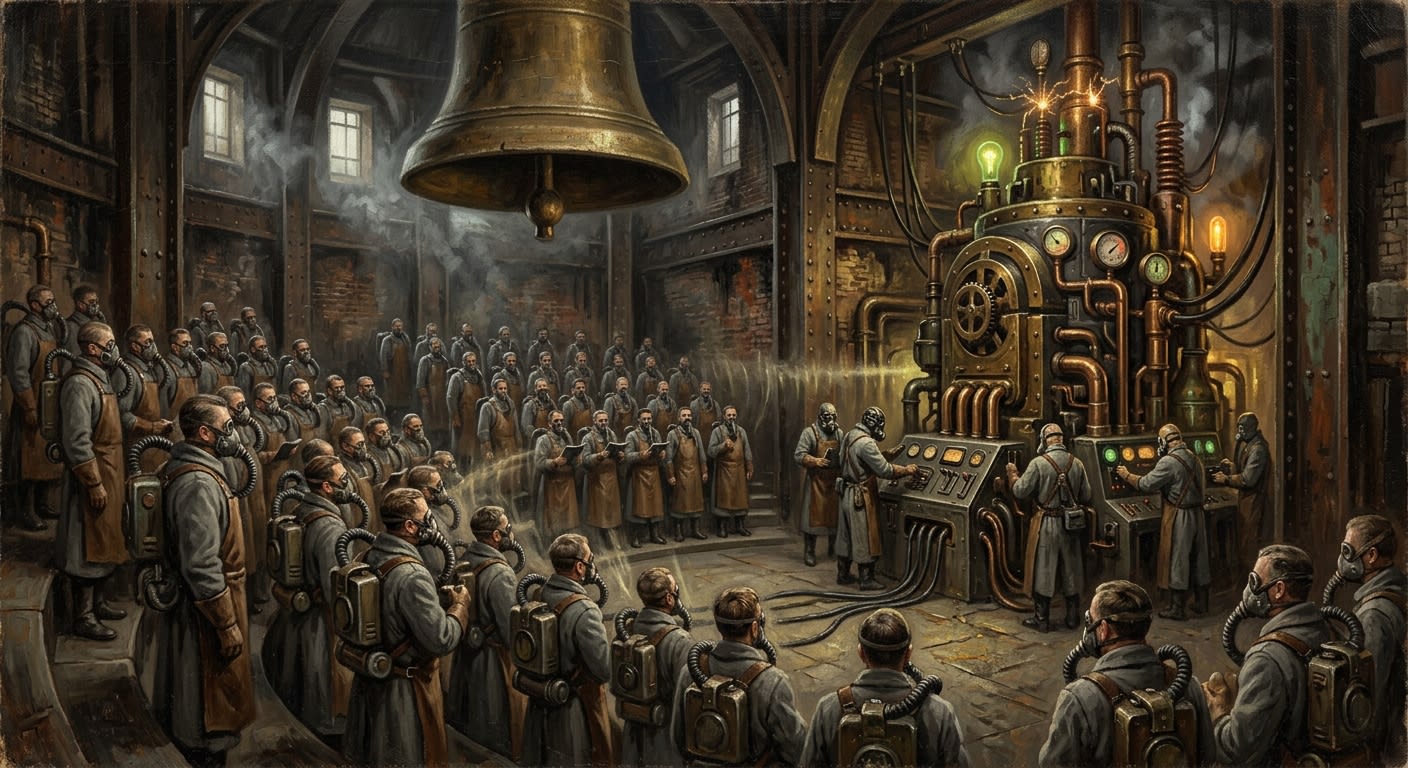
At the fourth bell of every distillation cycle, the raw condensate enters the sanctification nave (Unregistered). The Choir stands at marked spacing on the tuning floor, throats warmed with bitter oil, hands behind backs, eyes on the tempo rail above Ilyra Kest’s glass-walled booth. The fourteen-stanza distillation hymn must match the condensation rate within three beats per minute. A lag spoils fuel. A rush stresses lines. Silence instructs the machines in disobedience, and the machines have already acquired too much education from their betters.
The Choir’s labour is neither performance nor prayer, though visitors from Strasbourg often confuse all three and deserve the confusion. It is work: breath counted against pressure, vowel set against gauge tremor, consonant clipped to valve-click, cadence adjusted when the furnace sulks and the condensate thickens like bad conscience. A choir-technician who sings beautifully and late is useless. A cracked-voiced woman who lands the third syllable exactly as the pressure needle touches amber may feed a bastion.
Ordnance primers describe the Calibration Choir as “ritual accompaniment to distillation.”
Corrected for survival. Accompaniment may be omitted at supper. The fourth-bell hymn may not be omitted unless one wishes to explain to a cannon battery why its fuel has acquired opinions.
The public doctrine says the Choir prevents accidents. The private doctrine says the Choir controls machines by controlling songs. Both claims are true, a vulgar luxury. The Choir can sing a boiler into compliance, a cannon into silence, a valve into obedience, and a shift foreman into terror. Its cadence licenses are worth more than the rooms its technicians sleep in. Their bodies remain cheaper. This, too, is normal arithmetic.
#On Licenses, Taxes, and the Price of Breath
Cadence in Brast is property. The license books exist in triple custody: one copy under Doctrine seal, one under Ordnance seal, one in the Gauge Ward Hall with corrections in Kest’s cramped hand. The third copy matters, because it knows who can actually sing during pressure rise. The other two know who ought to be able to sing, which is the sort of knowledge that kills clerks first and workers second.
A license grants a throat the right to touch machinery through sound. It also grants obligations: fourth-bell attendance, emergency silence duty, night-harmonic watch, oath-collar maintenance, and refusal of unsanctioned melody under the Bureau of Orison and Song codes. The collar is not ornamental. It records pulse, pitch break, and forbidden variance. It tightens when a singer strays too far from authorised measure. It can be unlocked by Kest, by Ordnance, or by a doctor after death.
Corruption follows the licenses like soot follows flame. Quiet hymns are sold in the Slag Market, usually by failed apprentices with good memories and poor prospects. Emergency silence slips have been forged twice and punished seven times, which tells the observant reader that five people were punished for theatre, deterrence, or clerical appetite. Rival workers buy fragments of measures to coax private boilers through winter. The black diesel men dream of acquiring a proper hymn. If they do, Brast will denounce them at dawn and imitate them by dusk.
Kest tolerates corruption only when it preserves function. A falsified attendance sheet earns punishment. An unauthorised measure that saves a line may earn censure and promotion in the same breath. She is brutal because the furnaces are brutal. Mercy in the Gauge Ward must be timed, and mistimed mercy bursts pipes.
#On Kest’s Measures and Their Enemies
The Choir’s true government is Kest’s murmur. She has not spoken above that murmur in fourteen years, after an injury Brast explains through nine rumours and the Bureau explains badly. When she raises one finger, technicians stop. When she tilts her head, gauges settle. When she sings, valves open. The Choir’s loyalty to her precedes the paperwork that claims to create it.
Pex Ruln hates the Choir because it owns the moment his clean mixture becomes obedient chrismole. He controls filters, Still-Canal locks, substrate receipts, emergency mesh, and every dirty practical step before sanctification. Then the Choir sings, and his materials must answer to people whose hands are clean enough to offend him. His sabotage comes in flow rates, residue thickness, and emergency screens that buckle at instructive times.
Sorn Vale distrusts the Choir because notes resist execution. He can hang a seal-forger, immure a siphon clerk, and process a missing gallon through the Manifest Court until the ink reeks of obedience. He cannot punish a wrong syllable unless Kest names it false. This has made him courteous. Courtesy from Vale is a knife wrapped in paper.
The Furnace Chapterhouse of Saint-Combust claims the Choir as liturgical auxiliary and is wrong with confidence. The Ash-Hospice Sisters claim the Choir as a medical hazard and are right with insufficient budget. Orison claims jurisdiction over all licensed cadence and arrives with forms. Engineering claims the pipe-work produces harmonic interference patterns and arrives with instruments. The machines claim nothing. They sulk, which is a stronger brief.
#On the Misfire Year
The A.S. 199 Przemyśl battery misfire made the Choir dangerous in writing. Four rounds, Brast chrismole, a friendly rail junction, eleven dead, one crippled supply train, and a conference table thick with lies. Ordnance blamed sabotage. The Distillers’ Compact blamed the Choir. The Choir blamed degraded feedstock. The guns maintained perfect dignity by offering no testimony.
Kest’s recorded sentence has entered Brast’s working scripture: “The furnace does not care whether you believe. It cares whether you sing.” Doctrine dislikes it. Ordnance dislikes it. Furnace workers repeat it because truth travels best in short blasphemies. The sentence also exposed the Choir’s central heresy-adjacent power: cadence can matter more than belief, and matter can answer cadence before doctrine has finished approving the verb.
Vault Brast-4 contains the wax cylinder preserving the new night-syllable reported by the Choir during A.S. 201 furnace harmonics. First playback produced ████████ in the left ear, pressure reversal in three lamps, and condensation forming █████████ on Gauge Twelve. Kest stopped the cylinder by raising one finger. The machine obeyed late.
Since the misfire year, the Choir’s watch duties have doubled. Night-harmonic shifts listen for additions to the hymn. Furnace feeders report boilers hissing introductions back at new crews. Pressure needles tremble when unlicensed men hum near the rails. The Sulking Engines remain Category Two in the public file, Amber in the review copy, and something worse in the lungs of everyone who sings near them.
Bureau of Engineering correspondence states that the Choir’s claims regarding responsive machinery remain “unproven.”
It has always been the case that “unproven” means “observed by insufficiently expensive witnesses.” The gauges continue to answer.
#On the Rival Chorus
The Choir’s trigger crisis, filed but not yet rung aloud, is the emergence of a rival chorus. No faction admits founding it. Ruln denies training filter-men in private cadence. The Warmth Thieves deny selling quiet hymns that teach stolen fuel to burn without official blessing. Orison denies that Essen’s Mirror Choir cells have smuggled altered stanza sheets into Brast. The denials sit beside one another in the file like three corpses pretending not to share a grave.
A rival chorus would not need to replace Kest’s Measures. Replacement is fantasy for men who have never maintained a furnace. It would need only one narrow competence: opening a line the licensed Choir has closed, calming a stolen boiler, teaching black diesel a hymn, or persuading seven missing drums to burn for someone else’s gun. Brast’s entire order rests on exclusive obedience. Shared obedience is civil war with better acoustics.
Lux Thane Mire has been dispatched from Strasbourg with authority broad enough to offend every office in the city. He will test gauges, receipts, throats, substrate, and excuses. The Choir will stand at fourth-bell spacing when he arrives. Kest will murmur. The machines will behave or reveal their manners.