

#On the Table Under the Awning
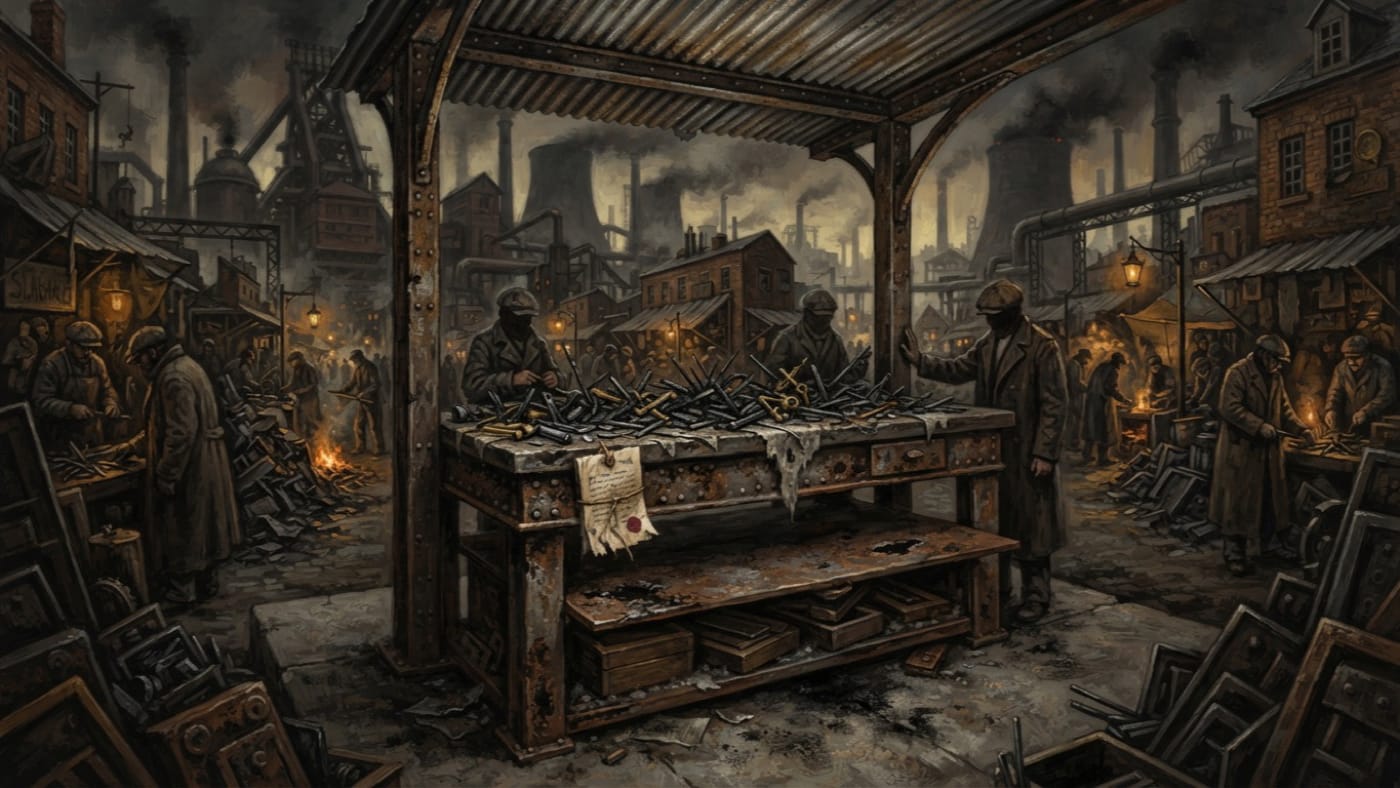
The Scrap Altar stands at the centre of the Slag Market, in the outer ring of Brast, where the furnace heat arrives late, secondhand and already invoiced. It is a table, and I record that plainly before the devout and the credulous get hold of it. It began as a sorting table under a sheet-metal awning, a flat place for dividing scrap into what could be sold, what could be melted and what could be lied about. It still has the shape of that work. It has a rusted edge, a set of plates with a lowest one beneath the rest, and a roof of sheet metal that drops soot on whoever stands under it.
Nobody has recorded who built it, who first sorted iron on it, or when the sorting stopped. This survey will not supply what the record lacks. The published market account says the Slag Market has no charter. That claim concerns the market. No charter for the table has reached Doctrine, and that is the whole of what I certify on the point.
Three practices are reported at the table, and they overlap without merging. Workers leave offerings on it. Warmth Thieves swear on it. Seal-cutters hide things under it. The market calls the sum of these an altar. I call it a component site, because the Bureau prefers nouns that can be inspected.
#On the Needles
Workers leave broken gauge needles on the table before they buy replacements. The market account records this as observed practice, and I have nothing to add to the observation. The needles come snapped at the pivot, bent past use or blackened at the tip, and they gather on the iron the way candle stubs gather in a side chapel nobody has been assigned to sweep.
The reason for the habit is unrecorded. The needle may be a payment, a receipt, an apology to the instrument, or a precaution against buying the same misfortune twice. The account describes the table as having acquired devotion through repetition. That is the account's interpretation, and a reasonable one. Repetition is the cheapest liturgy there is, and the poor of Brast can afford nothing dearer. No patron is named for the table, no rite has been written down, and no one has reported an answered prayer. I will not invent a saint to tidy the matter up. Brast already has Saint-Combust, and one saint assembled from furnace remains is enough for any city.
The Brast setting digest notes that official gauge serials cannot be sold in the Slag Market at all, being too easy to trace. I set that beside the needles and draw no conclusion from it. When the serial is unsaleable and the needle is broken, the market has already decided that a dead gauge is worth nothing, and the table appears to be where that worthlessness is put down.
#On Agreements Against the Edge
The market account says Warmth Thieves swear agreements against the table's rusted edge. It does not record the terms, the parties, the penalties, or whether anyone keeps a copy. An agreement made at an edge proves two parties and a piece of iron, which is not enough for a legal code. It does tell us that in the outer ring an oath wants something hard to stand against, and that a sorting table was the hardest thing available.
The commerce behind those oaths is heat. The Heat Allotment Office issues warm chits to ration survival. The Bureau of Ordnance sends sealed drums east. The Boiler Commons coughs under notices explaining sacrifice. Between the allotment and the cold room stand the crews described in the published tract: siphon crews in the Still-Canals, pipe-tappers in the Commons, chit counterfeiters in the market, and route-keepers in the Still-Alleys. Each of these needs a way to bind a partner when no lawful instrument will witness the bargain.
Brast setting digest, faction register: "Warmth Thieves of the Still-Alleys — cartel."
Corrected for this survey. The published tract on the Warmth Thieves finds loose networks united by appetite for heat and hatred of official arithmetic. A cartel keeps minutes, and no one at the edge has produced any.
Whether the edge binds every crew, a few crews, or only those whose grandmothers swore there before them, the accounts do not say. I have read the tract's etiquette of siphoning, with its hospice pipes, chalk-marked hours and child runners. Nothing in it ties those rules to this iron. The two may be connected, but they are not connected on paper.
#On the Lowest Plate
Seal-cutters hide wax dies beneath the lowest plate. Here the table's first trade survives most nearly intact. It was built for sorting, and it still sorts, separating the dies that will be needed tonight from the dies that must not be found tomorrow.
The setting digest places "a seal-forge under a scrap altar" in the Slag Market. The indefinite article matters. The market account has forgers working "under scrap altars" in the plural, beside vinegar stalls and in hospice laundries, and the Rail-Manifest Quarter account has them under scrap altars and pipe hoods. Brast has more than one altar made of scrap. The central table is the one with a name, and nothing proves it is the only one with a press under it. I enter the forge as reported somewhere beneath somebody's altar, and I decline to fix it in a place the sources leave open.
Hidden tools prove that tools were hidden. A wax die under a plate does not tell us which chit it stamped, which widow's ration it extended, or which drum seal it imitated, if it imitated any. The market account says much of the market's forgery is domestic, medical and funereal, and the Bureau would sooner it were military. That holds for the market at large. For this plate I have dies and no ledger of their use.
"The Scrap Altar holds their buried dies." — Slag Market, of the Wax Aunties.
Clarified. It holds buried dies. The same account says the Wax Aunties approve which seals may be cut without bringing the market down, and it shows that much and no more. My earlier sentence claimed ownership of every die under every plate, which is more than it could support. I have corrected it in my own hand, as Doctrine prefers.
The Aunties are old women, mostly furnace widows, whose hands know seal pressure by touch. They oversee some of the forging. The table is one of the places where that forging keeps its tools. Neither fact makes them its custodians, its clergy, or its landlords.
#On the Blessing That Arrived Second
The market account reports that a priest of the Furnace Chapterhouse tried to bless the table in A.S. 181 / 1891 CE and found three counterfeit blessing certificates already nailed to its underside. The date belongs to that attempt and to nothing else. It is not the year of the table's construction, consecration or recognition, and the account does not say whether the blessing was ever finished.
The episode tells us the order of events. The forgers' paperwork reached the table before the priest's did. Who cut the certificates, whose seal they imitated, and whether the priest took them away, burned them or quietly left them nailed in place are all unrecorded. The same account says the Chapterhouse raids the market only when a shrine grows popular enough to threaten approved ones. A priest arriving with a blessing suggests the table was popular enough to notice by A.S. 181, though not popular enough to raid. I set no tighter reading on it than that, and I record no miracle, because none was reported.
Ash-Hospice Row presses against the market's western edge through laundries, drying yards and vinegar stalls. Its published account has a Sister haggling for pitch "at a scrap altar" after a morning sermon against the market. The account says "a" altar. I leave her at whichever altar she chose and do not bring her to the central table. The Ash-Hospice Sisters buy what they condemn, and their account says no one has shown that they arrange the traffic passing through their linen. I hold to the same standard here.
#On the Present Survey
As of this compilation, in A.S. 201 / 1911 CE, the market is watched and frightened. Seven sealed drums disappeared from Manifest Court inventory in the spring. Commander-Auditor Sorn Vale has produced fourteen arrests and three confessions, and no drums. No account places the drums, their thieves or their route at the Scrap Altar. If the panic has reached the table, it has done so as audit weather, which reaches every table in the outer ring when the bell carries from the Court.
Two accounts report precautions in that weather. The Warmth Thieves tract says brass worms have been buried beneath Scrap Altar plates. The market account says the Wax Aunties have moved three die-caskets, and it does not say where they were moved from. I record that tools went into the plates and that caskets went somewhere. Neither report gives a cache, an owner or a count I could hand to a provost, and I would not hand one over if it did.
Inquisitor-Mechanic Mire is expected in Brast. The accounts in Doctrine's keeping do not say that he will come to the table, or what he would make of a pile of broken needles if he did. The Calibration Choir will want to know whether any of the needles came from its wards. The Bureau of Records will want the dies. The Chapterhouse will want its blessing back. The table will go on sorting what is left on it.