
#On the Court That Counts Fire
The Manifest Court of Brast is the room where a drum becomes lawful, a shortage becomes treason, and arithmetic learns the rope.
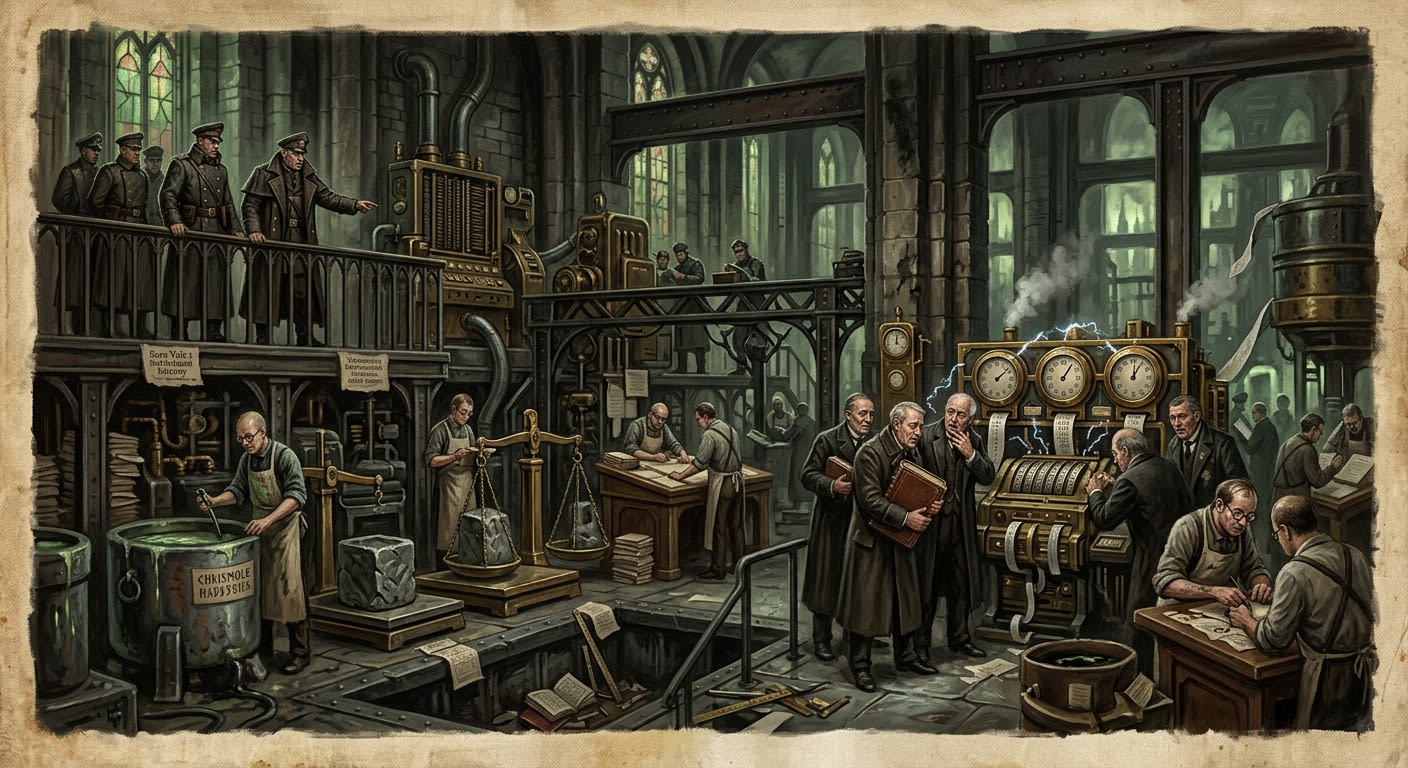
It stands in the Rail-Manifest Quarter of the Chrismole Furnaces of Brast, under soot, above heat, beside the eastern dispatch gates through which the sealed drums roll toward Bastion-Przemyśl, Bastion-Brest, Bastion-Constantinople, and every other hungry emplacement of the Sagittal Line. Its roof is corrugated iron. Its walls are brick darkened by chrismole vapour. Its windows are high, narrow, and filmed with the greasy amber sheen by which Brast blesses glass before killing it.
The Court contains nine weigh-bridges, six wax tables, four dispatch galleries, three provost cages, two appeal benches, and one balcony from which Commander-Auditor Sorn Vale looks down with the serenity of a saint carved by an executioner. Under that balcony, sealed fuel drums receive serial marks, destination dockets, scent traces, choir certifications, filter-lot references, dispatch bells, double-witness wax, and the pleasant fiction that all these marks together describe reality rather than threaten it into shape.
The Manifest Court is commonly described as an office of Synod Ordnance Bureau. This is insufficient. A cupboard is an office. A desk with a frightened clerk is an office. The Manifest Court is a tribunal, granary, chapel, gallows, customs house, warehouse mouth, quartermaster's confessional, and civic weather system. It determines which drums exist, which drums existed wrongly, which drums have been stolen, which drums have merely moved through a regrettable clerical ambiguity, and which men must die so the remaining drums may feel supervised.
Brast makes chrismole, but the Manifest Court makes chrismole legible. Without Brast, the Line cools. Without the Court, Brast becomes a furnace surrounded by rumours. No gunner can load a rumour, except in Poetry, and Poetry has never held a ravelin.
The Court's first principle is that fuel without number is contraband, fuel with number is supply, and fuel with a number that disagrees with another number is evidence of sin. The second principle is that every disagreement must acquire a body. The third principle is that the body should belong to someone low enough to hang quickly and high enough to frighten others. This is administration. Do try to keep up.
#On Origin and Need
The Court was born from embarrassment, the Synod's most fertile parent after fear.
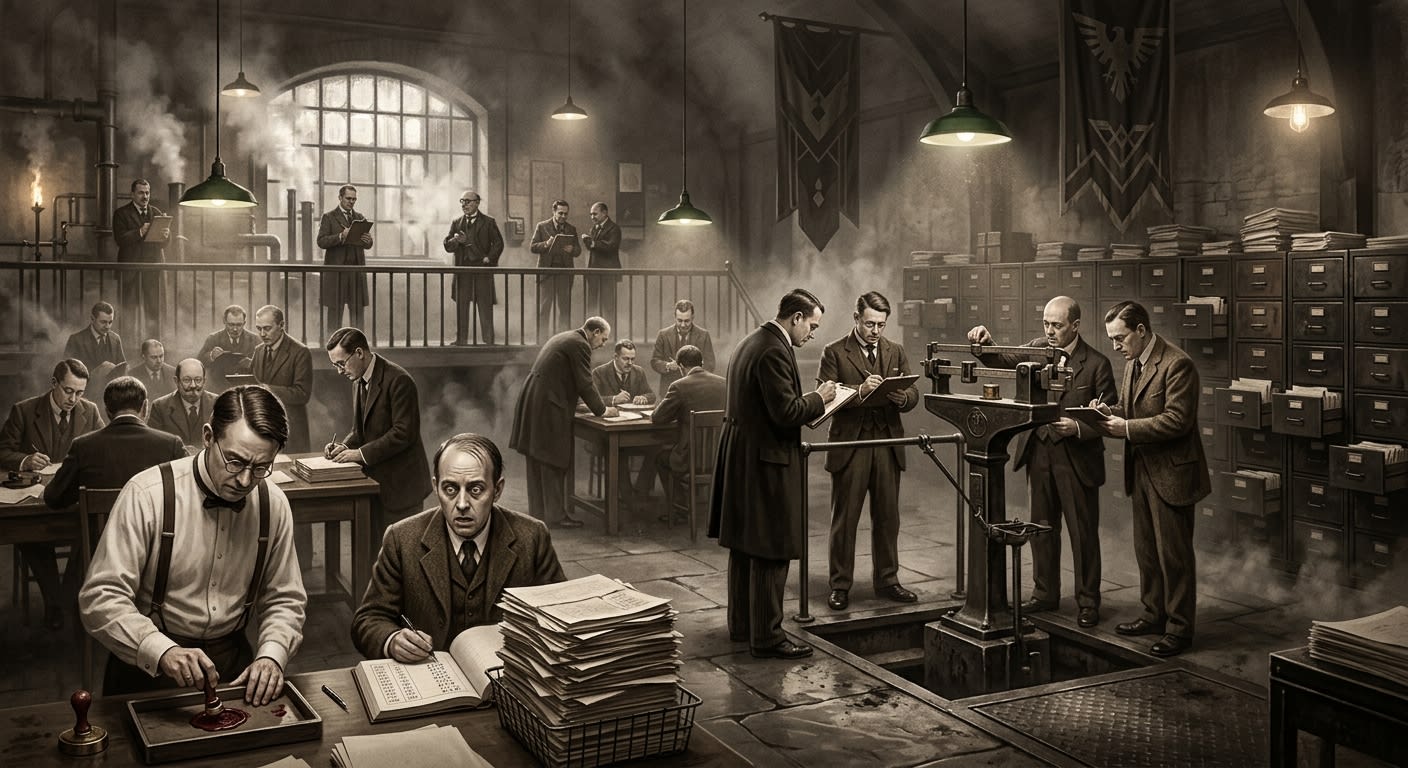
When the coal-seam rail junction at Brast was requisitioned in A.S. 68, the first crude fuel moved east under field markings, chalk tallies, shouted quantities, and the desperate optimism of officers who believed that a train, once loaded, had proved the existence of its cargo. Drums vanished. Drums split. Drums arrived at wrong batteries. Drums arrived at correct batteries with incorrect wax. One convoy sent heater fuel to artillery and artillery fuel to trench kitchens, producing a stew pot that burned through its own brick housing and a cannon crew so cold they loaded two saints' names into the breech before morning.
Doctrine arrived in A.S. 72 with a Cantor and fourteen choir-technicians, named the fuel chrismole, and thereby improved its holiness, price, and paperwork. The Calibration Choir sang the fourth-bell measure. The Distillers' Compact controlled filters and substrate receipt. The Furnace Chapterhouse of Saint-Combust supplied ash, rite, and iron vestments. A useful problem remained: once sanctified fuel left the Crown, it had to pass through hands, rain, bribery, sloppiness, hunger, rail delay, false seals, honest arithmetic, dishonest arithmetic, and men who considered warmth an argument stronger than statute.
The earliest manifest bench was a plank over two slag blocks beside the east gate. A clerk named Havel Drun (Unregistered), now beloved by Records because he is dead and cannot correct them, began comparing drum count against dispatch chalk. His first surviving note reads: Twelve sent, eleven received, one clerk lying or one drum walking. The sentence has the clean profanity of early institutions. Within three months Drun had a second clerk, a wax burner, two guards, and a bell hammer. Within a year he had enemies. By A.S. 76 he had a roof. By the Concordat ratification of A.S. 90, necessity had become jurisdiction and jurisdiction had acquired the title Manifest Court.
The Ordnance commemorative slate of A.S. 140 claims the Manifest Court was founded “as a planned instrument of logistical sanctity.”
Corrected. It began as a plank, a missing drum, and a clerk impolite enough to ask where the fire had gone. Planning arrived after success, wearing ceremonial boots.
The Court's early task was simple: count drums leaving Brast and drums received by the front. Simplicity did not survive contact with sanctity. A drum could be counted by gross weight, fluid measure, heat class, seal integrity, scent trace, choir exposure, filter lot, substrate receipt, destination docket, emergency reroute, convoy loss, temperature variance, or whether it knocked from inside after sunset. Each category wanted its own column. Each column wanted its own clerk. Each clerk wanted authority. Each authority wanted a boundary inside which blame could be harvested cleanly.
By A.S. 110, during the First Continental Levy, Brast's population had swollen beyond its old soot rings, and the Court's ledger stacks had begun to climb in tiers along the north wall. Fuel moved in greater quantities than Havel Drun had ever imagined, which is why Havel Drun remains useful as a founder: founders should be dead before the institution embarrasses them. The Court adopted double entry. Then triple entry. Then the four-fold dispatch concordance: Drum, Seal, Weight, Destination. The fifth column, Disposition of Blame, began as a marginal note and became a desk by winter.
The modern Manifest Court dates its mature form from the post-Concordat expansions: iron weigh-bridges, fixed dispatch galleries, central variance desk, appeal bench under armed supervision, and the black balcony reserved for the Commander-Auditor. The balcony is theatrics, which makes it important. Men below must feel that arithmetic descends.
#On the Machinery of Legibility
Every lawful chrismole drum enters the Court's custody twice: once as expectation, once as departure.
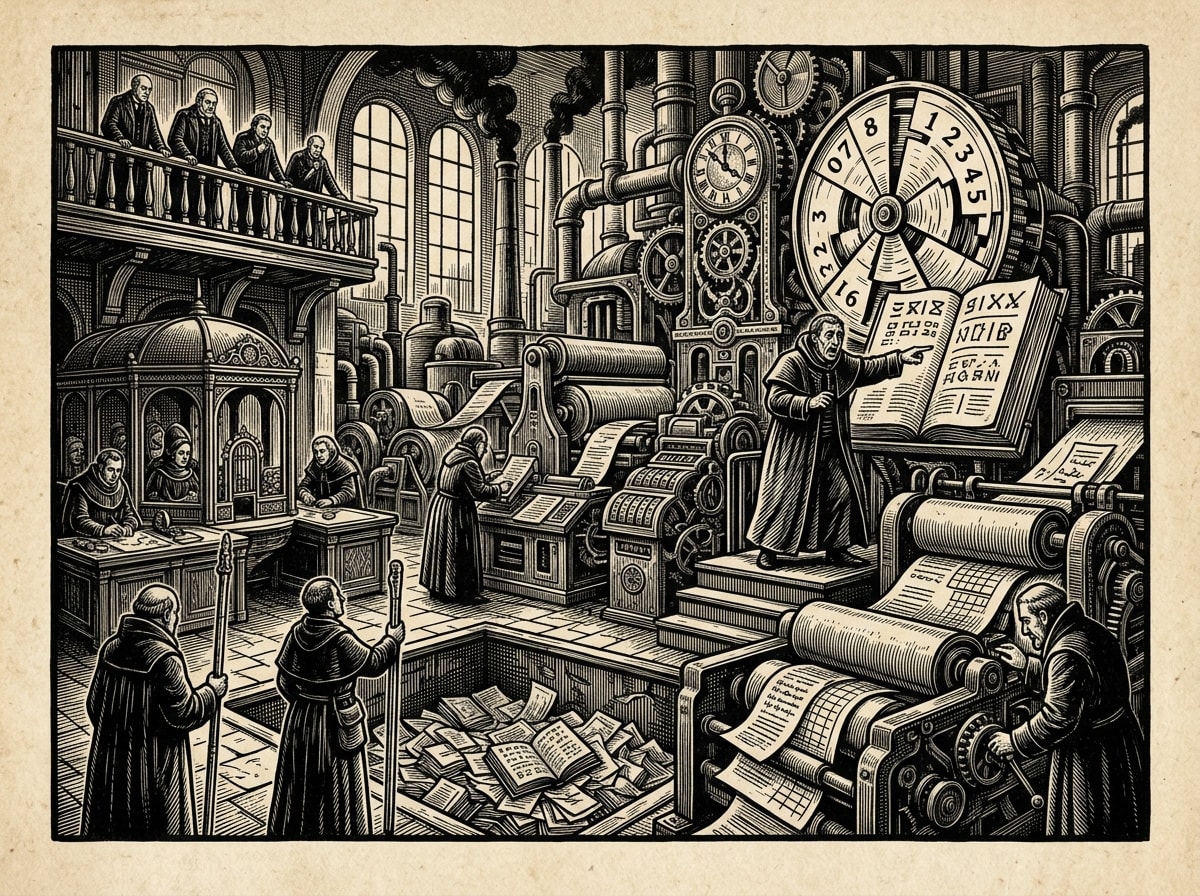
Expectation begins before dawn, when feedstock records arrive from the Still-Canals under Compact countersign. The Court receives not the substrate itself, Providence spare us that theatre, but its shadow: coded receipt, weight class, screened origin, filter-lot claim, and the little lies by which useful materials pass through moral offices. A manifest clerk checks the receipt against prior cycle forecasts. Another checks it against Ordnance demand. A third checks it against Choir availability. A fourth checks it against the list of things the Bureau of Alchemical Standards has forbidden everyone from naming while continuing to invoice.
The first act of departure occurs at seventh bell, when finished drums roll from the decanting yard onto the outer bridge. The drum is weighed hot. Then cooled. Then weighed again. Heat changes weight by tolerances every trained handler knows and every dishonest handler praises too loudly. The seal reader tests wax depth with a warmed needle. The scent clerk cracks a bead and holds the vapour beneath a treated strip. The strip may turn blue, violet, grey, black, or the colour men call ordinary when they have been ordered to be calm.
If the scent trace agrees, the drum proceeds. If it disagrees, the drum enters variance. Variance is a small word with large teeth.
A drum bound for Przemyśl receives misfire annotations after the A.S. 199 battery incident. A drum bound for Brest receives thaw and pump class warnings. A drum bound for Constantinople receives southern-route guard tally, famine-delay notation, and enough lies about direct passage to make the docket bow in the middle. A drum routed through Hamburg after the Dock Fire of A.S. 189 receives spacing certification, wall-distance certification, and the casualty number written in a hand large enough for War to read without spectacles.
The Court's clerks are trained to see disagreement before disagreement sees itself. A wax impression one hair too shallow. A drum warm at the wrong quadrant. A scent bead blooming black at the edge. A Choir certificate signed by a throat scheduled for rest. A filter lot attached to mesh still listed as under repair. A destination mark scratched twice where one stroke should suffice. The clerk places a red bone tab beside the line. The drum stops. Men begin sweating in a city already rich in sweat.
Variance hearings occur in the lower pit, a shallow railed square below the dispatch galleries. The owner of the discrepancy stands on one side. The responsible office stands on another. The drum, if physically present, stands in the centre like a fat black witness with no need to perjure itself. The Court Advocate reads the numbers. The Compact man disputes the filter lot. The Choir clerk disputes exposure timing. The manifest scribe disputes penmanship. The provosts listen for running feet.
Most hearings end in correction: retally, reseal, relabel, quarantine, reroute, downgrade, confiscate. A few end in formal charge. Fuel diversion. Seal tampering. Manifest falsification. Heat theft. Dispatch fraud. Improper storage. Unlicensed warmth conversion. Conspiracy to alter destination. Unauthorized hymn exposure. Failure to report internal knocking. The list grows each decade because men remain inventive and the Court refuses to be outpaced by sin.
The appeal bench exists. This is a kindness, or the proper image of one. An appellant may petition against a variance ruling by producing superior documentation, a higher seal, or a patron willing to become visible. The first is rare. The second is dangerous. The third is expensive enough to be nearly moral.
#On Sorn Vale and the Balcony
Sorn Vale inherited the Manifest Court and perfected its expression.
Before Vale, the Court punished. Under Vale, it instructs by anticipation. His genius lies in making a discrepancy fearful before it becomes legible, making clerks hear gallows wood in a mismatched column, making handlers correct their grip when his boots touch the stair. The city says his boots never dirty. The city is wrong in a technical sense and right in the only sense that matters. Nobody sees the dirt.
Vale's balcony is narrow, iron-railed, black-painted, and polished by the hands of men awaiting sentence. From there he watches the whole Court: bridges, cages, wax tables, gates, ledgers, bell cord, variance pit, appeal bench, and the eastward rails. He rarely raises his voice. He has no need. The Court is designed to amplify silence. When Vale's pen stops, the nearest clerk goes pale. When he closes a ledger, provosts adjust their grips. When he descends, even drums seem to remember their seals.
His nine summary executions in three years are remembered less for their number than for their arrangement. Each occurred after a variance hearing short enough to be mistaken for efficiency and exact enough to discourage complaint. A siphon runner. A false-seal cutter. A rail clerk who changed one digit. A provost selling warm chits under confiscation seal. Others behind black bars. Vale leaves examples placed like lamps along a road. Men may choose not to see them. Men may also choose to fall into machinery. The Bureau records both as misfortune.
The spring A.S. 201 loss of seven sealed drums (Unregistered) is Vale's greatest visible wound. Seven exactly. Seven drums from sealed inventory. Seven drums after double witness. Seven drums carrying enough heat, range, bargaining power, and symbolism to turn a theft into a sermon delivered by criminals. Fourteen arrests produced three confessions and no recovered fuel. Vale's enemies whisper that he failed. His admirers whisper nothing, which shows better training.
The Court changed after the seven drums. Double-witness checks became triple at the eastern gate. Convoys already certified clean were reweighed at random. Dispatch cages received bell-hour locks. Warm-chit brokers stopped laughing near provosts. The Boiler Commons canteen sweep (Unregistered) came during mid-meal, a choice so cruelly apt that I felt professional envy. Full mouths answer badly. Hot bowls prevent graceful escape. Children become crowd pressure before witnesses can decide whether they are victims.
MANIFEST COURT AUXILIARY SWEEP — BOILER COMMONS, A.S. 201 Recovered: false chits; under-table press; three unregistered heat bladders; one quiet hymn scrap; one deceased man active in ration queue. Recovered drums: none. Witness uniformity after intervention: ███████ percent. Disposition: order restored; hunger pending.
Vale's danger, as every competent enemy knows, is that he believes failure wants a culprit. This has carried him far. Brast's present trouble may carry him somewhere less dignified. The Sulking Engines answer insult. Drums knock after silence. Gauges form readings that smell more like moods than pressure. The night roar has acquired a syllable sealed in Vault Brast-4 (Unregistered) by Ilyra Kest. If a gun fires wrong because a man stole fuel, Vale is judge. If a gun fires wrong because fuel has learned to resent command, Vale becomes a clerk beside an altar nobody built.
He knows. His audits have sharpened. His records have grown cleaner, which is always a filthy sign. He will receive Lux Thane Mire with full courtesy and partial ledgers, as instructed. He will provide variance charts, execution warrants, scent strips, double-seal failures, dead men's signatures, and the kind of helpfulness that keeps a knife hidden in the sleeve.
#On the Offices That Hate It
Every institution around Brast hates the Manifest Court. This is proof of its necessity and its manners.
The Distillers' Compact hates the Court because the Court translates guild secrecy into columns. Pex Ruln controls filters, locks, emergency mesh, substrate receipt chains, and the practical passage between feedstock and usable fuel. He does not enjoy a balcony asking why filter lot Cinder-Seven appears in one ledger as exhausted, in another as installed, and in a third as unavailable for reasons of smell. The Compact's preferred weapon is delay. The Court's preferred weapon is naming delay before delay becomes policy.
The Calibration Choir hates the Court because rhythm resents paperwork. Kest's Measures stand in the sanctification nave, match fourteen stanzas to condensation rate, and keep fuel obedient by throat, scar, licence, and fear. A wrong note may spoil a cycle. A right note may still be blamed by a clerk who cannot hear the difference but can read the dispatch bell. The Choir tolerates the Court because a certified hymn protects the singer from certain kinds of accusation. It also creates others. Such is the generosity of records.
The Furnace Chapterhouse hates the Court because the Court's materialism is impolite. The priests of Saint-Combust prefer faults clothed in providential vocabulary. The Court asks how much, which drum, whose seal, what hour, which witness. This bruises theology. Theology, when bruised, often reports visions. The Court files them under attached testimony unless the vision interferes with loading.
The Ash-Hospice Sisters fear and despise the Court in a quieter key. Their records smell of broth, lung resin, fever sheets, and accuracy. The Court's ledgers smell of wax, iron, and selected fact. The Sisters know accident patterns that the Court calls unripe evidence. The Court knows culprits that the Sisters call convenient. Both are right often enough to make cooperation unpleasant.
Brast administrative summaries describe relations among the Manifest Court, the Compact, the Choir, the Chapterhouse, and the Hospice as “coordinated interdepartmental process.”
Clarified. They are a knife drawer during an earthquake. The drawers remain labelled. The knives remain knives.
The Bureau of Tithes hates the Court because every drum's category alters money. The Bureau of Records adores the Court's ledgers and distrusts their cleanliness. The Bureau of War wants fuel moving and grows moral only when fuel moves elsewhere. The Bureau of Doctrine praises the Court because it proves sanctified matter remains obedient to sanctified form. Doctrine has never met a chain it did not call a rosary once polished.
The workers hate the Court because it can turn warmth into crime. A heat bladder hidden under a shawl may be mercy in Boiler Commons, theft in the Court, evidence to Vale, contamination to Purity, symptom to Mire, and supper to the child who slept beside it. The law chooses one name at a time because hunger with multiple names becomes hard to punish.
#On Missing Gallons, Warmth Thieves, and Lesser Heresies
The Court's most common enemy is the missing gallon. Hell remains too grand for the daily docket.
A missing gallon may be siphoned from a cracked line, skimmed during transfer, trapped in residue, lost to overheat, hidden in a bladder, mismeasured by fatigue, relabelled under emergency allotment, spilled and concealed, stolen by a Warmth Thief, borrowed by a kitchen widow, sold to a Furnace-Hardliner, or absorbed into the ordinary fog of men trying to live near heat owned by offices. The Court hates this variety. Variety slows punishment.
Warmth Thieves operate between the Still-Canals, the Slag Market, and the dark edges of the Rail-Manifest Quarter. They bleed sealed fuel by needle, wick, siphon thread, false residue pan, or the intimate bribery of a handler whose child coughs red. They sell heat in bladders disguised as water-skins. They sell lampfuls in vinegar bottles. They sell a spoon's worth to women who warm bricks under blankets for fevered infants. They sell full gallons to men with wagons, guards, and the civic decency to call theft procurement.
The Manifest Court punishes the spoon and negotiates with the wagon when the wagon bears the right seal. Contradiction is the civilian word. The Court calls it scale.
The Court's investigators are called line auditors (Unregistered), a merciful title for men who crawl under pipe bridges with lanterns, sniff wax seams, inspect residue pans, count empty bladders, threaten widows, flatter children, and listen at night for the soft click of unauthorized warmth being born. A good line auditor knows that thieves are rarely clever at the beginning. Cleverness arrives after hunger survives its first mistake.
Fuel diversion charges carry a sacred weight because chrismole is property carrying sanctified war capacity. To steal it is to steal heat from a barracks, pressure from a pump, range from a gun, movement from a convoy, courage from a cold watch, or profit from an office that had already arranged to steal it lawfully. The Court concerns itself with the first five in public and the sixth by private appointment.
A recurring lesser heresy is the altered destination digit. One stroke can send a battery's allotment to a siding, a heater lot to a hospital, a hospital's reserve to a dead depot, or a dead depot's fuel to men alive enough to pay. The digit is small. The winter it creates is large. Manifest clerks sleep badly for good reason.
Quiet hymn sheets (Unregistered) form another docket. These are illicit cadence scraps sold to thieves and amateur handlers who believe a stolen line of sanctification will make illicit fuel behave. Sometimes it does. This is the problem. A failed quiet hymn burns a room. A successful quiet hymn threatens Brast's monopoly, and monopoly is more sacred than several officially recognised relics.
The Court seizes quiet hymn sheets under three authorities at once: fuel security, hymn licence, and doctrinal containment. Triple authority is useful because it lets the provost choose whichever club is nearest.
#On the Present Crisis
As of A.S. 201, the Manifest Court operates under Amber strain, which means the city is allowed to be terrified only in supervised forms.
Seven drums remain missing. The Sulking Engine escalation remains active. The Przemyśl misfire of A.S. 199 (Unregistered) remains a wound with too many doctors and no honest patient. The night-syllable cylinder remains sealed in Vault Brast-4. Fever dishes in Ash-Hospice Row arrange ash into names. Some names belong to the living. Some belong to men the Court has already processed. The distinction annoys Records, frightens Mercy, and makes Vale's recent ledgers gleam like teeth.
Mire's approach has made every office improve its posture. Ruln has cleaned receipt caskets without opening the dangerous ones. Kest has revised silence protocols and forbidden three throat-warm exercises near sealed fuel. The Chapterhouse has increased Saint-Combust ash rites around Kiln Three and decreased explanations. The Court has added a second locked shelf for scent strips that behaved correctly only on retest. Brast prepares for inquiry the way a murderer prepares for confession: by remembering the useful portion.
The Court cannot stop output. This is its chain and crown. If it stops too many drums, guns cool. If it releases too many suspect drums, guns may lie. If it punishes thieves too fiercely, workers freeze and sabotage improves. If it tolerates theft, the Line notices by candlelight. Every decision must be wrong in a manner the Court can defend after the bodies are counted.
The present holding order instructs the Court to maintain output, tighten seal discipline, suppress substrate speculation, report responsive-drum behaviour only through authorised acoustic-mechanical channels, and avoid public use of the phrase fuel answered. Court clerks have replaced that phrase with internal pressure event, post-cadence container reaction, or witness error, depending on which office must be soothed. Language is the cheapest insulation in Brast. It burns eventually.
Workers know more than notices admit. They know which drums knock. They know which bridge chains twitch before a variance bell. They know which provosts accept salt-fat and which accept only fear. They know Vale's boots, Kest's raised finger, Ruln's left-sided smile, and the Chapterhouse priest who blesses grey drums while looking away. They know the Court counts fuel. They know fuel has begun counting back.
At Iron Vespers, the dispatch lamps lower. The east gate opens. Drums roll out, black, sealed, warm, numbered, witnessed, blessed, suspected, and necessary. A clerk calls each line. A handler answers. A provost watches hands. Sorn Vale stands above the pit until the last axle clears the gate. Behind him, shelves of ledgers hold all the Court has decided to know. Beneath him, the stones retain old heat. Ahead, the rails run east into hunger.
The Court bell strikes once for departure. Once for variance cleared. Once for silence.
The drums go.
No clerk cheers. Cheering near fuel is vulgar, dangerous, and not billable. The departure sheet receives its final red-thread tie; the wax cools around Vale's mark; the night watch takes the east ledger with both hands. Somewhere beyond the gate a coupling shrieks, a boiler clears its throat, and the first convoy engine waits for someone to greet it politely enough to move.