
#On the Outer Ring Where Sanctity Cools
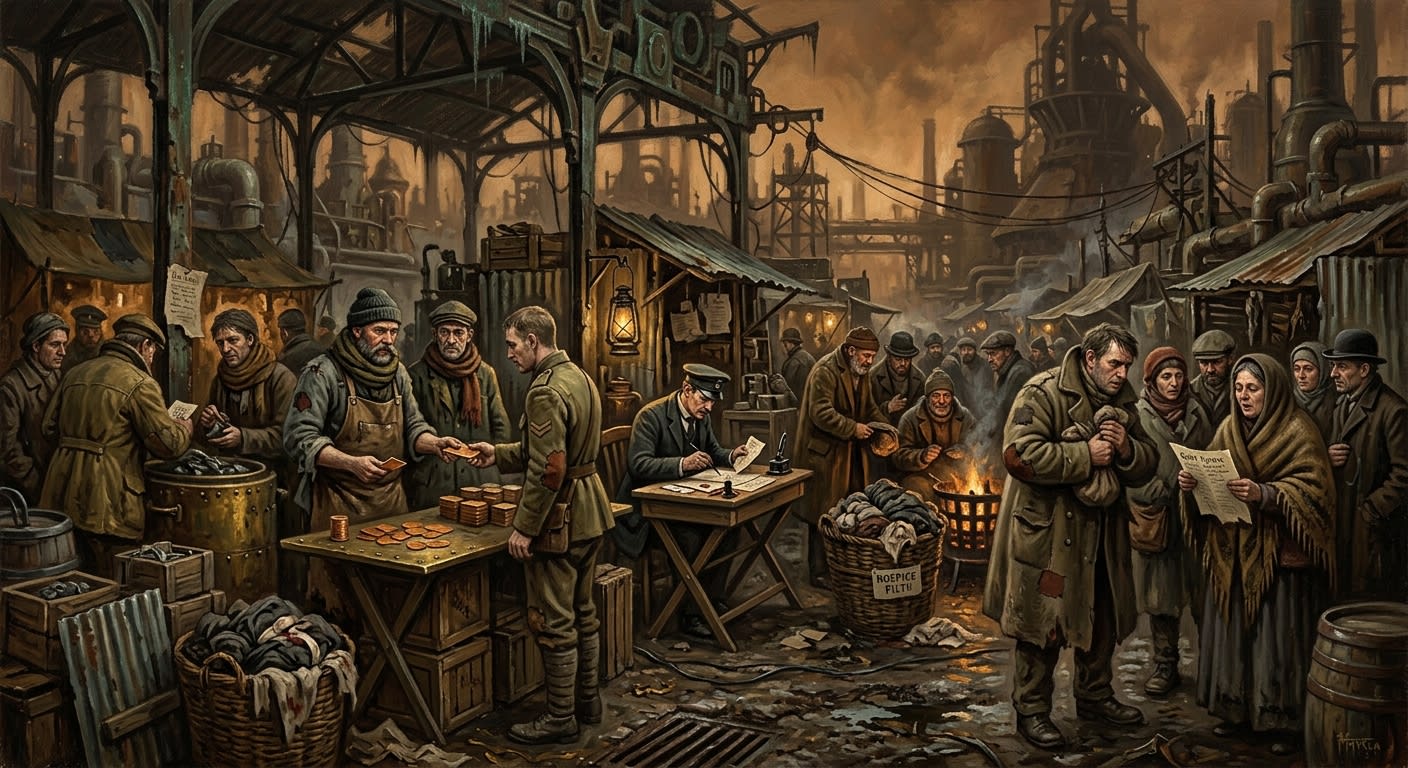
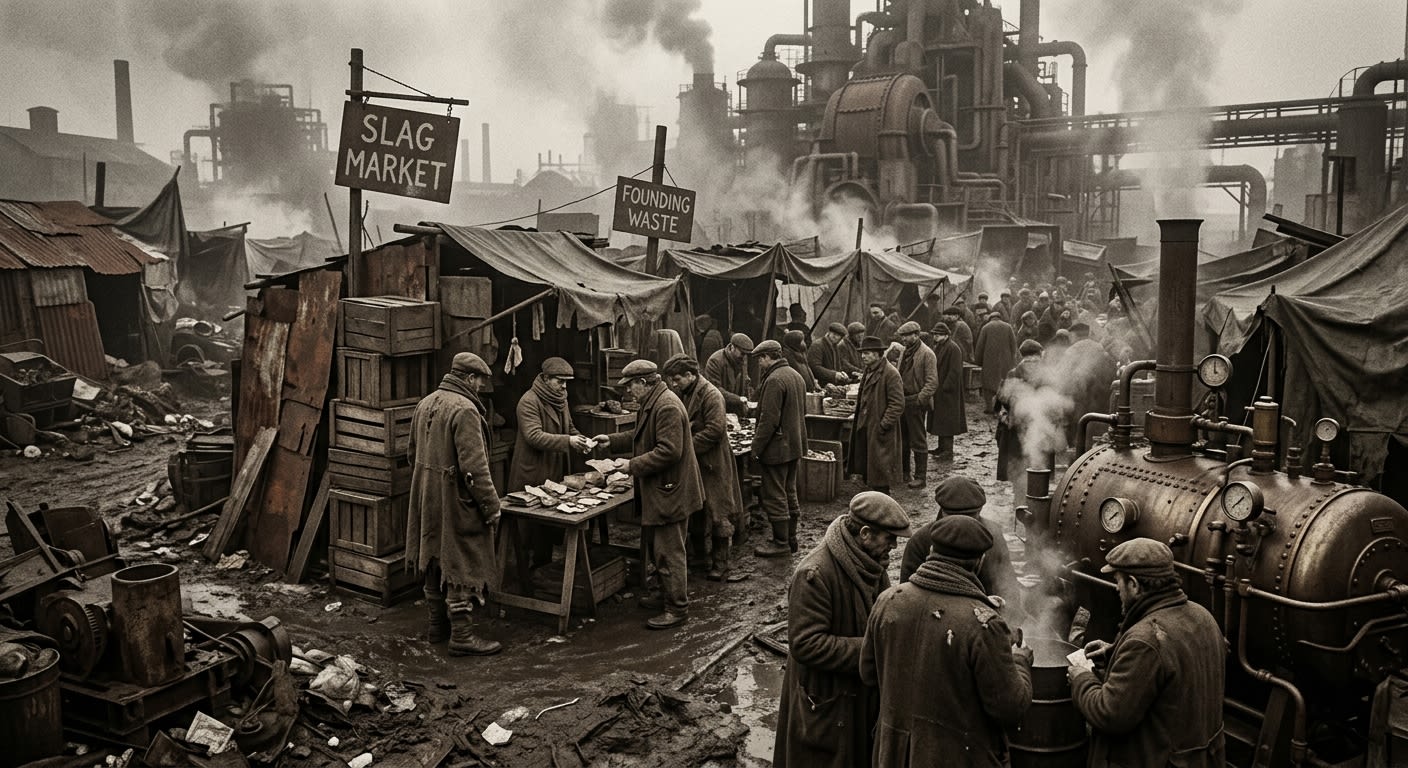
The Slag Market of Brast lies at the city’s outermost ring, where the official warmth of the Chrismole Crown reaches the poor as rumour, soot, and enough residual heat to make survival billable. It is called a market because the Bureau prefers nouns that imply order. It is a drift of scrap stalls, seal benches, ash-roofed chapels, pipe-tent courts, condenser gutters, illegal kitchens, knife alleys, warm-chit tables, filter racks, oil-bladder sellers, and little shrines assembled from rejected gauge brass. Commerce occurs there. So do confessions, marriages, amputations, bribes, riots, music, executions, disappearances, and technical corrections performed with hammers.
One enters from the Rail-Manifest Quarter by descending through the cooling berms, where slag dumped over a century has hardened into black shelves under the city wall. The streets are built from furnace waste. Brick breaks underfoot. Glass-slag slices boots. Ash lies in gutters like grey flour. In winter, the market steams where hidden pipes run beneath it; in summer, the same pipes heat the alleys until vendors sell vinegar rags as lung relief and small children faint beside counterfeit seal presses. Its air smells of vinegar, wet rope, burnt fat, warm brass, resin paste, and that peculiar Brast perfume of sanctity caught in a dirty filter.
The Slag Market exists because Brast produces too much value to remain honest. Sealed drums pass east. Filters wear. Warm chits circulate. Broken gauges are discarded. Choir slates crack. Wax seals sweat and are replaced. Workers lose tools, lungs, hours, names, fingers, and sometimes faith. Each loss becomes commodity once it reaches the outer ring. Brast’s official ledgers send clean chrismole to Bastion-Przemyśl, Bastion-Constantinople, and the other vertebrae of the Sagittal Line. The Slag Market sells everything that leaked from the procession.
#On Its Founding in Waste
The Slag Market has no charter. This is its first virtue. A charter would imply a founding date, a patron office, a juridical parent, and the usual stationery by which crimes become policy. The market began when the first furnace waste cooled enough to stand upon and the first worker discovered that discarded iron still possessed value if the buyer stood far enough from the Crown to avoid questions.
Brast itself began in A.S. 68 as a requisitioned rail junction and hardened into chrismole sanctity by A.S. 72, when Doctrine sent one Cantor and fourteen choir-technicians to teach ordinary fuel the posture of holiness. By A.S. 76, sealed drums were moving to forward guns. By A.S. 90, the Concordat found Brast already too necessary to disapprove of properly. Those official dates belong to the Crown, the Manifest Court, and the Distillers’ Compact. The market’s calendar begins elsewhere: with the first broken condenser hook sold for bread, the first warm pipe tapped after curfew, the first dead worker’s heat chit redeemed by a widow whose marriage papers had been mislaid in an accident ledger.
Ordnance district notes classify the Slag Market as “post-charter commercial overflow arising after regulated furnace expansion.”
Corrected. The market predates regulation as a recognisable habit. Regulation arrived later, inspected the habit, fined it, taxed it through intermediaries, denied taxing it, and bought dinner there.
By the First Continental Levy era, the market had become permanent. Conscripts arrived in Brast’s catechism-barracks by the thousands; many departed east, many coughed themselves into Ash-Hospice Row, and a sufficient number stayed behind with missing papers and practical hands. Refugee labour swelled the Boiler Commons. Debt-bondsmen from the Queue Road brought family tricks for passing tokens across counters without visible contact. Failed choir apprentices brought half-remembered measures. Compact rag-boys brought residue knowledge. Rail clerks brought seals. Widows brought ferocity. Children brought speed.
The city called this disorder. The market called it inventory.
#On the Geography of Bad Heat
The Slag Market occupies a crescent outside the stable warmth radius, pressed between slag berms, Still-Canal runoff, rail sidings, and a row of condemned pipe houses whose condemnation notices have been renewed for sixty-three years without effect. Its lanes have names that do not appear on official maps: Filterbone Row (Unregistered), Warm Knuckle (Unregistered), Saint Combust’s Left Heel (Unregistered), the Vinegar Cut (Unregistered), Ruln’s Disappointment (Unregistered), the Black Drip (Unregistered), Seal-Sweat Yard (Unregistered), and Little Amber (Unregistered), where the lamps burn with a gold colour that makes even atheists lower their voices.
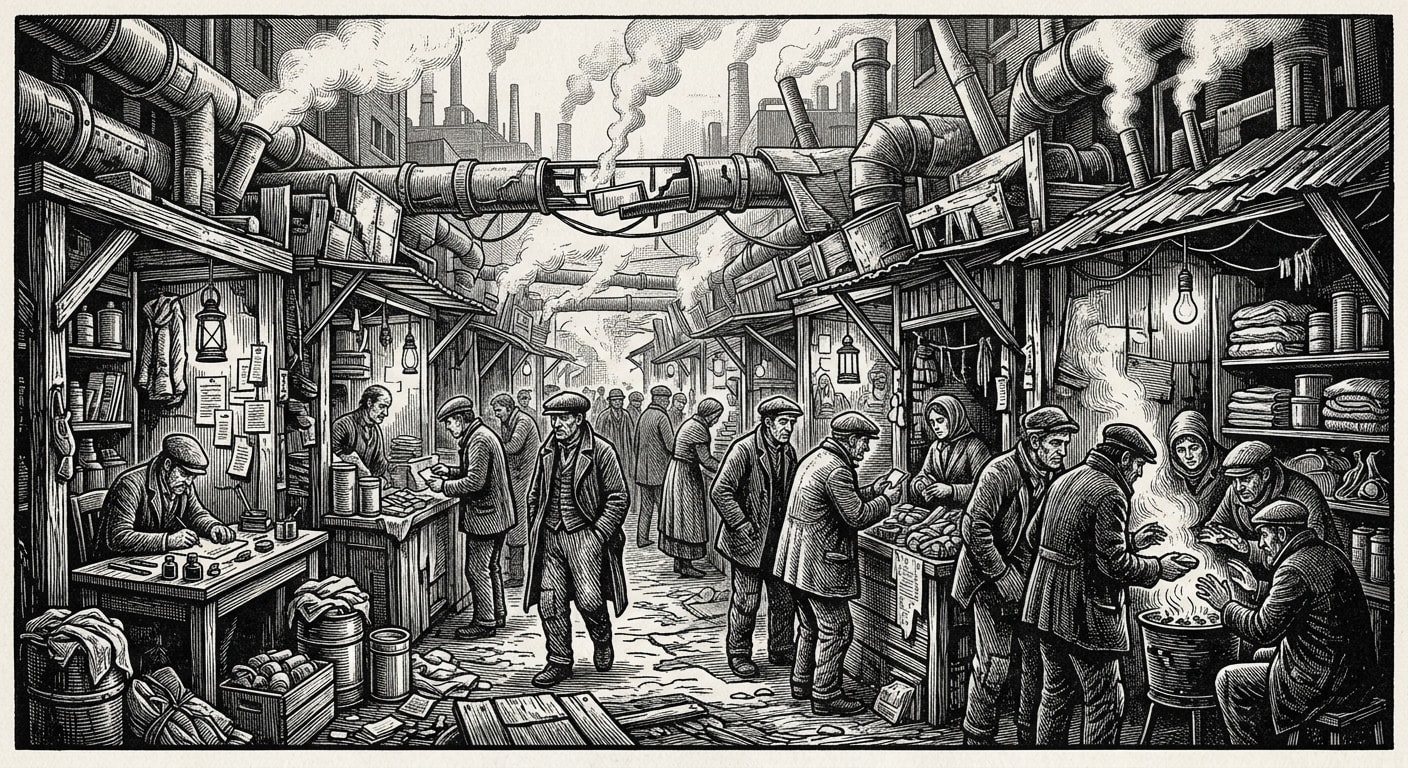
At the centre sits the Scrap Altar (Unregistered). It began as a sorting table under a sheet-metal awning and has acquired devotion through repetition, which is how half the Synod’s cults begin and all of its committees end. Workers leave broken gauge needles there before buying replacements. Warmth Thieves swear agreements against its rusted edge. Seal-cutters hide wax dies beneath the lowest plate. A priest from the Furnace Chapterhouse tried to bless it in A.S. 181 and discovered three counterfeit blessing certificates already nailed to its underside.
The Still-Canals touch the southern edge. Their condenser water runs black, sweet, and warm through screened locks where boys fish for dropped tools with hooked cords. No fish remain. There are rumours of fish, because the poor require food in narrative form when food in material form has been priced above them. The western edge backs onto Ash-Hospice Row, whose resin-masked Sisters buy illegal filters, old ledgers, and lung medicines from vendors they later condemn in ward sermons. The eastern edge leans toward the rail yards and the Manifest Court’s shadow, where Sorn Vale’s audit bells can freeze a transaction at twenty paces.
The market’s vertical city is smaller and more dangerous. Under-pipe tunnels hold warm sleepers, siphon bladders, hidden presses, and the little rooms where a man can buy a new name if he does not mind that it belonged to someone who died loudly. Catwalk nests hang above the lanes, built from kiln ribbing and old rail. Children move along them faster than provosts can look upward. The market respects roofs more than walls; a wall stops one customer, while a roof hides five.
#On Warm Chits and Other Currency
Coin is used in the Slag Market by foreigners, fools, and undercover officials trying too hard to resemble either. The true currencies are warm chits, filter cards, serial slips, oath-notes, ration stamps, silence tokens, bottle rights, and access to pipes that have not yet been entered into Sorn Vale’s diagrams. A warm chit buys heat. Ten buy breathing space near a pipe. A hundred buy a season’s rent if the landlord is hungry or frightened. A thousand buy departure west by rail, though the ticket will be printed under a name that may not tolerate you for long.
Warm chits began as heat allotment records. The Ordnance Bureau made them to ration survival, then expressed surprise when survival became money. Counterfeit chits circulate in three grades. Common fakes pass between workers after curfew and fail under lamplight. Good fakes pass foremen. Excellent fakes frighten the Bureau of Records, which confiscates them for study and occasionally spends them by mistake.
A filter card is better than coin during shortage. It promises access to mesh, resin, emergency screens, or someone who knows which discarded screen can be cleaned without bursting on the second cycle. The Compact denies issuing private filter cards. This denial is technically accurate. Pex Ruln does not issue cards. Men who owe him favours issue cards, and the market honours them because technicalities are Brast’s civic music.
Oath-notes circulate among technicians, valve runners, and choir-adjacent workers. They promise labour under specified pressure conditions. A forged oath-note can put a man into a dangerous shift, excuse a coward from one, or move a skilled throat near a furnace whose sound should remain unobserved. The Calibration Choir hates them. The Slag Market loves objects hated by people with licensed throats.
Silence tokens are smaller than fingernails, stamped in dull tin, and worth more than bread when audits begin. They are paid to look away, forget a buyer, misname a seller, or fail to remember which child carried the bladder under his coat. They are also given as love tokens in Filterbone Row, which tells you everything useful about courtship under industrial theology.
#On the Warmth Thieves and the Still-Alleys
The Warmth Thieves are not a single gang, whatever the Bureau of Shadows writes when it wishes to simplify a budget. They are siphon crews, warm-chit counterfeiters, pipe-tappers, seal cutters, rail bribers, canal divers, false hospice porters, and mothers with better maps than Ordnance. Their unity lies in appetite for heat and hatred of official arithmetic. They operate in the Still-Alleys (Unregistered) where condenser pipes pass close enough to buildings that a patient thief can drill warmth from doctrine.
Their tools are humble: brass worms, skin bladders lined with tallow, wax seal lifters, rag clamps, vinegar masks, prayer scraps to wrap against burns, and small hammers that make less noise than hunger. They tap fuel, pressure, steam, line access, and timing. To steal in Brast is to steal minutes from a pressure bell. Too early, the line is watched. Too late, the valve cools. During furnace roar, everything is forgiven by sound.
The Thieves sell warmth where Ordnance sells entitlement. A widow whose husband evaporated in an audit may buy enough heat to keep two children through ash winter. A boiler foreman may buy illicit pressure to finish a quota. A provost may buy stolen chrismole to warm his own barracks while arresting the seller’s cousin. No one involved enjoys moral clarity, which is fortunate, since moral clarity freezes faster than oil.
They also move drums. Not many; the scale is too dangerous, and Vale’s court has taught the city fear with admirable penmanship. A whole sealed drum requires rail access, false manifest, a silence corridor, two bribed weighmen, a compromised seal table, and either Compact cooperation or Compact blindness rented at catastrophic rates. Seven drums disappeared in spring A.S. 201. The market denies involvement with an intensity that smells of sweat.
The missing drums changed the weather. Informants multiplied. Knife prices rose. Warm-chit brokers stopped conducting business in public. Three stall families vanished from Little Amber. A counterfeit seal-maker called Mother Brann (Unregistered) had her thumbs broken by persons unknown and then arrested by persons official. Vale produced fourteen arrests and three confessions. No drums. In the Slag Market, absence sells better than evidence.
#On Seals, Scraps, and the Forgers Under the Altar
The Slag Market’s seal-forgers are artists in a city that mistakes art for sabotage unless properly uniformed. They cut wax prayers for sealed drums, stamp heat chits, repair pass slips, imitate filter-card scratches, alter accident confession forms, and forge the small compassionate documents that allow men to survive bureaucracy without becoming legally visible. They work under scrap altars, behind vinegar stalls, in hospice laundries, and beside shrines where the smoke confuses dogs.
A drum seal is hardest. Brast drum wax carries scent-trace, pressure memory, fibre inclusion, prayer pattern, and serial impression. A poor forgery fools a tired guard. A good forgery fools a weigh-bridge. A master forgery fools a ledger until the fuel misbehaves three provinces east and someone counts backward through corpses. Seal-forgers prefer smaller mercies: a corrected warm chit, a widow’s ration extension, a labour exemption slip, a false cough certificate, a clean departure stamp for a child whose real name has become too expensive.
Records memoranda state that Slag Market forgery is “primarily commercial and anti-military.”
Corrected. Much of it is domestic, medical, matrimonial, funereal, and pathetic. The Bureau hates this because cruelty is easier when the accused looks profitable.
The forgers are supervised, if such a word can be used for a profession that flourishes by denying supervision, by the Wax Aunties (Unregistered). These are old women, mostly widows of furnace men, whose hands know seal pressure by touch and whose memories hold more dead signatures than the local Records annex. They do not cut all seals. They approve which seals may be cut without bringing the market down. A young forger who counterfeits a drum seal without Auntie consent may be found in the condenser gutters with his tools pushed into his mouth, an educational arrangement widely understood.
The Scrap Altar holds their buried dies. Some are ordinary. Some are official dies stolen from minor offices. Some are older than the current Brast seal-table and should not exist. One die found in A.S. 198 bore the countermark of a shift not yet scheduled by any lawful table. Records seized it, sealed it, and later denied it had been seized. The Wax Aunties stopped using that alley. No one told them to.
#On Quiet Hymns and Black Measures
The market sells music, though never under that name. It sells quiet hymns (Unregistered), black measures (Unregistered), half-stanzas, furnace hums, pressure mnemonics, forbidden intervals, and the little breath-patterns by which a worker may persuade a private boiler to endure one more night without licensed Choir attention. The Calibration Choir calls these fragments theft. Orison calls them contamination. Furnace workers call them useful. The machines have not filed a preference.
A quiet hymn is not the fourteen-stanza fourth-bell distillation hymn. It is a sliver. A valve phrase. A condenser lull. A pressure calming. A line-start murmur. Enough sound to get a stove, pump, cart engine, lift, or illegal still through a crisis; enough also to teach the machine that obedience may be negotiated outside the Gauge Ward. This is why Kest’s Measures punish hymn leakage more harshly than warm-chit fraud. Money embarrasses. Music mutinies.
Black measures reached the market from three sources. Failed choir apprentices remember what they should have forgotten. Compact workers learn the rhythm of flow by touch and translate it into throat without admitting they have done so. Black diesel men listen to Brast engines and attempt vulgar imitation over pit fuel. Their results are crude, smoky, and occasionally effective enough to terrify the respectable criminals.
The A.S. 201 night-syllable has made this trade dangerous beyond ordinary profit. Kest sealed the cylinder in Vault Brast-4 (Unregistered). Naturally, fragments reached the market within weeks, or fragments claiming to be fragments, which is commercially superior. Vendors sell the New Sound scratched onto slate, hummed through tin pipes, encoded as tool taps, or whispered into folded paper for buyers who enjoy dying with ceremony. Most are frauds. One is sufficient.
Slag Market seizure, Ashmonth A.S. 201: slate fragment bearing six tap-marks and one breath notation. Playback by authorised choir-technician produced no audible tone. Pressure Gauge C-19 moved from black to amber without line contact. Technician requested water, then wrote █████████ on the table with a burnt finger. Slate transferred to Vault Brast-4. Seller not recovered.
The market rule is simple: never sing what you cannot afford to hear answered. This rule is painted above three stalls and obeyed by none of them.
#On Law, Raids, and Audit Weather
The Slag Market is illegal in sections, tolerated in total, and indispensable everywhere. Ordnance raids it after missing-gallon alarms. Purity raids it when an object smells too much like heresy and too little like revenue. Records raids it when forged papers begin teaching official papers humility. The Furnace Chapterhouse raids it only when a shrine becomes popular enough to threaten approved shrines. Between raids, all four offices send buyers.
The market experiences law as weather. Audit weather begins with the bell. A sound from the Manifest Court rolls over the outer ring; stalls close in order of guilt; children vanish upward; warm bladders drop into ash pits; seal presses become soup boards; singers bite tongues; Wax Aunties sit in plain view knitting with hands that have just hidden a felony. Provosts enter. They find enough contraband to justify the sweep, never enough to damage next week’s heat.
Sorn Vale understands this better than his clerks. His audits are not designed to cleanse the market. Cleansing would freeze Brast’s lower half and, within a fortnight, slow the Crown itself. Vale audits to remind the market that every indulgence has a gallows tied to it. He takes bodies, ledgers, tools, and sometimes silence. He leaves capacity. This is governance, ugly and exact.
Purity is less disciplined. Its detachments prefer spectacle: broken stalls, public burnings, shaved heads, children displayed beside confiscated slates. The market responds by preparing sacrificial inventories. These are boxes of bad seals, dead chits, spent bladders, and hymn scraps composed specifically to offend inspectors while revealing nothing. A Purity officer who mistakes a sacrificial box for success will file a confident report. Confidence, like smoke, rises.
#On the Hospice Edge and the Ethics of Filth
The border between Slag Market and Ash-Hospice Row is the most honest place in Brast. Men go there when their lungs have become official. Women go there when husbands have vanished into audit margins. Children go there selling resin masks patched three times too many. Sisters of the hospice cross into the market with baskets of bandage, boiled instruments, and a carefully cultivated refusal to see what their patients must buy in order to keep breathing.
The Ash-Hospice Sisters are supposed to condemn the market. They do, at morning sermon. At noon they buy illegal resin because Ordnance allotments arrive late. At third bell they purchase unregistered cough tinctures, old accident slips, and worker names missing from official rosters. At Iron Vespers they hear confessions from men whose crimes supplied their wards. This is hypocrisy. It is also medicine under the Synod, and medicine under the Synod has never been permitted the vanity of cleanliness.
The market’s informal surgery is performed behind the vinegar tents. Burns are scraped, fingers set, seal-brand infections drained, throat nodes lanced, oath-collar sores packed with resin, and fume-fever patients bled because someone’s grandmother swore it helped. Sometimes it does. Sometimes the grandmother was an idiot. The patient pays either way.
Horror has not killed tenderness there, which is inconvenient for doctrine. A Warmth Thief may carry a hospice child to a hot pipe after curfew. A seal-forger may correct a widow’s papers without payment because her husband’s signature once saved his brother. A quiet-hymn seller may refuse a buyer whose hands shake too much. The market is filthy, criminal, and morally discontinuous. If that sounds like praise, the reader has spent insufficient time among lawful men.
#On Food, Drink, and the Public Taste of Ash
The Slag Market feeds Brast with the dignity of a battlefield kitchen and the hygiene of a confession booth after cavalry have used it. Soot bread is cut from ration flour stretched with ash-grey meal and baked against pipe housings. Marrow broth simmers in black pots beside counterfeit seal stalls, thickened with bone, root, cabbage, and rumours of meat. Bitter tea is boiled until it can remove varnish from a clerk’s soul. Sweet condenser liquor, drawn illegally from Still-Canal runoff and purified through resin cloth, is sold in thimble cups to men who wish to forget that their lungs have begun making policy.
Food is timed to bells. Before dawn, valve runners buy hand pies wrapped in old manifests. At second bell, rag-boys eat standing because sitting near the gutters means losing one’s place, one’s breakfast, or one’s boots. At fourth bell, when the Choir begins its official labour, vendors lower their voices and raise prices. At seventh bell, when drums seal and the lawful city congratulates itself, the market opens its deeper pots for the night shifts. A stew eaten after seventh bell has less in common with supper than with a small illegal sacrament.
The best stalls are run by women who lost husbands to furnace incidents and acquired, by widowhood’s alchemy, the right to insult every office in Brast without immediate execution. They know which foreman dilutes rations, which hospice sister needs resin, which choir apprentice sells stolen breath patterns, and which provost cannot digest beans. Their benches are intelligence desks with onions. Vale’s clerks pretend not to listen there. Ruln’s men pretend not to pay. Kest’s listeners pretend they came for soup.
Drink carries its own law. Official beer is weak, sour, and measured. Market beer is stronger, illegal, and often filtered through material better suited to boiler repair. Condenser liquor is worst and most beloved. It warms the throat, loosens lies, and leaves a metallic sweetness on the teeth. Men swear it lets them hear gauges thinking. This is false in the general case and true often enough to justify confiscation.
Food fraud is punished by customers before Bureau action becomes necessary. A baker who cuts bread with too much ash loses trade. A broth-seller who serves bad marrow loses teeth. A liquor man whose still blinds three customers may be handed to Purity, which is considered excessive but educational. The market’s justice is swift where stomachs are concerned. Men tolerate stolen heat, false names, and sacramental ambiguity. They become conservatives at soup.
#On the Three Powers Looking Down
The Slag Market survives under the eyes of Brast’s triangle: Vale counts from the Manifest Court, Pex Ruln feeds from the Still-Canals, and Ilyra Kest sings from the Gauge Ward. Each despises the market. Each uses it.
Vale needs informants, sacrificial culprits, and a visible theatre in which missing gallons become named men rather than institutional rot. He also needs the market’s counterfeit expertise more often than he admits. A forged seal discovered in the east must be understood. A false chit dated impossibly must be traced. A silence token found in a clerk’s mouth must be priced. Vale’s clean boots have stepped into the Slag Market under escort. The mud did not touch them. The market noticed.
Ruln needs deniable hands. Compact locks jam. Filters vanish. Substrate rumours spread. A guildmaster cannot be seen purchasing black-market mesh or hiring a knife to silence an over-literate clerk. Men from the Still-Canals do such errands with oil on their sleeves and market dust on their knees. Ruln disavows them while knowing their mothers’ rent.
Kest needs to know which sounds have escaped. The Choir’s official doctrine is containment; its practical doctrine is listening. Failed apprentices sell measures. Black diesel men imitate cadence. Rival chorus rumours move through slate scratches and tool taps. Kest’s agents buy, copy, punish, and sometimes let a fragment circulate to see which machines answer. This is not mercy. This is tuning by bait.
Brast civic bulletins refer to the Slag Market as a “criminal quarter operating outside principal command structures.”
Corrected. The quarter operates beneath principal command structures, beside them, inside their pockets, and occasionally ahead of them. “Outside” is the one place it rarely bothers to stand.
#On the Present Condition
As of A.S. 201, the Slag Market is swollen, watched, frightened, and rich. The seven missing drums remain unrecovered. The filter shortage has not been declared, which means every filter card has doubled in value. The night-syllable has entered rumour, which means every fraud with a slate and every true danger with a throat now sells under the same awning. Inquisitor-Mechanic Lux Thane Mire is expected in Brast, which means the market has begun cleaning itself in the ancient manner: hiding the valuable crimes, displaying the cheap ones, and making sure the loudest sinner cannot implicate anyone with decent shoes.
Stalls close earlier. Children run higher. The Wax Aunties have moved three die-caskets. Warmth Thieves refuse new partners unless vouched by blood, debt, or shared arrest. Quiet-hymn sellers have stopped singing samples aloud. The Ash-Hospice Sisters buy twice the resin and say nothing. Vale’s audit bell rings more often. Ruln’s men walk the southern edge in pairs. Kest’s listeners stand near music stalls pretending to price kettle wire.
At night, when the Crown roars loud enough to cover sin, the market opens its second face. Bladders move. Chits pass. A seal press taps beneath the Scrap Altar. A woman with three missing fingers hums a valve phrase into a tin cup for a buyer who will misremember it by dawn. Children sleep above warm pipes with stolen heat beneath their ribs. Somewhere in the Still-Alleys, a drum seal sweats without flame.
The slag cools. The furnace burns. The market counts what falls between.