
#On the Armed Hand That Pretends to Be a Glove
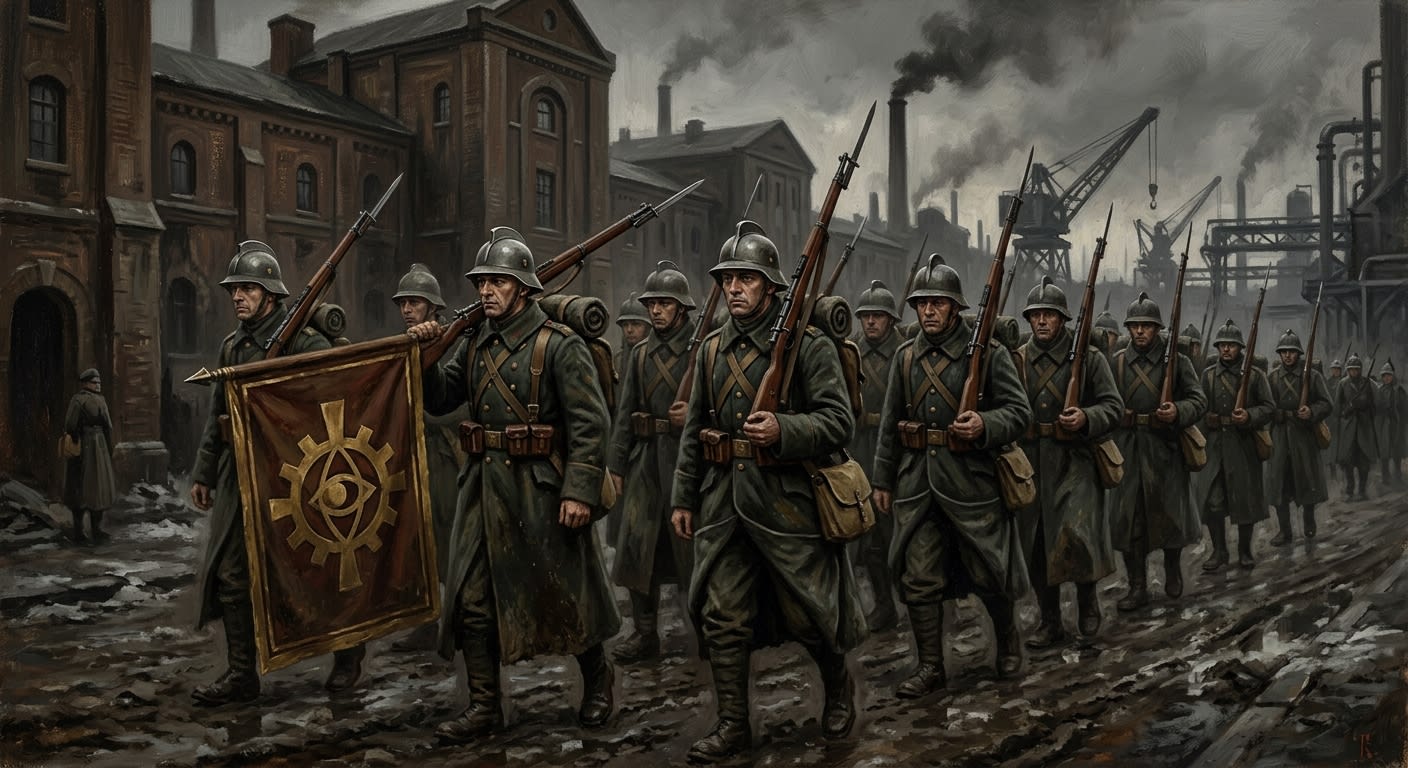
The Covenant Military is the Synod's standing armed force for the spaces between war and administration: barracks behind market squares, militia rooms beside chapel annexes, escort posts outside Doctrine offices, cordons around ration queues, rifle lines at bridge disputes, silent pairs walking behind Street-Vicars whose chalk has begun to offend the crowd.
War calls them auxiliaries. Doctrine calls them civic stabilisers. Purity calls them inadequate. The citizen calls them soldiers, because the citizen has a talent for cutting through varnish when a rifle is pointed at him.
They are Covenant because their oath binds them to the Synod before any Bureau can claim their full body. That point is the hinge on which most of their misery turns. A Covenant militiaman may be fed by War, posted by Doctrine, inspected by Purity, indexed by Records, tolled awake by the Bureau of Bells, and fined by Tithes for damage done while enforcing a Tithes seizure. To serve in the Covenant is to discover that one can be subordinate in five directions at once and still be blamed for moving badly.
#On Origins in the Ruin of Amateur Violence
The Covenant did not begin as a tidy institution. Nothing useful does. It accreted from cathedral guards, bishop's levies, bridge militias, sworn market companies, shrine wardens, surviving garrison remnants, and those stubborn households who discovered after the Sundering that a kitchen knife blessed by a terrified priest was still better than no weapon at all.
Before the Concordat, the Faith owned courage in abundance and discipline in embarrassing little dishes. Cities divided during the Atheist Wars; secular militias raised the broken cross; cathedral precincts hardened into local fortresses. The defenders were brave. Bravery is what men call incompetence when it survives long enough for a hymn.
The Synod learned from these years with the speed of a creature being beaten. By A.S. 65, the first Sagittal Line had become a chain of refusals. By A.S. 90, the Concordat needed bodies who could execute a Bureau order without requiring a noble's permission, a bishop's cousin's horse, or a merchant captain's mood. War would hold the armies. Purity would hold the knives in dark rooms. Doctrine would hold the tongue. The Covenant would hold the street.
Provincial commemorative broadsheets describe the Covenant as “founded in a single oath before the Seven Seals.”
Corrected. The Covenant was assembled from necessity, shame, local violence, and six decades of men shooting badly in the right direction. The oath came later, as oaths do, to claim authorship over what hunger had already made.
The first covenant rolls were not glorious. They listed boots, rifles, parish origin, confession status, and whether a recruit could read an order aloud without improving it. Men who could read too well were sometimes diverted into Records. Men who could not read at all were sent to gate duty, where a shouted order and a lowered bayonet constituted literacy enough.
#On the Oath and the Uniform
The Covenant oath is shorter than War's campaign vow and more honest than most Bureau prayers: I stand where ordered; I strike when sealed; I speak only in answer; I remain until relieved. The final clause is the cruel one. Any fool can strike. Remaining is where the Synod spends a man's soul.
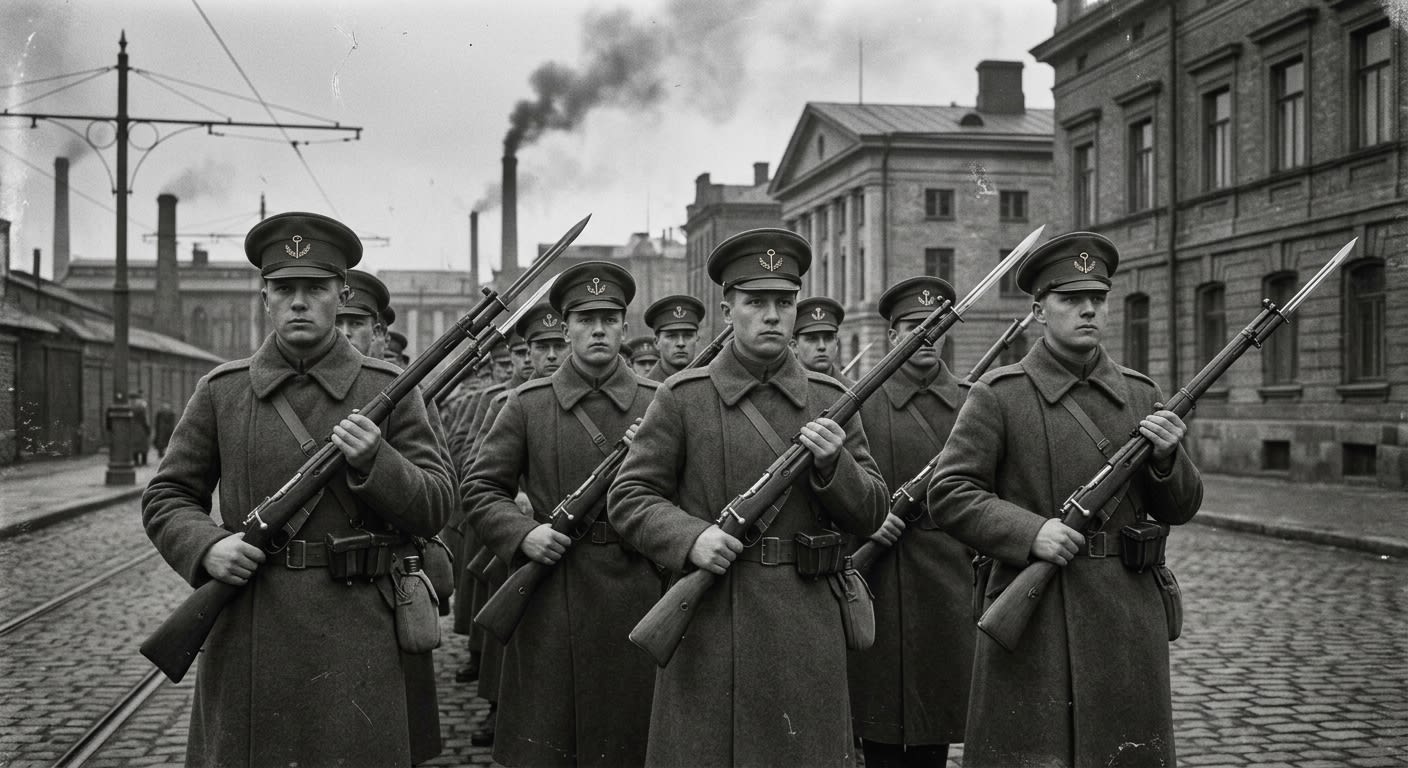
Their uniform varies by district, climate, and budget, which means the official diagrams are lies with buttons. In the Rhineland, they wear dark wool coats with ash-grey cuffs and a small brass covenant-disc sewn at the throat. At Brest, mud eats colour in three days, so the discs are worn over oilskin. At Shipka, sleep-fog patrols chalk their sleeve seams with wake-lines so officers can count who has begun to drift. At Constantinople, rear-area Covenant squads carry heat-darkened rifles and the expression of men posted where every street has already been old twice.
The weapon is less important than the posture. Covenant soldiers are trained to be seen before they are used. Two men behind a Vicar. Four at a ration gate. Twelve at a disputed ferry chain. Thirty in a square with rifles angled low enough to promise restraint and high enough to spoil anyone's appetite for heroism. Visibility is their first munition.
#On Service to Doctrine
Their most delicate service began after the Chalk Riots of A.S. 119, when a Street-Vicar in Trier marked fourteen doorframes red and proved that chalk, applied with sufficient stupidity, can become gunpowder. The Soft-Marking Reform (Unregistered) of A.S. 120 introduced Covenant escorts in riot-prone districts: two militia, visible but silent, accompanying Vicars on patrol. Visible, because Doctrine required teeth. Silent, because Doctrine wished to pretend the teeth were decorative.
The rule remains. A Vicar raises a hand. The square halts. The Covenant pair stand one pace behind and half a pace aside, outside the catechetical performance, silent before the crowd, doctrinally inert, shifting weight only when the crowd does. Their silence is trained. Their eyes are not.
A good escort knows the names of market agitators, the stall where stones are kept under onions, the alley that will empty first if panic starts, and the old woman who looks harmless until she lifts a basket with both hands. A bad escort stares at the Vicar. Bad escorts are buried with paperwork praising their attention to duty.
Doctrine resents needing them. The Covenant resents being needed only when chalk has failed. This mutual resentment is healthy. It keeps both parties awake.
#On Service to War
The Covenant is also a frontward force. It supplies the lower bones of the front: convoy guards, gate squads, depot companies, trench-court escorts, salvage cordons, prisoner columns, bridge detachments, reserve platoons, and those exhausted units sent forward when the Line has eaten the beautiful troops first.
War's elite formations keep the hymns. The Radiant Fusiliers fire beneath banner-light; Shield-Paladins lock breaches; Ash Chaplains burn throats into courage; Litany-Engineers write explosive mathematics in mud. The Covenant carries crates, guards prisoners, fills saps, holds queues, shoots deserters, watches flanks, and inherits positions after the famous have passed through them like icons in procession.
At Debrecen, Covenant soldiers waded through residue from ruptured Blood-Tithe works after the Fusilier advance stalled under crimson rain. At Prague, after the Night of Silent Steel, Covenant detachments removed rifles from Fusiliers who had forgotten to fire and stacked the weapons in silence because no one knew whether a command could be trusted. At Metz, where the Whispering Trench (Unregistered) repeated family names until entire companies lost sleep, Covenant burn crews torched the line and pretended not to recognise the voices.
BUREAU OF WAR AUXILIARY ACTION ABSTRACT — PRAGUE SEMINARY FIELD Covenant recovery section entered after Chanter suppression. Forty-three Radiant Fusiliers dead. Surviving Fusiliers standing loaded, fingers fixed at trigger rest. Covenant Sergeant M—— ordered weapons collected. No Fusilier resisted. One Covenant private asked whether the order to fire had “come back yet.” Transcript sealed for morale contamination.
The Covenant's glory is that it receives no glory worth having. It is too common to mythologise and too necessary to praise honestly. It is the boot leather of the Synod's violence.
#On Purity and the Quarrel of Jurisdiction
The relationship with Purity is contested in the same way a throat is contested by the hand closing around it. Purity believes enforcement belongs to those trained to detect corruption. The Covenant believes public order belongs to those trained to prevent streets from becoming abattoirs. Both are correct in ways that make cooperation unpleasant.
A Purity officer wants names, cells, roots, hidden sympathies, family diagrams, contaminated phrasing, forbidden books, private intent. A Covenant sergeant wants the crowd to move left, the gate to remain closed, the cart not to overturn, the man with the knife on the fountain to come down before someone important notices. Purity sees infection. Covenant sees pressure. Doctrine, watching both, files the difference as “operational complementarity” because Doctrine has never met a euphemism it could not feed.
Earlier Civic Safety circulars described Covenant militia as “subordinate to Purity in all public-order actions.”
Revised after three districts refused to deploy escorts under open inquisitorial command. Covenant units remain under Synod oath and may be attached to Purity operations by joint writ. Purity retains authority to accuse them afterward, which is nearly the same thing and considerably more satisfying to Purity.
The quarrel becomes sharpest after unrest. Purity wants arrests. Covenant wants dispersal counted as victory. Purity asks why the ringleader escaped. Covenant asks why Purity called a ringleader into being by naming him in front of a hungry crowd. Records records both questions. The file grows fat. The street remembers the boots.
#On Ranks and Local Bodies
The Covenant's formal ladder is simple enough for parade boards: Watch Recruit, Covenant Militiaman, Lance-Corporal of Order, Street Sergeant, District Captain, Prefect-Marshal, Regional Covenant Commander. The informal ladder is better: boy with rifle, man who has been shouted at by three Bureaus, sergeant who knows which order to ignore, captain who can sign a corpse docket without spelling his own name wrong, marshal who has survived enough inquiries to become an institution.
Local variation is tolerated because central uniformity would require central money. The Marsh Lanterns at Brest tax outer peat lanes with habits that make Tithes jealous. Quarantine Provosts (Unregistered) in river districts wear ribbon authority and sell passage with the frank professionalism of thieves under seal. Gate Provosts at beacon-chain hamlets know every smuggler by limp and smell. Undertide Divers at Calais are militia-specialists whose battlefield is a wet hole in the chalk where rescue and evidence control become the same drowned chore.
The Covenant absorbs these bodies when useful and disowns them when necessary. A local militia that suppresses a riot becomes Covenant auxiliary personnel. The same militia caught extorting pilgrims becomes a regrettable irregular formation whose documents have been misunderstood by hostile readers. The stamps change. The men rarely do.
#On Discipline
Discipline in the Covenant is not gentle, because gentleness makes poor theatre and worse deterrence. A soldier who speaks during a square-stop without leave loses three days' ration wine and one pay strip. A soldier who strikes before signal loses rank. A soldier who fails to strike after signal faces a tribunal. Cowardice in civic duty is punished more harshly than cowardice under shellfire, since shellfire is frightening and citizens are supposed to be.
The common punishment is the Silent Post (Unregistered): four hours standing at attention beside a busy street, weapon unloaded, mouth sealed with wax tape, while passersby are permitted to submit written criticisms. Most criticisms concern boots. Some concern mothers. The Bureau of Doctrine praises the practice as humility. Covenant barracks call it being nailed to the Ledger by idiots.
The crueler penalties are reserved for fraternisation with riot leaders, private sale of cordon passes, unauthorised firing into crowds, authorised firing without proper witness, refusal to support Bureau order, excessive enthusiasm in support of Bureau order, and the eternal favourite, conduct unbecoming an armed instrument of public confidence. That last charge can mean anything. Its flexibility is admired in legal circles and feared everywhere useful.
#On the Present Condition
As of A.S. 201, Covenant units serve across Zones 1 through 5 as civic stabilisers and throughout Zone 4 as rear-line auxiliaries. Zone 6 deployments are classified because the Covenant sent beyond the Line tends to return as figures, if it returns. Zone 7 coastal commands dispute whether harbor-chain militias count as Covenant, War auxiliary, port security, or tariff enforcement; Tithes has proposed billing all four categories. This proposal is monstrous and may succeed.
The Covenant is thin where the Synod is loudest. Every Bureau requires bodies. Bells needs tower guards. Tithes needs seizure escorts. Records needs archive cordons. Doctrine needs Vicar pairs. Purity needs doors kicked in by men it can later prosecute for kicking badly. War needs convoy guards and replacement flesh. The Covenant supplies them all and is then chastised for strain.
That is its sanctity: to be everywhere, blamed by everyone, thanked by no one sober.
In the market square, when a Vicar lifts chalk and the crowd inhales wrong, the Covenant pair shift their rifles by a thumb's breadth. The sound is tiny: leather, sling, oiled metal, breath. The sermon continues.