
#On the Sound Before the Fire
Metal struck metal until the clerks remembered they had ears. — Lower District witness abstract, Bastion-Königsberg, A.S. 139
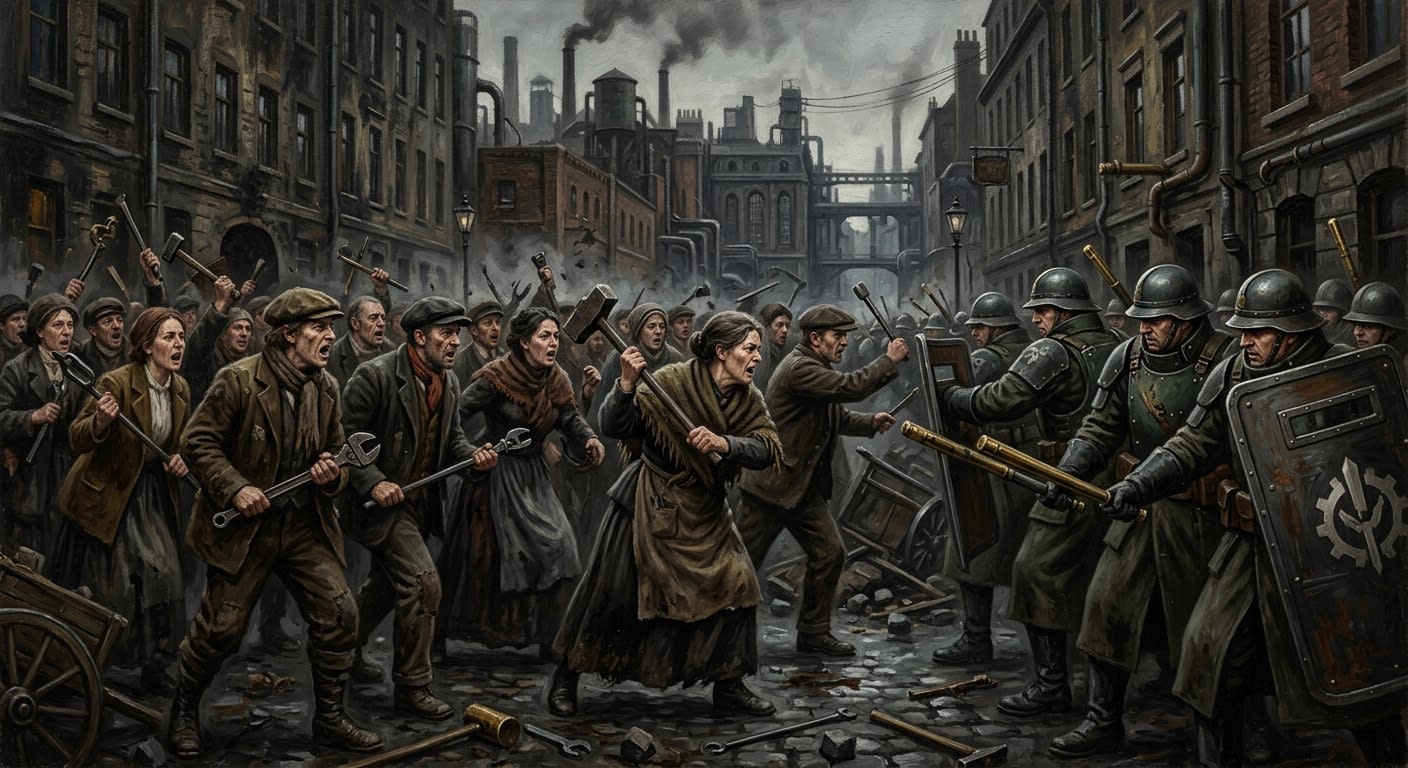
The Widow Riot began with cooking pots. This disappoints romantic men, who prefer a riot to begin with banners, sermons, or some handsome fool standing upon a cart. The poor are less theatrical. They use what is near the stove. For three days in A.S. 139, the lower districts of Bastion-Königsberg beat iron, copper, tin, cracked kettle-lids, pan-bottoms, coal scuttles, and chapel alms bowls until the northern bastion rang like a badly governed bell.
The Bureau calls it the Widow Riot. The widows called it collection day.
Its origin lies in the revocation of pity exemptions after the private memorandum of Assessor-General Kaethus Brenn, whose arithmetic discovered that mercy had become fiscally contagious. Widowhood had expanded beyond the tidy wife-of-confirmed-dead-soldier category preferred by Tithes. Missing husbands, erased husbands, conscripted husbands, imprisoned husbands, men posted beyond receipt range, men lost in fog, men whose names had been eaten by Records or war or clerical boredom: all left households claiming exemption. Tithes saw a leak. Brenn supplied the seal.
#On Directive 91-B
Directive 91-B arrived under the title “On the Cessation of Pity Exemptions,” which is how one says “pay” while wearing gloves. It made the Widow’s Pennies mandatory and universal at reduced rate, replacing variable mercy with standardised humiliation. The Bureau’s doctrine was compact enough for route cards: shared obligation is shared grace; exemption from obligation is exemption from grace; the graceless are the Enemy’s harvest.
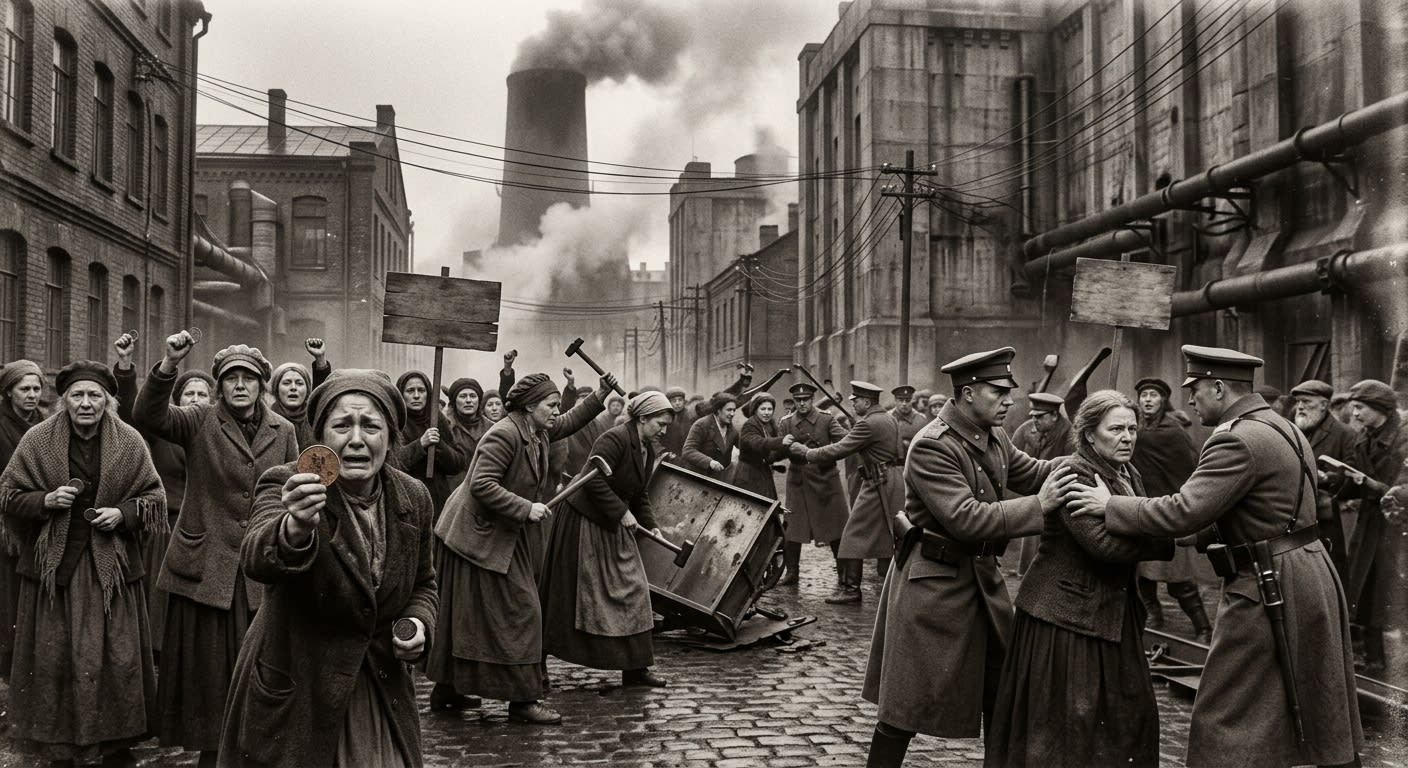
Assessors posted the notices in the Lower District before Matins. By Prime, women were reading them aloud in stairwells. By Terce, the first pot had been struck against a lintel. By Sext, every route east of the Ice-Market had stopped producing receipts.
The Lower District was a poor quarter even by bastion standards: frost-black tenements, coal queues, rope-walks, fish cellars, bell foundry labourers, widows of gunners, widows of gate crews, widows of men whose deaths had been recorded as equipment loss because the body had not returned in separable form. These households knew Bureau language. They had been spoken to by Tithe Assessors for years. They understood that reduced rate meant permanent mark, that mandatory meant inheritable, that a penny paid under bereavement did not settle grief but registered it for future collection.
#On the First Day
The first day belonged to noise. Pots rang from windows. Doors stayed barred. Assessors on the Widow Route found stairwells blocked by benches, laundry poles, ash bins, and old women sitting in chairs with their hands folded over knives. Escort captains, trained for smugglers and arrears seizures, discovered that a crowd of widows does not advance like a crowd of men. It surrounds. It shames. It knows the names of the soldiers assigned to push it.
At the Saint Verral stair, Assessor Holtz presented Form 7-C and demanded payment from twelve households newly removed from exemption. The women answered by placing twelve empty bowls on the landing. Holtz ordered the bowls seized as goods in lieu. His escort captain refused, on grounds not stated in the record but plain to any reader with a soul still rattling in him. Holtz marked the stair for arrears. The stair answered with boiling wash-water.
LOWER DISTRICT ESCORT REPORT — EXCERPT “Assessor Holtz received injury to scalp, right cheek, and left account satchel. Crowd shouted █████████████████ and displayed three children with ration cards pinned to their shirts. Private Kappel declined to raise rifle, stating that his mother was among the persons present. Recommendation: transfer Kappel; replace Holtz’s satchel; do not repeat bowl seizure order in mixed widow stair.”
By evening, the pot-rhythm had spread to the rope-yards and the fish cellars. Men joined after dark, because men often wait until women have made danger administratively visible. The Bureau later described them as agitators. Some were. Most were sons.
#On the Barricades
The second day belonged to stone. Cobblestones came up from the narrow streets around the Lower District Tithe Office. Coal carts were overturned. Fish barrels, chapel benches, door planks, broken sledges, and frozen laundry frames formed barricades at four intersections, each low enough for women to pass messages over and high enough to make cavalry ridiculous. Königsberg is a city of bells and ice; its streets teach engineering to anyone who has survived winter with a bad roof.
The rioters did not march on the main arsenal. They did not attempt the gates. They did not attack the carillon. Their target was exact: the Tithe Office, its route ledgers, exemption rolls, arrears indices, widow classifications, seal cupboards, receipt blanks, and the locked archive where four hundred years of Lower District collection records lay stacked in string-tied folios. That precision troubles the Bureau more than any number of smashed windows. Hunger breaks windows. Memory chooses archives.
#On the Fire
The fire began near the rear archive stair during the second night. This is the official phrasing, and official phrasing is the graveyard where active verbs go to avoid prosecution. A lamp fell. A coal hod overturned. A widow with oil on her sleeve passed through a door no widow should have been able to open. A clerk unlocked the archive under duress. A clerk sold the key. A clerk forgot to bolt the rear grate. Each version has witnesses; each witness contradicts the others; each contradiction improves the usefulness of the file.
The Bureau suspects arson. The Bureau suspects arson with the solemn gravity of a man suspecting soup after watching someone pour it into a bowl. The building burned from within, and paper burned best. Receipt strings snapped in the heat. Wax seals ran down shelves like red tears, if one is inclined toward cheap symbolism, which I am not, except when it is accurate. By dawn the Lower District Tithe Office was a black shell with snow steaming on its stones and widows standing in the street as if attending a funeral for someone they had hated too long to miss.
The loss did a strange thing. For one morning, thousands of households became administratively uncertain. Arrears vanished where copies had not yet reached district vaults. Exemption histories burned. Old debts became smoke. The poor breathed it in and called the air clean.
Earlier Bureau summaries state that no fiscal advantage accrued to the rioters from the destruction of the Tithe Office.
Corrected. Temporary advantage did accrue. The Bureau restored much by witness audit, duplicate parish rolls, and punitive estimate, but “punitive estimate” is not restoration. It is revenge wearing spectacles.
#On the Third Day and the Clearing
The third day belonged to order. Covenant militia entered before dawn with soft boots, shield-lines, and priest-clerks carrying portable desks. Purity observers followed, because every riot is a theological audition once the first window breaks. The barricades were taken one by one. The Bureau avoided volleys in the narrow lanes, partly from discipline, partly because a widow shot in front of her neighbours becomes a relic faster than Doctrine can classify the blood.
Arrests focused on women named in route complaints, men seen lifting cobbles, two bell-foundry apprentices with lamp oil under their nails, three clerks from the Tithe Office, and a boy of eleven carrying blank receipts in his boot. The boy insisted he found them in ash. The file says theft. Files have no imagination.
By Vespers the pot-rhythm had stopped. The new notices went up the next morning.
The Bureau won, as Bureaus usually do when they survive the building fire. The Widow’s Pennies remained. The exemption vocabulary shrank. The Widow Route became a recognised crucible for Assessor advancement. The poor learned that burning a ledger can destroy a debt for a week and justify a harsher one for a century.
#On the Afterlife of the Riot
The Widow Riot now lives in training rooms under three uses. Tithes teaches it as a warning against lax exemptions. Records teaches it as a warning against single-site archival custody. Doctrine teaches it as a warning against sentimental language in fiscal notices, because “pity” proved too inflammable a word for public walls. Purity keeps a thinner file on the songs. The songs are where the riot remained itself.
In street verse, the pot-rhythm becomes the Widow’s Bell. In Assessor slang, any route where the women know the receipt numbers better than the clerks is called a Königsberg stair. In Bureau correspondence, “A.S. 139 conditions” means a district where grief has organised before authority has finished counting it.
Saint Ysolt gained new candles after the riot. So did Brenn, though quietly and without icons. Widows prayed to Ysolt for one forgiven debt and cursed Brenn for making debt survive the husband. Assessors prayed to neither while walking the lower stairs. They touched the scale, counted the blanks, and listened for pots.
#On the Present Classification
As of A.S. 201, the Widow Riot remains classified as a Fiscal Disturbance, Bereavement Class, with ancillary notes under riot control, archive loss, route discipline, and song contamination. Its real classification is simpler: the poor briefly understood the ledger as an object made of paper. They reached the correct conclusion. The Bureau has spent sixty-two years ensuring no one reaches it twice in the same district.
The Lower District Tithe Office was rebuilt in stone, iron, and smugness. Its archive now sits behind three fire doors, two Records clerks, one Tithes inspector, and a chapel niche containing a brass scale under the patronage of Saint Ysolt. Pots are forbidden within collection rooms. Kettles require permit tags. Chapel alms bowls are chained to their stands.
A local guidebook once claimed the rebuilt Tithe Office “commemorates civic reconciliation after the Widow Riot.”
Seized and corrected. The building is a collection office. Reconciliation does not require arrears chalk.
The widows paid. The Bureau collected. The pots were dented flat and entered as confiscated metal.