
#On the Approach
"Pay clean. Pass clean." — Inscribed above the central arch, A.S. 94. The rain has not worn the words. The rain has tried.
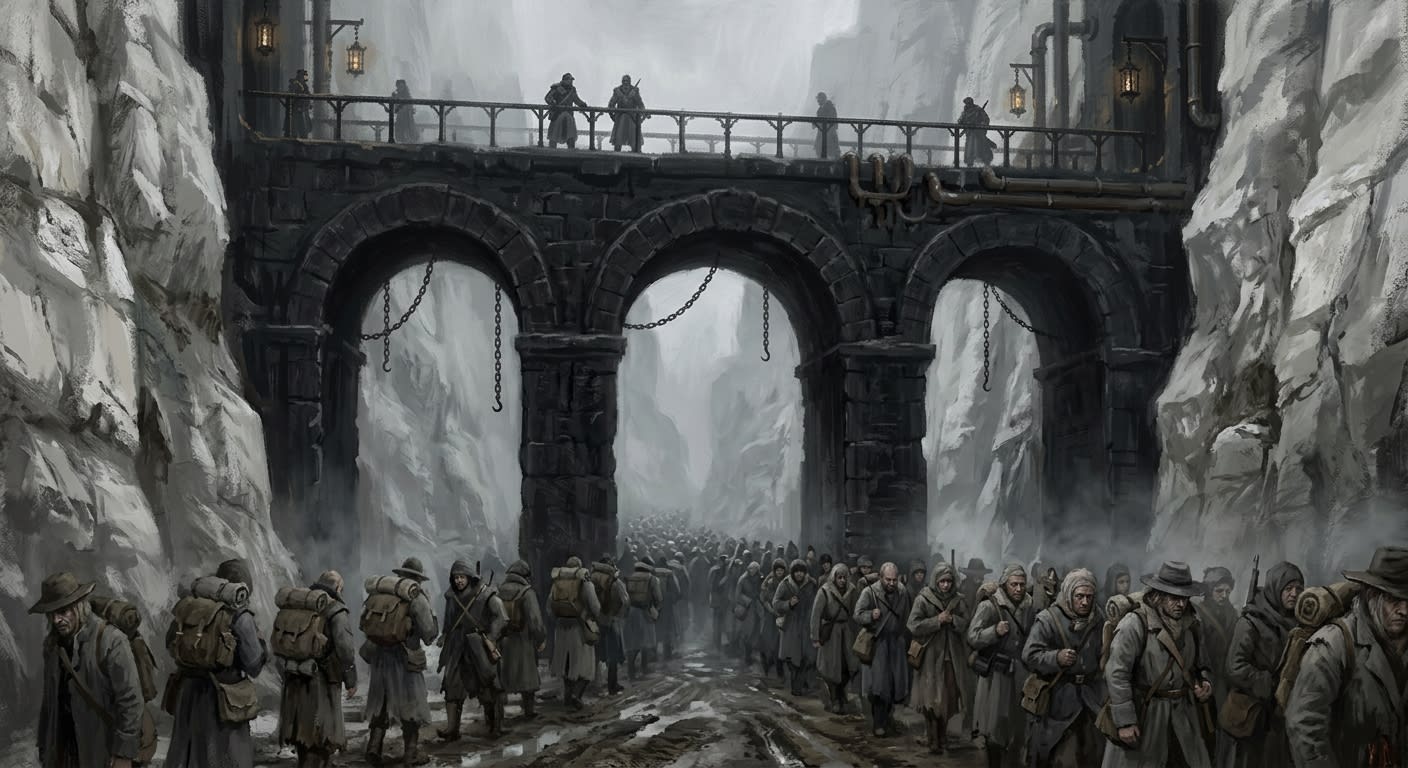
The pilgrim roads of western Europe carry, in any given season, between forty and ninety thousand souls moving eastward toward the Sagittal Line, and every one of them — the penitent, the conscript, the refugee claiming penitence to avoid conscription, the merchant selling tin saints at four hundred percent margin — must pass through a bottleneck. The Bureaucratic Synod has many such bottlenecks. It collects them the way other governments collect forts. But Griefgate is the bottleneck's bottleneck: a ravine cut through chalk bluffs where the Pilgrim Roads narrow to a single defile, gated by three black-stone arches hung with chains that have not been oiled since the Concordat, and staffed by men whose professional function is to convert your sorrow into a number and then charge you for the arithmetic.
The town — if one may dignify a revenue apparatus with the word — sits wedged into the defile like a cork in a bottle, and operates on the same principle. Nine thousand eight hundred permanent residents service a population that swells to thirty or forty thousand during the pilgrimage seasons, when the queue stretches a mile back from the arches and the waiting itself becomes a kind of economy. Griefgate grows no food and produces no goods. It produces delay, and from delay it extracts confession, coin, labor, intelligence, and that most portable of Synod commodities: the stamped indulgence slip.
The Choir-Broker Hall of Peregrine Row, one to two days west by mule-road, feeds pilgrims into Griefgate's maw. They arrive singing. They leave — those who leave — in silence, lighter in the purse and heavier in the knowledge that guilt, in the Synod's reckoning, is weight, and weight must be measured, and measurement must be paid for.
#On the Three Arches
"Three lanes. One throat." — Broker Compact proverb, attributed to the first Master Assayer.
The Gate itself is old. Older than the Synod, older than the toll system, older than the grief-tax — a Roman-era aqueduct remnant, three arches of black basalt that survived every fire and every army because no one could be troubled to tear down something so inconvenient to demolish and so profitable to occupy. The Synod, upon inheriting the structure during the post-Concordat consolidation of the pilgrim roads (A.S. 92–97), recognized at once that a natural choke-point requires only a ledger and a stamp to become an organ of governance.
Three arches, three lanes. The left arch is Coin — commercial traffic, merchants, supply caravans. The right arch is Confession — pilgrims presenting for spiritual clearance before proceeding eastward. The central arch is Cargo — sealed goods, military materiel, reliquary transports under Bureau escort. Each lane has its own queue, its own marshals, its own toll schedule, and its own particular species of indignity.
The architecture compresses. Chalk bluffs rise on both sides, close enough that a man might touch both walls with outstretched arms in the narrowest stretches. The arches amplify sound — prayers, coin-clink, the wet shuffle of a thousand boots on wet stone — into a low drone that the Bureau of Bells has classified as a Category Two Ambient Resonance, meaning it is real enough to measure but insufficiently interesting to fund a proper study. Above the arches, a bridgewalk connects the bluffs: the provost gallery, from which the Gate-Canon's officers observe the flow and, when required, interrupt it.
The design is accidental and perfect. The Romans built for water. The Synod inherited a machine for processing souls.
#On the Economy of Measured Grief
"Guilt is weight. Weight must be measured." — Gate Chapter Catechism, posted at all three arches.
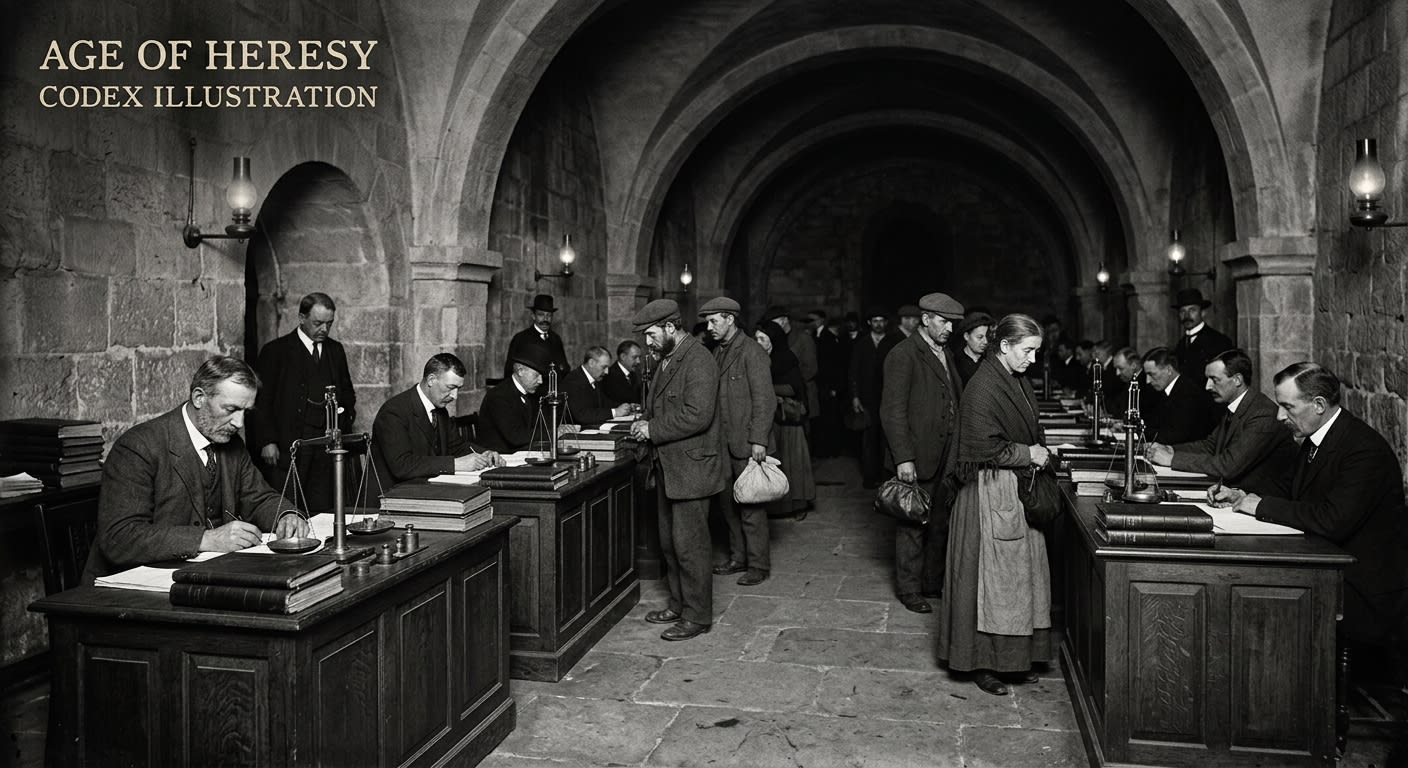
The Widow's Pennies Exchange — the institution that gives Griefgate its colloquial name — occupies a vaulted hall beneath the central arch, and its business is the conversion of suffering into revenue. The term "widow's pennies" predates the Exchange itself; the Bureaucratic Synod first imposed an emergency taxation under that name during the Famine of A.S. 65, levied on war widows as a percentage of their pension. The tax was abolished. The name migrated to Griefgate, where it attached itself to the grief-tax system with the tenacity of a barnacle that has found a hull moving in the right direction.
The grief-tax operates as follows. Every traveler presenting at Griefgate must declare, under confession protocol, the nature and degree of their current spiritual burden. A death in the family, a sin unabsolved, a debt unpaid to the Church — each category carries an assessed value, tabulated in the Exchange's public grief-tables, which are posted on the walls of the hall like weather forecasts and updated with the same cheerful indifference to the feelings of those affected. The assessed value becomes a toll. Pay the toll, receive a stamped indulgence slip — "portable clean," in the local cant — and proceed through your assigned arch. Fail to pay, or fail to confess a burden that the confession clerks subsequently detect, and you are reclassified from "pilgrim" to "detained," which is the Exchange's way of saying that your journey has paused and your labor has not.
The Assayers of the Bitter Scale, a craft order occupying a row of acid-stained booths along the left bluff, perform coin verification in open view. Every coin tendered at the Exchange passes through their hands — weighed, bitten, tested with reagents that stain the assayers' fingers a permanent green. The theater is deliberate. A crowd watching its coin tested is a crowd not rioting, and a crowd not rioting is, by the standards of Griefgate, a crowd well governed.
The indulgence slip itself deserves remark. A rectangle of heavy paper, stamped with the Gate Chapter's seal in red wax and the confession clerk's mark in black, it functions as a travel pass, a spiritual clearance, and a negotiable instrument simultaneously. Indulgence slips circulate. They are traded, hoarded, forged, and — in the culvert market beneath the arches — sold at prices that fluctuate with the season, the queue length, and the current humor of the Gate-Canon. A clean slip, freshly stamped, buys passage through any checkpoint on the pilgrim roads for thirty days. A slip with a smudged seal buys a conversation with an inquisitor that the traveler would prefer not to have.
The recent innovation — beginning approximately A.S. 199 — has been the widespread tradability of these slips as a secondary currency. Portable innocence, denominated in wax and paper. The Bureau of Records, when informed, expressed the opinion that any document bearing a Synod seal retains its doctrinal validity regardless of the number of hands through which it has passed. The Bureau of Purity expressed the opinion that the Bureau of Records should mind its own stamps.
#On the Governance of the Gate
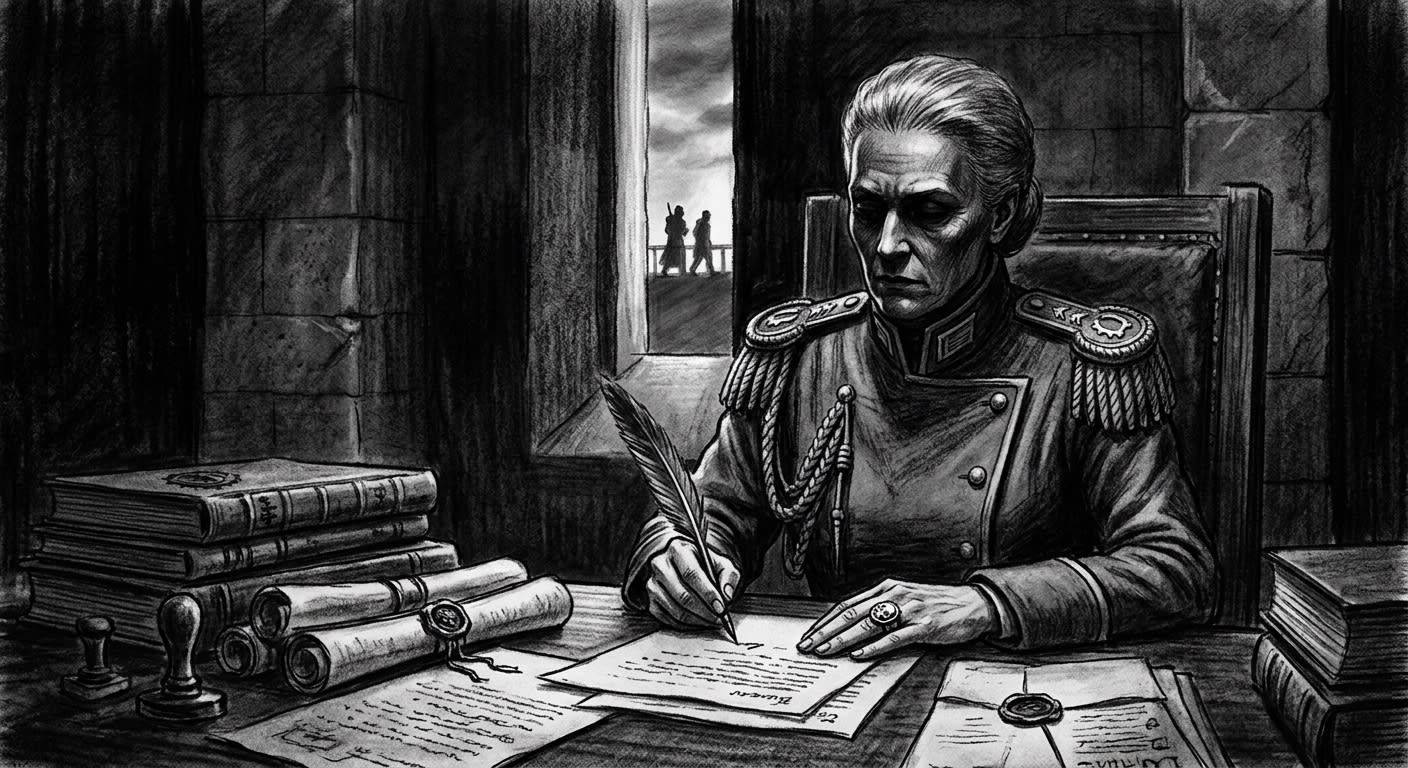
The Gate-Canon of Griefgate holds an appointment that is, in formal terms, a "Joint Stewardship of the Synod Gate Chapter and the Licensed Broker Compact Council," and in practical terms, a license to squeeze. The current holder is Gate-Canon Meral Voss, a woman whose smile has been described by three separate inspectors as "a locked door" and whose doubt inspections have never, in fourteen years of service, failed to produce a confession. She does not sweat. This has been noted in Bureau files as a possible sign of either sainthood or sociopathy, and the Bureau has declined to investigate which, on the grounds that both produce acceptable administrative outcomes.
Beneath Voss, the real machinery of governance is tripartite. The Broker Compact Council — the licensed toll brokers who operate the Exchange — controls lane priority, toll rates, and the speed at which paperwork moves, which is to say, the speed at which everything moves. The Assayers of the Bitter Scale control coin truth, and with it the power to freeze all commerce by declaring a "taint" — a contamination of the coin supply that requires full re-assay before any transaction may proceed. And Arbiter-Widow Solenne, known as "Blue Veil" for the mourning gauze she has worn for eleven years over a husband whose death no one has verified, controls the grief-tax courts, where disputes over assessed burden are heard, judged, and resolved with a speed that suggests the verdicts were written before the complaints were filed.
The three fear different things. Voss fears a riot that the Synod blames on laxity. Halve fears a counterfeit flood that breaks the assay trust. Solenne fears her own ledger surfacing — a ledger that, if the culvert reports are accurate, contains grief-tax assessments for tragedies that were manufactured by the Exchange itself to justify labor seizures.
The Queue Marshals — the "Rope Saints" — are the visible arm of order. They carry rope, whistles, and the authority to reclassify any traveler from "queued" to "detained" for infractions that range from the serious (cutting a blessed queue-rope, which is treated as sacrilege) to the interpretive (singing in line, which is forbidden on the grounds that it "stirs crowds," though whether the crowds are stirred toward rebellion or merely toward a more bearable afternoon is left deliberately unclear). The rope itself is blessed daily by a Gate Chapter deacon. To cut it is heresy. To step over it is merely expensive.
#On the Confession Stalls and the Doubt Inspections
The Kneel-Sheds, as the pilgrims call them — the confession stalls ranged along the right bluff — are where the true business of Griefgate is conducted. Every traveler seeking passage must kneel, confess, and present a narrative of spiritual condition that the confession clerks will compare against the traveler's papers, appearance, companions, stated destination, and — most critically — previous confessions filed at other points along the pilgrim roads.
A story that matches is a "story-fit." A story that does not match triggers a "doubt flag," and a doubt flag triggers an inspection, and an inspection triggers a conversation with one of the Gate Chapter's inquisitorial inspectors that ends in one of three ways: clearance (rare), additional assessment (common), or detention in the Holding Pens (frequent enough that the Pens maintain a permanent staff of fifty).
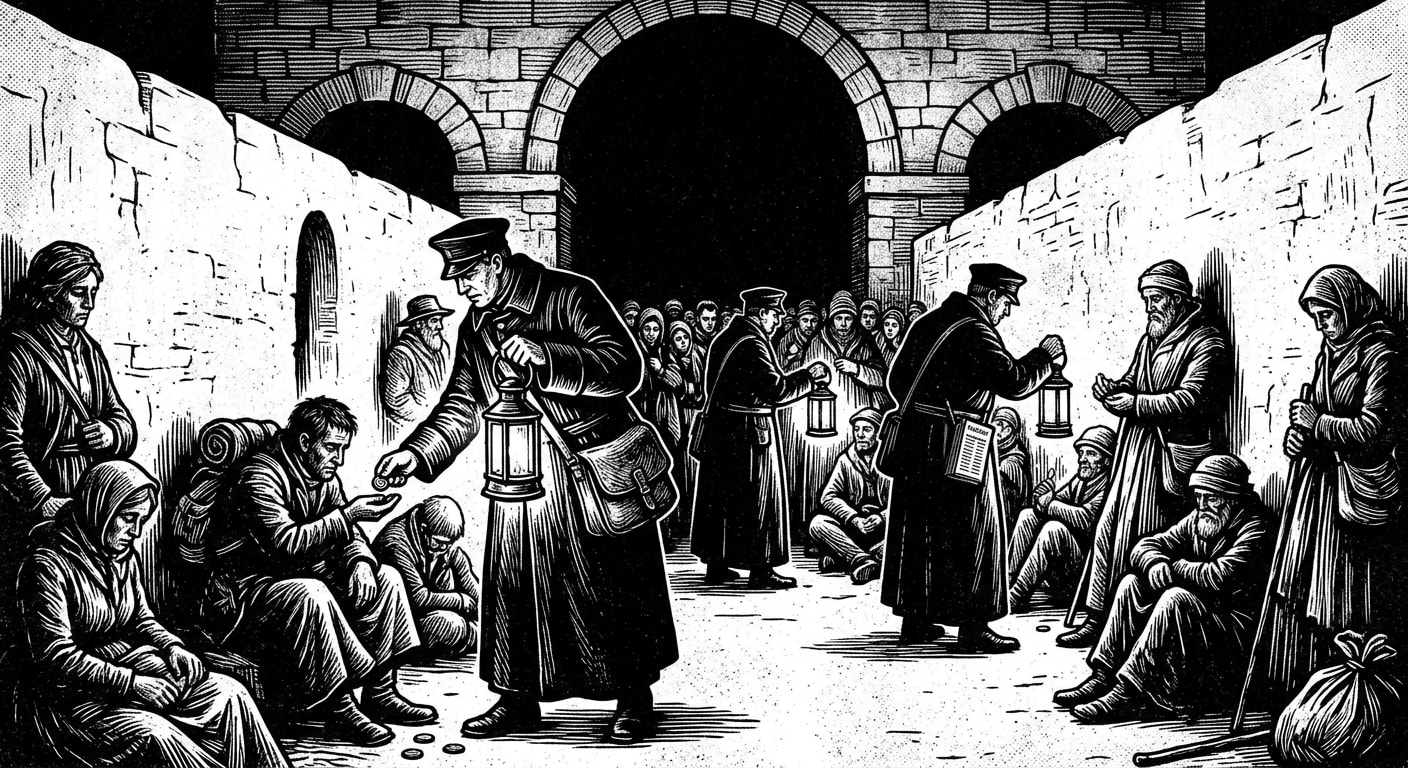
The Holding Pens — "Delay Gardens" in the local euphemism that decorates cruelty with flowers — occupy a depression behind the eastern bluff, roofed in canvas that leaks, floored in straw that rots, and administered by clerks who convert each day of detention into a debt payable in labor or coin. The arithmetic is straightforward: a detained traveler costs the Exchange nothing to house and earns the Exchange a daily increment that compounds faster than the traveler's remaining funds can sustain. The result, in a sufficient number of cases, is a labor-conversion contract — a document that transforms a pilgrim into a worker for a term that is always described as "temporary" and is never defined.
Disease in the Pens is seasonal. Trench-fever from the damp bedding. Infection from the stamp-cuts — the small incisions made on the wrist to mark a detainee's status, which are, the Gate Chapter insists, entirely for administrative purposes and should not be confused with branding, which would require a different form.
#On the Anomaly Beneath the Arches
The grief resonance is real. The Bureau of Bells confirmed it in A.S. 143, during a general survey of acoustic anomalies coincident with the Year of Ash Rain, and reclassified it in A.S. 187 as Category Two Ambient — present, measurable, insufficiently lethal to warrant a dedicated study.
When the crowd beneath the arches reaches a certain density of sorrow — and the threshold, the Bureau concedes, has never been precisely calibrated — the stone begins to remember. Wax seals smear. Coins tarnish on contact with the Exchange counters. Bells, if any are rung, produce a flat tone that confession clerks describe as "damp." People forget names. Their own names, sometimes, mid-sentence, standing in the queue with their papers in their hands and their mouths open around a syllable that the arch has swallowed.
█████████████████████████████████████████████████████████████████████ ██ FIELD NOTE — A.S. 199, GATE-CANON'S PRIVATE ARCHIVE ██████████████ ██ "The stone does not remember grief. The stone ██████ grief. ██████ ██ I have sealed the subsurface chambers. Do not ████████████████████ ██ The sobbing you hear at night is structural." ██████████████████████ █████████████████████████████████████████████████████████████████████
The local superstition — "Don't cry under the arch. The stone remembers" — predates the Synod. The Synod's contribution has been to measure the phenomenon, classify it, and then do nothing, which is the Synod's standard response to anomalies that do not interfere with revenue collection.
Countermeasures, such as they are: incense fans in the Exchange hall to mask the wax-smearing effect. "Steady chants" recited by confession clerks during high-throughput periods to stabilize the acoustic environment. Segregation of visibly mournful travelers into a side queue — the "Grief Lane," a culvert where the weeping are stored until they are quiet enough to be processed without affecting the seals.
#On the Culvert Market and the Commerce of Shadows
Beneath the arches, in drainage culverts that the Romans bored and the centuries enlarged, runs a second Griefgate. The Culvert Market operates in permanent twilight, knee-deep in runoff during the spring rains, and trades in everything the surface Exchange will not stamp: forged lane tickets, blank indulgence slips, rented witnesses who will swear to any grief-story for the price of a meal, and — most profitably — passage itself.
The Culvert Choir, as the smuggler network styles itself, moves people and contraband under the arches for a fee that varies with the desperation of the client. Their tunnels are mapped in bone — carved into the walls of the culverts in a notation that the Bureau of Bells, upon discovering a sample, classified as "non-linguistic" and therefore not subject to the Index Damnatus. The Choir would disagree with the classification, if the Choir acknowledged its own existence, which it does not.
What cannot be bought in the culverts: doubt clearance once flagged. The Synod's inquisitorial apparatus does not extend into the tunnels, but neither does it need to. A doubt flag follows a name, and a name follows a person through every checkpoint on the pilgrim roads until the flag is resolved or the person ceases to travel, whichever comes first. The culverts can bypass the Gate. They cannot bypass the Ledger.
#On the Present Condition
Griefgate in the present year — A.S. 201 — operates at capacity and beyond it. The roads are swollen. Refugee traffic from the eastern theaters, pilgrim surges driven by the Synod's latest round of mandatory penitential travel, and the ordinary commerce of a continent at war have combined to produce queue times that stretch to three days during peak seasons. The Holding Pens have been expanded twice in two years. Disease outbreaks — two confirmed in A.S. 200, one suspected in early A.S. 201 — have been attributed to overcrowding and managed by the expedient of reclassifying the sick from "detained" to "medically exempted," which removes them from the Pens and places them in a roadside ditch that the Gate Chapter has designated, with characteristic generosity, a "recovery annex."
Previous Bureau assessments described Griefgate's throughput capacity as "adequate to projected demand through A.S. 210."
The assessment has been revised. Current throughput is adequate to current demand, provided "adequate" is understood in its theological sense — sufficient unto the purposes of the Creator — rather than its logistical one. The assessors responsible for the prior estimate have been reassigned.
The shadow economy of indulgence slips has produced its predictable consequence: forgery. The Culvert Choir now deals in blank slips — unstamped paper of the correct weight and weave, requiring only a competent forger's seal to become functional currency. The Gate Chapter is aware. The Broker Compact is aware. The Bureau of Purity has dispatched an investigative cell that arrived in A.S. 200 and has, to date, produced a report recommending "further observation," which is the Bureau's way of saying that the problem is too profitable to stop and too embarrassing to acknowledge.
The Broker Compact wants looser clearing standards to increase throughput and, with it, toll revenue. The Synod wants tighter inspections to feed labor quotas for the eastern construction programs. Gate-Canon Voss navigates between the two demands with the skill of a woman who understands that the system's contradictions are the system's fuel: tighten enough to create delay, loosen enough to prevent riot, and extract from the gap between the two a revenue stream that keeps both masters satisfied and neither informed of the other's actual share.
And beneath it all — beneath the toll booths, beneath the assay counters, beneath the confession stalls and the Holding Pens and the Culvert Market — the buried truth that the culvert talk carries and the surface ledgers deny: the Exchange manufactures guilt. False confessions seeded into the Great Ledger. Grief-tax assessments for losses that were invented by the Exchange's own agents. Detention quotas filled by travelers whose only crime was arriving with a story that the confession clerks had been instructed, in advance, to find insufficient. The machinery of purification running in reverse: the Gate does not filter the guilty from the innocent. The Gate produces guilt on demand, because guilt is the commodity the system requires, and the system requires it in quantities that genuine human failing alone cannot supply.
A clean traveler who refuses to confess — who stands in the queue with clear eyes and empty hands and says "I owe nothing" — is, to Griefgate, an existential problem. The grief-tables have no column for the unburdened. The Exchange has no form for a soul that does not owe. And so the Doubt Inspector leans forward, and asks one question, and the question is always the same: "Are you certain?"
No one is certain. The arch hums. The wax smears. The stamp comes down.
Fiat dolor, et dolor fit census.